Your cart is currently empty!
Blog
-
Day 14: Scene vs. Summary
What, exactly, is a scene? I find it helps to think of scene as a mini-story, complete with a beginning, middle, and end. A scene, like a story, begins with a conflict or an implied question that begs to be answered, and builds to a climax. Whereas a story generally fades to some sort of resolution, a scene often ends on a more ambiguous note, compelling the reader to keep reading.
Anything very important that happens in your novel should be written as a scene.
Large spans of time in which something happens should be summarized.
Today, write the scene of an important moment in your character’s life in 1500 words or more.
Then, summarize five years of your character’s life in 500 words or fewer.
-
Day 10: Develop Your Subplot
There will almost always be a secondary plot line, or subplot. Ideally, the subplot will accomplish several things:
- Deepen characterization—of the protagonist, other characters, or both
- Complicate and comment on the primary chain of events
- Keep things interesting
- Raise the stakes of the novel
Almost without exception (I say almost, because there is always an exception), the subplot must intersect at key points with the main plot.
In Lars Gustafsson’s The Death of a Beekeeper, one subplot is the narrator’s friendship with two schoolboys, who come by the dying narrator’s house to hear his stories of intergalactic warfare.
In the utterly riveting thriller Arctic Chill, by Arnaldur Indridason, Inspector Erlunder is investigating the death of a young boy who is found frozen to death in a pool of blood at a Reykjavik apartment block. The investigation into the boy’s death is the main story line. The subplot, however, is every bit as interesting: when Erlunder was a child, his younger brother was lost in a blizzard. The brother’s body was never found, and Erlunder has lived with the grief and guilt all of his life. The subplot about the little brother’s disappearance gives emotional resonance to the main story line. The death of another boy, in another place, brings to mind Erlunder’s helplessness to save his own brother decades ago.
In The Year of Fog, the primary subplot is the deterioration of the relationship between Abby, who lost the child, and Abby’s fiancé Jake, Emma’s father. Can their relationship hold up under the stress of the tragedy? What will happen to them?
If you haven’t already done so, now is the time to think seriously about your primary subplot. Sub means under, of course. Think of your primary subplot as an undercurrent to the main plot of the novel, something that runs underneath the main story line, influencing it, deepening it, making it more interesting.
I say primary subplot, because there may be several, but there should be one that is more important than the others.
If the subplot isn’t yet clear to you, that’s okay. Think about your protagonist’s major relationships and major struggles. Which one of these might lend itself to an interesting subplot?
Now, list any ideas you have about potential subplots.
Now, what is another question (in addition to your central question) that will keep the reader turning pages? This question should be related to your primary subplot. Write it down now.
Secondary question:
Now, write 1600 words developing your subplot.
One primary plot and one secondary plot are generally enough to keep up a novel’s forward motion. You can have a tertiary plot as well. Of course, talking about these plots as separate entities is not entirely accurate, because the main plot and the subplots are always at play with one another, intersecting, coming apart, and intersecting again.
-
Love & Heartbreak
Write 500 words about your protagonist’s biggest romance.
Then write 500 words about your protagonist’s biggest heartbreak.
-
Great Political Fiction in 2 New Editions
Fiction Attic Press is delighted to announce to new editions of the strange, funny, and deeply relevant stories of the enigmatic Jiri Kajanë. Both are available in beautiful, complimentary paperback editions – great for giving to the politico or propagandist in your life, the one who just can’t shut up at the dinner table. Smart, irreverent, and surprisingly moving, the adventures of Albania’s fictitious Deputy Minister of Slogans are more relevant that ever.
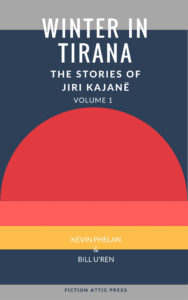
Winter in Tirana: The Stories of Jiri Kajanë (Volume 1)
Winter in Tirane: The Stories of Jiri Kajane, brings together six intertwined tales of bittersweet love, absurd politics, and comic hijinks by the enigmatic Jiri Kajanë. Set against the final days of the Albanian empire, the stories follow an unnamed narrator–the Deputy Minister of Slogans–and his young friend Leni as they attempt to navigate a landscape of shifting political alliances and unsettling personal affairs. By turns funny, profound, and deeply moving, Winter in Tirane is an exploration of the meaning of identity, the power of suggestion, and the complex relationship between a story and its creator. Winter in Tirane presents a startlingly imaginative take on the notion of the author as fictive construct.Some Pleasant Daydream: The Stories of Jiri Kajanë (Volume 2) BUY THE BOOK
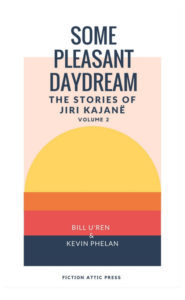
Some Pleasant Daydream: The Stories of Jiri Kajanë (Volume 2)
Continuing where Winter in Tirane leaves off, SOME PLEASANT DAYDREAM features six stories by the enigmatic Jiri Kajane. The collection follows the adventures of the Deputy Minister of Slogans and his best friend Leni. By turns hilarious and poignant, the stories examine what it means to be immersed in a culture of propaganda and doublespeak in which what one says and what one means are often two very different things. BUY THE BOOK
About the Author
Time Out Scotland once named Jiri Kajanë “the second greatest living Albanian writer,” after Ismail Kadare. But who is Kajanë?
According to some accounts, Kajanë was raised in Kruje, Albania. His satirical drama, Neser Perdite (Tomorrow, Every Day), is rumored to have received great acclaim in a singular 1981 performance before being banned by the Albanian Ministry of Culture. Due to Kajane’s allegedly precarious standing before the revolution, his work has never been published in his home country. Kajane has never been photographed.