Your cart is currently empty!
Blog
-
Appeal – flash fiction by Dan DeMarco
Avoid asking questions that begin with why. These questions sound like, Why did you have to die? Why did you have to die like this? Why did you have to die before me? You aren’t really looking for an answer when you ask this kind of question. You’re looking for an assurance that your wife’s death was not simply a cruel accident, that these things are maintained by a higher order, that the death of your wife was a necessary part of some incomprehensible divine plan. You must completely expel these thoughts from your mind if you are to have any success in your encounter with your dead wife. Since she entered the afterlife your wife is no doubt in some sort of metaphysical state, transcending the limitations of the physical, and so from this vantage point it is likely that she can see well into your past and understand every thought and feeling you experienced toward her while she was alive: every white lie you ever told her, every girl you may have fantasized about replacing her with, every time you secretly wished she was dead. Do not dwell on the fact that she knows all of these things. You will only have time to ask your wife a single question. Depending on how fast you’re able to transcribe her messages, her reply could go on for several seconds. And so with this extremely reduced time window to work with, you would be well advised not to entertain open-ended cosmic notions, such as the possibility that your wife was taken from you as some sort of divine punishment. Everything has been cast in a different light now; small, formerly inconsequential memories have taken on a new, horrible significance—like the time all the way back in high school, when you told your friend you would sell your soul just to get a girlfriend, and you met her the week after. Like the night you and she first made love, the sticky summer air floating in through the screen in her open window, enveloping your bodies on the floor as she moved on top of you, whispering “Damn you, damn you, damn you” in your ear. All of this is to say, you must, under no circumstances, have your predestined place in the afterlife become a topic of this otherworldly interrogation. If it is revealed that you two are destined to remain eternally apart from one another, you would most likely lose emotional grip. Likewise, if you greet the ghost of your dead wife with silence or uncertainty, you risk undermining everything. Your wife may answer your silence with silence of her own, and by the time you manage to splutter out a greeting, or a half-hearted question, she will have already faded back into the ether. Or, your wife may commandeer the silence to ask questions of her own. She may choose to interrogate you about the fantasies of infidelity you entertained that she can now see quite clearly. She may ask you why you shied away from the thought of having a child with her. She would ask you these questions, even though she already knew the answers, to see what you would say. But it would still be preferable to be asked this way than to be asked a question that begins with why. These questions sound like, Why don’t you pray for me anymore, like you used to? Why did you take down that framed picture in the living room, of us smiling and holding each other under what used to be our tree in the park? Why do you avoid bringing me up in conversation, or even bringing up things related to me, like that movie that I always quoted, or the song that I would sing every morning? Why are you trying to forget me? You are already quite drunk and the letters on the board you bought from the mall are swimming in front of you. There is a possibility that nothing will happen at all. There is a possibility that your wife just doesn’t exist anymore, anywhere. When you are left alone, sitting on the floor in front of the toy-store Ouija board, drunk and red-eyed, plastic planchette unmoving in your hands, there’s no telling what you might do. You’re so old now. Take a deep breath. Think of her. This is your window. Ask.
Dan DeMarco‘s work has previously been published in Hobart Literary Journal. Find him on Twitter @itsdandemarco.
Image courtesy of Teddy Kelley via unsplash.
-

Rich Houses – memoir by Samantha Krause
I don’t remember how it started. It would be a summer night, or weekend winter morning, or Sunday afternoon anytime of year. The house would be in its usual quiet state, my mother napping upstairs and the dogs asleep on the couch. My dad would find me, reading in my room or in some other idle activity. He would ask, “Feel like going for a drive?” And always, I would.
While there was rarely an explicit destination, we always seemed to end up going to see the rich houses. There weren’t any in our little town of a thousand, but the closer you got to Madison the easier they were to find. We had a few go-to neighborhoods we liked best, with names like Glenwood or Eldenbrook or Goldenberry Acres. Most were suburb developments that had been tacked onto the edges of the city as afterthoughts, made up of houses that looked clean and cold. If we grew tired of these there were always more, further back into the hills, up larger smoother winding roads.
It was a funny thing to do, especially considering we weren’t poor at all—the house we lived in was big and white and sat at the edge of our small town, looking out at fields of corn that lit up in the sun; my parents had steady, well-paying jobs. Yet there was still a clear distinction between my pretty white home and these orderly neighborhoods, these extravagant mansions with driveways so long we had to admire most from afar.
My dad would inch along the pavement so we could both take in the grand, three-story or more estates, some with marble pillars, gargoyles, elaborate fountains, five-car garages. We would point out these details to each other, saying what we liked and didn’t, laughing at the stone baby statues or the strangely coiffed shrubs. “Look at how silly the big things are,” we would seem to say with our gestures; “We would never be so silly as that.”
Though we laughed, I never thought of this activity as malicious or sad. In my head that’s why my mother never came along—not because she would have necessarily been these things, but because it would be more painful than fun for her; she would become unhappy at seeing something without being able to hold it for her own. I tried not to blame her for this longing that sprung up in her fairly often—we couldn’t go swimming without her mentioning her desire for our own pool, or hear of a relative’s vacation without her expressing her kind-hearted envy. These desires bothered me more than they probably should have; after all, it’s not a crime to want. I only thought that she should be happier with all that we had, or at least pretend to be. Things weren’t going to drastically change, and we had plenty, so what was the use in lusting for more?
This is what I asked myself as we ambled through the quiet neighborhoods. My father and I didn’t want these houses–or so I thought—we only wanted to imagine being the people who lived in them, or the kind of people who lived in them, who had maids and landscapers and chandeliers and pools; people who were doctors or dentists or lawyers, who were just like us but somehow very different. In my mind these people wore suits regularly; they bought their cars from lots, shiny and unused. They took family vacations to Europe and filled their homes with the memories of the trips, smiling in Paris and smiling in Florence. When bills came in the mail they didn’t worry, because there was nothing to worry about.
Okay, yes, my father and I wanted these things. The real difference between us and my mother was that we knew we weren’t meant for that sort of life. This was a simple rule of the universe and I had learned it from my father on these drives early on. We could look, even touch, but there was an impassable sort of space between those buildings and us, a kind of life we could pretend to know but would never live inside of ourselves.
Neither of my parents finished college. Through their twenties they lived in shitty apartments and worked shitty jobs, in bars and bakeries and taking graveyard shifts. Eventually they fell into their careers as office people doing office things and met in a copy room. There was marriage, then me, then a tiny house in a tiny town and then my brother. Then, by some stroke of luck, a job for my father that paid him more than he ever thought he could earn with only a high school diploma. This allowed us to have mostly everything that we needed, including a bigger, prettier house on the edge of town.
And yet the rich houses called to us still. The ones that sat on the edge of Lake Mendota were my favorite; they were a little older, built into the hill of the shoreline, some with windows so huge you could see right through the first floor and out to the water. A few of these my father had been in many years ago, when he went to the big city high school and got invited to parties by star athletes and other rich kids. He never went into great detail about them, but I imagined the parties from movies—parents out of town, kegs tapped by football players, stereos blasting in low-lit rooms. And my dad, young and unaware of all his life to come, maybe sitting out by the water with some friends.
I loved to imagine twirling on those hardwood floors all alone, looking out at the blue, the sun coming in. From inside the car I wondered if the people who lived there ever got used to their view, if it ever seemed to them less spectacular than it seemed to me as we rode by and glanced briefly in. That was the only animosity I felt, if any—the worry that the residents couldn’t appreciate what they had as much as I would if it were mine.
The ritual continued all through my high school years. Often we would be on the way back from somewhere else, the grocery store or my grandma’s house, and decide to take the long way home. I knew most all of the neighborhoods by then, and had seen the houses in them many times. Still, we would inch along in the same slow way, inspecting the landscaping and catching glimpses of people in the windows. At one of the more extravagant houses he would sometimes stop the car completely for a moment.
“There’s where you’ll live after your best-selling novel makes millions,” he’d say, half joking, half not. The first time he said this it took me by surprise; out of nowhere he had broken his own rule of allowing himself to really believe in these houses as places for us. Now I see that he had only meant the rule for himself, and that, without knowing it, I had always been exempt. He saw a lifetime of potential waiting for me, a life in which I would belong in all the places he never did. All his stories of washing dishes in fancy hotel kitchens, of serving people with club memberships and endless bar tabs, came back to me at a new angle. From his angle.
But all I could do was laugh: at the stone lions guarding the driveway, at the likelihood of making any real money as a writer, and at the thought that I’d ever live in such a uselessly big house. I didn’t know a lot, yet, about what I wanted out of life. But I couldn’t imagine any scenario in which I ended up that close to where I started, alone or with some sort of family, looking out the window at the cars driving slowly by.
When I was old enough, I would go alone and look at them sometimes. I’d go when I wanted to escape my own life and imagine others for myself, lives in which I wasn’t me, but someone else entirely. I would drive in the same slow way, peering into the windows of lavish possibility. I would pass people walking with their dogs, or children, or alone, and imagine myself in their bodies, with their thoughts and worries and desires instead of mine, which were getting old and tedious.
I can still hear the radio playing in the background, still smell the coffee in my dad’s metal thermos and hear the stories he told me about the impressive adventures of his twenties. Going to see the rich houses was a normal tradition to us; it was treasured time spent together; it was once every month or every few. Then, after we had finally seen enough, he would turn the car around and we would go home.
Samantha Krause graduated in 2017 from Bennington College, where she studied creative writing and French. She is originally from near Madison, Wisconsin.
Image courtesy of Matt Jones via unsplash
-

An Instance of Emotion – flash fiction by Bianca Radulescu-Banu
You’re dying. Of a sickness, to be exact. It doesn’t matter which; all that matters is that soon, your life will cease to exist.
No one knows exactly when. It could be months, it could be tomorrow. You wish it’ll happen sometime after Sunday, because you were planning on going to a party your friend is throwing. You’ve already RSVP’d yes–it would be a shame to have to cancel.
No matter how many sympathetic glances people have thrown you, you are convinced you’ve made your peace with the end. And then suddenly, the moment comes.
Of all things to be doing just before losing consciousness, you’re standing in a lunch line with your friend. With a jolt, you see two of her, and then three.
You find it hard to breathe, and hear a distant voice asking if you’re okay. All you can manage to focus on is the pounding in your skull, and your blurred vision.
Did you just murmur something? It’s getting hard to make out. You’re probably just groaning–you can’t find the energy to speak coherently anymore.
But none of this is what’s going through your mind right now. What you’re thinking is something along the lines of, “Holy fuck, it’s actually happening right fucking now, holy fuck holy fuck holy fuck…”
The boys to the right of your crumpled body probably think you’re just dehydrated. The girls behind you are concerned. However, they’re more focused on your skirt, which was, during the process of falling on the ground, hiked up over your underwear. You pay no attention. You are unconscious.
Although, if you were still able to think, you would probably be disappointed that you will, after all, miss the party on Sunday. It’s all right. It will have been dull anyway.
Bianca Radulescu-Banu is sixteen years old and lives in Lexington, MA with her family.
Image courtesy of Roland Larson via unsplash
-

River Bottom – flash fiction by Misty Urban
She sat on the deep wooden porch in the chair her grandfather had made, and she rocked. The evening clouds, dark in their underbellies, clumped and hurried toward the line of beech trees lining the creek. The insects hummed and the birds chittered and the frogs croaked nervously, and once in a while the big garrulous ga-THUMP of the bullfrog belched through the other noise.
From the bedroom inside the house she heard the same sporadic hacking, the guttural expulsion and then the dry wretched scratching for air. Behind it was the rattle she’d heard before, when the grandfather who’d shaped this chair had lain, years ago, in that very bed, choking up lungs tarred black by a life in the coal mines. When she heard that rattle, she came out on the porch to wait.
No one worked in the coal mines anymore; now they blew up mountains and scraped the top flat as an angel cake, pushed the blasted rubble and the twisted roots of the great oaks and spruces into the valleys, suffocating rivers, towns, a whole way of life. Fast, maybe. But not clean. Death never was.
Some time ago, before the belly of the sun had reached the far blue hill, he’d stopped calling her name, ceased the faint, desperate cackle for “Ell – Ell—Ell.” Soon it would all cease, all of it. The spitting up of his saliva and the stomach lining poisoned by lead, nicotine, the many strange compounds with their haunting names that he had breathed by choice and by lack of choice all his life. The querulous “Nell! Get in here, you good-for-nothin!” The curses, the hand flat and hot against her ass or the back of her head, or pointed, as it had once or twice, toward the shotgun leaning behind the door. The hands that had been so eager and fumbling in their cold meaty softness on her wedding night, when she was bought and unwrapped like a slab of meat. All the times that heavy imprint had come with a “Dammit, it’s for your own good!” or “Why you make me do these things?” or “Wipe that look off your face, or you’ll get it agin.” You could hardly blame a man for doing what he’d seen other men do all his life, for doing what he was driven to do. But you could hardly blame a woman, could you, if the bruises went deep and lodged there, waiting.
She wasn’t unchristian; she’d left a glass of water by the bed. He couldn’t reach it. It wouldn’t help. Tomorrow she would look on a new sunrise, a new land, the land that had belonged to her family for a hundred years and would now belong only to her, the fields, the creek bottom, the ancient trees that had not yet been gutted by disease or rot or bulldozers dowsing for coal. She listened to the dry scratching voice and the way it blended with the frogs, like a chorus of nature, no sentient thought behind it but the desperate wish to survive. She listened the bullfrog bellow and stop. She rocked. In a little while the faint, damp, muddy river smell would come drifting up on the fog.
Misty Urban’s work has appeared in Karawane, Talking River, New Letters, Indiana Review, and Quarterly West, among other places. Her short story collection A LESSON IN MANNERS won the Serena McDonald Kennedy Award and was published by Snake Nation Press. I teach writing and coordinate the Writing Center at Muscatine Community College in Muscatine, IA. Visit the author online at MistyUrban.net.
Image courtesy of Giles Lambert
-
Eating Octopus – Essay by Judith Gille
1.
My brother-in-law Andy and I decide to take his mother (my mother-in-law) out for a “Last Supper.” We are calling it that because she is scheduled for brain surgery next week, and at age ninety, the outcome is hard for even the neurosurgeon to predict. Andy is eager to try the Omega Ouzeria, a new Greek restaurant that recently opened on the street below my Seattle condo. They specialize in seafood and he loves eating things that once swam in the sea. In fact, he loves eating every kind of food.
2.
The week before the Last Supper, my mother-in-law discovers that the mortality rate for neurosurgery patients is not 3% like she thought. “It’s 5%!” she exclaims, as if the neurosurgeon or someone in his office has been trying to pull something over on her. I remind Maxine that she still has a 95% chance of survival. “I think you’ll make it through the surgery just fine,” I say, “but recovery could be challenging.” (Actually, I might have said “hell”).
3.
While living in France years ago, I learned the distinction between un gourmet who is a connoisseur of fine food, and un gourmand, a lover of food in general. My brother-in-law falls decidedly into the latter category. Like my Uncle Harry, who once said, “I’ll eat anything that moves,” Andy is from Texas. I don’t know if this is a trait of Texans in general, but I do know Andy has paid for this philosophy of food more than once when our families have traveled in Mexico together.
4.
Maxine’s life has been a miracle of modern medical intervention. When she was a child she had radiation treatments for a severe ear infection that supposedly could have killed her. At age 45 she had a hysterectomy, at age 68 she got two bunion-ectomies, at age 75 she got a cochlear implant, at 78 a bladder saddle, and at 80 she had a pacemaker installed, at age 88 she had her left hip replaced, and at 89 she had all of her teeth recapped at a cost of $40,000.
5.
Rain is coming down in sheets the night Andy and I take Maxine to the Omega Ouzeria for dinner. Being nearly paralyzed on her left-side (hence the need for surgery to remove the benign tumor thought to be causing the paralysis), it takes a Herculean effort on Andy’s part to get her up and out of her apartment, down the elevator, through the Fred Lind Manor Retirement Home, and out to where I’m parked in the back alley. The two of us get drenched as we struggle to get Maxine and the walker she needs to get around into my Honda Fit. When we arrive at the restaurant, the whole routine is reversed. We are drenched all over again.
6.
We are sitting at Omega, our clothes soggy and hair matted to our heads, studying the menu. Maxine is slumped on the bench seat across from Andy and me, complaining about the noise even though there is no one else in the restaurant on this evil-weathered night. Everyone else had the good sense to stay home.
7.
At her apartment, prior to the surgery, I try to share a few Buddhist principles with Maxine. I talk about things like forgiveness and not judging ourselves or others too harshly. I also want to ask if it would be okay for me to send metta, thoughts of loving kindness, to her while she’s in surgery, but she cuts me off. “Science is my religion,” she says firmly. She has told me this many times. Once again, she’s betting science, or at least the modern medical establishment, will “save” her.
8.
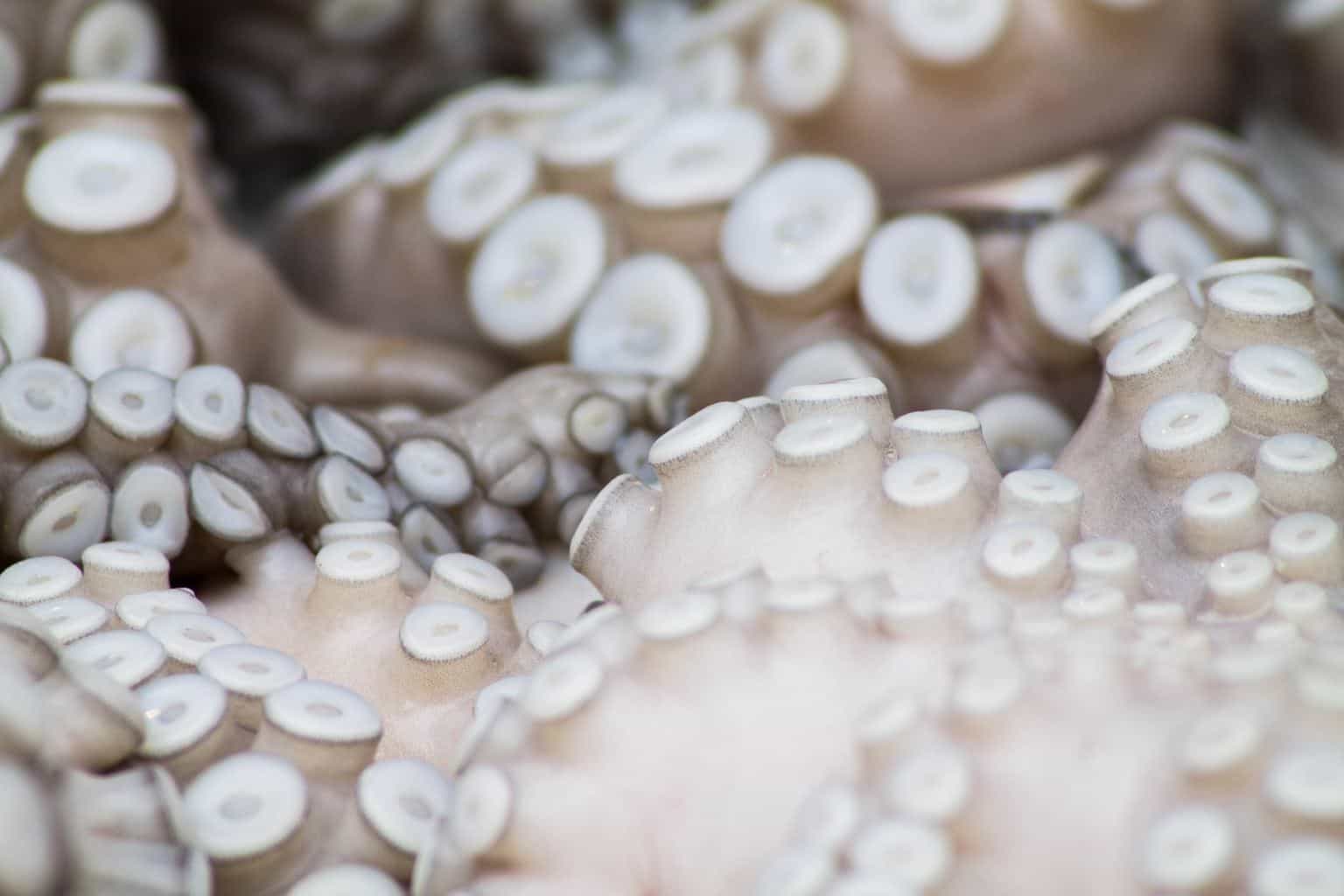
At Omega, we settle on a small plate seafood extravaganza. We order oysters, a plate of mussels in a garlic, butter and white wine sauce, and some smoked trout. “How ‘bout a little octopus?” Andy says ogling a long white tentacle with dark red suction cups packed in ice at a nearby serving station. I cringe. I don’t like the idea of eating octopus. The last time I ate octopus was over forty years ago. I was living in Mexico with my boyfriend and we shared a cóctel del pulpo at a hole-in-the-wall restaurant where mostly gringos hung out.
9.
Octopuses are cephalopod mollusks with eight suckered arms, a soft sac of a body, and sharp, beaklike jaws. While orangey-brown is the color most commonly associated with octopuses, they have special pigment cells called chromatophores in their skin that connect to their nervous systems allowing them to change color and pattern to match their environments or warn off predators. The extremely venomous blue-ringed octopus (Hapalochlaena lunulata), changes from deep blue to an eye-ball busting yellow with blue rings when threatened. My uneasiness about eating octopus, however, isn’t because I’m afraid it might be poisonous or because they can change color so adeptly. I’m hesitant about eating a creature that is believed to be the most intelligent of all the invertebrate species. Paul, an octopus with the same name as my husband, lived at the Oberhaven Aquarium in West Germany and could predict the outcome of World Cup soccer matches more reliably than the bookies. The eight-armed oracle went 8 for 8 in his 2010 prognostications.
10.
Maxine’s primary care physician counselled her against the surgery, but my husband and I find this out too late. We are sitting in a small consulting room at Virginia Mason Hospital waiting for Dr. L., the neurosurgeon, to arrive and give us news of how the removal of the meningioma went. I’m expecting a skinny, older Chinese guy wearing wire-rim glasses and dressed in a white lab coat. My preconceived notions about neurosurgeons are blown out of the water when a husky, exhausted-looking, long-haired millennial in wrinkled green surgical scrubs comes in and casually throws himself into an upholstered chair facing us. Dr. L. shakes our hands. “It pretty much went as expected,” he announces with a yawn. “Except that I couldn’t get all of it.”
11.
In addition to predicting soccer matches, octopuses use tools, solve problems, and can find their way through mazes which is more than you can say for some humans. They are good mimics and can ape the behaviors of other species (my son can do this, too!). They build fortresses out of shells and other objects they find. Like ravens, they are drawn to bright, shiny objects. This is what The Octopus’s Garden, the only song Ringo Starr ever wrote, was about. That and the infighting going on between members of the world’s most famous rock band.
12.
After our meeting with Dr. L., my husband and I head up to intensive care to find Maxine. My mother-in-law has always been a coquettish beauty, in the vein of Audrey Hepburn or Grace Kelly. She had round blue eyes, high cheekbones, clear skin, perfect teeth and a delicate, turned-up nose. Now, laying the hospital bed with a shaven head and ninety over-sized staples holding her blood-caked, carved up head together, she looks like the Bride of Chucky. Paul and I find her not only awake, she’s euphoric. It’s hard to tell if this mind state is being produced by some drug she is on or relief at learning that she is still alive.
13.
To some Northwest Coastal tribes of British Columbia, the octopus plays an important role as a medicinal animal and is considered to possess formidable powers over sickness and health. Japanese, Alaskan and Northwest native groups sometimes refer to the octopus as the Devil-fish. Devil-fish images can be found on totem crests of the Tlingit and Haida. In the Nootka legend “Raven Annoys Octopus,” the wily Raven gets his due when he insists on bothering Octopus while she is gathering clams. It’s a rare animal that can one-up Raven.
14.
From Avia, Queen of the Symbolic Meanings blog: “Octopi are invertebrates, meaning they do not have a structured spinal column. This is symbolic of agility, grace and flexibility. She is able to slip out of the tightest places, and ambulate as if she is the embodiment of water itself. Take the time to observe the way the octopus moves – it is hypnotic. As a totem, the octopus reminds us to loosen up – relax. The octopus can detach a limb at will to serve as a distraction against would-be predators. From a totem perspective we could translate this to mean that we ourselves have the ability to cut loose excess baggage in our lives in order to achieve our desire.”
15.
My mother-in-law is not reconciled to the “excess baggage” she has cut-loose. Unlike the octopus, she can no longer ambulate, let alone gracefully. More than a month after surgery, mobility has not returned to her left-side and the strength on her right side is a fraction of what it was pre-surgery. Another of my husband’s five brothers, the one who is an M.D. himself, tells me a joke he learned in med school: “What do you call a walking, talking neurosurgery patient?” Answer: “Pre-op.”
16.
The neurosurgeon and neurologist are baffled. They claim there is no clear reason for the fact that Maxine can do little more than lie in a bed or in a reclining wheelchair in the nursing home she is now consigned to. She is angry and disconsolate about what has happened to her and blames Dr. L. Dr. L recommends psychotherapy. Maybe it will help her “loosen up.”
17.
Andy asks the waiter at Omega if the grilled octopus is good. “Best thing on the menu,” she says without hesitation. So we end up ordering it. The avid gourmand in him wins out over my silly objections about eating an invertebrate that often demonstrates more smarts than we humans do. Maxine declines to try it but I decide to have a taste. Mixed with a lightly-dressed salad of fresh field greens and fingerling potatoes, the octopus has a tender texture and faintly smoky taste. I chew it slowly, deliberately, savoring each delicious bite.
18.
Andy is back in Seattle a month later to visit his mother in the nursing home and he is still carrying on about how good the octopus at Omega was. As for me, I’ve learned a couple of important lessons since that night and am now convinced of two things: 1) I will never eat octopus again and 2) if I ever reach age 90 and still have my wits about me, I think I’ll also pass on brain surgery.
Judith Gille’s articles and essays have appeared in numerous newspapers including The New York Times, the LA Times, and The Dallas Morning News, in magazines, literary anthologies and online journals. Her memoir, ‘The View from Casa Chepitos: A Journey Beyond the Border,’ was awarded Writer’s Digest Grand Prize in 2013.
Image courtesy of Antonella Lombardi, via unsplash
-

Above Lyman’s Riffle
Memoir by James Ross Kelly
The old man’s house was falling down ten years after his death; twenty-years after, the whole south face of Lyman Mountain and Ernie’s place by the Rogue River, was divided up and there were expensive homes built at various river viewpoints and no notion of Ernest Lyman, who had lived there for almost a century—was in anyone’s mind. However, one year after he’d passed, on a hot August, dusk evening that was beginning to cool, I waited for the red glow down river and Vaux’s swifts darted through warm air and willows along the river. Swifts in the red day glow off in the west and evening light.
That evening I could see to my right, the hundred year old black walnut and cherry orchard across the road, and up the hill the road that would take you to Ernie’s hard rock mine, and below the mountain as it turned north, Sam’s Creek was trickling in through the willows upstream from, where I was standing.
Once I had seen a specimen nugget come out of Sam’s Creek, which was as big as your thumb and weighed over an ounce. The nugget had come from a small inner tube dredge, sucking gravel off the bottom of the creek for gold fines that settled after the gravel rattled across a shaker board. The dredger came up with a frogman mask and then showed Jack and I the nugget of that day’s find. Ernie let the guy, Jack’s friend, dredge the creek. The man had tried to offer Ernie half of what gold he dredged. Ernie waved him off, despite living in the old falling down house; he’d invested well and had no need for money.
This evening I’m watching the brick chimney, from Ernie’s house, that juts upward from its tin roof at the bottom of Lyman Mountain. Ernie’s parents built the house when he was two, in 1898— when the mine began to pay. He was born across the road not far from where Ernie let me tear an old apple packing shed down two years before his death. The apple orchard had been gone since shortly after the Second World War. The shed was full of nineteenth and early twentieth century artifacts, a “Coolerator,” with only three bullet holes in it—I took the old upright icebox home and kept food in it on the porch in the winter, and would throw in a block of ice in the summer and it would cool beer for three days, despite the bullet holes. As the packing house deconstructed, behind the siding on the inside wall, written in penciled-in childlike scrawl, a scribe from 100 years ago had written, “Amen, Brother Ben, Shot at a Rooster and hit a hen!”
Later, from a ladder, I sided my house with those old Douglas fir lap boards, which were brown and richly weathered with reds, and gray and gold hues— while my own children, my real wealth, squealed and ran across my own side hill seven miles away.
This years ago evening, the Table Rock Black-tail deer were waiting for the near darkness of after dusk for a drink of river. Now the swifts begin to draw close. For one minute they come together in ever tightening circles, closer and closer together. Then as one— they swirl into a whirling black-funnel-down-cloud fifty feet in height above the house; and they are into-the-chimney—in one second, or two.
If I could take you back there I’d want you to make you fly with the Vaux’s swifts that had been up and down the river feeding on flying insects. You’d come together when they began to draw close. You’d come to the high, rapid twittering, high whistled chipping, and in ever tightening circles, swirling and swirling you’d spin collectively together in a great pinwheel-like circle. A gyre coming more and more altogether directly above the chimney—then suddenly, in one morphic resonant being with them you’d come down and into a whirling black-funnel-down tornado-like cloud; fifty feet in height, above the house and then into-the-chimney, full of this day’s hatch settling and chittering for a brick gripped sleep. When you came back I’d tell you a lot of things are like that.
The old man said the little birds used the chimney every summer as long as he could remember. Yet this was the last time I saw this. An hour before, casting and mending my line that evening, I had taken a ten pound hen summer steelhead in the riffle above the falls; on wet fly, a Teeter’s weighted-woolly-worm. Ernie had told me ten years before— it was an evening riffle.
James Ross Kelly lives in Northern California. He has been a journalist for Gannet, a travel book editor, and had a score of labor jobs — the in-between, jobs you get from being an English major. Most recently, he retired as a writer-editor for the Forest Service, where he spent the better part of the last decade in Alaska. He started writing poetry in college, and after college continued and gave occasional readings in the Pacific Northwest during the 1980s. His poems have appeared in Westwind Review, Open Sky, Siskiyou Journal, Don’t Read This, Table Rock Sentinel, and other journals and anthologies.
-

Conspirators – Fiction by Judith Serin
When Clive broke up with Clara, who worries if she is intelligent, he told her that their relationship was only sexual. When he left me, always unhappy with my body, he said I didn’t really turn him on. Our common hurt was what brought us together. We felt he’d negated us, body and soul.
We met at a party in my cousin’s backyard. Bonnie steered me past her overpoweringly fragrant jasmine vine to a small woman sitting on the shaded bench.
“Celia, my dear, you must cheer Clara up. She’s feeling rotten about a man.”
“Really?” I stared at the beautiful, flower-like woman. “Me too,” I added after Bonnie strode away. My cousin was too close to my our family for me to let her know about the failures in my personal life.
“Aren’t they fuckers?” Clara’s voice was low and slightly guttural.
The obscenity put me at ease. “Christ, yes, and this one you wouldn’t believe.”
“Mine was worse.”
“Don’t be so sure.”
We compared notes. Clara’s story of a blissful beginning, uneasy middle, and final betrayal was familiar, similar to my story, to the stories which many of my friends tell about their one or two disasters. Then she mentioned the name Clive. The dates of our relationships overlapped. We discovered the depths of his treachery.
We became friends. There was an immediate intimacy between us. We could talk endlessly about Clive with a degree of obsession we hid from others. Clara didn’t say, annoyance tingeing her voice, “Why don’t you just forget him?” She knew the answer.
We did things together to distract ourselves. We discovered that we liked the same movies, the same parks, the same cafes. We spent much of our days together, since we both worked part-time. I taught art classes to small children and their mothers. She was a secretary to a psychologist who once a week good-naturedly tried to seduce her, while she good-naturedly refused. Jerry was remarkably easygoing. She told me that he didn’t protest when she pulled the filing cabinet down on herself by opening the two top drawers at the same time, the day after Clive broke up with her. She sat sobbing, surrounded by papers, until her employer returned from a long lunch and helped her straighten up.
Events take on significance later. Once Clara appeared in the doorway of my classroom, her face streaming with tears. The mothers shifted in their low childs’ chairs.
“Clar,” I ran to shield her from them, “are you O.K.?”
“Yes. Get back to work; I’ll wait in the hall.” She slid her back down the wall and landed sitting, her knees drawn up, as though she were pulling into a shell.
I returned to the classroom and busied myself mixing paint, my back to the mothers. God damn their eyes, I thought, for the first time understanding the phrase. I didn’t want our sorrow to be observed.
“Hope your friend feels better,” Mrs. Gruber remarked at the end of class as she pushed Johnny out the door.
“I’m sure she’ll be all right,” I answered brusquely. Clara huddled in the hall, staring through the passing procession of knees. “Did you notice the figure Johnny drew today?” I continued. “He’s really developing fast. The blue painting…” My eyes were drawn to some movement or change. Had Clara left? I didn’t see her. Then she was there again, crouching motionless.
Mrs. Gruber coughed delicately. “The blue painting,” I responded, “is very, ah, thoughtful, sophisticated.”
I watched Mrs. Gruber click down the stairs, her firm hand on Johnny’s wrist as he thumped from step to step. “Come in,” I called to Clara. “I’ve got to clean up. What happened?”
“I just needed to see you.”
I put my arm over her shoulder, holding my paint-crusted hand away from her mauve flowered blouse. “We clash,” I said, fingering my red apron.
“It’s a disguise. So people won’t know how close we are.”
“Conspirators.”
She smiled slowly. “Yeah, it’s us against Clive and the world.”
Another time she lost me for a moment. We were at an art opening I felt obliged to attend. I edged the crowd with Clara, trying to seem absorbed in Billy Sagan’s slick, expensive paintings. “So this is how he does it,” I gestured at a large canvas of geometric shapes. “The colors this year; it’ll go with any room your decorator designs.” I glared at the genial drunk in the center of the crowd. He saw me, flopped his hand, and smiled lopsidedly. “Nice work,” I shouted.
I turned back to the wall. There were too many people there that I recognized and might have to speak to, and they were dressed too flamboyantly. What had I been thinking of, coming to an opening without jewelry, a hat, or a period costume? I felt conspicuous. I hated the crowd for their successes, for the way they chatted and laughed, the way they slid, plastic wine glass in hand, from one conversation to another. There was Laura Rogers moving toward us like a ship. I knew what our exchange would be like. I would admire her ponderous ceramic necklace, which, of course, she had made herself. She’d ask me what I was doing and I’d answer that I was still teaching kids and finding time for a few drawings. I’d ask her what she was doing: another grant, a new show opening soon, a choice teaching job.
“Celia?” Clara turned slowly, peering through the crowd.
“I’m right here.” I put a hand on her shoulder.
“Huh?” She whirled around. “That’s funny. I didn’t see…”
“Oh Celia, and who is your gorgeous friend?” Laura bore down upon us.
A few days later we sat in a cafe. I played with the sugar in the bowl. I wanted to relate last night’s dream: Clive chasing me into a public bathroom, my terror as I waited in the gray stall, knowing he would enter when the other women left, knowing he had a knife in the pocket of his pale blue jacket.
I wanted to hear how Clara would interpret this, what sexual connotations she would catch. I wanted to spill the frightening dream onto the white tablecloth between us, letting her rearrange it into a daylight phrase.
But a man was watching us. I was angry at the intrusion, angry at his arrogant expression, angry because I was sure it was beautiful Clara who interested him.
“What’s wrong?” Clara asked me.
I leaned toward her. “That man’s looking at us.”
She turned. Her eyes met his. “Are you looking at us?”
He half rose. “Yes, you look too good to ignore.”
“Well please stop. We want to talk. You’re making us uncomfortable.”
He slumped back into his chair.
“Clara, that was fantastic. I never know what to say to them.” The man gulped his coffee and left. “I just get so flustered.”
“It’s O.K. Men looking at us has been bothering me lately too.” Her shoulders drooped.
I poked the spoon into the sugar. “I wish we were invisible.” I looked up. Clara was gone.
“Clar!”
“Celia?” I felt a hand grope for mine.
“Clara, are you there?” The table where our hands were clasped was empty.
People looked in our direction. What would they do to invisible women? I heaved Clara’s weight toward the back door. A small strip of grass behind the building. I crumpled, panting.
“Clara, what should we do?”
A gasp or stifled giggle.
I lay back on the grass. I held up my hand and looked through it at an alligator shaped cloud. My breathing slowed, sank. The sky darkened. I saw the flesh of my solid hand.
Clara sat nearby, her legs crossed tailor-fashion. She had lost her air of exhaustion; she looked alert, interested.
“Celia,” a smile of greeting, “you’re back. What do you think?”
“I don’t know. It just happened. I didn’t feel anything. It just sort of happened.”
“Let’s try it again.”
I stared at her.
“Come on. Think about something you want to get away from. I know, that dinner party I told you about, the one when Clive talked to that woman photographer all night and I didn’t know anybody.” Her shoulders sagged; her image wavered. She was gone.
“Clara, come back!”
“It worked.” Her voice was exultant. “Come on, Celia, try.”
“I don’t want to. Please come back.”
“In a minute.”
I felt scared, lonely. I thought that there had been plenty of times when I would have loved to be invisible. The high school dances, before I knew better and stopped going. Oh God, trying not to stare at Walter Griffin as he sauntered in my direction, but also not looking away in case he did want to ask me to dance.
I started. I couldn’t see myself. I reached for Clara’s hand.
We went in and out of being invisible. Our lives didn’t change much. Lighter and more pliant than most people, we floated in this new element, entering museums and movies for free, watching others unobserved, though it was hard to remember not to talk, and more than once our voices puzzled or scared some passerby.
Before, we had avoided going anywhere near Clive’s house, though we were drawn to it, imagining the blue shutters, the brick stairs, the one pine tree in front. Now, invisible, we walked past it often, gorging ourselves on pain and the freedom to feel it. Once, we peered in the kitchen window.
“Wonder If he still keeps a jar of caviar in the fridge,” I said.
“And green olives.”
“Ugh,” I responded. Clara liked to eat bitter things. I loved everything fattening, sweet or salty.
“You know, he keeps the back door key under the third geranium.”
“I know.” I thought ruefully of Clive’s luck; I had never let myself in while Clara was waiting for him in the bedroom room with a book.
“Let’s go in.”
“Clar!”
“Why not? I’m hungry.”
The key clicked, scaring me. We entered cautiously. The house reeked of his presence and I wanted him. I also wanted to smash the antique porcelain fu dog in the hall, to kick the Oriental rugs into a heap, scrawl on the etchings, and, most of all, to batter the shiny, inscrutable suit of armor that stood on the landing of the stairs. His perfection, his horrible self-sufficiency.
“Clara,” I whispered. I had gone into the living room without her. I called into the doorway of each room except the bedroom. If I didn’t find her soon, I knew I would wait, visible, on Clive’s bed for his appearance, probably with a startled woman holding his hand.
“Hi,” she answered in the kitchen. “I’m eating.” An enormous sandwich, several layers of cheese and meat, lifted into the air.
A few evenings later we felt restless. There were no movies we wanted to see and Clara’s television bored us. The summer air settled on my shoulders. I stretched my arm; it was like moving through soup. “I wonder what he’s doing.”
“Fucking.”
“Yeah, probably.”
“We could go see.”
“Okay,” I surprised myself by agreeing.
He was alone. He lay among his colored pillows, the sheets crumpled around him. His body was thin, long. He looked vulnerable, yet closed. We stood several feet from the bed, holding hands, trying to be angry. Clara sobbed once and he stirred, an uneasy sleeper.
“Should we go?” I whispered.
“Yes. Oh, he looks so innocent.”
I pulled her toward the door, my stomach furry. She reached out as we passed him and laid her fingers on his thigh. He sprang up.
We clattered down the stairs and fumbled with the front door lock. In the uproar of our escape, I can’t be sure I heard his voice, higher than usual, shouting behind us.
At my apartment we fell into the two fat chairs. Clara finally spoke, “I bet he was really scared.”
Her face twisted between a smile and a sob. My mouth twitched and we laughed.
“Oh God, can you imagine? He must be petrified.”
“Good.”
“Celia,” Clara looked at me eagerly, her full-lipped mouth half open, “Let’s go back; let’s really scare him.”
“Yes.” My tongue lay in my mouth like a pastel lozenge. Evil had a delicious taste.
For a week we didn’t talk about that night. We stayed visible and saw several movies. On Friday we went to a department store. The number of customers surprised us until we realized it was lunch hour. I felt uneasy among the crowd. Clara gasped. “Look.” She pointed and vanished.
Clive stood by a table, examining a bolt of blue cotton printed with enormous red roses. The blue matched his eyes and, possibly, his living room curtains. In the daylight, I saw he had gotten very tan.
His head turned, and I disappeared, reaching for Clara’s hand. We stood still. I was afraid the shoppers would bump into seemingly empty space, more afraid to try to push through them. Clive bought several yards of the fabric and left with the parcel under his arm. The store began to empty; lunch hour was over. “Let’s get out of here.” I pulled Clara into visibility.
That evening we went to his room. It was sunset, the sky a tender pink-tinged blue. Colors fluoresced in that light–the geraniums by the door, the roses on the new cloth draped over the living room sofa. We climbed the stairs quietly. Clive lay against his pillows, his right hand resting on an open book by his side. He was looking at some treachery, his eyes reflective, inward. He wasn’t thinking about us.
Clara gripped his arms. I sat on his legs and unbuttoned his shirt.
His mouth, like an O, floated above us, the screams issuing from the cream colored ceiling, the round moon scaling the window.
Judith Serin has taught Literature at CCA for many years. Her books include the poetry collection, “Hiding in the World” (Eidelon Editions), and an artist’s book featuring Serin’s poetry in collaboration with book artist Nikki Thompson, “Days Without (Sky)” (Deconstructed Artichoke Press). She has published numerous short stories and poems in journals and anthologies.
-

Bloodwork at 341
Flash Fiction by Ric HoebenHere, it reeked something sulphurous of an election day, and none of the big political names meant anything of significance to me. All I craved after was getting back to the resort and out of the steamy haze of summer sidewalk.
My wife, she’d had me call down to the liquor store to see if they were open—she wanted that blueberry vodka stuff again, we’d been tearing through the bottles going on four day straight, we’d been put up for her week’s vacation at the Pampas Inn, and all of it smacked of something she and I were not greatly accustomed to in our normal days of bluejean living. I’d been laid off from General Electric for a thinking problem, wifey had slaved as a paralegal back home in Sellars, slaved so damn hard her boss gave her this fat relax week at his condo. And so, we had lobster, we had impolite sex, we had jacuzzi, we had the sticky linger of blueberry in the mouth each morning, waiting to greet us with its great, morning punish.
I got myself down to the familiar brick store, sniffed it, licked its walls. Inside, they knew my name now, they smiled at my face now, they said hello to my liquor eyes now—I was their boy, the new daddy on the streets. They probably thought I’d become a regular, a man they’d see on and on for years, a man from just over on the South Causeway. But I was far, far from home. I paid for the Smirnoff half gallon and nodded and left out the ever-bell-clanking door.
It had occurred to me that I was a dying animal. I’d been living it, day in/day out, dehydrated, depressed, head in a fog, and testosterone at a record low, had given up smoking, even did a few push-ups here and there, none of it built me back up. I thought the present resort trip would help. It had not.
Cloudy, cloudy, cloudy, I ran square into a bum. A Mexican one, and the precious vodka shattered as he whistled tunes unknown.
“What the hell?” I screamed. “As if I am not feeling bad enough, as if I am not thinking about suicide some nights!”
He scooped down to pick up the shards of glass. Why, I wondered, did a bum pass by these affluent paths anyhow, who was he in his Latino skin and why here?
“Go to church?” he said from his kneel. He had no sweat about him, even in flannels and beard.
“Look, daddy, you really shat on my parade here, and I’m thinking you better give ‘em to me.”
“Give what?” he fired back.
“Whatever money you’ve cadged for today, you give it all on over to me. You rained on it, you rained on my parade. My wife’s, too, daddy.”
“For years I’ve come down this way. For years I’ve been looking for a cross. Plenty of churches, but not a damn cross on any one of ‘em.”
He put out his hand as if he wanted to shake mine, as if he were a gentleman golfer, as if his Jaguar were parked just in earshot.
I snarled and walked back in the direction of the high throne of the wife, empty, desolate. I’d have to conjure up some story, get another Andrew Jackson out of her mauve purse and march right back down the same, stupid street. My ears rang and the haze of my head pounded—I would have done sloppy murder for a thick cheeseburger and a Mountain Dew, but nothing like that existed in the Gehenna as I knew it.
Each step hurt, and I wanted to vomit all of the anxieties of my life out across the glimmer of the flagstones underneath me. What had bitten me, what had come up in me? My tongue tried to escape my body, my fingers did not move as commanded, my brain could not control even my bladder, and I gave over to peeing, draining it all down my Walmart khakis. I’d done this before, but it had been a while. Now here it had happened again, here in public with cars passing and crisp mailmen walking, and four irons a-hitting. Here I stood drenched in my dying.
He was right. He was damned right.
I saw a church, something straight out of a Clint Eastwood, and then another one, taller, like a standard out of South Beach, and a small pink one, immaculate was its garden, its awning, its arbor, but it had no cross to speak of—none of them churches had a cross. And this fact, for reasons unknown, was one enormous, hard pill to swallow.
I began to run, my piss-wet, sloshing legs somehow finding an energy, past the identical condos and mailboxes and seashell prints and oyster decorations and garden gnomes, but never a cross, never a cross, never a cross. The very word got stuck in my higher functioning: cross, cross, cross. Shitless, I could not stop running and looking as quick as my eyeballs would work for me. I flew down Addison Avenue and saw flamingoes and highschoolers tanning their round buns, but no old ruggeds thereat. Sprinted up Victory Lane and saw the Import Cars place and a woman and her dalmatian and her husband pumping iron as he walked alongside her, but what I wanted to find would not come out and be shown.
I ran myself ragged, as they say. Ran myself to the point of thick exhaustion, sat down on a corner and tried to summon something new. My wife? Could I call her? Could she come get me? Could she leave that damn king size and that damn watermelon and that damn ocean breeze smacking her pale thighs and come straight down to real life and fetch me? But I did not even know where to tell her I was. The streets had become something unfamiliar. The election signs were long gone, that eternal striking of Titleists, absent.
***
Looking to my port and then to my starboard, I found the drizzle. I knew the storm would press on, I’d seen the weatherman dance and ramble on about it, back in the morning, when she and I were sharing cantaloupes and coffees and working off the vise of the hangover and there being nothing much more to do than fish-stare at the goofy weatherman and the soaps, like our parents always did, like our grandparents always did, like some things never change. But under the graying drip of rain, I hunkered down and realized that all nature of things did change, that cells die and nations war and people get fired in America and babies are born with or without you and leaders fall and money not only talks but shouts sometimes and, and, churches and yards and businesses exist in motion without Jesus crosses to them. My testosterone was low, and I had no job, and my only friend anymore was my wife and her big thighs and her lackadaisicalness. The tranquil drizzle turned into regular and, then, after that, supreme. The drops came on with a mean sting to them, and I caught sight of a fine canopy of live oaks to sit myself under and wait out things. I crawled after that spot, my nails in the soft earth, my useless body going along with their small gains, and finally, painstakingly, I reached the shelter of love, that abode of power, the endless castle of home.
Ric Hoeben, M.F.A. from The University of Florida, lives in Georgetown, South Carolina, by the coast. His most recent work has been found in Tampa Review, storySouth, Glimmer Train, James Dickey Review, Clapboard House, The Monarch Review, Spork, Atticus Review, Hobart, Connotation Press, Burrow Press Review, Pithead Chapel, Umbrella Factory, the Newer York, and Waccamaw.
image courtesy of Tomo Sodoge via unsplash
-
Over the River and Stabbed to Death – Essay by Randy Osborne
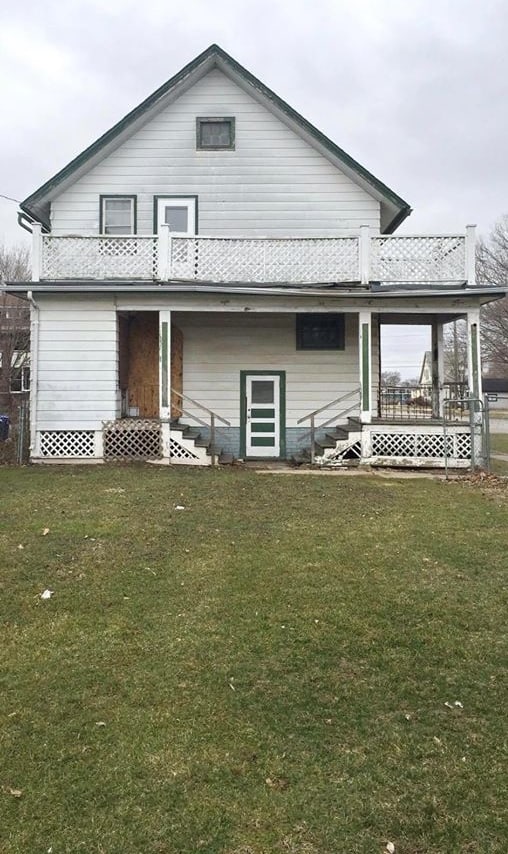
My childhood home is for sale – bank property, cheap – because of the murder in the backyard. I might buy it.
Not murder by the standard of law, the jury decided, but a violent and fatal act just the same. And not in the yard but in the main room of the house, the room where my grandmother Madeline worked her sewing-machine treadle decades ago. See how she pushes the fabric through and the needle jumps and cloth cascades off the table. The Singer whirrs, its clackety chatter like celluloid flapping loose on a full reel when the movie’s done. The curtain can never lift on that screen again, of course. Ridiculous to think. And yet.
Here’s what happened at 1802 S. Fourth St. in Rockford, Ill., about a week before Christmas 2011, according to trial testimony. Terry Johnson, 47, visits resident Raymond Gitchel, 59, for the purpose of smoking cocaine. They smoke cocaine. Johnson tries to steal a bag of heroin from another guest. He and Gitchel argue. Gitchel tells Johnson to get out. Johnson refuses. The dispute grows noisy, and someone appears from the second floor of the house with a baseball bat. But Gitchel acts first. He plunges a knife deep into Johnson’s thigh. Johnson cries out to all present, “He just stuck me!” Then to Gitchel, “I can’t believe you just cut me! I can’t believe you just stuck me!” Finally Johnson limps away – trouser leg no doubt soaked already – complaining that he will need stitches. He doesn’t get them. The knife has sheared his femoral artery. Johnson is bleeding to death.
Later, one of Gitchel’s housemates reports Johnson begging for help outside. Everybody ignores this. “Oh well, he should have left,” Gitchel remarks. The temperature sinks to 21 degrees that night. Next morning Johnson lies face up in the grass beside the chain-link fence.
What should we do, somebody asks. “I don’t know,” Gitchel says. “I’m going to make a sandwich.”
My grandmother Mad would love this story. I love this story. She raised me.
On pulpy detective magazines Mad raised me. On Poe and Hawthorne and the Bible (Old Testament only, please). On mythology, too, which is why Johnson’s thigh injury makes me think of the Grail King, his grievous wound, his barren land.
Mad raised me alone, her husband having jolted the family by leaving for some strumpet he met at work. An old man. They could hardly believe the sap still flowed. But when does it ever not?
In news video the day after the crime, trench-coated cops tromp the plank steps of Mad’s yellow-taped front porch. The same steps where I once sat, chin in hands, and waited for my life to start. I would grow up a writer or doctor – if the latter, a surgeon, specifically. I would incise people. The blade, like words, can harm or heal. Or I would be a radio star.
Gitchel paid $40,000 for the house in 1999, the year of my second marriage; today the bank asks $8,365. But the roof leaks, the wiring’s shot, and the furnace is stripped. “I don’t even go inside,” the real-estate agent tells me. Floors are falling through. The place is condemned.
Many scholars of the Grail legend believe that the word “thigh” is a euphemism for genitals, the king’s injury “a dolorous stroke.” Dolorous. Delores.
***
On a night in 1986, Ronald Ower became another man knifed and left to die in Delores Park, my favorite patch of San Francisco green. Teenagers wanting to “rob a faggot” attacked him as he made his way home. I learned about Ower while researching morel mushrooms.
A delicacy prized by chefs all over the world, the morel belongs to the genus Morchella.
Species names roll out like a magical chant: esculenta, rufobrunnea, augusticeps. Ower, a university student and aspiring biologist, was the first to cultivate morels. The New Scientist took notice. “Morel enthusiasts rejoice!” The day was near when they’d no longer need to “grovel through the woods” for “a few of these delectable fungi.” Ranging tan to black, morels are unmistakably phallic, as an author hints in the journal Mushroom. “I step back, circle and, for a moment, admire the spectacle. Stooping, I run my fingers gently along the surface of the cap, in and out of the grooves and hollows, down the long rubbery stem.” In the Midwest, the 1960s witnessed a morel bonanza thanks to Dutch elm disease’s massive kill-off. All those rotting stumps.
Ower grew morels on his kitchen table. He filed for a patent, outlined his methods in Mycologia, and signed a development contract with an agricultural biotech outfit in Michigan. But by the time his patent cleared, Ower no longer dwelt among the quick.
His killing happened, coincidentally, on the night of my birthday. Because I scan the world non-stop for such discoveries, I can’t help but notice also that Ower’s initials match my own. It makes sense to me that his last name, spelled as if to suggest a debt, is pronounced like a unit of time.
***
In 1967, my mother clinched her own second husband and retrieved me from Mad. Our time felt less deep than I expected. I had her at last, yet I didn’t. He had her, in that bedroom down the hall. This my mother and I shared: During the damp seasons, we foraged in the woods for morels. “Delicious because they are wild,” she told me, herself now less wild than ever.
Super-domestic, in fact. Free of the workplace and happily kitchen-bound, she refined her cooking skills to the delight of my retired stepfather. A few years passed. They decided to scale it up. They bought a restaurant.
Here I washed dishes, and swept floors, and met Cheryl. Doe-eyed, full-lipped Cheryl, 16, with a pageboy haircut and springy step, at her first job, waiting tables. The sexual draw was almost immediate, and mutual.
I was 21, and I was the son of her boss. She wasn’t even legal. I didn’t care. Did, but didn’t.
Also I was the obvious choice, wasn’t I, when Cheryl’s parents told her that she could only attend the outdoor concert at Sinnissippi Park if accompanied by someone older, someone responsible?
The music is nearly over. Cheryl sits between me and her friends. I am behaving. But then, I can … feel her. I turn and meet her stare. Reader, I lean into that jailbait. Her lips first a pliant mash, then breathily open. Noses to cheeks. Tongues teaching each other, being taught. It goes on for about a half-minute.
We pull away and cast our eyes at anything elsewhere, dizzy.
The rest is hardly worth telling. Cheryl’s friends take her home. At work Monday we’re both shy. I speak to her in a distant way, almost cordially after that, certain that I’ll be taken into custody any day.
My parents sell the restaurant, and it’s years later when I see Cheryl’s wedding notice. The last name of her fiancé is peculiar and sticks with me – might have anyway – and his first name is the same as mine. Naturally, I attach meaning to this, take points. She wanted me.
***
2013: Jurors acquitted Gitchel of murder but convicted him of involuntary manslaughter and sentenced him to five years in prison, with credit for 508 days served. At the Rockford newspaper’s website, where I went to comb the archives for details, the current front page blasted news of a major drug bust. “Nearly 30 people have been taken off the streets along with around two million dollars’ worth of cocaine, marijuana, and prescription drugs. Among those arrested [are] a dentist, a high school football coach, and other area professionals.” Out of curiosity, since I knew a few people in town, I scanned the names – and there he was. The other Randy.
Had their marriage lasted? I Googled. Located him, but no Cheryl. Here’s a Facebook photo. Paunchy fellow in hotel pool with blonde babe, definitely not Cheryl. Rings on their pertinent fingers.
More legwork brought me Cheryl’s address. The Google street view shows a single-level house, solid white, set back from the road under a grove of trees that dapple the sunlight. In the driveway a small car, also white. Maybe it’s the weekend, she’s home. By herself?
I would contact her. Not online – that’s too impersonal. Phone call? Potentially awkward.
A letter, I’ll compose a letter. Everyone appreciates real mail with handwriting, ink.
No, I will do none of this. Nor will I buy Mad’s old place in some sorry attempt to grow again what can sprout one time only, and best existed wild. A torn, scattered-to-the-winds patchwork impossible to stitch back together.
But I hope Cheryl has replaced him, replaced the Randy that I foolishly imagine “replaced” me. Gendered humankind roams the earth with lonely holes and then each of us ends up in one. Nomads. Monads.
How can I, this bag of meat, dream ideas from nothing but air, make sparks in mud? How can I begin to know myself, before the credits roll? As with poor Johnson when he staggered from the Gitchel house, nobody wants to hear our shocked complaints. The wound is worse than we know. It finishes us.
Randy Osborne’s essays are listed in the Notable sections of Best American Essays 2015 and 2016. His writing has appeared in Salon, The Rumpus, Full Grown People, The Lascaux Review, Flyleaf Journal, Empty Mirror, Identity Theory, 3Elements Review, Bodega, SLAB, Loose Change, Green Mountains Review, Spry Literary Journal, Scene Missing, Thread, and other small magazines, as well as the Chicago Tribune, Atlanta Journal Constitution, San Francisco Bay Guardian, and St. Louis Post-Dispatch. His work has been published in four print anthologies and nominated three times for the Pushcart Prize, as well as Best of the Net. This essay originally appeared in SunStruck Magazine.
-
Everything I Know About My Great Grandfather – Memoir by Walburga Appleseed
My great-grandfather had a Bavarian accent, a German passport, and an eye made of glass as a souvenir from fighting in the First World War. He played the zither. My great-grandfather married a woman from Basel-Land, a local beauty who obsessed about tidyness and created stunning embroideries which she displayed on their dark-red sofa and which my mother, the grandchild, wasn’t allowed to touch. He played the zither for my mother. She played the concertina. Later, they played together. My great-grandfather knew the ouvertures to all the operas and operettes ever played at Zürich’s theatres during his lifetime, his favourite being Rossini’s “Wilhelm Tell,” and whenever he went to the opera, he’d take my grandmother, his daughter, with him.
My great-grandfather with surname Gammel, blond hair and blue eyes, mysteriously turned into a Swedish citizen when the Second World War broke out and my grandmother and her German passport lived too close to the border and needed to invent neutral origins to keep her going through life in a hostile Swiss village. He brewed beer for a living. My great-grandfather brewed beer for a living and lived in an apartment in the middle of Zürich, with the river Limmat flowing on one side, the railway track running along another, and a large road along a third side, and my great-grandfather took great pleasure in all three of these features, because he said he never got bored at home–sittting out on the balcony, waiting for the 15:20 train up north, or the 17:30 train down south, watching the boats along the river, or the trams, cars and horses on the road. He brewed beer and played the zither. My great-grandfather had to leave his beloved apartment when he couldn’t live on his own anymore, and he eventually died in an old people’s home somewhere in Zürich, of neglect, or abuse, nobody knows which exactly, and my grandmother was too busy running a farm, bringing up four children and dealing with abject poverty to be able to investigate. I’ve still got the zither.
Walburga Appleseed likes her chocolate dark, her wine rich and her fiction short. Her flash fiction has appeared online and in print. She recently won the Winchester Prize for flash fiction. In a parallel existence, she also writes for children. Visit her online at https://walburgaappleseed.com.