Your cart is currently empty!
Author: Editor
-
7
I Am Screaming at the Top of My Lungs
By Chet KozlowskiThe first time you meet him it’s at that crazy corner of 23rd and Broadway, where that building that looks like a long piece of layer cake comes to a point. It’s where the streets are the widest, where they all come together and cross over each other and split apart every which way. It’s late afternoon: lights switching, horns honking, pedestrians pedding, cell phoners barking. So much hubbub it’s amazing more don’t collide. It’s a very complicated place, and you just watch your shoes and go with the herd. You’re small enough to glide through, young enough to go unnoticed. What’s more invisible than a girl with a skateboard? You mutter lyrics and scratch your itchy nose. You’re heading home after doing the bag in the park with Demo and the crew. Who cares about the chaos? The bag makes it all a warm blur.
You’ve been hearing him without even knowing it. His voice is just one of the street sounds, until you get closer. Then it slices through: “Can somebody please assist me? Won’t somebody give me hand?†A chant, clear and patient, over and over.
You’re not one to be curious, but you look up now. There he stands, in the middle of the sidewalk. “Won’t somebody just help me, please? I need assistance.†Nobody answers him. The crowd surges past, breaking around him.
You’re not one to stop, but you do now. The herd behind you jostles and swears. He stands rooted against the tide. “Can’t anybody help me here?†He clutches a stick to his chest. “I am screaming at the top of my lungs,†he says, which makes you giggle, because he’s not. He’s just talking loud and clear, like a teacher leading a fire drill.
You’re not one to help, but now you’re standing in front of him. Up close, he’s a big guy, maybe as old as your dad, crewcut, khakis, sneakers and a yellow tennis shirt. He stares over and past you, straight ahead.You clear your throat. “What do you need?†you say. Your mouth is gummy — that’s the bag — and your voice sounds like it belongs to somebody else.
He cocks his head and peers down. “I need help crossing the street,†he says. His eyes roll around, knuckles in brine. When you don’t answer he asks, “Are you there?†He can’t see you. He’s blind.
“I’ll help,†you say.
“Good.â€
You don’t know where to touch him. “Take you by your arm?†There’s a food stain on the front of his tennis shirt. The collar’s all twisted.
“Let me put my hand on your shoulder,†he says. You come around. “Short,†he says. You walk him to the curb.
Traffic lurches and whooshes past. “Busy corner,†you say.
“Tell me about it,†says the blind man.
“Gotta wait for the light,†you say.
“You’re a kid,†he says.
You shrug.
“Not many kids stop for me.†The light changes.
“You’re a good kid,†he says.
“Cross,†you say, and you lead him into the street.
The crowd comes at you. No ducking and weaving now, you’ve got this guy in tow. A straight path is what’s called for here. Make way.
“Folks stop for me, but not many kids,†he says. “I’m at this corner every day. I ask for help and sometimes I can feel somebody right next to me, not saying anything. I hear them breathing. I say to them ‘Can you help me?’ and they just don’t answer.†His hand is soggy on your shoulder. “What is it with people?â€
You shrug.
“What’s your name?†he says.
“Abra.â€
“Abra?†He snorts. He gazes up blankly; his eyes roll. “What’s your last name, Kadabra?â€
Ha ha. Like you never heard that joke before. “It’s short for Abigail Ramona,†you say. “That’s my whole name. Abra’s my nickname.â€
“Pick up your feet.â€
“What?â€
“You shuffle your feet.â€
“Do not.â€
“I can feel it.â€
“Curb,†you tell him. “Step up.†You two made it to the other side.
He lets go of your shoulder. “There’s a restaurant right here, right? A Keough’s or something?â€
You look around, see nothing but a stone wall with windows. “It’s a hotel, I think. No restaurant.â€
“Yeah?†He flicks out the stick he’s carrying; it telescopes into a cane. “Oh well. You should stand up straight, you know.â€
“I do.â€
“You slouch.â€
“Do not.â€
He clicks the skinny cane on the sidewalk. “It’s never too early to develop self-respect. Stand tall.â€
Your shoulder twitches where his hand was. You still feel it there.
He cocks his head. “Hey, you’re not coming from shop class, are you?â€
“No.â€
“Making model airplanes?â€
“No,†you say, but you know what he means. You sniff your shirt.
“I just picked up a whiff off you. Strong smell. Like turpentine. Or glue of some sort.â€
That’s the bag, you want to say. Demo sprayed a lot this time. The smell clings to your clothes. It’ll wear off by the time you get home, but right now, whew.
“Oh well,†he says. “Better hope nobody lights a cigarette near you.†He turns and starts tapping his way up Fifth. “Thanks for the help, Abigail Ramona,†he calls back. “See you around.†And then he’s gone.
On the walk home you go back to watching your shoes.
What’s he say, the blind man? He needed help and you helped him and he starts talking trash. He’s wrecking your high with this hoohah.
What’s he mean, self-respect? You got it, as much as you need to.
Short? Maybe, for your age. Slouching? Makes it easier to slip through the cracks. Shit, what’s he know about anything anyway? He’s blind. Goodbye, Buddy, you should’ve said. Don’t walk into any walls. That’s one thing you know. There are walls everywhere. If he could see, he’d see them there.
Walls to get over, walls to get around. You try to be the smartest, the fastest, the best, but the walls always come up in front of you.
There’s the wall of how much you know and how much you don’t. The wall of how pretty you are and what clothes you wear. The wall of not understanding no matter how much it’s explained. That’s why being with Demo’s so good for you.
Demo says chill, you chill. Demo says run, you run. Demo sprays inside the bag, says breathe deep, you breathe deep. Take a whole headful, Demo says. Demo says and you do.
The bag doesn’t break down these walls, or get you over them. It just makes you not care they’re there. So what does the blind man know? Some walls you can’t get over, no matter how much you don’t shuffle or slouch or have self-respect. All you really need is the bag. The bag makes things better.
By the time you get home you’ve got yourself convinced.
You see the blind man again, weeks later, in a bus shelter. You’re with Demo and the crew and he taps in. Everyone goes quiet. He folds up his cane and stands to the side. He holds it to his chest. You ignore him.
“Can somebody tell me when the #42 comes by?†he asks.
Nobody answers. Demo and the crew snicker, and you do, too.
“Can any of you assist me? I know you’re there.†That calm request.
But something’s in the air and he sniffs it. That’s the bag.
“Abra?†he says, but you don’t answer. “Abigail Ramona?†Demo and the crew wonder and nudge. But you just look away and watch your shoes. ï®
— 7/21/03, New York City -
5
Staking Claim
by Vanessa HuaYears before my mother died, my sister was prepared.
Ilana arrived home one weekend, clutching two packs of Post-Its. “It’s time,†she said, handing me a yellow stack. She unpeeled a bright orange sticky note, and slapped it onto a pint-sized terracotta warrior that guarded the living room, a gift from our great-grandmother.
The industrious chemists at 3M invented the sticky notes to free people from the tyranny of paper clips and staples. The jaunty curl of paper wound up on all kinds of never-before-possible surfaces: in a choir book to mark various hymns, on an eyes-only memo from your department head, and on the kitchen counter, as a Dear John note. Or on your inheritance.
“Olen, let’s not worry when Mom goes,†she said. “You hear about those families fighting over nothing at funerals, because there’s no will. It’s easier to divide it up now, when we’re not so emotional.â€
She slapped another Post-It onto a wooden radio, the big heavy kind they made copies of at Restoration Hardware. I looked over at my mother, who curled up on the couch with a mug of green tea. The vulturing of her property did not perturb her.
“It’s okay with me,†she said. “Whatever you kids want to do.â€
Her attitude was typical. My father was killed when I was a baby. A pizza delivery truck in on-coming traffic hit a deer, flinging the buck into the windshield of my father’s Buick. After that, my mother saw no use in getting in the way of what was supposed to happen. Fate interrupted the mundane.
I flicked the Post-Its like a cartoon flip-book under my thumb. It would be different if Mom were hooked up to life support, or fading away in a rest home. But she’d had us young, sometimes mistaken for a big sister when she dropped Ilana and I off at elementary school.
Now she ran her own country antiques store in Sutter Creek. She wore sleeveless tops that showed off her strong and tanned arms. When I helped her with pick-up and deliveries, she had no problems holding up her end of the oak dressers and teak armoires.
Five years earlier, I had moved from New York back to the foothills of the Sierra Nevada to finish my dissertation on Civil War folk songs. I had never been comfortable in the city, with its endless squirming crowds and heaps of garbage left for pick-up each night.
Despite the change in habitat, I had trouble writing. The chunk of fool’s gold, the poster of constellations that glowed in the dark, and the wrinkled 1987 Sports Illustrated swimsuit issue in my bedroom placed me in childhood, the wrong century.
“Go ahead,†I said. Ilana, three years older, had always used her head start over her little brother to her advantage. She laid down the rules, and I would hold back, trying to figure out how to catch up.She plopped Post-Its on more than she’d be able to fit in her tiny condo, and even on items that clashed with her sleek décor. She didn’t have a husband, or a house, or kids, but was already staking claim to the accessories of her future life.
Ilana was a San Francisco attorney who specialized in lawsuits to prevent what could happen. She came home rare enough to make her visits a production – ones that justified my mother cooking my sister’s favorite biscuits, each time– but often enough to avoid guilt.
Soon, the living room looked as if a flock of monarch butterflies had touched down, the orange notes fluttering at times in the hot breeze. I held off. There wasn’t much I wanted, wasn’t much I could see in my future. But that afternoon, I hid what mattered in the crawl space of the garage, under a crate of encyclopedias and a pile of wooden tennis racquets.
The next morning, the camera I’d stashed was sitting in the coffee table, tagged with an orange Post-It. I cradled the Rollieflex in my right hand. I’d found my grandfather’s camera when I was a teenager.
Its twin lenses looked liked an odd pair of spectacles mounted on the rectangular case, which rested on the small end. The camera had a large square viewfinder on top. People couldn’t tell when you were taking a picture.
She’s done it again, I thought. Taken what I wanted, without even knowing, without spite. Ilana had the present and the future all wrapped up. I only had the past.
“I was looking for my old cheerleading uniform in the garage, and found this,†Ilana said, sweeping the Rollie away from me.
“Don’t you think it will make a cool decoration, for when I get a guest bedroom? I wonder if it works.â€
“It does,†I said, tugging it away.
“You’ll have to show me how. Maybe I’ll take it now, instead of waiting,†she trailed off, even she unable to say “when Mom dies.â€
I considered Solomon’s choice, and let the camera slip out of my fingers.The lenses shattered against the tile floor, and a large crack shot through the case, over-exposing the photos I’d taken of bleary newlyweds stumbling out of a B&B, of my unsuspecting mother, beautiful, at the shop counter, of a gold mine tower silhouetted at sunset.
We stared down at the smashed pieces.
“Ouch,†Ilana said. “Then again, I just got a digital camera, so maybe I didn’t need more junk to clutter up my place.
I picked up the Rollie and looked through the viewfinder: nothing. Nothing plus me. -
10
Chibas Speaks
by Steve Almond(for Eduardo Chibas 1907-1951)
August, 1951. In Havana, in a studio the width of his arms, Chibas speaks. His voice swells with heroism. Clustered around wooden radios the shape of cathedral doors, listeners reach to adjust the volume.
Chibas says: Batista is a thug, the university has become a refuge for murderers, Cuba, with her beautiful girdle of mountains, her sea bass and garlic, Cuba starves. In her elegant buildings, American gangsters feast on steaks and shoot disease into our women. Roulette wheels spin and the Arawak die. Father Varela, with his elegant proofs, dies. Jose Marti dies. His victorious love and turbulent appetites, dead; moral progress fails, gives way to tailfins and murder. All that remains of history is the gesture.
Chibas speaks and thinks not of the words (they are always the same) but of his father. When Chibas was a boy, his father built him a toy bridge from slats of wood. Chibas smoothed his fingers along the wood for hours, pretended to march off to work with his father, a little man in a little coat and hat.
Where is that bridge today? He wonders this even as he speaks to the poor and the hopeful of Cuba, as he laments what the island has bec
ome. There is no goodness left in this place. His father told him this.The time has come to face the truth, Chribas says, to wake ourselves from centuries of slumber.
But something is happening. Something is happening to Chibas as he speaks; a slice of mango is falling into his mouth; like a second tongue, only sweeter. The fingers of his first lover are grazing his stomach, the glorious stink of the melacon fills the hazy studio, his father’s lemony cologne, applied, with a gentle dab of the thumb, to the back of his neck. These are the minutes he wishes were a thousand years.
He has to remind himself: this is really happening. This speech, these words, the plan behind them. He has to remind himself: duty.
The address is over. In his trouser pocket, the pistol is dense and cold. What is death but the end of a bridge that connects us to childhood? What is goodness but a kind of awful bravery? Chibas thinks: Forgive me father. He alone knows what comes next.
Steve Almond is the author of the story collection My Life in Heavy Metal, as well as a nonfiction book about candy bars, forthcoming from Algonquin Books. His fiction has appeared in Tin House, Playboy, Other Voices, The Mid-American Review, Nerve, and many other magazines. “Chibas Speaks” originally appeared in Story Quarterly. Steve lives in Somerville, Massachusetts and teaches at Boston College.
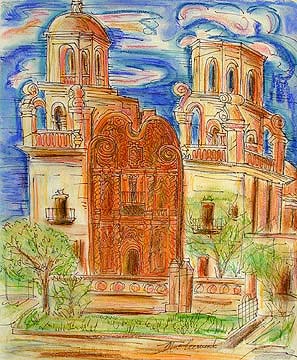
Manhattan-based artist Matt Cervenka studied at the School of Visual Arts and S.U.N.Y. at Farmingdale. Extensive travels in the Southwest, Mexico and Europe have provided inspiration, and Matt has incorporated their cultures in his work. Presently, Matt enjoys working with gouache, pen and ink, acrylic, and mixed media.Austrian Television’s Tema recently aired an interview with Matt, featuring his animal portraits. See Matt’s New York Cityscapes at Portable Muse.
-
15
contention
by Jenny PritchettOne evening at the end of May she stood with one hand holding open
the refrigerator door, staring at the grid of shelves.
“We need more of something,†she said.
He looked up from the stack of essays he was grading. A blossom of
red ink, like the mouth of a geisha, had formed where his lips met.
“What are we out of?†he asked.
“Everything. There’s nothing in here.â€
She hitched her jeans at both hips and squatted, the light from the
refrigerator bulb scalloping her face like a peeled apple. She had lost
the weight from the twins already; he could imagine the jaunt of her hip
cupped in his hand. She stood, gripping puckered plastic bags in both
hands—what had been dill, carrots, basil, now muddy and smearing.
“I was going to do something with these,†she said, holding up the
herbs before tamping them into the top of the garbage pail beneath the
sink. “Waste of money.†She heaved the pail to the back door, leaving
the bag open.
“Not that much money.†He bared his teeth, rapping them with his
pen.
“Still money.†She slid the crisper drawers in with her boot and
swung the door of the refrigerator closed. The condiments rattled in
their jars.
“I don’t feel like cooking tonight,†she said.
“So don’t.†He swung his head back to his stack of essays. It was
unbelievable what the kids expected him to read. He scribbled in a
margin, “Huh??â€
“What do you feel like?†She pulled at the hair at the nape of her
neck. He sat before her at their heavy, all-purpose table, heels hitched
on the rungs of a splintery chair.
“Anything’s fine with me,†he said.
She sucked the inside of her lip, watching her husband. Then she
turned and left the room. He watched the far kitchen wall, listening to
her exit through the plaster and paint, the footsteps, keys, door,
gravel, the smacking shut of the car door. He looked down at his stack
of papers. The sudden silence had mired the words in front of him. He
felt untied and wasn’t certain he was capable of grading tonight. He
imagined himself running through the kitchen to the front hallway,
nabbing his jacket from the hook he’d hammered into the plywood, the
balls of his feet spinning in the gravel as he chased down the car,
panting, leaning in the driver’s side window with his lopsided grin.
“Tony’s,†he would say to her. “My treat.â€
Instead, from the front window, he watched the headlights of their
car bounce into the near-dark, past the McKutcheon’s house next-door and onto the new asphalt four-way at the end of the road that led to town.
He pulled back the curtains she’d made, tiny blueberries he pinned to
the window with the tips of his fingers. It was seven-thirty. The
evening stretched before him like a marathon.
Jenny Pritchett lives and works in San Francisco with her boyfriend,
Sean, and their 140-pound English mastiff. Her fiction has appeared
in Boulevard, and she is working on a collection of short stories,
most of which reference her home state of Illinois.William Diehl lives in Loma Linda, California.
-
Merciless Daylight, Hot into the Night, Summer 2004–by Michelle Tea
 Should have run upstairs to thump on Georgie’s door, I would have seen the note pinned to the wood alerting the world that she’d been selected for the sleep-study and was in seclusion at a medical compound somewhere in the city. Instead I walked the grassy parkway in the warm night, my tattoo radiating heat like a sunburn. The breeze felt like the dry air that rushes out from a baking oven when you lower the door, it didn’t help at all. Only marginally better than the cramped apartment and my pathetic fan whirring its futile breath around the room. I walked the parkway and it was lively with others escaping their sweltering homes, lots of dogs in the grass and beer on the benches. I turned down the cobblestones to UqBar and shoved the swinging doors open.
The stink of old kegs and a century of spilt liquor smacked me in the nose. I understood that to adjust to the cigarette haze hanging like a cloud cover I would be forced to smoke one myself. At least a cigarette would have a filter, you know? UqBar was packed. Not what I expected, but I guess the heat was making everyone nuts, making everyone crave a beer and respite from the terrible warm of their apartments. And if there’d only been the usual four or five people slumped on the bar, UqBar would have been pretty cool, a darkened cave, the walls black, a trough of ice behind the bar. But all the yahoos and their body heat and sweaty t-shirts had ruined it. They were crazy with the relentless summer and were drunk already and dancing, going mad, their bodies’ humidity rising into a human smog that made the air swampy. I was hoping Georgie showed up soon so we could split, maybe plant our asses on the smooth green grass of the parkway and play with other people’s dogs or something.
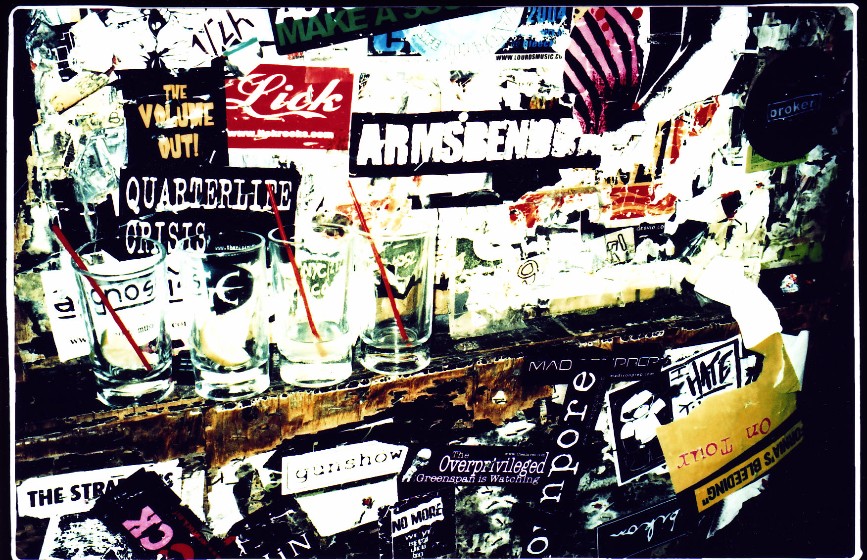
I found a tall stool alongside the wall and got to absentmindedly picking at the band stickers plastered all over the place. The narrow ledge was cluttered with empty cocktail glasses, their little red straws dry and lonely. Willie the bartender looked seriously stressed out, his ruddy Irish face even redder and splotchier with this bad weather and the motion of keeping up with the throngs banging on his counter for their drinks.
Wednesday nights I meet up with Georgie and we drink soda waters Willie throws down for free, fizzing them up as we empty them, plunking a fat wedge of lime into the bubbles. Typically he settles down at the far end of the bar, giving me and Georgie our privacy, and gets to work writing a play based on his dramatic Irish alcoholic family. Wednesday nights are a funny at the UqBar: me and Georgie with our non-drink drinks, a scattering of olde tyme boozers, hard-drinking senior citizens whose cauliflower noses burst with gin blossom bouquets. They resent the bar’s switch from a dank townie sports bar to a hangout for bike messengers and artists with bands on the weekends. They hate change generally and change that affects their drinking in particular, but instead of scuffling over to Dapper’s or Patâ’s for their watery whiskeys they keep an allegiance to a long-past time, their tired asses hugging the busted barstools, getting tanked, glaring at everyone and starting sad little fights on occasion. So there’s us, there’s them, and somewhere in the middle is William, tossing back a shot of something every so-many-pages, never complaining about the utter lack of tips because Wednesday nights leave him alone. No customers to yank him out of the flow of his story, no visits from his dad, both the owner of the establishment and the star of Willie’s play.
I felt bad bothering Willie tonight. He was so hectic, and he hates to work. His orange hair was tugged into a messy ponytail, I was jealous of the teensy breeze it must have created as it swung against his neck. I wanted a water but I didn’t want to hassle him and I didn’t want to get up and lose my seat to a looser. I sniffed at the glasses in the lineup before me. Sniff sniff, the supposed smell-less smell of vodka cut with a juice. Sniff sniff, the sickly sweet stink of gin. The glasses with a bit of syrupy brown pooled at the bottom I ignored, they were obviously whiskey dregs, or rum and cokes. This is my favorite bad game to play with myself. Sniff out an abandoned drink, do my best–my very best–to discern its contents and, sure it’s just a harmless shot of water, toss it back. A sort of Russian roulette, if you will. But I haven’t been wrong yet. As it is an obviously twisted game for a recovering drunk like myself to play, nobody in my life lets me indulge. Like a teenage girl hiding out in her bathroom with a razor, I do my secret sniffing on the rare occasions I’m alone at a bar. Georgie, wise to the fucked-up customs of my head, even goes so far as to arrive at UqBar fifteen minutes before my arrival, so I’m under her watchful stare the whole night. But I wouldn’t do it around anyone, anyway. It’s a private ritual, like nose-picking but really, really bad for you. Bad for me.
Anyway, Willie must have spotted me with my snout in a glass cause he came swaggering over, pushing through the loaf of people globbed throughout the bar, and sloshed me a nice, clean glass of water. Water bubbling pure, honest bubbles. Water hugging a green jewel of lime. Thanks, Willie I said. He clanked the empty glasses together in his huge paws, knocking the straws to the ground. Fuckin’ Crazy In Here, he bitched. Can’t Keep Up With These People. Where The Fuck They Come From? We looked around at the townies, dudes you’d more likely see throwing darts over at Dapper’s, ladies with badly bleached mops of hair and tiny terry cloth outfits; weekend regulars drinking mid-week beers–quiet indie kids sweating in their black jeans, hairspray melting on their black hairdos. And the old guys, the geezers. It’s too hot for them in here, I motioned to death row, the curve of the bar closest to the door, where they clustered like moody crows. One of them’s gonna kick it someday, I told him. Then what’ll you do? I Got Practice With That Sort Of Thing, Willie shook his ponytail. They’ll Be In Good Hands. Willie clapped me on the shoulder and I flinched. Shit, he drew back his fingers gummy with my tattoo medicine. What’s This? He tried to back up for a look and rear-ended a frat-looking kid in a tight white baseball hat. Whiteheads, me and Monica called them. Monica being my incredibly recent ex-girlfriend but you, being my diary, already know that. The whitehead started honking, like Willie was trying to freak him on the dance floor and make him a fag or something. When Willie pulled himself to his full height, hands filled with glass, the Whitehead realized he was the bartender and got friendly again. Sorry, Bro! Can You Pour Me A Guinness?
Yeah, Willie gave a sharp nod, all the niceness sucked dry from his face. He turned back to me. We’ll Talk About That Later, Right? Holler When Georgie Shows Up, I’ll Bring Ya’s More Water. I watched him squeeze between a thick wall of flesh and disappear.
And then there was Monica. I think she’d been in the corner behind death row since I got there, but a guy who’d been hunched over the bar straightened up, and in the gap between his undershirt and the drooled-upon bar below, I saw her there and in that instant she saw me. I felt a rush of hot and cold badness, I think it was anxiety, anxiety and anger, like what the fuck was she doing in my bar, she knows me and Georgie hang out here every Wednesday, were we going to have to do that stupid fucking thing where you negotiate where and when we can and can’t go to the various bars and coffeehouses that make up our lives? I’d thought we could do better then that, thought that common sense and basic kindness would keep her out of my few regular haunts and there she was, her intensely curly hair pulled into a knot on the top of her head, sweat shining the makeup from her face. And I felt a plain swell of sadness and simple fear. The first few days of a breakup are crucial alone days. The risk of getting back together out of basic fear, neediness and habit are strong and it was my plan to avoid Monica until I was stronger then all my most pathetic inclinations.
That’ Water, I Hope? She was there before me, being little and wily and able to slink and shove her way through a crowd with relative grace. And I said, Yeah, Of Course and was annoyed that she’d think I’d be so dramatic as to get drunk over her when I was the one that ended the whole thing. I didn’t need her mothering me or framing me as some fragile alcoholic. I wondered if she’d seen me sniffing the glasses earlier. Her fingernails were painted with elaborate leopard landscapes, pink and red leopard. The tiny rhinestone on her longest pinky-nail flashed and I remembered the balls of soggy cotton she’d leave around my apartment, stinking like poison and nail polish melted into the fiber, and I felt a wash of regret. I’ll never see those cotton balls again. Unless I find one, weeks from now, under the sink in the bathroom, behind the toilet, and am made unbearably sad by it. But this is what I wanted, right? Something to feel, some sort of life, even the life of a miserable and heartsick fuckup.
Why are you here? I asked her. I know I was pouting or talking in a fight-starting voice but I couldn’t help it. It was so loud at UqBar. Willie was blaring some awful CD, real slit-your-wrist tunes, depressing Radiohead or something. The mournful keens filled the bar and still the drunk girls on the stage danced,a s if to some Britney Spears track on endless repeat in their heads. Why was Willie playing such bleak music? It was like we were all in some indie film about grim alcoholic drama and this was the soundtrack.
I Came With Tracy, Monica said, and I looked but the old drunk had resumed his face-first plunge into the bar, blocking my view. Why Are You Here? Well, I’m not drinking, I snapped defensively. I’m waiting for Georgie, like always.
Georgieâ’s Gone, she told me. Georgie’s Doing a Sleep Study, She’ll be Gone All Week. How do you know? I asked. I was sounding more and more like a child, but it was a downhill movement that I couldn’t quite stop. I don’t want to talk to you when you’re drunk, I told Monica, even though I did rather like her when she was drunk. She got extra silly and tended to take her clothes off in public. Well, Talk To Me Now, Then, she said, tinkling her glass. Before I Get Drunk. By the toxic green of her glass and the sweet and sour odor emanating from the rim I guessed it was a Midori melonball. A Midori melonball, I scoffed. This was stupid, this was terrible. This was why we’d broken up–a whole lot of numbness punctuated by useless bickering. Tracy’s Drinking Irish Car Bombs, she snarked, If That’s More Real For You.
Listen, I said, how did you find out Georgie’s gone, and who’s watching the bees? Georgie made part of her money renting out her body to various medical studies, and she made the other part by embarking upon short-lived entrepreneurial experiments. Currently she is keeping a hive of bees in the backyard, in hopes of starting a honey dynasty. I’m Watching Them, Monica said. Why you? I felt totally betrayed. Georgie takes off to some sleep torture and recruits Monica to baby the bees? So that means you’re going to be at the apartment all the time?
Not Yours, she said. We Won’t Have To See Each Other.
You’ll be in the yard, I accused. I’ll totally see you.
Pull The Blinds, she shrugged. Don’t Look Out The Window.
I’ll know you’re there, I said. Don’t act like it’s not a big deal.
Georgie Asked Me. Now she was whining.
I can do it, I said. It’s my fucking yard. Why don’t I just do it.
Because You Hate It, Monica said. You Hate The Bees. You’re Scared Of The Bees.
It is true that the bees stung me repeatedly last time I tried to care for them, when Georgie had gone in for a speed study, totally ruining her so-called sobriety by having medical technicians administer government-issue crystal meth straight into her veins. It is true that I almost killed the bees, much as Georgie almost killed herself, submitting to such a jackass experiment. There Was A Fifty Percent Chance That I’d Just Get The Placebo, she’d rationed. Georgie’s Russian roulette. A whole lot dumber then mine, if you asked me. But Monica, it’s true, Monica loved the bees. She was fucking Snow White with them, they buzzed around her like she was their one true queen, they let her pet the fuzz of their backs with her littlest finger.
I Don’t Know Why Georgie Didn’t Tell You, Monica went on. When Did You Last Talk To Her? And I thought and I thought and I realized that I hadn’t talked to Georgie all week. Even our usual Wednesday the week before had been cut short. Hmph, I snorted.
What’s This? Monica said, her voice a rush of alarm and surprise. I Got A Tattoo, I said proudly. Life goes on, right? Here I am, freshly tattooed, part of the flow of life itself, giving myself a little hurt, just a human, hurting. I smiled.
I Thought You’re Broke, Monica accused. She squinted at it. “Joy and Monstrosity.” She paused. That’s From That Song. You Got A Tattoo Of The Song We Broke Up To. And You Have No Money.
I quit therapy, I explained. It was my therapy money. The tattooist gave me a deal. Timotha? You know her?
Monica was staring. She took a hard suck on her straw and swallowed. Her leopard nails tapped the glasses in swift little taps. You Think That’s Smart? Quitting Therapy? Quitting Therapy? Breaking Up Like This? She swallowed hard again even though her mouth was opened. She swallowed like she was going trying to swallow her very throat turn it inside-out like a crazy magician’s trick. Are You Sabotaging Your Life, Annabella?
I don’t know, I said. I really might be. We stared at each other and I saw a moat of tears flooding up behind her eye makeup and I grabbed her wrist. She clutched her drink harder and shook me off.
Jesus, I don’t want your fucking drink! I yelled. Probably I did want her drink, but that’s not why I grabbed her wrist. I grabbed her wrist to say, you don’t want to cry here, you don’t want to cry in front of me, go back to Tracy. I didn’t grab it because I’m some sort of booze fiend with no self-control. I got a sickening flash of Monica talking to someone–her next girlfriend, maybe a boyfriend, maybe just someone we both knew together, saying, “Oh yeah Annabella is such an alcoholic, it’s really intense, it was so hard to be with her . . . you didn’t know? No, she has no control, it was really, really difficult.” And the new girlfriend or maybe boyfriend would hug her tight and smooth her wild curls and they would all feel safe in their lack of alcoholism, or our mutual friend would cluck and say that’s awful and the pity would slosh back and forth between them.
You Are Such An Asshole, Monica said.
This makes it easier, I said. Just hate me, then. Sure. Then there can be a bad guy, I’ll be the bad guy. And my alcoholism can be the reason and now you’ve got a whole little story to tell everyone about why we broke up. To tell yourself. Good-bye. I slurped my water. The carbonation felt violent, seared my throat, made me choke a little. Made my eyes tear up. I waved my hand. Really, I said. Go back to Tracy. You left her in the corner forever ago. This is stupid. I’m outta here. I felt dumb for having used the phrase “outta hereâ” but really I was shaking.
You Got A Tattoo Of The Last Song We Had Sex To, Monica said.
I know, it looks really bad, I said.
You Mean It Seems Crazy? she asked.
I nodded. Yeah.
Because It Looks Really Beautiful. But It Seems Really Fucked Up.
I left the bar. I slammed and shoved my way past Monica and into the mix of people. The bad sad music howled and the drunks chattered and I chucked the swinging door out into Boston and the hot hot air hit me in the face. I had nowhere to go, so I went home.
Should have run upstairs to thump on Georgie’s door, I would have seen the note pinned to the wood alerting the world that she’d been selected for the sleep-study and was in seclusion at a medical compound somewhere in the city. Instead I walked the grassy parkway in the warm night, my tattoo radiating heat like a sunburn. The breeze felt like the dry air that rushes out from a baking oven when you lower the door, it didn’t help at all. Only marginally better than the cramped apartment and my pathetic fan whirring its futile breath around the room. I walked the parkway and it was lively with others escaping their sweltering homes, lots of dogs in the grass and beer on the benches. I turned down the cobblestones to UqBar and shoved the swinging doors open.
The stink of old kegs and a century of spilt liquor smacked me in the nose. I understood that to adjust to the cigarette haze hanging like a cloud cover I would be forced to smoke one myself. At least a cigarette would have a filter, you know? UqBar was packed. Not what I expected, but I guess the heat was making everyone nuts, making everyone crave a beer and respite from the terrible warm of their apartments. And if there’d only been the usual four or five people slumped on the bar, UqBar would have been pretty cool, a darkened cave, the walls black, a trough of ice behind the bar. But all the yahoos and their body heat and sweaty t-shirts had ruined it. They were crazy with the relentless summer and were drunk already and dancing, going mad, their bodies’ humidity rising into a human smog that made the air swampy. I was hoping Georgie showed up soon so we could split, maybe plant our asses on the smooth green grass of the parkway and play with other people’s dogs or something.
I found a tall stool alongside the wall and got to absentmindedly picking at the band stickers plastered all over the place. The narrow ledge was cluttered with empty cocktail glasses, their little red straws dry and lonely. Willie the bartender looked seriously stressed out, his ruddy Irish face even redder and splotchier with this bad weather and the motion of keeping up with the throngs banging on his counter for their drinks.
Wednesday nights I meet up with Georgie and we drink soda waters Willie throws down for free, fizzing them up as we empty them, plunking a fat wedge of lime into the bubbles. Typically he settles down at the far end of the bar, giving me and Georgie our privacy, and gets to work writing a play based on his dramatic Irish alcoholic family. Wednesday nights are a funny at the UqBar: me and Georgie with our non-drink drinks, a scattering of olde tyme boozers, hard-drinking senior citizens whose cauliflower noses burst with gin blossom bouquets. They resent the bar’s switch from a dank townie sports bar to a hangout for bike messengers and artists with bands on the weekends. They hate change generally and change that affects their drinking in particular, but instead of scuffling over to Dapper’s or Patâ’s for their watery whiskeys they keep an allegiance to a long-past time, their tired asses hugging the busted barstools, getting tanked, glaring at everyone and starting sad little fights on occasion. So there’s us, there’s them, and somewhere in the middle is William, tossing back a shot of something every so-many-pages, never complaining about the utter lack of tips because Wednesday nights leave him alone. No customers to yank him out of the flow of his story, no visits from his dad, both the owner of the establishment and the star of Willie’s play.
I felt bad bothering Willie tonight. He was so hectic, and he hates to work. His orange hair was tugged into a messy ponytail, I was jealous of the teensy breeze it must have created as it swung against his neck. I wanted a water but I didn’t want to hassle him and I didn’t want to get up and lose my seat to a looser. I sniffed at the glasses in the lineup before me. Sniff sniff, the supposed smell-less smell of vodka cut with a juice. Sniff sniff, the sickly sweet stink of gin. The glasses with a bit of syrupy brown pooled at the bottom I ignored, they were obviously whiskey dregs, or rum and cokes. This is my favorite bad game to play with myself. Sniff out an abandoned drink, do my best–my very best–to discern its contents and, sure it’s just a harmless shot of water, toss it back. A sort of Russian roulette, if you will. But I haven’t been wrong yet. As it is an obviously twisted game for a recovering drunk like myself to play, nobody in my life lets me indulge. Like a teenage girl hiding out in her bathroom with a razor, I do my secret sniffing on the rare occasions I’m alone at a bar. Georgie, wise to the fucked-up customs of my head, even goes so far as to arrive at UqBar fifteen minutes before my arrival, so I’m under her watchful stare the whole night. But I wouldn’t do it around anyone, anyway. It’s a private ritual, like nose-picking but really, really bad for you. Bad for me.
Anyway, Willie must have spotted me with my snout in a glass cause he came swaggering over, pushing through the loaf of people globbed throughout the bar, and sloshed me a nice, clean glass of water. Water bubbling pure, honest bubbles. Water hugging a green jewel of lime. Thanks, Willie I said. He clanked the empty glasses together in his huge paws, knocking the straws to the ground. Fuckin’ Crazy In Here, he bitched. Can’t Keep Up With These People. Where The Fuck They Come From? We looked around at the townies, dudes you’d more likely see throwing darts over at Dapper’s, ladies with badly bleached mops of hair and tiny terry cloth outfits; weekend regulars drinking mid-week beers–quiet indie kids sweating in their black jeans, hairspray melting on their black hairdos. And the old guys, the geezers. It’s too hot for them in here, I motioned to death row, the curve of the bar closest to the door, where they clustered like moody crows. One of them’s gonna kick it someday, I told him. Then what’ll you do? I Got Practice With That Sort Of Thing, Willie shook his ponytail. They’ll Be In Good Hands. Willie clapped me on the shoulder and I flinched. Shit, he drew back his fingers gummy with my tattoo medicine. What’s This? He tried to back up for a look and rear-ended a frat-looking kid in a tight white baseball hat. Whiteheads, me and Monica called them. Monica being my incredibly recent ex-girlfriend but you, being my diary, already know that. The whitehead started honking, like Willie was trying to freak him on the dance floor and make him a fag or something. When Willie pulled himself to his full height, hands filled with glass, the Whitehead realized he was the bartender and got friendly again. Sorry, Bro! Can You Pour Me A Guinness?
Yeah, Willie gave a sharp nod, all the niceness sucked dry from his face. He turned back to me. We’ll Talk About That Later, Right? Holler When Georgie Shows Up, I’ll Bring Ya’s More Water. I watched him squeeze between a thick wall of flesh and disappear.
And then there was Monica. I think she’d been in the corner behind death row since I got there, but a guy who’d been hunched over the bar straightened up, and in the gap between his undershirt and the drooled-upon bar below, I saw her there and in that instant she saw me. I felt a rush of hot and cold badness, I think it was anxiety, anxiety and anger, like what the fuck was she doing in my bar, she knows me and Georgie hang out here every Wednesday, were we going to have to do that stupid fucking thing where you negotiate where and when we can and can’t go to the various bars and coffeehouses that make up our lives? I’d thought we could do better then that, thought that common sense and basic kindness would keep her out of my few regular haunts and there she was, her intensely curly hair pulled into a knot on the top of her head, sweat shining the makeup from her face. And I felt a plain swell of sadness and simple fear. The first few days of a breakup are crucial alone days. The risk of getting back together out of basic fear, neediness and habit are strong and it was my plan to avoid Monica until I was stronger then all my most pathetic inclinations.
That’ Water, I Hope? She was there before me, being little and wily and able to slink and shove her way through a crowd with relative grace. And I said, Yeah, Of Course and was annoyed that she’d think I’d be so dramatic as to get drunk over her when I was the one that ended the whole thing. I didn’t need her mothering me or framing me as some fragile alcoholic. I wondered if she’d seen me sniffing the glasses earlier. Her fingernails were painted with elaborate leopard landscapes, pink and red leopard. The tiny rhinestone on her longest pinky-nail flashed and I remembered the balls of soggy cotton she’d leave around my apartment, stinking like poison and nail polish melted into the fiber, and I felt a wash of regret. I’ll never see those cotton balls again. Unless I find one, weeks from now, under the sink in the bathroom, behind the toilet, and am made unbearably sad by it. But this is what I wanted, right? Something to feel, some sort of life, even the life of a miserable and heartsick fuckup.
Why are you here? I asked her. I know I was pouting or talking in a fight-starting voice but I couldn’t help it. It was so loud at UqBar. Willie was blaring some awful CD, real slit-your-wrist tunes, depressing Radiohead or something. The mournful keens filled the bar and still the drunk girls on the stage danced,a s if to some Britney Spears track on endless repeat in their heads. Why was Willie playing such bleak music? It was like we were all in some indie film about grim alcoholic drama and this was the soundtrack.
I Came With Tracy, Monica said, and I looked but the old drunk had resumed his face-first plunge into the bar, blocking my view. Why Are You Here? Well, I’m not drinking, I snapped defensively. I’m waiting for Georgie, like always.
Georgieâ’s Gone, she told me. Georgie’s Doing a Sleep Study, She’ll be Gone All Week. How do you know? I asked. I was sounding more and more like a child, but it was a downhill movement that I couldn’t quite stop. I don’t want to talk to you when you’re drunk, I told Monica, even though I did rather like her when she was drunk. She got extra silly and tended to take her clothes off in public. Well, Talk To Me Now, Then, she said, tinkling her glass. Before I Get Drunk. By the toxic green of her glass and the sweet and sour odor emanating from the rim I guessed it was a Midori melonball. A Midori melonball, I scoffed. This was stupid, this was terrible. This was why we’d broken up–a whole lot of numbness punctuated by useless bickering. Tracy’s Drinking Irish Car Bombs, she snarked, If That’s More Real For You.
Listen, I said, how did you find out Georgie’s gone, and who’s watching the bees? Georgie made part of her money renting out her body to various medical studies, and she made the other part by embarking upon short-lived entrepreneurial experiments. Currently she is keeping a hive of bees in the backyard, in hopes of starting a honey dynasty. I’m Watching Them, Monica said. Why you? I felt totally betrayed. Georgie takes off to some sleep torture and recruits Monica to baby the bees? So that means you’re going to be at the apartment all the time?
Not Yours, she said. We Won’t Have To See Each Other.
You’ll be in the yard, I accused. I’ll totally see you.
Pull The Blinds, she shrugged. Don’t Look Out The Window.
I’ll know you’re there, I said. Don’t act like it’s not a big deal.
Georgie Asked Me. Now she was whining.
I can do it, I said. It’s my fucking yard. Why don’t I just do it.
Because You Hate It, Monica said. You Hate The Bees. You’re Scared Of The Bees.
It is true that the bees stung me repeatedly last time I tried to care for them, when Georgie had gone in for a speed study, totally ruining her so-called sobriety by having medical technicians administer government-issue crystal meth straight into her veins. It is true that I almost killed the bees, much as Georgie almost killed herself, submitting to such a jackass experiment. There Was A Fifty Percent Chance That I’d Just Get The Placebo, she’d rationed. Georgie’s Russian roulette. A whole lot dumber then mine, if you asked me. But Monica, it’s true, Monica loved the bees. She was fucking Snow White with them, they buzzed around her like she was their one true queen, they let her pet the fuzz of their backs with her littlest finger.
I Don’t Know Why Georgie Didn’t Tell You, Monica went on. When Did You Last Talk To Her? And I thought and I thought and I realized that I hadn’t talked to Georgie all week. Even our usual Wednesday the week before had been cut short. Hmph, I snorted.
What’s This? Monica said, her voice a rush of alarm and surprise. I Got A Tattoo, I said proudly. Life goes on, right? Here I am, freshly tattooed, part of the flow of life itself, giving myself a little hurt, just a human, hurting. I smiled.
I Thought You’re Broke, Monica accused. She squinted at it. “Joy and Monstrosity.” She paused. That’s From That Song. You Got A Tattoo Of The Song We Broke Up To. And You Have No Money.
I quit therapy, I explained. It was my therapy money. The tattooist gave me a deal. Timotha? You know her?
Monica was staring. She took a hard suck on her straw and swallowed. Her leopard nails tapped the glasses in swift little taps. You Think That’s Smart? Quitting Therapy? Quitting Therapy? Breaking Up Like This? She swallowed hard again even though her mouth was opened. She swallowed like she was going trying to swallow her very throat turn it inside-out like a crazy magician’s trick. Are You Sabotaging Your Life, Annabella?
I don’t know, I said. I really might be. We stared at each other and I saw a moat of tears flooding up behind her eye makeup and I grabbed her wrist. She clutched her drink harder and shook me off.
Jesus, I don’t want your fucking drink! I yelled. Probably I did want her drink, but that’s not why I grabbed her wrist. I grabbed her wrist to say, you don’t want to cry here, you don’t want to cry in front of me, go back to Tracy. I didn’t grab it because I’m some sort of booze fiend with no self-control. I got a sickening flash of Monica talking to someone–her next girlfriend, maybe a boyfriend, maybe just someone we both knew together, saying, “Oh yeah Annabella is such an alcoholic, it’s really intense, it was so hard to be with her . . . you didn’t know? No, she has no control, it was really, really difficult.” And the new girlfriend or maybe boyfriend would hug her tight and smooth her wild curls and they would all feel safe in their lack of alcoholism, or our mutual friend would cluck and say that’s awful and the pity would slosh back and forth between them.
You Are Such An Asshole, Monica said.
This makes it easier, I said. Just hate me, then. Sure. Then there can be a bad guy, I’ll be the bad guy. And my alcoholism can be the reason and now you’ve got a whole little story to tell everyone about why we broke up. To tell yourself. Good-bye. I slurped my water. The carbonation felt violent, seared my throat, made me choke a little. Made my eyes tear up. I waved my hand. Really, I said. Go back to Tracy. You left her in the corner forever ago. This is stupid. I’m outta here. I felt dumb for having used the phrase “outta hereâ” but really I was shaking.
You Got A Tattoo Of The Last Song We Had Sex To, Monica said.
I know, it looks really bad, I said.
You Mean It Seems Crazy? she asked.
I nodded. Yeah.
Because It Looks Really Beautiful. But It Seems Really Fucked Up.
I left the bar. I slammed and shoved my way past Monica and into the mix of people. The bad sad music howled and the drunks chattered and I chucked the swinging door out into Boston and the hot hot air hit me in the face. I had nowhere to go, so I went home.
Michelle Tea is the author of Valencia, The Chelsea Whistle, Rent Girl, Against Memoir, and many other books. She is the cofounder of the notorious all-girl poetry roadshow Sister Split, and continues to drag herself and other brave performers across the US on grueling performance-art boot camps. Born and raised in Chelsea, Massachusetts, she presently lives in San Francisco with her transboyfriend and their weird cat. Click here to read more of her work and find out about upcoming readings.
Subscribe to get new flash fictions in twice a month in your inbox.
Submit your flash fiction or personal essays to Fiction Attic.
-
Issue 3: Counting Love, by Erin McCluskey

counting love
by erin mccluskyn equals what is left
There was no way to solve for n. They had tried, but the papers had been wrong; an algebraic equation does not always yield the same result in Wisconsin as in California. In his last letter to her he went over the proofs he had done in California and she couldn’t find anything wrong with his math, but in Wisconsin the variable n came out different. She held his letter and his answer for n and knew things would have to end between them. She knew this was emptiness but she couldn’t make herself believe this was 0; the round parallel curves seemed too smug to her. She liked the resignation of 5, the swagger of 7, the lank stance of 1. He is 1, she thought. His thinness never stopped her from wanting more of him.
She knew she would have to write to him. She had found his kidney in the toe of her running shoe and she wanted to know where she should send it to or if he would rather come and get it himself. He was already missing 5 inches of intestine that he had left with his last lover and she thought he would probably want his kidney returned. When they met he told her about the missing intestine and the 2.4 grams of skin tissue gone from his thigh and the piece of rib and he asked her if she would fix him, make him whole. She was always breaking the ends of pencils and the edges of her fingernails, so she told him she couldn’t help. She thought that would be the end of him. But he sent her lists of square roots and radicals and mixed fractions and she started to bend to him. He stood outside her apartment and recited finite equations up to her window, and after a while she let him come inside, sit at her table and talk.
He told her about how he died for the first time. He fell in love with a beautiful accountant who would have nothing to do with him and his imaginary numbers. He begged and pleaded for the accountant’s love but the accountant would not have him. The accountant wanted numbers to be real, to be whole, and divisible by 2 if at all possible. Over coffee, the accountant told him their love would never make sense, that there was no sense in their going on like this. The accountant got up from the table to leave and he, in a fit of desperation, grabbed onto the accountant’s bag. He and the accountant struggled over the bag, the accountant finally yanking it from his hands. The accountant’s payroll book slid out of the bag and fell open on the ground. The shock of seeing the perfect whole numbers written neatly in rows and columns in the accountant’s even hand killed him instantly. The accountant felt bad about killing him and brought him back to life but still refused to see him. He left California and moved to Wisconsin because, he said, when you die once you want to die again.
In Wisconsin he gave 5 inches of his intestines to a nun who prayed to St. Erasmus. The saint was martyred because he spoke too often of a theory that was a loose thread which, if tugged, would unravel everything that passed for the fabric of reality. The nun who prayed to St. Erasmus believed in the saint’s brilliance and directed her prayers to an image of him next to a ship’s windlass. St. Erasmus had escaped from persecution on a ship sailed by angels and, when they saw him depicted next to the windlass, his believers thought he had been martyred by having his intestines wound like the ship’s rope around the windlass. The nun who prayed to St. Erasmus believed that St. Erasmus had come back for her and that, to maintain the image of sainthood, he imitated the saint’s wounds and pulled out 5 inches of his intestines and wound them around a spool for the nun. The nun begged him to leave her and to carry his thread into the world. So he left the convent and the nun had the 5 inches of his intestine wound on a spool placed in a reliquary.
He told her that prayers to St. Erasmus will ease abdominal pain and he said that he always thought love would be like the loops of paper that his mother taught him to twist once and tape together at the ends. He could trace the entire circuit of the paper with his pencil and the line would travel inside and outside the paper curves. His mother said that this was infinity: the ability to draw a line and not stop.
The stories he told sitting at her table were like this. She didn’t need to say anything. She listened carefully and sat with him while he talked. When he was done he stopped talking and she pulled out a pad of legal paper, yellow with red lines, and they worked on proofs, silently, until they were tired. She didn’t regret bringing him into her life as long as he did not ask her a second time to fix him, to make him whole.
There was an evening when he sat down and told her that he had to leave because he did not think he would die in Wisconsin. He told her about his room in California with a bed and a 75-gallon fish tank for his two carniverous fish. He shared sushi with his fish; he ate the rice and nori and they ate the flying fish roe. He asked her to keep the things from his room in Wisconsin; there was a bed and a one-eyed toad in a jar and a one-eyed python in Tupperware under the sink. After he left, he started to send her proofs, he didn’t write about his past loves and what he had lost, the things he talked about when they sat together at her table; he only wrote numbers and variables. She went over his equations carefully and sent him new proofs and corrections. She bought a pink-toed tarantula because she started to miss him. The tarantula had two eyes and the python slid into a funk because he was envious.
He sent her a telegram like they did to announce a death in the Civil War and it said,
I always wanted STOP love to be STOP something I could keep STOPbut love is STOP nothing but water and stars STOP n equals what is left STOP (more…)
-
More Lies–flash fiction by Gloria Frym

Rumor has it, this woman goes through dogs. Some women go through husbands, some men go through women, some kids go through clothes, ballerinas go through toe shoes, spendthrifts go through money, overeaters go through cookies. And so forth. But this woman, this is her sixth dog in a short time. Longer, of course if you count it in dog years.
The porch gossips say, and who knows if they can be trusted, who really knows what’s what, that she might have a disease. You know the kind they feature on a 60 Minutes or “ER.” The kind that glues people to the TV because they’re horrified and compelled like they’d be at a bloody accident or a building on fire. So long as it’s not them or theirs.
Dog #1 died suddenly.
Dog #2 died suddenly after a brief illness.
Dog #3 died slowly after a slow illness and many vet visits.
Dog #4 died some way, no one remembers.
Dog #5 rolled over and died.
Dog #6 is okay now but was sick as a small puppy.The gossips are crossing their fingers. After all they live in the same vicinity. The woman says the veterinarian says that there’s something toxic in the soil in her backyard. What if there’s something toxic in all their backyards? What if her house and their houses were built over old gas stations or car repair shops? It’s hard to believe that this woman would ever let her dogs out in her backyard. Dog #6 she carries in a baby front pack because he is very little. He’s not going to get much bigger, either. But now, she says, he’s better, and she lets him move around on a leash. In fact, she walks him. So, say the gossips, and she probably never puts him outside alone. That’s why they’re suspicious.
It could be that this woman simply has bad luck with pets.
It could be that this woman makes her pets ill so she can nurse them, right up to their death.
She has no children and no husband.
The gossips say, Thank God for that.
It is very hard, given the circumstantial evidence, when one is told of such events, not to believe them. They sound so plausible, even if there is no proof. Why do they appeal to one’s instincts rather than one’s reason? Juicy bits of information about a woman who is rather nervous and neurotic, who strolls down the street with a different dog every year or so.
Goes to great lengths, far away places to buy the dogs, after long email conversations with their breeders. Always a pure-bred dog. Always from out of state. The facts start to pile up, right? Something, if one had nothing else to do, one could take to a private investigator. He’d solve it, all right.
Can you go to jail for murdering a dog? It’s a misdemeanor. The law considers dogs “chattel.” But you remember that guy who threw a dog off the freeway? That was cruelty. That got him jail time. How about murdering someone else’s dog? That would also get you jail time.
Somewhere there is something called an Animal Patrol. Not like they take animals to the pound, but they remove abused pets from homes. Kind of like Child Protective Custody Services.
Yesterday, I lied.
A good lie, told spontaneously, is a piece of art, though it makes person like me guilty. It could be addictive. It worked that well.
It all started after I’d heard about the woman with the succession of dogs.
The car wouldn’t start. The battery dead, again.The operator at triple A says, 45 minutes.
Forty five minutes, I say, oh no! I have to pick up a child!
From school or from daycare? the operator asks.
From daycare. If you’re late, they just take the kid to Child Protective Custody Services.
Oh my God, the operator says, greatly alarmed. Is that what they do these days?
Oh yes, I say, they just don’t want to wait.
In two minutes, a tow truck arrived.
So your little car won’t start, hon?
Yeah, it’s always the battery.
He did his jumping magic with great dispatch.
When I thanked him for arriving on the scene so quickly, he said, Oh, you deserve even faster service.
How could it be faster, I thought?
Of course, he said, What you deserve and what you get are two different things in this world.
Yeah, I know I said. I mean I was just laid off, I lied again.
You in the tech biz?
No, I’m a school teacher.
A teacher! For Christ’s sake, the bastards. It will come back to them. Some kid will kill a dog because nobody taught him the right way to behave.
This piece was originally published in 2005.
Gloria Frym is the author of How Proust Ruined My Life and Other Essays (2020), The True Patriot (2015), How I Learned (1992), Distance No Object (2001), and several other volumes of poetry and prose, including By Ear, Back to Forth, Impossible Affection, and Homeless at Home. She is also the author of a book of interviews, Second Stories: Conversations with Women Artists. Since 1987, she has been a member of the core faculty of the Poetics Program at New College in San Francisco. She also teaches in the MFA Program in Writing at California College of the Arts.
Subscribe to get new flash fictions in twice a month in your inbox.
Submit your flash fiction or personal essays to Fiction Attic.
-
Okay, a Cake Then! by Jiri Kajane
translated by Kevin Phelan & Bill U’Ren
It’s late at night and I’m alone when the word reaches me that Edmond Spaho has died. For some reason, it’s news that I need to share, so I pull on a coat, lock the door, and begin the walk over to my friend Leni’s top floor apartment. He lives at the far end of the city, across the boulevard, through the park, and past the university. Although it is quite cold outside, I look forward to the long walk, the chance to breathe in the crisp night air and the opportunity to escape the oppressive walls of this empty apartment.
Preoccupied with my work at the Ministry of Slogans, I haven’t seen Leni in a good while. It has been nearly three weeks since we met at Selman Kratka’s place to toast my fortieth birthday. Against my vague protests, Leni had invited a few mutual friends, as well as some colleagues from the Ministry. It was a rather enjoyable party, although I found myself somewhat distracted by thoughts of my ex-wife Ana and how strange it was to be celebrating another birthday without her.
I head up the back stairs to Leni’s flat and knock lightly, peeking through the brown window. A rumbling sound arises from the other side of the apartment, a light appears, and then Leni emerges, his face a little distorted through the warped glass.
“Ah,” he says, motioning me in.
“Did I wake you?”
“I don’t know,” he mumbles, rubbing his eyes. “I guess.”
“I’m sorry. We can talk tomorrow.”
“No, no, it’s fine,” he insists, lighting the burner on the stove.
“Cocoa?”“Yes, please.”
We sit at the kitchen table for a while, both quietly sipping our drinks, warming up, vaguely watching the empty courtyard below. Leni casually relates his most recent efforts to further a relationship with this girl, Kosi. She seems to like him, although I suspect she’s afraid of any commitment. For weeks now Kosi has spurned his invitations, instead requiring that each of their meetings happen only by chance—no plans allowed. As a result, Leni and I have spent a lot of time devising new ways for him to circumvent this required atmosphere of happenstance. Recently, however, we’ve been running short on ideas.
“I feel like she’s figured me out,” he says.
“How so?”
“I’ve been watching the downtown area, as we discussed, and sometimes even loitering around the museum, trying to casually run into her.”
“And this hasn’t worked?”
“A couple of times, yes. But mostly, no.”
“Oh,” I say, unable to come up with the right words to allay his frustration. Then, silence. Finally, as if the thought has just occurred to him, Leni declares that we now must formulate a brand new plan, something ingenious and foolproof.
“Yes!” I agree. “At once!”
“So be it!” Leni shouts. But then, despite our seemingly dynamic and industrious exclamations, we simply sit there speechless, continuing to think. Action, apparently, cannot be taken just yet.
Although I’ve personally met Kosi only twice, I can safely say that she is a bit of an odd girl. In my mind, I quickly conclude that any new plan has to be something of equal peculiarity, something that would make her embrace fully this concept of fate, and subsequently realize that, indeed, she and Leni were meant to be together. Perhaps not forever, but at least for now.
“She works in the Italian Embassy,” Leni says, brightening.
“So you’ve told me.”
“There should be something we could do with that, don’t you think?”
“Yes, of course,” I say. “Perhaps you could take a crash course in Italian and then disguise yourself as a businessman from Milan visiting for the first time. A requisition can be made for a tour guide from the Embassy, someone young enough to understand the youth market here. You will be the young fashion consultant trying to capitalize, and Kosi will be your escort! As time goes on, she’ll slowly fall in love with you, and then, when it’s too late, you can remove the disguise and show her that she’s actually fallen for Leni.”
“Perfect. That will be Plan A,” he says.
“Agreed!” I laugh, trying to picture him as an exotic clothier, slyly donning a thin brown moustache and a generous supply of powder to make his skin appear more Mediterranean. Yet somehow, this vision is too difficult to conjure up, and in the end all I can see is Leni looking like himself, only slightly darker.
“Or what if I were to get a second job, perhaps as a guard at the Embassy,” he says.
“Yes, good one. Of course, you would have to pass a marksmen’s test, and then maybe demonstrate some abilities in martial arts. Not so hard.”
“Plan B,” Leni exclaims.
He looks at me for a moment, awaiting a response.
“Yes, Plan B,” I say. “These are both brilliant.”
Maybe fifteen seconds go by before we both falter in our attempts to maintain a tone of seriousness, a tone of solemnity—as if real problems can be solved only when approached with a somber, perhaps even grave, disposition. Leni smiles lightly, nearly a sigh of relief, and I cannot help but grin in return. Unfortunately, the levity quickly fades and the room’s subsequent silence becomes far too distracting, temporarily delaying new plans to fool Kosi. We sit there for a moment, staring out at the courtyard and then back at our empty mugs.
“More?” he asks. “I stole a canister from the hotel.”
“Sure.”
He fiddles with the broken gas knob on the broiler, then places a small saucepan full of milk atop the burner, a blue flame kicking up as it touches the metal. Clearly, neither of us desires the actual cocoa as much as the heat which will be generated in the process. After that, it’s quiet again, Leni casually stirring the milk, me staring off into space. I like this about him. Obviously, I’d come over to his house to discuss something specific—Why else would I appear so late and unannounced?—and yet still, he feels no need to pressure it out of me.
“So,” I finally say, “Edmond Spaho has died.”
“Really?”
“Yes, a few weeks back.”
“Where did you hear this? From Ana?” he asks, still moving the fat wooden spoon around in the milk. Perhaps, this sounds like a strange first question. Anyone else would probably ask, “How did he die? When? Where?” Not Leni, though. He knew the story well. He knew that whenever Edmond came up, we were really speaking of Ana and me, and so, plainly, his first question was the logical one.
“No, unfortunately. I was talking to my cousin. Remember Arti?”
“The smelly one with the goatee beard?”
“He called for a favor—his nephew has applied to the Ministry—and he simply mentioned it in passing. ‘Spaho’s body has finally washed ashore,’ he said. ‘What!’ I said, not believing him, ‘Spaho is dead? Edmond Spaho?’ ‘Yes,’ Arti answered, almost annoyed. ‘Didn’t you know.’”
“Such an awful way to find out,” Leni says, bringing the cocoa over to the table.
“I know. Typical Arti.”
“How did it happen?”
“Nobody’s sure. Supposedly a fishing accident, although that sounds unlikely. His boat was still docked at Fierze, nets up.”
“Strange,” Leni says, handing me a jar of whipped cream—Property of the Hotel Dajti stamped along the side.
“Yes. But remember that letter I got a few months ago? Edmond rambled on about the past, covering everything in such detail that you’d think it had all happened the day before. Yet his wife’s been gone ten years now, and his son almost five.”
“Yes—since the Butrinti,” Leni absent-mindedly mumbles, leaning back in his chair.
“Suicide then?”“Probably. I’m really not sure—perhaps it doesn’t even matter. Edmond was so unhappy. At least now, his misery is over. But it still seems surprising.”
“Well, he was a young man,” Leni says, then quickly laughs at his unintended meaning. At my recent birthday party, we’d disagreed as to whether this milestone of forty was an official sign that my youth had passed. Edmond and I were the same age.
“Not so young,” I respond, smiling.
Leni drops another dollop of whipped cream into his cocoa, spilling a little down the side. It slowly drips to the table, leaving behind a snail-like trail on his mug.
“On the walk over here, I thought it was Edmond’s predicament that made me unhappy. Now, I’m wondering if it is simply my own.”
Leni looks up with a puzzled expression.
“I guess I’m talking about Ana,” I say, continuing. “How strange, yes? And embarrassing, too. Edmond is dead, and my thoughts turn to Ana, or, even worse, to myself.”
“Well…” Leni mumbles.
“You know, when Ana and I first met on that train ride, I was on my way to visit Edmond Spaho.”
Leni nods, like always, and it’s as if he too had been on this train ride twenty years earlier, as if his stake here is equal to mine. Whenever I tell this story, I feel like, just for a second, that if we imagine it hard enough, the two of us might be able to recreate that day, recreate the whole scene, and change something along the way—slightly altering the future so that I still might be with Ana. At times I think maybe I should have played hard to get, or maybe we shouldn’t have eaten in the station together, maybe I should just have gotten her telephone number and met Edmond as planned. Any little thing could have made a difference. It’s hard to know whether something that has happened in the past is important or marginal. How can you tell the difference? How can you assign responsibility? Perhaps something as simple as the way I held my salt shaker or the way I opened the door for her led me to where I am now.”She was coming back from Isa Drumberi’s.”
“Of course,” he says. “Isa, Ana’s best friend.”
“Hard to believe it’s been three years since she died,” I say, remembering the moment Ana told me the news.
“That’s right,” Leni nods, having mentally verified my calculations.
“I guess I’m just picturing that train ride again. First, Isa, and now Edmond—the two destinations. And, of course, in the middle, Ana herself wants nothing to do with me. I’m just wondering now that everyone involved has disappeared, does the event itself disappear, too? If all the pieces to a puzzle are missing, is it still a puzzle?”
“I don’t know,” Leni says, obviously thinking. “Who’s to say? Then again, if I—Leni, an outsider—know the story, it must be real, right?”
“Yes, yes,” I immediately reply, chuckling at the thought of a conversation we’d recently had about his great-uncle Bardhyl. The uncle, in his old age, Leni claimed, had been convinced that he would not die until the stories about him faded. So, hoping for a longer life, he began weaving lengthy, sordid tales about the things he’d done. At first, Leni said the family found it amusing, almost entertaining, but then time ran on and the stories became decidedly less interesting. Soon, everyone tired of this strange obsession; friends stopped calling, and neighbors refused to visit. Fortunately it was not long after that he died—reportedly in the middle of some story about a pony he’d briefly owned as a child. Leni and I agreed that it was all a nice idea though.
“Well,” Leni mumbles, huddling over the stove, warming his hands, “I suppose we’re finally done with the cocoa.”
“Yes. I couldn’t drink another mug.”
“That’s what I thought,” he says, resignation in his voice. It’s not that I’ve offended him, that the cocoa isn’t good enough to merit a fourth cup, but rather, just the idea that the oven will no longer be in use, making it hard for our conversation to continue. Without heat at this time of night, Leni’s kitchen can become unbearably cold in an instant. Yet, we cannot simply leave the oven burning; it’s hard to rationalize using the expensive fuel for mere conversation.
“Well, I suppose I should head home,” I say.
“No, stay,” Leni urges, rising, “let’s make a cake.”
“What?”
“I’ve got recipes here from the hotel. Why not? I’ve been wanting to make one for weeks now.”
“Okay,” I offer, surprising myself. “A cake, then!”
Leni turns the oven up a notch, opens the pantry and removes four grey cartons and a notebook teeming with papers. “Citrus cake, fig cake, sponge, pound, chocolate leaf,” he reads aloud.
“Sponge cake.”
“That does sound good,” Leni responds, pulling a mixing bowl and steel measuring cups out from under the sink.
I casually rummage through the cabinets and pull down the required ingredients. “You know,” I say, returning to our previous conversation, “during the first year after Ana left, I continued on, almost controlled by this need to somehow fix our relationship, to recapture that amazing feeling of our first day on that train.”
“You thought that it would solve your problems—put you back together,” Leni adds, cracking an egg into the mixing bowl.
“Yes. As Dr. Viseri used to say, ‘You’re born, you come out, and then you spend the rest of your life trying to get back in.’ For me, I suppose, it’s the same with Ana. I squandered so much of our time simply trying to renew that original feeling. It was such a waste!”
Leni nods, smiling slightly to put me at ease. “Kosi says this strange thing trying to explain why she is the way she is. The courtship, she tells me, will never last longer than the mystery and curiosity. Not even one moment.”
“Yes, and I am proof,” I laugh, measuring out a small spoonful of vanilla extract.
Leni is due for work at the hotel in a few hours, and yet he doesn’t appear worried about getting back to sleep. “Do you believe that? Do you believe that it’s over when the mystery ends?”“Well,” I hedge, trying to remain optimistic.
“I’m not sure either,” he offers. “Kosi says a lot of crazy things.”
It’s hard to hide my confusion about this theory. Yet, I know any uncertainty should remain concealed. For Leni’s sake, it’s my duty to inform him that Kosi is wrong, that closeness is, in fact, a key ingredient to successful relationships, that you must know everything about each other—needs, wants, desires—before you can truly be together. It’s what he wants to hear, what he believes—it’s what I believed too for all those years with Ana. Yes, I must explain how this need for mystery and curiosity is merely some misguided idea on Kosi’s part, and that it will certainly pass. Yet, how am I, of all people, able to judge whether or not this is true? And secretly, I’m wondering if Kosi might be a little wiser than I had originally ascertained—even if such a conclusion means I have a better chance with some stranger standing on a street corner than I do with Ana.
“Is that what’s coming between you two?” I say, handing him the whisk. “Is this why she won’t see you like a normal person?”
“I suppose,” he offers, almost resigned.
“Well, maybe that’s a good thing,” I mumble, glancing out the window toward the courtyard. The sky looks so familiar to me at this strange hour. I am reminded of all those late nights following my promotion to the Ministry of Slogans. In the years before that, while working for Hansa at the Ministry of Symbols, I’d thought the elevation in status and responsibility was something I wanted, but when it finally happened, I became anxious and troubled all the time. At night, it got even worse. While Ana retired to our bedroom for sleep, I retired to my study to work, often keeping the candles burning for hours, plagued with worry. Soon, I got no sleep at all. Grey halfmoons appeared under my eyes. My complexion became a pale gloss, curiously resembling those small wax Hoxha figures that once adorned the Palace of Culture.
“I’d never dreamed you would be like this,” Ana confessed one morning as she found me propped at my desk, hopelessly awake, melted candlewax spread about. “After all, this isn’t the way Deputy Ministers are supposed to act.”
“I’m new at this. And for all we know, perhaps it is. Certainly, it wouldn’t surprise me to learn that every high-ranking official in the city lies awake at night. How could they not?”
“Because they have confidence and poise, something leaders are supposed to have.”
“I’m not exactly a leader.”Ana frowned and poured us each some coffee. I stared at the mug for a moment before pouring in some sugar and gulping it down.
“I don’t want to belabor the issue,” she said, “but how can you expect me to sit back and not say anything? You’re up when I’m asleep, and you’re up when I’m awake.”
“Right. So you get to see me more often,” I said, forcing a laugh, trying to ease the conversation.
“Yes, normally this would be good. A great difference from your position with Hansa, when you were busy all the time, when you had to fit me into your schedule. But now you are not the same person. While I see you more often, it is not actually you that I am seeing. You’ve changed.”
“Change is good I thought.”
“I’d rather see you the old way instead of this. You’re awake, but too tired to do anything except be awake.”
It was true. I’d lost interest in nearly everything but the job, my new position as the Deputy Minister of Slogans. Fear of failure, fear of not making a great impression on everyone, had consumed me. Everything else was pushed to the side—my health, my friends, my sense of humor, and Ana. It wasn’t until the season changed, sometime after Skenderbëg Square was covered in frost, that I finally was able to balance the new job with my old life, my old self. I’d finally secured the confidence of the key dignitaries, the other Ministers, my staff. In fact, I’d probably had their confidence all along, but how was I to know? Unfortunately, in the process of discovering this, I seemed to have lost a piece of Ana’s confidence, and maybe even some of my own. Or perhaps that’s not it at all—perhaps I simply allowed her to see a side of me that she did not like.
Inside at Leni’s, the faint, sweet smell of cake slowly drifts around the room and around our conversation. Outside, the streetlights remain off, leaving only the moon to illuminate the dingy apartment buildings and the small cement square that they surround. As the wind begins to gust, I can detect outlines of the different items hanging from Mrs. Dronka’s clothesline. Pants, shirts, towels, blankets, underwear. None seem to even bend in the breeze, apparently frozen stiff by the winter air. Closing my eyes, I can almost imagine her walking outside each morning to check if they’re dry, and then quietly walking back inside, disappointed. Spring is nearly four months away.
I watch while Leni mixes the creme topping, whipping it loudly and feverishly, as if there’s a time limit. Then he dips his index finger in for a taste, nods, and dumps the concoction into a separate tin. “Want to lick the spatula?”
“Thanks,” I say, leaning over the sink with it. When I’m done, I wash the pans and measuring cups. Behind me, Leni laughs.
“What?” I ask.
“Oh nothing,” he laughs again. “I was just thinking about you and Ana on that train.”
“Yes?”
“About how you woke up and realized she was sitting there—a pretty girl alone in the compartment with you!—and how the first thing that ran through your mind was the sudden fear that you’d been snoring.”
I cringe with embarrassment, although still smiling at the memory.
“And it turned out to be true!”
“Well, I was hoping you’d let me forget that.”
“But it’s part of the story…”
Then we both just sit there replaying some absurd event that occurred nearly twenty years ago. With a strange ease, I can picture it all so perfectly, every detail coming alive, the colors bright and vivid. And from the look on his face, it appears that Leni is able to do the same.
“Tell me again,” he says. “How does it go?”
Time Out Scotland once named Jiri Kajane “the second greatest living Albanian writer,” after Ismael Kadare. But who is Kajane?
According to some accounts, Kajane was raised in Kruje, Albania. His satirical drama, Neser Perdite (Tomorrow, Every Day), is rumored to have received great acclaim in a singular 1981 performance before being banned by the Albanian Ministry of Culture. Due to Kajane’s allegedly precarious standing before the revolution, his work has never been published in his home country. Kajane has never been photographed.
“Okay, A Cake Then!” is collected in Winter in Tirane: Stories by Jiri Kajane, published by Fiction Attic Press.