Your cart is currently empty!
Category: Wayback Machine
Stories, essays, interviews, and ephemera from the early days of Fiction Attic Press
-
Chibas Speaks
by Steve AlmondAugust, 1951. In Havana, in a studio the width of his arms, Chibas speaks. His voice swells with heroism. Clustered around wooden radios the shape of cathedral doors, listeners reach to adjust the volume.
Chibas says: Batista is a thug, the university has become a refuge for murderers, Cuba, with her beautiful girdle of mountains, her sea bass and garlic, Cuba starves. In her elegant buildings, American gangsters feast on steaks and shoot disease into our women. Roulette wheels spin and the Arawak die. Father Varela, with his elegant proofs, dies. Jose Marti dies. His victorious love and turbulent appetites, dead; moral progress fails, gives way to tailfins and murder. All that remains of history is the gesture.
Chibas speaks and thinks not of the words (they are always the same) but of his father. When Chibas was a boy, his father built him a toy bridge from slats of wood. Chibas smoothed his fingers along the wood for hours, pretended to march off to work with his father, a little man in a little coat and hat.
Where is that bridge today? He wonders this even as he speaks to the poor and the hopeful of Cuba, as he laments what the island has become. There is no goodness left in this place. His father told him this.
The time has come to face the truth, Chribas says, to wake ourselves from centuries of slumber.
But something is happening. Something is happening to Chibas as he speaks; a slice of mango is falling into his mouth; like a second tongue, only sweeter. The fingers of his first lover are grazing his stomach, the glorious stink of the melacon fills the hazy studio, his father’s lemony cologne, applied, with a gentle dab of the thumb, to the back of his neck. These are the minutes he wishes were a thousand years.
He has to remind himself: this is really happening. This speech, these words, the plan behind them. He has to remind himself: duty.
The address is over. In his trouser pocket, the pistol is dense and cold. What is death but the end of a bridge that connects us to childhood? What is goodness but a kind of awful bravery? Chibas thinks: Forgive me father. He alone knows what comes next.
Chibas Speaks, by Steve Almond, appeared in Issue 10 of Fiction Attic: The Journal of Elegant Wit
Steve Almond is the author of the story collections My Life in Heavy Metal and God Bless America, as well as Candy Freak and a bunch of other books. His fiction has appeared in Tin House, Playboy, Other Voices, The Mid-American Review, Nerve, and many other magazines. “Chibas Speaks” originally appeared in Story Quarterly. Steve lives in Somerville, Massachusetts and teaches at Boston College.
Manhattan-based artist Matt Cervenka studied at the School of Visual Arts and S.U.N.Y. at Farmingdale. Extensive travels in the Southwest, Mexico and Europe have provided inspiration, and Matt has incorporated their cultures in his work. Presently, Matt enjoys working with gouache, pen and ink, acrylic, and mixed media.Austrian Television’s Tema recently aired an interview with Matt, featuring his animal portraits. See Matt’s New York Cityscapes at Portable Muse.
Subscribe to get new flash fictions in twice a month in your inbox.
Submit your flash fiction or personal essays to Fiction Attic.
-
Staking Claim. flash fiction by Vanessa Hua
from the archives (originally published in Issue 5, June 2012)

image courtesy of Jessica Gale Years before my mother died, my sister was prepared.
Ilana arrived home one weekend, clutching two packs of Post-Its. “It’s time,” she said, handing me a yellow stack. She unpeeled a bright orange sticky note, and slapped it onto a pint-sized terracotta warrior that guarded the living room, a gift from our great-grandmother.
The industrious chemists at 3M invented the sticky notes to free people from the tyranny of paper clips and staples. The jaunty curl of paper wound up on all kinds of never-before-possible surfaces: in a choir book to mark various hymns, on an eyes-only memo from your department head, and on the kitchen counter, as a Dear John note. Or on your inheritance.
“Let’s not worry when Mom goes,” she said. “You hear about those families fighting over nothing at funerals, because there’s no will. It’s easier to divide it up now, when we’re not so emotional.”
She slapped another Post-It onto a wooden radio, the big heavy kind they made copies of at Restoration Hardware. I looked over at my mother, who curled up on the couch with a mug of green tea. The vulturing of her property did not perturb her.
“It’s okay with me,” she said. “Whatever you kids want to do.”
Her attitude was typical. My father was killed when I was a baby. A pizza delivery truck in on-coming traffic hit a deer, flinging the buck into the windshield of my father’s Buick. After that, my mother saw no use in getting in the way of what was supposed to happen. Fate interrupted the mundane.
I flicked the Post-Its like a cartoon flip-book under my thumb. It would be different if Mom were hooked up to life support, or fading away in a rest home. But she’d had us young, sometimes mistaken for a big sister when she dropped Ilana and I off at elementary school.
Now she ran her own country antiques store in Sutter Creek. She wore sleeveless tops that showed off her strong and tanned arms. When I helped her with pick-up and deliveries, she had no problems holding up her end of the oak dressers and teak armoires.
Five years earlier, I had moved from New York back to the foothills of the Sierra Nevada to finish my dissertation on Civil War folk songs. I had never been comfortable in the city, with its endless squirming crowds and heaps of garbage left for pick-up each night.
Despite the change in habitat, I had trouble writing. The chunk of fool’s gold, the poster of constellations that glowed in the dark, and the wrinkled 1987 Sports Illustrated swimsuit issue in my bedroom placed me in childhood, the wrong century.
“Go ahead,” I said. Ilana, three years older, had always used her head start over her little brother to her advantage. She laid down the rules, and I would hold back, trying to figure out how to catch up.She plopped Post-Its on more than she’d be able to fit in her tiny condo, and even on items that clashed with her sleek decor. She didn’t have a husband, or a house, or kids, but was already staking claim to the accessories of her future life.
Ilana was a San Francisco attorney who specialized in lawsuits to prevent what could happen. She came home rare enough to make her visits a production–ones that justified my mother cooking my sister’s favorite biscuits, each time–but often enough to avoid guilt.
Soon, the living room looked as if a flock of monarch butterflies had touched down, the orange notes fluttering at times in the hot breeze. I held off. There wasn’t much I wanted, wasn’t much I could see in my future. But that afternoon, I hid what mattered in the crawl space of the garage, under a crate of encyclopedias and a pile of wooden tennis racquets.
The next morning, the camera I’d stashed was sitting in the coffee table, tagged with an orange Post-It. I cradled the Rollieflex in my right hand. I’d found my grandfather’s camera when I was a teenager.
Its twin lenses looked liked an odd pair of spectacles mounted on the rectangular case, which rested on the small end. The camera had a large square viewfinder on top. People couldn’t tell when you were taking a picture.
She’s done it again, I thought. Taken what I wanted, without even knowing, without spite. Ilana had the present and the future all wrapped up. I only had the past.
“I was looking for my old cheerleading uniform in the garage, and found this,” Ilana said, sweeping the Rollie away from me.
“Don’t you think it will make a cool decoration, for when I get a guest bedroom? I wonder if it works.”
“It does,” I said, tugging it away.
“You’ll have to show me how. Maybe I’ll take it now, instead of waiting,” she trailed off, even she unable to say “when Mom dies.”
I considered Solomon’s choice, and let the camera slip out of my fingers.
The lenses shattered against the tile floor, and a large crack shot through the case, over-exposing the photos I’d taken of bleary newlyweds stumbling out of a B&B, of my unsuspecting mother, beautiful, at the shop counter, of a gold mine tower silhouetted at sunset.
We stared down at the smashed pieces.
“Ouch,” Ilana said. Then again, I just got a digital camera, so maybe I didn’t need more junk to clutter up my place.
I picked up the Rollie and looked through the viewfinder: nothing. Nothing plus me.
Vanessa Hua is an award-winning journalist and the author of the novels Forbidden City and A River of Stars. Her fiction has appeared in the Atlantic Monthly, ZYZZVA, Calyx, American Literary Review, River Styx, and elsewhere. She received first place in the 2008 Atlantic Monthly student fiction contest. She received scholarships from the Bread Loaf Writers’ Conference. Visit her at vanessahua.com.
Subscribe to get new flash fictions in twice a month in your inbox.
Submit your flash fiction or personal essays to Fiction Attic.
-
Romney Schell, At the Disco (1979)
 I found myself wandering around Midtown, nearly 3:00am on a Tuesday night, finally single, finally alone. The town that never sleeps was asleep, and the storefront lights were out. A streetsweeper moved up and down Broadway, preparing for the the hordes of tourists that would converge with the first crack of sunglight. The vendors’ carts were packed and gone, the T-shirt shops now finally closed. I had been awake for nearly two straight days, and yet even the thought of bed seemed absurd. If I could just kill another hour, I could then hop the one uptown to see Major. He was still baking at the Donutland on West 96th, and, if I remembered correctly, his shift started at four. He would laugh when he saw me. It had been months. “Single again?” He would ask. “Yes.”
Then I would settle into the kitchen, put on a pair of gloves, and help him prepare the dough. Later, we would talk. At four in the morning though, it was all about the donuts. First the old fashioneds, then the crullers, and finally the cakes. They had to be ready by six, or it would be too late. With donuts, as Major will tell you, it is all about timing. People don’t eat donuts for lunch or dinner. On a Wednesday morning, if the line isn’t too long, if they’re not running late, commuters will stop in on the way to the train, on the way to work. As with many things, the window is small, and once it is closed it is closed.
Fiction Attic Press occasionally publishes found texts by writers you’ve never heard of. Where did we find them? We can’t tell you.
-
10 Questions: an interview with Kate Braverman

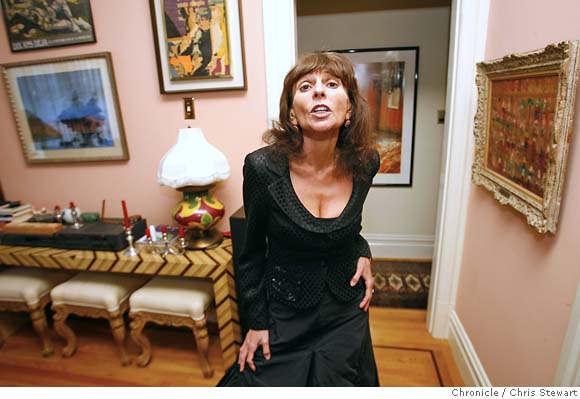
Kate Braverman photographed by Chris Stewart for the San Franicisco Chronicle In 2005, Michelle Richmond conducted this interview with Kate Braverman. Topics discussed: Braverman’s long career, experimentation in writing, book autopsies, San Francisco writers, revision, writing about climate, live audiences, and more.
Kate Braverman books: Lithium for Medea (1979), Palm Latitudes (1988), Squandering the Blue (1990), Wonders of the West (1993), Small Craft Warnings (1998), Frantic Transmissions to and From Los Angeles: An Accidental Memoir (forthcoming 2006, winner of the Graywolf Nonfiction Prize)
What are you reading right now?
In my new mission to build a critical apparatus for this region, which I think is lacking because we are a unique post-historical conceptual region–that’s our legacy and reality–rather than a 20th century area measured in miles and area codes. So I read the National Book Award offerings, particularly Vollmann’s Europe Central which I loved, and Didion’s Year of Magical Thinking which I loathed.
One is a revolutionary view and the other etiology of privilege. I want to make distinctions, from the text outward. A real political voice rises indigenous from the page effortlessly. A false one happens by inflicting the politics onto the page and then filling in a story. I can recognize the difference. I read Blaise Cendrares’s Prose on the Transsiberian for the pleasure, as I pick up one of the same half a dozen poets and just read out loud for the music and transcendent joy. Plath. Neruda. Paz. I re-read, recently books of the 70’s, beginning with Hunter Thompson, ‘Robert Stone’s Dog Soldier and A Flag for Sunrise, Tom McGuane’s 92 in the Shade and Panama. I like to be read to. My husband is re-re-re reading out loud the LaCarre Tinker Tailor trilogy for the 8 or 9th time. That trilogy is better than Grahme Greene. I read very little, as reading is a work activity for me, as demanding as writing. I don’t read a book, but autopsy it. With somebody like Vollmann, one of his novels is like receiving the schematics for literary wmd’s.
2. It’s the 25th anniversary of the publication of Lithium for Medea. Congratulations! Any advice to writers on how to hang in there for the long haul?
When I began pubishing in the early and mid 70’s, it was the publishing world. Then it became the publishing business, then the publishing industry. When I began publishing, it was “a hand shake” situation, it was daring to use a female name, as the chances of publication were automatically diminished. My first stories were sent out with just initals, as was the custom then. K.E. Braverman. Not overtly belonging to that unpublishable caste, females.
How to hang in for 25 years, doing experimental work and taking the chance that the increasingly random maketerplace will not delete you, the spreading dumbness and numbness of a reading public that wants tiny conventional restatements of what they already know rather than engage in the trek of ambiguity and complexity a real literary work demands?Agents and publishers who care least about the literary merit but most about sales? Marcel Duchamp said if you’re 20 and you write poetry, you are 20. If you’re 50 and you write poetry, you’re a poet. I write because I have a calling I’ve been practicing for 30 years and it is the way I interface with reality. I am addicted and can not live without it. I’ve burned all the boats back, so I am marooned on this island where there is only landscape, dialogue blowing in with the vanilla scented wind and a word processor. No seasons, no climate, no time zones, just the work. It’s not a question of hanging in, but rather chancing to survive.
Most of the writers I meet don’t have a calling. I’ll do another 12 drafts of a piece that’s been rejected because I know I can make it better, get deeper, find where there’s an intersection I missed. Many writers I meet are not writing for the acts of alchemy that can occur when the page is entered into by convenant, caress and sacrifice. They are not using the page as it is meant to be used, but inflicting other mediums onto the innocent surface–as tv shows or tv sized ideas in book format. This is not a book, but a desecration. Why don’t those people simply write screenplays or treatments? Essentially, I’ve been reading San Francisco writers and re-reading.
3. Your husband is a musician, correct? Do you write to music? If so, was there a soundtrack of choice while you were composing your latest book, Frantic Transmissions to and From Los Angeles: An Accidental Memoir?
My husband is a research scientist, a molcular biologist, genetic enginner, biomaterials, nanotechology visionary, and futurist. We tied for the Economist Prize in 2003, he wrote about the ethics of nanotech and I wrote a prose poem about growing up in LA and we were astounded to tie for the prize. He’s writing a book about the implications of the new technology on our collective human future.
He’s a musican by love. Over the years, we’ve experimented with putting his music behind or collaged with my poems. He’s in charge of all the music. Now we’ve got about 90 minutes of set music with poems and will be performing then for the Lithium for Medea birthday parties I’ll be having in NY, Paris, Instanbul and other cities. I’m using the 15 poems I arbitrarily chose that were written in the same voice, and then wrote a narrative for and between, the poems that were the spine and anatomy of LFM
4. What is the significance of the title of your forthcoming book, Transgressions to and From Los Angeles: An Accidental Memoir? Were there any other titles in the running before you chose this one?
The new Graywolf Prize book didn’t have a sound track but the 7 seasons that lashed me as I wrote it in a farmhouse in the Allegheny Mts. of remote rural western NY State, just above PA where our nearest city was Buffalo and there was an 8 month virulent winter. It had a brutal yellow glare, since it’s about growing up in LA, moving to the country for that mythic second life in buccolic rural America. Then I spent a month in Prague and soaked up Gothic architecture and the lavendar on the cobblestones and the reds and purples of acres of Bohemian crystal and gave the book a certain softening gilt, garnets on the fingers, neck and wrists.
There were no alternative titles, but there was a new ending I wrote after I’d won the prize which GW rejected. I wonder if it was censored and will be trying to identify those I can ask to read the ending I wrote and tell me if they think the real end was censored and if it damaged the political trajectory. I suspect it did.
I need to keep my living environment as bland, unobtrusive, quiet visually and audio as possible. I don’t have a tv or subscribe to any print publications. I delete popular culture completely from my writing life. I’ve been lisening to the same dozen albums for 10 years. I’m not interested in fashion, sports, the sport of politics. I pull the blinds when I write. I keep my back to the wall when I work. I’m a method writer, I live what I write (and so much more) so I’ve almost got my skin off, I’m using the loose tissue for sails, so I am always vulnerable and find transitions between the writing region and ordinary world extremely difficult.
5. You’ll be doing some events in Paris upon the publication of Frantic Transmissions in February. What does Paris mean to you as a writer?
I told my French publisher, Quidam, that I always wanted to be avant garde, but 25 years was more than I had planned on. When the books were published in Italy, it was information presented and received in so listless and posthumous a fashion, another publisher, another problem, that I didn’t see a way of partipating effectively. With the French, I sought contact and established a personal relationship by email. I offered to go and this has turned into a real tour. Turkey is publishing LFM in Jan and Palm Lat, my 1988 novel in May, and after Paris, I’m going to Istanbul for Univ readings, tv and media. I just found out about this and am very excited. Paris holds a significance not only in the conventional literary sense one ordinarily thinks of, but as a sign that my work must find a global audience, that the political intentions of my work might not be acceptable to American audiences (after 30 years) in the demand on the reader to engage in illness, marginalization, racism, the struggles of single mothers, anti-Semitism, the degradation of the 60’s asethetic entirely—I ‘ve always thought my books would be better read outside this country which continues to swing to right=Christian side in a suffociating, frightening way.
6. Okay, we ask this of everyone: what’s your favorite San Francisco eatery?
I am not interested in food as fashion. I hardly eat at all, don’t drink alcohol, work odd hours and don’t have a single favorite restaurant. I am not interested in food any more. A bowl of brown rice, oatmeal, fruit. I live on the milk in cafe lattes and vitamins. I just lost interest in food, selecting it, carting it in, preparing it, cleaning it up. In the Allegeny Mt exile, there were no restaurants and social life was the senior faculty inviting one another over for dinner. I learned to cook, grew my own foods, once made 3 pies a day for an entire summer to perfect my crust.
When our daguther left for college, I annnounced I was no longer cooking. When we moved to SF, I announced I was no longer shopping or washing dishes. The women’s arts are too time consuming–it takes me all day to make a dinner and clean it up. I don’t have six hours laying around like that. Or I chose not to. I have always resented the time and energy the correct wife and mother is supposed to give to banal unnecessary activities. I am disturbed by how easily women writers cave into the same traditional peer pressures, especially with children. I want to make a car bumper sign that says JUST SAY NO TO SOCCER.
I’ve dealt with these issues in the 2 collections of unpublished stories I have. Professional women are gutting their work and personal schedules for the new holy collective hallucination of soccer. My daughter, who is graduating from law school in May was raised by a feminist artist who was not a dillatante, but actually worked all the time. I told her my writing life was as much a real job as being a doctor or lawyer, that I had hours of work, that I wasn’t available for her every whim. We live in a society where every kid’s stray spasm of enthusiasm is met with an immediate new uniform and coach. It’s random. Like week of the “C”. Every kid has cello lessons, Chinese and calligraphy, canoe lessons. Then it’s “M” week. Mandolines, Mandarin study, Muslim awareness, micro something, Mars study. We give our children an enormous sense of entitlement by mutilating our professional and personal lives for childish passing whims. What kid actually possesses the plethora of gifts we routinely attribute to them? Virtually no one. It’s another passing fashion that I am passing on.
7. Climate is often such an enormous presence in your writing. Why?
I go native wherever I live. As a CA writer, as a writer without skin, I write on a molecular level using my synapses as tools, the external landscape is a character for me. I’ve been more intimate with certain landscapes than certain husbands. My aesthetics have an errotic compoenent. I love landscape in a profound way I can translate onto the page, which is a unique kingdom, with its own unique rules and seasons, like a continent, vast, mysterious, inexplicable and inexhorable. To be a CA woman, even more so in LA where I was based for 20 years. is to inhabit a non-traditional America, without seaons, closer to Mexico City or the Pacific Rim than Europe. In LA, it was always about keeping the indigenous out, that real art could actually be done by residents of the subliterate heathen masses was unthinkable when I began doing it. We have a different relationship to traditional anglo-europen writing. We don’t have Hawthrone’s dark forest, we’re not in opposition to our nature but coexist with it in harmony. Our cities are named for Spanish saints and butchers. Asia blows in our wind. It is a climate that encourages experimentation and a more confessional approach. That’s why SF has a legacy as an outlaw capital. We welcome the renagade, the outlawed, the visionary and eccentric here. LA does now, but only if the individual is carrying a pass from a studio and can prove they have a movie in a secondary phase of development. Climate has an impact that is defining. When I lived in rural isolation, where getting 12 miles to the town with a supermarket was often impossible, a certain smallness of ambition and possibility becomes an intrinsic compoenent of one’s actions and vision. I love SF, this port city built by desperate gold diggers and the adventuresome that have at least moored here at pivitol junctions.
8. Much of your work seems to beg to be performed. How would you describe the relationship between you and the audience during a live performance?
I began as a poet and one of the first poetry readings I attended was one I gave. As a poet and now a writer of incantory prose, such writing is intended to be read out loud. I have seen many opportunities during my career to put the work on stage. During the 70’s, when I came of age as a writer (I was a Haight Ashbury runaway at 15 and put myself through Berkeley High and Cal in LA (Hunter Thompson and the Beats are 20 and 30 years older then me) it was the time of Punk. Since many of the punk bands went through the Venice Poetry Workshop, which I was a director of at the time, poets and punk bands were performing together. I saw the change of dynamic becoming a performer would require and this did not appeal to me and my work on the page. I used to do readings with a pencil in one hand so I could live edit, feel the kinetics of where a piece was off. Trust your ear, not your eye. Trust the physical kinetics, not what the lines look like. I write music. I don’t write, I compose. I started to give live readings in SF after many years of not having a live audience and I loved it again, felt the thrill again. We would, over the years, do an occasional gig with music, but I didn’t want to put the energy into it—a form of washing dishes, dispensible. Now we’re doing it for fun, the classic poems with music written as for songs. The rush of connecting with an audience when you don’t have a book in your hand is up there with injecting drugs and sex. It’s an A list rush. Since moving to SF, I’ve become more experimental about the work in all forms, including considering stage and music, rythem, cadance, that which accentuates the incantory nature of the work. Our living room is now an ad hoc recording studio. We’re exploring a whole new terrain. I think I can write directly to the music and will be trying that as an experiment. Writers don’t experiment enough, take the wild chance, rearrange, restructure, re-experience, reinvent. Our approach with the sound collages is an entirely new synethesis. The possibilities are still unfolding.
9. Robert Polito, who judged the Graywolf Nonfiction Prize, called your prizewinning manuscript ” an enthralling mix of memoir, history, and fever dream.” What is the role of dream in literary creation? More specifically, fever dream?
Many answer, though few are called. To volantarily enter a sort of permanent house arrest, to live as though you are at all times engaged in a public psychoanalaytic session/AA sharing meeting, while feeling you are being interrogated by state police and confession to a priest is not for everyone nor should it be. To live with emotional malaria is not a wise decision and should only be taken if there is no alternative. They are graduating 10,000 certified MFA writers a year. That’s 10,000 unemployed writers who must get jobs teaching in MFA programs, of which few will be gainfully employed and fewer still will earn a living from the sales of their work.
In her great book on writing, The Writing Life, Annie Dillard observes that very few are writers and very little harm comes to them. I would add that the converse is also true. Looking at the artists of the last century in America, it’s a story of suicide, drug adiction, alcoholism, child abandonment, divorce, dysfunction, mental illness. Of course, when men engage in these behaviors, we say they not etching lives of brutal chaos, but are the embodiment of the mythic artist. When women engage in these identical behaviors, we call them mentally ill aberrations and degrade and dismiss their contributions. The fever dream, the complete surrender to a transcendent other has always been the province of males. When women enter this state of grace and vertigo, we call them mentally ill, promisicus, defective. Women are chained on the page as they are in life. The marketplace demands female versions of real characters that lack the epic dimensions males are permitted. This has not altered signifcantly during the 30 years of my work.
The new book is a complete experiment in subverting genre. It’s an “accidental memoir” and is, as all my work, rendered in my primary language, which is poetry, with its musical, incantory component. It’s real history, fiction, pure poetry, stand-up comedy monologues, essays I’d written for the LA Times during the Allegany exile, impressions by a CA woman on small town life. It’s about space, architecture, climate, region, identity, aging. It’s pushing the envelope on what nonfiction can do, and since Capote, Mailer, Didion and HST, nonfiction seems a fertile field, less fortressed, fewer crocodiles in the moats.I do wonder about the last chapter, which I may post on my web.
10: What’s in your attic?
Do you mean that metamorphically? My work is largely autobiographical, though the page requires a complete transformation of the original impulses. There are always 2 stories, the one you set out to tell and the dynamic that occurs when the page speaks. It’s a dance, you do some, the page does some. In this dynamic arises the discovery and revelation, the alchemy. My real life is much more exciting then what I’ve written in my 11 published and 5 still unpublished books. My life as a teenage runaway. My life in the LA Punk scene. My life in the barrio of LA where I had an illigitimate baby. My life on the run with my infant from prosecution by the authorities who wanted to decree that I tie my destiny to a stranger I didn’t want to know; most women wouldn’t run. I did. My activities as an anti-war activist during the 60’s. I think my attic has been open for decades. I invite the curious in.
author photo by Chris Felver
Visit Kate Braverman’s web site at www.katebraverman.com.
-
Giacomo’s Seasons by Mario Rigoni Stern
translated by Elizabeth Harris Behling
editor’s note: Le stagioni di Giacomo (Giacomo’s Seasons) won the 1996 Grinzane Cavour Prize and has been translated into French; it was also adapted as a play in Italy. An earlier excerpt of this novel, also translated by Elizabeth Harris Behling, appeared in issue 14.
15.
Autumn came early. The insistent rain that always marked the woodcocks’ leaving kept the recuperanti, the men who salvaged scrap weaponry, from going out much. One Sunday afternoon in November, four friends were huddled under Piero Ghella’rs cantilever roof. Hands in their pockets, shivering, they watched the sadness blowing gently over the piazza and the streets. A short while before, they’d added up their pocket change.
“Four of us!” one of them burst out. “And we can’t even come up with four lire to go to a movie; we don’t even have one lira to get ourselves a half-liter of wine at the tavern! What kind of life is that!”
“I’m joining the fascists. Then maybe I can get into the border guard.”
“You’d be better off trying for the forestry militia,” the first one said.
“It’s harder to get in,” another answered. “You’ve got to have good recommendations. And there’s no telling when those jobs will be posted, either.”
“Tomorrow,†the first one said, “I’m going to the town hall to see if there’s some jobs listed–any job. I can’t stay around here anymore. Maybe I’ll sneak into Switzerland and find some work, way up in the mountains. Like Toni Ballot did.â€
“I think I saw a job posted over by the public bathhouse. Let’s take a look.â€
It was a notice to sign up for two years in the royal carabinieri with reenlistment into regular service. The one who’d said he was anxious to leave slowly read the notice out loud. Then he said, “Tomorrow morning, I’m going to the Registry Office to get the forms. I’ll sell the recupero in my shed to get my papers stamped.â€
“Not me,†another one said. “I’m not going into the carabinieri. I’m waiting for the forestry to be posted. And I’m joining the Fascist Party, too–and I sure hope my pink card doesn’t come in the meantime.â€
That pink card was your draft notice ordering you to present yourself for military service that also served as a pass from home to your designated barracks.
The four men watched as Albino Vu made his way slowly up the street. They greeted him and asked if he was going to the movies.
“The movies!–what for?–life’s one big movie! Last night I was out drinking some and I wound up spending the night at the carabinieri’s. Good people, them carabinieri. So now I’m sober, and I’m headed back to Boscosecco.†He stopped and took a deep breath. He hadn’t talked that much in a long while. But he’d watched these four grow up, had known them since they were kids out hunting with their shotguns.
“There’s a good movie playing,†said the one who wanted to go into the forestry militia. “It stars a beautiful actress, Greta Garbo. She plays the queen of Sweden.â€
“I don’t care if they’re beautiful or Garbo–don’t you listen to women’s garble.†Vu shuffled off again, his recupero sack over his shoulder.
People said Albino Vu acted that way because of what he’d discovered after he came home from the war: while he was off in the trenches, his girl was fooling around with his friend who’d been rejected by the army. After that, Vu left town, his house, everything. He headed into the mountains where he’d fought and he’d lost so many real friends–and he stayed up there, even in wintertime, in some pasture, or holed up in a bunker, waiting for spring. He didn’t need much to live on, almost nothing. He found quality recupero, not quantity, and always small stuff. Dried gun powder for the hunters that he traded for shoes or old clothes. Copper he’d sell to Seber to buy himself just enough food to hold him a time, and never more than that. The rest he’d spend on wine at Pozza’s or Toni della Pesa’s where he’d sit and have philosophical debates with Motorcycle Gigi. The four friends watched as Vu walked off, singing a song that cheered up the street.
The recuperanti had a crisis on their hands. The lira had been revalued, so metal prices dropped. Even worse–the forestry militiamen and the local woodsmen were saying the recuperanti’s digging was destroying the topsoil in the pastures and damaging the seedlings so the woods couldn’t grow back. Someone informed the authorities, and they threatened the recuperanti with fines, even prison.
One day–it was nearly summer of that year, 1931–we found out the National Fascist Party was planning to set up an enormous camp, right here by us, for the children of Italians in the Fascists Abroad Organization. They picked a spot in the fertile meadows around the Rendola River, and the hay was cut and gathered early.
“So,†the recuperanti said, “you get fined for digging up rocks in the mountains. But destroy our best meadows, and you’re a hero.â€
Giacomo’s father went down to the Rendola one afternoon to get a look at this famous camp for himself. They were marking the spots for the tents, setting up the kitchens, and digging the latrines. Two commune workers were there and some folks he didn’t know who must have come up from the valleys. Maybe they were in the Volunteer Militia For National Security.
“Hey, you!†A man wearing shorts and no shirt was calling to him. “You wanna work?â€
“Yeah, but not for free.â€
“Get your jacket off and come here.â€
So that’s how Giacomo’s father found work for almost two months. The first thing was arranging the tents in a row according to the blue prints. The entrance to the camp, down a lane off the local road, was framed by two enormous pennants with the tri-colored flag and the Savoy coat of arms. All along this lane were still more pennants with flags leading up the gentle slope to the top of the hill, and finally, to a huge portrait of Mussolini with his bald head. The clearing around this portrait would be for camp gatherings, for raising and lowering the flag. One tent could hold maybe twenty kids; there were enough metal-frame bunk beds for a thousand teenaged-fascist Avanguardisti. To carry water from the town aqueduct, the men had to build an above-ground piping system fitted to dozens of washtub taps. In other words, quite a job.
Right away you could tell Giacomo’s father knew what he was doing. He always went home at night with something in his jacket pockets: bread, bologna, quince fruit bars wrapped in tissue paper. They gave him a big noon meal and a snack at five–a real waste of food–so he brought the leftovers home for dinner.
He’d been working fifteen days when the province fascist party secretary and the fascist mayor, the podestà , arrived along with other officials up from Rome, all of them there to see how Camp Mussolini was coming along. Chauffeurs and aides were bouncing around like grasshoppers.
“You’re behind!†the party secretary said. “Get going! Get those pine branches up on the arches–and the fasces, too–get those axe blades and sticks tied together! And how about the sentry boxes? The truck will be here tomorrow with the muskets. Have you set up the gun racks? Hop to! Hop to!â€
To speed things up (seeing how the volunteer militiamen liked to slip into the tents farthest out for a little nap after eating), Giacomo’s father told the director he ought to hire some other workers: “I know a couple of good men. Men who know how to work and to work hard.â€
“Maybe you’re right,†the director said. “Bring them along tomorrow and we’ll see how they do.â€
The next day Giovanni showed up with Moro and Moleta, two recuperanti. Between Moro Soll’s shouting and Moleta’s quieter approach, they got the workers moving.
The Avanguardisti started to arrive by cablecar. “Our fine boys from the Italians Abroad have heard Mother Italy’s great voice calling, and they answer with affection. They are coming to the Altipiano from all over the world. From scorching hot Africa and the wintry North. From the distant Americas to our neighbor nations of the Alps. Here in Camp Mussolini, Dante’s words beat a path into every heart. Our Mother Tongue, sweet vehicle of faith and solid fortress of our nation, stands proud among so many exotic languages, enchanting all with her sweet song. As these boys wander our mountains, they will grow to appreciate the beautiful, heroic stories of their fathers, those brave men who volunteered to fight for their country, who told their stories in a distant land, among a foreign people. Now, in our mountains, these fine boys will understand the silent eloquence of their fathers’ memories and they will be filled with a greater, ever more vital pride in being sons of Italy.†And so on.
One day the camp director (who was really a marshal on loan from the light infantry) asked Giacomo’s father if he knew how to cook, too. Giovanni automatically said yes. And that’s how he wound up a cook’s helper, along with Moro Soll.
The last of the Avanguardisti were there now. The days went by with the bugle call: reveille, breakfast, fall-in, flag-raising, prayers for the king, for Il Duce, for the country, for the far-off families. Choir practice: “Rising Sun,†“Youth.†Then gymnastics, close-order drill with muskets, group games for “instilling discipline and order, physical excellence, quick decision-making and reaction time, and for improving all bodily systems.†There were also group hikes in the sacred mountains of the motherland, everyone marching and singing:
We are Fascists from abroad
Marching fast and proud
With Mussolini at our side
We know how to fight
We know how to die.
If the reds dare show their snouts
Smash’em!
Give’em our heels and fists
Smash’em!
Then to show what we’re about
Smash’em!
We’ll finish ‘em off with a club
finish ‘em off with a club!At that song, Giovanni and Moro shook their heads. “Poor Italy,†they muttered.
After evening rations, lowering the flag, and changing the guard at the camp entrance, the Avanguardisti were off-duty. They went out in groups in their snappy uniforms, wandering through town, looking to strike up a conversation with some girls, trying to impress them by speaking another language, but they always swore in Italian. Mario and Nino met a few Avanguardisti from Casablanca and Salonica, and they and the girls would all wind up playing together on Via Mount Ortigara.
One morning the local officials and the podestà were inspecting the camp and saw Giacomo’s father at work in the kitchen, and they protested because “he was a suspicious element–not an official party member.†Old Sharpshooter (that’s what everyone was calling the technical director of Camp Mussolini by now) told these officials that it was fine by him, that he couldn’t care less if Giovanni was a white shirt, a black shirt, a red shirt, or a yellow shirt. Then came the night, after evening rations, when Giacomo’s father went off to the Villa Rossi grove with the leftovers from the kettle and almost got himself fired. Once again Old Sharpshooter came to his defense, this time against Padre Salsa, the hero-chaplain who had three rows of medals over the red cross on his chest. The padre had joined the camp to carry Faith and Country to these fine lads of the Fascists Abroad.
Giovanni had arranged things with Giacomo and the other local children to make sure any pasta or minestrone left over after rations got back to their homes. The children, crouching in a trench with their pots, would wait for him every afternoon and evening. Padre Salsa surprised him just as he was scooping some pasta out from the kettle.
“What’s this?–caught you, you thief!–you swindler!â€
“Padre, sir, this was extra food. Leftovers. They were just going to throw it away.â€
“Scraps should be saved for the farmer’s pigs!â€
“But this is still good. Giving it to hogs–that’s such a pity. And these children going hungry.â€
“These children are lazy, raggedy beggars! They’re never to show their faces around Camp Mussolini again! They’re a disgrace to Italy! Now–out!–out of here! Scat!â€
The children fled, nearly crying, with what little pasta Giacomo’s father had been able to give them. Padre Salsa ordered the kettle knocked over; the rest of the pasta spilled into the dirt. He went straight to Old Sharpshooter. “This has got to stop–our boys from abroad mustn’t see them! Shameful! That man should be kicked out of here!â€
“He’s worth more than five soldiers. I’ll see to it this doesn’t happen again.â€
That night, after Giovanni and Moro Soll cleaned up the kitchen and prepared for the next day’s caffellatte and cocoa, they went home and decided on a plan. Every evening at the same time Padre Salsa ate at the Croce Bianca Inn. Moro would keep watch and at just the right moment, he’d whistle for the children hiding deep in the bushes. Old Sharpshooter pretended not to notice; so all that month the local children enjoyed Camp Mussolini’s delicious pasta and minestrone–and they weren’t the only ones. Things went the same the following year.
In the spring of 1932, work started on the ossario or “bone†monument. It was going up on the Laiten Hills, east of town, where the bombed-out houses had been left unrepaired. The boys from town, and their fathers before them, used to climb those hills to play.
In the spring, kites would rise in the sky. “Dragons,†they called them. Vittorini from the pharmacy could make the very best dragons out of wax paper, bamboo slats, and glue. He’d also come up with a type of wooden reel with iron pins that let out or wound the string, depending on what the dragon needed as he soared up above, higher than the larks, the crows, the circling hawks.
Summers, even though the owners didn’t like their meadows trampled, boys and girls went up and gathered armfuls of red lilies (“archpriestsâ€) before the grass was cut.
In the fall, the Piazza boys and the Uptown boys used to have wars at the very top of the Laitens, on all the rocks from the cannon volleys, which had been piled in one big heap. Sometimes they’d have sling-shot battles with lead pellets for ammunition. Lucky for them, their helmets were Austrian, not Italian.
Winters, they set up a ski-jump on those hills where everyone had first learned how to ski. And that’s how Mario broke his arm one February afternoon, making a jump.
It was a summer day when the engineers and surveyors went up the hills escorted by the podestà and the fascist party secretary. With their range finders, their tape measures, their theodolites, the technicians got to work surveying, measuring, scribbling. And so, after numerous proposals, offers, conferences, tests, and on-the-spot investigations, the Roman authorities decided that a great monument was to be built and that this great monument holding the remains of our heroes who’d died on the Altipiano (for the country’s salvation) would go right here, on our hills of play. To make room for the imperial-style arch, all the quiet cemeteries in the meadows and woods were leveled. Hundreds of workers started in with picks and shovels, digging up the rocks, preparing the foundation, the cement and marble burial niches. Everything dug up was loaded onto Decauville handcarts, then brought down to the meadows near town and dumped, for future road construction.
17.
They were waiting on the spring thaw like they’d never waited before. The larks had returned to the sunny river banks, but since it still froze up here at night, the birds–or so the older people claimed–would fly back down to the plains at dusk. Everyone was waiting, too, for the jobs to start up again and for the time when they could start spreading manure on the potato fields. The Grass family was already hauling manure in panniers, early in the morning, step by step up a path, over icy snow and patches of bare ground: over “harnust and happar†as they used to say in the ancient tongue. The Grasses were getting a head start on all the field work, making sure everything was done at home in case jobs opened up on the huge ossario monument (the bone monument) or on some community road project.
And when the late-morning sun was high enough to warm the communal fields, Giacomo and his father would go up with picks and shovels and work their small plot of ground by the woods. Both Giacomo’s father and his grandmother thought this plot would be good for lentils, maybe even potatoes the year after that. Twenty kilos of lentils in the house by November meant good minestrone all winter.
They would borrow five kilos of seed lentils from the Zais, who’d had an excellent crop the year before with their big field on Poltrecche. If they couldn’t pay the Zai family back in lentils, they’d do it selling recupero.
And they weren’t the only ones clearing the communal fields by the woods, out past the private properties. With winter coming to an end, smoke rose from the burning brush and turf in the sunniest spots on the hilltop. Glacial moraine and rocks were gathered to make dry support walls for reducing the slope. The rocks and gravel piled up from the digging were placed below these walls. If there wasn’t enough manure to spread, beech leaves and red-spruce shavings would do. By the time the cuckoo returned in April, the finished plots would be so neat and orderly, so harmoniously sculpted from the landscape, so breath-taking as seen from Petareitle Hill, that they’d be called “The Gardens.â€
With the noon bell, the neighbors gathered together to eat, to talk a little about life and smoke a pipeful in peace. Gigio Rizzo, the municipal guard, would pass by once in a while to check on their work and to make sure everything was going according to the unwritten laws: no damaging the woods, no trespassing. He also had the job of figuring out the total area tilled by each family for the annual municipal tax on their permanent lease.
Gigio Rizzo was stern but fair, a man of a few, choice words. Always dignified in his forestry uniform and well-oiled boots, carrying that cornel-wood cane with the curved handle, walking with that fast, sure stride. You always felt his presence, even when he wasn’t there. He didn’t wear a sidearm and if he sometimes heard subversive talk, well, he certainly wasn’t reporting anything back to the podestà . Like that day Giacomo’s father blew up about all the misery and how Il Duce’s revaluing the lira and decreasing wages was helping out the capitalists, not the proletarians.With snow creeping back toward the heights, the men started going out for recupero again, leaving the women to plant and tend the plowed fields.
And work started up again on the ossario monument. The touchy inspector from the public works office was incredibly stubborn about the big white blocks from our few Altipiano quarries–the slightest defect and the marble was rejected. Sometimes the quarry workers tried filling in a chip or flaw with marble dust and putty, but nothing got by the inspector. He’d smash the block with a sledge hammer so it couldn’t even be used on some less important job.
The blocks, from quarries sometimes as far as two hours away, were dragged up the Laiten Hills on horse- or mule-drawn carts. The stonecutters would finish the marble up there according to the designs: each block had its number and assigned place in the monument. With levers, rollers, jacks, and tackle, the workers hauled the blocks up to the masons, who set them in place. The construction site was one big swarming, organized ant hill. The foremen paid attention to every last detail. The engineers from Ferlini & Roncato Contractors were afraid of the touchy inspector–he’d pop up silently, bark out a few words, and with a single wave of his hand have whole sections knocked down–they’d been carelessly done–or a block already up there had to be replaced.
One hot, muggy June day, a foreman spotted a worker whose shirt wasn’t soaked in sweat.
“You! Yeah, you! Come here. Why aren’t you sweating? What have you been up to?–lying around in the shade?â€
“I never sweat, Boss. I just naturally don’t sweat.â€
“Bull. Don’t give me that. Everybody sweats here. We don’t want any wise guys working on our hero monument.â€
“It’s not my fault I don’t sweat. My comrades’ll tell you. Ask anybody.â€
“Doesn’t matter–you’re fired. And remember: ‘buddies,’ not ‘comrades.’ Come back Saturday for the rest of your pay.â€
Maybe this foreman was in such a rotten mood because he’d gone into the workyard latrine that morning and seen “Death to Il Duce†scratched in charcoal on the planks. As a model for the workers, he pointed out the innocent giant who’d just been discharged from the mountain artillery and who, rumor had it, used to present arms with a 75/13 howitzer barrel. He was strong as a horse, with the spirit of a child. Using levers and rollers, he moved solid blocks of marble around like they were pumice stone.
At noon, the workers would find some shade in a ditch or by one of the monument walls under construction. They’d make a fire from carpenters’ shavings and set a mess kit on the embers, warming up their soup and polenta brought from home. During this hour break, some of the town boys would climb up the Laitens, maybe to see what their play-hills were going through, but also just curious about all the work. The boys started to know these laborers by name, these men from nearby towns. Some were young, almost boys themselves. Others were old and gray-haired. Many had been in the Great War, but they didn’t seem all that moved to be building this enormous monument for the bones of their comrades.
Mario climbed the hills almost every day. A number of the men knew his family, and one day a group asked if he’d bring them a bottle of wine. There were eight of them, sitting around a fire, toasting some polenta on the coals, and with thirty centesimi each, they came up with the two lire and forty centesimi needed for a bottle of local wine. Mario raced down to his family’s shop, bought the wine, and raced up the hills again, knowing the men had to get back to work. This way, they could at least have a couple of mugs of wine in peace.
Later at supper, Mario’s grandfather said, “You should go up there every day at ten-to-twelve with six bottles in a couple of baskets. I bet you can sell every last one.â€
And so at the foreman’s whistle, Mario would make sure he was up on the Laitens with his baskets and his six bottles of wine. He’d work his way through the groups as the men put their money together for the two lire and forty centesimi. Sometimes when payday was far off, they’d ask for a bottle on credit and Mario, just like his grandfather taught him, always agreed without drawing up a note. The poor don’t cheat. When the wine was all sold, he’d sit and listen to the men’s stories.
One in particular stayed with him. Nando dell’Ecchele told them how he’d sold his recupero one night, then stopped at Margherita’s for a glass with Vu. Afterwards, going home, when he was just outside town by the cross, there was this silent line of soldiers on the road right in front of him. The full moon kept slipping through the clouds–it was bright out just then, so he got a good look. The soldiers were pale, silent, walking without a sound–except their sighing. The long line of soldiers was coming from the mountains to the south, marching through the hollow between the hills, and up again, through the Nos Valley, toward the higher mountains.
Other scattered groups of soldiers in single file trickled down from the mountains into the valley. You couldn’t see a beginning to them, or an end. Nando just stood there, absolutely still, until the dawn grew light, and the moon went down, and they all disappeared.
“The dead soldiers’ spirits,†said an old worker who’d been a driver in the war.
“Sure,†another said, “but were they Italian or Austrian?â€
“I can’t remember,†Nando answered. “Maybe both.â€
“You ask me,†another man said, “you had one glass too many with Vu. Who knows what that glass was telling you.â€
“I barely had a drop. A half-liter’s nothing split two ways.â€
“And now,†said the one who’d spoken first, “here we are, building a monument for the soldiers’ bones. And their spirits, out wandering the mountains.â€
They stayed quiet until the foreman’s whistle called them back. Mario, unsettled, went straight home, not stopping in the meadows, and up in his room he sat at his desk and wrote a poem, long gone now. Just three lines are left:
In the cold moonlight
they walk the mountains together–
the living and the dead.Mario Rigoni Stern is from Asiago, Italy, in the Veneto. He is one of the most prestigious writers of northern Italy and has published fifteen works of prose with Giulio Einaudi Editore and Il Melngolo. His Il sergente nella neve (1953), The Sergeant in the Snow, is considered one of the great novels about the Italians at the Russian front during World War II. His works have been translated into twelve languages, and he has won numerous awards, including the 1978 Campiello Prize for the novel, Storia di Tonle (The Story of Tonle) and the 1999 Pen Club Prize for the short story collection Sentieri sotto la neve (Paths Beneath the Snow). Le stagioni di Giacomo (Giacomo’s Seasons) won the 1996 Grinzane Cavour Prize and has been translated into French; it was also adapted as a play in Italy.
Elizabeth Harris Behling grew up in Arizona and Kentucky and now teaches creative writing at the University of North Dakota. For her translations, she has won several awards, including the Dudley Fitts Award and the Gary Wilson Award. Her stories and translations of Italian prose and poetry have been accepted in Other Voices, Denver Quarterly, Florida Review, Northwest Review, Alaska Quarterly Review, and other magazines. She has had fiction-residency fellowships at the Blue Mountain Center and the Ragdale Foundation.
The image: This poster was created by Luigi Martinati in 1935.
-
Mirceau Doviescue
She had beautiful furniture and a number of fancy rugs. There was a bed, of course, with several well-worn quilts, a large comforter, and hundreds of pillows. On a cold day in Timisoara, it would lure you in and not let go. If the curtain was pulled back, you could lay there in luxury and warmth, and see all the way down Podul Decebal, over the river, and out past the bus stop where less fortunate people huddled together in ice and snow, waiting for a bus that might never arrive.
Mirceau Doviescue (1934-1992), The Girl From Arad
-
10 Questions with Rachel Pastan

Rachel Pastan grew up in suburban Maryland and attended Harvard College and the University of Iowa Writers’ Workshop. She has published short stories in magazines like The Threepenny Review and Mademoiselle, and won the Arts and Letters Fiction prize and the PEN Syndicated Fiction Award. She has received fellowships from the Wisconsin Arts Board and the Delaware Arts Council, and she has been a Fellow at the Bread Loaf Writers Conference. This Side of Married was selected for Barnes and Noble’s Discover Great New Writers series. This interview was conducted in 2005 by Michelle Richmond.
What are you reading right now?
Imamorata by Joseph Gangemi, as part of my campaign to be familiar with the work of Philadelphia writers (I moved to the Philadelphia area a few years ago). It’s the story of a psychic-phenomena debunker in Philly in the 1920s–very well written and compelling. My favorite book of the past few months is Truth and Beauty by Ann Patchett, the story of the author’s intense friendship with the writer Lucy Grealy, who died of a drug overdose (suicide?) several years ago.
2. Do you write to music? If so, what was the soundtrack for This Side of Married?
No, I write to silence. I’m always going around turning off radios and CDs and the children’s story tapes, and putting ticking watches away into drawers. Anything with a rhythm gets in the way of the rhythm of the sentences.
3. What’s the most surprising comparison you’ve heard when people talk about your book? Has anyone compared your novel or your writing to the work of another author in an unexpected way?
I was surprised that my editor felt This Side of Married was like a Laurie Colwin novel. I love Laurie Colwin but had not thought our work was alike. Then I reread Family Happiness and the parallels in subject matter and mood were frighteningly apparent.
4.Sisterhood is at the heart of This Side of Married. Parents always say they love all their children equally, but I have a hunch they’re just being diplomatic. Which of the three sisters are you most attached to?
Oh, I love Isabel! She’s not as mean and impossible as Tina, but she has more of an edge to her than Alice. Alice can be stern sometimes, but I like someone with an edge.
5. What’s your favorite book from childhood?
Charlotte’s Web. I wish I had a more interesting choice, but E.B. White takes everything he knows about life–and death–and works it all into this book. It also has some of the most beautiful sentences in all of literature.
6. What’s your favorite Philadelphia eatery?
Vetri! Incredible Northern Italian food in a the lovely, relaxed atmosphere of a Society Hill townhouse. The only drawback is how difficult it is to get a reservation. In a (much) more informal vein, I also love Johnny Brenda’s (a dive bar with terrific food–grilled octopus, falafel) in Fishtown.
7. What other titles were in the running for your book before you decided on , and why did This Side of Married seem like the perfect fit?
At First Sight, The Second Sister, Men and Other Reptiles. This Side of
Married makes it clear the book is about marriage/love/relationships without being too straight-forward about it.8. Which question would you least want an audience member at a reading to ask?
Well, the question I get asked most frequently that I don’t like is: Why did such and-such a character do *that*? I think the person asking really wants me to explain why, but I feel the book itself should explain way. If it doesn’t, then the book has failed. So I hear those questions as criticisms, whether or not they’re meant that way.
9. Let’s say someone fell in love with your book and wanted to show his or her appreciation by bringing a gift of a food item to one of the readings. What item would be most likely to inspire your everlasting gratitude?
Buratta, the mozzarella-like cheese from Northern Italy; or petit fours.
10. What’s in your attic? If you don’t have one, what’s in your hall closet?
I’m not sure what’s up there, except what’s closest to the stairs: suitcases, outgrown clothes from one child waiting for the younger one to get bigger, winter boots, sharp nails sticking out of the floor, and a vast quantity of filters for the air conditioner.
Since the publication of this interview in 2005, Rachel Pastan has published three more novels: In the Field, Alena, and Lady of the Snakes. Visit Rachel Pastan’s website to learn more.
-
Social Contract–by Stephen Elliott
originally published in Issue 11 of Fiction Attic: The Journal of Elegant Wit
“You have the right to bare arms,” she says, slipping the ropes through my fingers, and then around my elbows, pinning them painfully together and cinching them through the window handle above my head. “Just not these arms.”
Her skin is the color of pasta. She has large cheeks, a careful mouth.
“Harry Truman invented the national security state,” she says, my right leg pulled at the ankle by a long cord that finally connects at the base of a radiator. My other leg spread, the rope looped around the refrigerator. My legs spread akimbo, my body utterly vulnerable. “The people have to be afraid, Truman said. That was the way Harry Truman thought. We have to fear the communists. Franklin Roosevelt was dead. Long live Franklin Roosevelt.”
The nipple clamps hurt. The ball gag she has stuffed into my mouth makes it impossible for me to answer her, if there was an answer to be given. She didn’t ask me if I wanted this. She’s stronger than me, especially since my accident. I never fight her anymore. She does what she wants.
“The Geneva convention holds that you can’t torture prisoners. America is a signatory to the Geneva convention. Are you a prisoner?” I nod my head. She closes my nose shut with two fingers. I can’t breath through the gag she has forced into my mouth. There is a moment of peace. This is it, I think. I am going to die. And then my body starts to flop, the panic coming through me involuntarily, and she’s laughing, and she lets go of my nose, and the air rushes into my body in deep, sweeping breathes, and her laughter fills the room with its cruelty.
“We don’t care about treaties,” she says. “Hitler didn’t care about Versailles and they gave him Czechoslovakia, the Rhineland, and Austria. Anshlung. That’s what they call it. But Hitler had his problems. Repressed homosexual.” Her hand runs along my stomach and the top of my leg and then down beneath me, her finger touching my anus.
“Are you a repressed homosexual? You don’t seem to like sex very much. I think you are.” I feel her finger slip slightly into my anus and then out. “So he died in a bombed out bunker in Berlin in 1944, with his new wife. What the hell for?”
I watch as she stands and walks to the closet and dips through the door, rummaging through the sound of paper bags. She has such long legs. She’s a cyclist. Her long thin body is knotty with strips of muscles. Then she’s in front of me, between my legs,
looking gleefully into my eyes, forcing something large into my ass. I scream into the gag, a muffled gasp, a blunt dulled shriek. Whatever it is goes in and it burns and it stays there, throbbing slowly. The pain begins to subside. But she still has something in her hand and she squeezes it and an electric shock shoots through my bowels, my eyes bulging in my face, my body pouring sweat onto the sheets.“I was wondering if that would work.”
She smiles, warmly, happy, and content. It’s been twelve years now since the first day we met. A couple of waiters in a young restaurant on the edge of the city, working to make ends meet. We didn’t know what we had.
“We don’t care about treaties,” she continues. “In 1954 Eisenhower signed a treaty that provided for free elections in Vietnam in two years time. But when it came due he changed his mind. He said if Vietnam had free elections Ho Chi Minh would receive eighty percent of the vote. And that wouldn’t be good for America. So much for democracy. Do you feel cheated? Look at the Iranians. The Shah served us well for
twenty-five years. Then they took hostages.”She steps forward, her naked foot on my stomach, she walks over me, and then places her foot on my face. She rubs her foot over my face, back and forth, across my nose. She steps on the clamp on my nipple and I let out another involuntary dull scream. “Cheated by our vows, to have and to hold, to love and to cherish, to protect, till death do us part. Do you think we’ve parted too early? Did you think things would be different when you pledged your allegiance in school, and at the baseball games? That your country would protect you, while the bombs fell and U.S. installed dictators sent death squads into the villages of South and Central America to kill the women and children first. Here is your democracy.”
Her foot presses hard on my face, and my nose hurts, I think it’s going to break. With the heel of her foot she pushes the gag further toward the back of my throat. Tears spring from my eyes, soaking the fabric around my ears. “You should be able to answer some of my questions. You should. I’m not blaming America,” she says, sitting heavily on my chest, and then turning around, facing away from me. Her long back, straight and proud, the bulb of spine and her dark hair which she’s taken to wearing short. She’s wrapped a chain around my penis and balls and she’s slowly making it tighter. “I was born here, same as you. I’m not blaming anybody. It’s just that you have the right to remain silent, and maybe the Republicans really did win the election, and maybe they didn’t.
It’s too close to call. Both sides believed in three strikes you’re out. Life sentence, no parole. How many strikes do you have?” she asks, turning her head to me briefly and then going back to her task.
“There’s no welfare here. You’ll have to work for what you get.”
I’ve surrendered myself to the continuous pain. I’ve allowed the pain running through my body to numb my mind. This is my wife. This is what we have. Who would have thought we would have lived in this apartment all this time.
“And then the wars came.” Another shock rings through the electric plug in my ass, pain striking through me, her hand in my hair pulling hard, her other along my ribs, buckling forward as if she was riding a horse, her feet sliding back toward my cheeks. And then stopping. She’s loosening the chains. Gently wrapping her thumb and forefinger around
my penis and balls. “And they flew planes into our buildings and our buildings crumpled and fell to the ground. We have to defend ourselves. They would have done it anyway, whether we deserved it or not. That’s the way people are. And the president didn’t want to consult congress anymore. He asked them to dissolve themselves, to remove themselves from the conflict. And of course they did. Self-preservation, in the face of terror.She slides her body back, so her ass is just in front of my nose, the smell of her and her flesh totaling my vision.
“Do you remember Bukharin?” she asks. “It was 1936, and he confessed in a public address to the people. He turned on his fellow Bolsheviks, Kamenev, Trostsky, Zinoviev, all Jews. He wanted to save himself. But Stalin placed him under house arrest anyway. Koba, why do you need me to die? he asked in his unanswered letter to Stalin. But who was he to ask for forgiveness? All of the original Bolsheviks subscribed to a doctrine of terror, of starving their own people. It was merely the rooster coming home to roost.” Her hand is in my mouth, fishing out the gag, plucking it from between my cheeks. She rubs her fingers inside my lips, massaging my gums. And she’s right, I breathe so much easier now.
She undoes the rope at my ankles and my knees slide together, my legs bending on their own will. She undoes my hands from the window and releases my elbows but keeps my hands tied together. My hands tied, I curl into a ball, pulling the tear soaked sheet with me. And she curls behind me, her body circling my body, her knees forcing between my
knees, one hand underneath my head and across my chest, the other between my legs, gripping my penis. I can feel her body, her strength which seems to increase everyday even as mine declines. Her body is so firm, intent and purposeful.“My darling,” she says, a whisper, her voice like the cars on the street, penetrating into the darkness. Thank God for the evenings, when the sun is down. “I’ll protect you.” Her breath swimming across my ear, searching through my hair. “You don’t have to worry. Never worry. Never ever worry again. I am here. I will keep you safe.”
Stephen Elliott grew up in Chicago, where in his teens he was made a ward of the court and placed in various State run homes. He attended the University of Illinois and received his Masters from Northwestern University. Currently Stephen Elliott is the Marsh McCall lecturer in Creative Writing at Stanford University. His books include Happy Baby, What It Means To Love You, A Life Without Consequences, and Jones Inn. He also edited the fiction anthology, Politically Inspired. His web site is www.stephenelliott.com.
-
Merciless Daylight, Hot into the Night, Summer 2004–by Michelle Tea
 Should have run upstairs to thump on Georgie’s door, I would have seen the note pinned to the wood alerting the world that she’d been selected for the sleep-study and was in seclusion at a medical compound somewhere in the city. Instead I walked the grassy parkway in the warm night, my tattoo radiating heat like a sunburn. The breeze felt like the dry air that rushes out from a baking oven when you lower the door, it didn’t help at all. Only marginally better than the cramped apartment and my pathetic fan whirring its futile breath around the room. I walked the parkway and it was lively with others escaping their sweltering homes, lots of dogs in the grass and beer on the benches. I turned down the cobblestones to UqBar and shoved the swinging doors open.
The stink of old kegs and a century of spilt liquor smacked me in the nose. I understood that to adjust to the cigarette haze hanging like a cloud cover I would be forced to smoke one myself. At least a cigarette would have a filter, you know? UqBar was packed. Not what I expected, but I guess the heat was making everyone nuts, making everyone crave a beer and respite from the terrible warm of their apartments. And if there’d only been the usual four or five people slumped on the bar, UqBar would have been pretty cool, a darkened cave, the walls black, a trough of ice behind the bar. But all the yahoos and their body heat and sweaty t-shirts had ruined it. They were crazy with the relentless summer and were drunk already and dancing, going mad, their bodies’ humidity rising into a human smog that made the air swampy. I was hoping Georgie showed up soon so we could split, maybe plant our asses on the smooth green grass of the parkway and play with other people’s dogs or something.
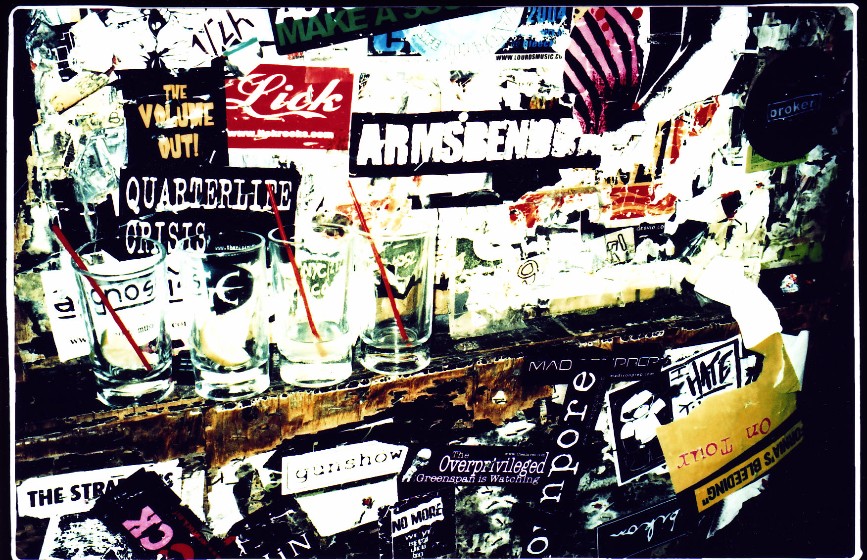
I found a tall stool alongside the wall and got to absentmindedly picking at the band stickers plastered all over the place. The narrow ledge was cluttered with empty cocktail glasses, their little red straws dry and lonely. Willie the bartender looked seriously stressed out, his ruddy Irish face even redder and splotchier with this bad weather and the motion of keeping up with the throngs banging on his counter for their drinks.
Wednesday nights I meet up with Georgie and we drink soda waters Willie throws down for free, fizzing them up as we empty them, plunking a fat wedge of lime into the bubbles. Typically he settles down at the far end of the bar, giving me and Georgie our privacy, and gets to work writing a play based on his dramatic Irish alcoholic family. Wednesday nights are a funny at the UqBar: me and Georgie with our non-drink drinks, a scattering of olde tyme boozers, hard-drinking senior citizens whose cauliflower noses burst with gin blossom bouquets. They resent the bar’s switch from a dank townie sports bar to a hangout for bike messengers and artists with bands on the weekends. They hate change generally and change that affects their drinking in particular, but instead of scuffling over to Dapper’s or Patâ’s for their watery whiskeys they keep an allegiance to a long-past time, their tired asses hugging the busted barstools, getting tanked, glaring at everyone and starting sad little fights on occasion. So there’s us, there’s them, and somewhere in the middle is William, tossing back a shot of something every so-many-pages, never complaining about the utter lack of tips because Wednesday nights leave him alone. No customers to yank him out of the flow of his story, no visits from his dad, both the owner of the establishment and the star of Willie’s play.
I felt bad bothering Willie tonight. He was so hectic, and he hates to work. His orange hair was tugged into a messy ponytail, I was jealous of the teensy breeze it must have created as it swung against his neck. I wanted a water but I didn’t want to hassle him and I didn’t want to get up and lose my seat to a looser. I sniffed at the glasses in the lineup before me. Sniff sniff, the supposed smell-less smell of vodka cut with a juice. Sniff sniff, the sickly sweet stink of gin. The glasses with a bit of syrupy brown pooled at the bottom I ignored, they were obviously whiskey dregs, or rum and cokes. This is my favorite bad game to play with myself. Sniff out an abandoned drink, do my best–my very best–to discern its contents and, sure it’s just a harmless shot of water, toss it back. A sort of Russian roulette, if you will. But I haven’t been wrong yet. As it is an obviously twisted game for a recovering drunk like myself to play, nobody in my life lets me indulge. Like a teenage girl hiding out in her bathroom with a razor, I do my secret sniffing on the rare occasions I’m alone at a bar. Georgie, wise to the fucked-up customs of my head, even goes so far as to arrive at UqBar fifteen minutes before my arrival, so I’m under her watchful stare the whole night. But I wouldn’t do it around anyone, anyway. It’s a private ritual, like nose-picking but really, really bad for you. Bad for me.
Anyway, Willie must have spotted me with my snout in a glass cause he came swaggering over, pushing through the loaf of people globbed throughout the bar, and sloshed me a nice, clean glass of water. Water bubbling pure, honest bubbles. Water hugging a green jewel of lime. Thanks, Willie I said. He clanked the empty glasses together in his huge paws, knocking the straws to the ground. Fuckin’ Crazy In Here, he bitched. Can’t Keep Up With These People. Where The Fuck They Come From? We looked around at the townies, dudes you’d more likely see throwing darts over at Dapper’s, ladies with badly bleached mops of hair and tiny terry cloth outfits; weekend regulars drinking mid-week beers–quiet indie kids sweating in their black jeans, hairspray melting on their black hairdos. And the old guys, the geezers. It’s too hot for them in here, I motioned to death row, the curve of the bar closest to the door, where they clustered like moody crows. One of them’s gonna kick it someday, I told him. Then what’ll you do? I Got Practice With That Sort Of Thing, Willie shook his ponytail. They’ll Be In Good Hands. Willie clapped me on the shoulder and I flinched. Shit, he drew back his fingers gummy with my tattoo medicine. What’s This? He tried to back up for a look and rear-ended a frat-looking kid in a tight white baseball hat. Whiteheads, me and Monica called them. Monica being my incredibly recent ex-girlfriend but you, being my diary, already know that. The whitehead started honking, like Willie was trying to freak him on the dance floor and make him a fag or something. When Willie pulled himself to his full height, hands filled with glass, the Whitehead realized he was the bartender and got friendly again. Sorry, Bro! Can You Pour Me A Guinness?
Yeah, Willie gave a sharp nod, all the niceness sucked dry from his face. He turned back to me. We’ll Talk About That Later, Right? Holler When Georgie Shows Up, I’ll Bring Ya’s More Water. I watched him squeeze between a thick wall of flesh and disappear.
And then there was Monica. I think she’d been in the corner behind death row since I got there, but a guy who’d been hunched over the bar straightened up, and in the gap between his undershirt and the drooled-upon bar below, I saw her there and in that instant she saw me. I felt a rush of hot and cold badness, I think it was anxiety, anxiety and anger, like what the fuck was she doing in my bar, she knows me and Georgie hang out here every Wednesday, were we going to have to do that stupid fucking thing where you negotiate where and when we can and can’t go to the various bars and coffeehouses that make up our lives? I’d thought we could do better then that, thought that common sense and basic kindness would keep her out of my few regular haunts and there she was, her intensely curly hair pulled into a knot on the top of her head, sweat shining the makeup from her face. And I felt a plain swell of sadness and simple fear. The first few days of a breakup are crucial alone days. The risk of getting back together out of basic fear, neediness and habit are strong and it was my plan to avoid Monica until I was stronger then all my most pathetic inclinations.
That’ Water, I Hope? She was there before me, being little and wily and able to slink and shove her way through a crowd with relative grace. And I said, Yeah, Of Course and was annoyed that she’d think I’d be so dramatic as to get drunk over her when I was the one that ended the whole thing. I didn’t need her mothering me or framing me as some fragile alcoholic. I wondered if she’d seen me sniffing the glasses earlier. Her fingernails were painted with elaborate leopard landscapes, pink and red leopard. The tiny rhinestone on her longest pinky-nail flashed and I remembered the balls of soggy cotton she’d leave around my apartment, stinking like poison and nail polish melted into the fiber, and I felt a wash of regret. I’ll never see those cotton balls again. Unless I find one, weeks from now, under the sink in the bathroom, behind the toilet, and am made unbearably sad by it. But this is what I wanted, right? Something to feel, some sort of life, even the life of a miserable and heartsick fuckup.
Why are you here? I asked her. I know I was pouting or talking in a fight-starting voice but I couldn’t help it. It was so loud at UqBar. Willie was blaring some awful CD, real slit-your-wrist tunes, depressing Radiohead or something. The mournful keens filled the bar and still the drunk girls on the stage danced,a s if to some Britney Spears track on endless repeat in their heads. Why was Willie playing such bleak music? It was like we were all in some indie film about grim alcoholic drama and this was the soundtrack.
I Came With Tracy, Monica said, and I looked but the old drunk had resumed his face-first plunge into the bar, blocking my view. Why Are You Here? Well, I’m not drinking, I snapped defensively. I’m waiting for Georgie, like always.
Georgieâ’s Gone, she told me. Georgie’s Doing a Sleep Study, She’ll be Gone All Week. How do you know? I asked. I was sounding more and more like a child, but it was a downhill movement that I couldn’t quite stop. I don’t want to talk to you when you’re drunk, I told Monica, even though I did rather like her when she was drunk. She got extra silly and tended to take her clothes off in public. Well, Talk To Me Now, Then, she said, tinkling her glass. Before I Get Drunk. By the toxic green of her glass and the sweet and sour odor emanating from the rim I guessed it was a Midori melonball. A Midori melonball, I scoffed. This was stupid, this was terrible. This was why we’d broken up–a whole lot of numbness punctuated by useless bickering. Tracy’s Drinking Irish Car Bombs, she snarked, If That’s More Real For You.
Listen, I said, how did you find out Georgie’s gone, and who’s watching the bees? Georgie made part of her money renting out her body to various medical studies, and she made the other part by embarking upon short-lived entrepreneurial experiments. Currently she is keeping a hive of bees in the backyard, in hopes of starting a honey dynasty. I’m Watching Them, Monica said. Why you? I felt totally betrayed. Georgie takes off to some sleep torture and recruits Monica to baby the bees? So that means you’re going to be at the apartment all the time?
Not Yours, she said. We Won’t Have To See Each Other.
You’ll be in the yard, I accused. I’ll totally see you.
Pull The Blinds, she shrugged. Don’t Look Out The Window.
I’ll know you’re there, I said. Don’t act like it’s not a big deal.
Georgie Asked Me. Now she was whining.
I can do it, I said. It’s my fucking yard. Why don’t I just do it.
Because You Hate It, Monica said. You Hate The Bees. You’re Scared Of The Bees.
It is true that the bees stung me repeatedly last time I tried to care for them, when Georgie had gone in for a speed study, totally ruining her so-called sobriety by having medical technicians administer government-issue crystal meth straight into her veins. It is true that I almost killed the bees, much as Georgie almost killed herself, submitting to such a jackass experiment. There Was A Fifty Percent Chance That I’d Just Get The Placebo, she’d rationed. Georgie’s Russian roulette. A whole lot dumber then mine, if you asked me. But Monica, it’s true, Monica loved the bees. She was fucking Snow White with them, they buzzed around her like she was their one true queen, they let her pet the fuzz of their backs with her littlest finger.
I Don’t Know Why Georgie Didn’t Tell You, Monica went on. When Did You Last Talk To Her? And I thought and I thought and I realized that I hadn’t talked to Georgie all week. Even our usual Wednesday the week before had been cut short. Hmph, I snorted.
What’s This? Monica said, her voice a rush of alarm and surprise. I Got A Tattoo, I said proudly. Life goes on, right? Here I am, freshly tattooed, part of the flow of life itself, giving myself a little hurt, just a human, hurting. I smiled.
I Thought You’re Broke, Monica accused. She squinted at it. “Joy and Monstrosity.” She paused. That’s From That Song. You Got A Tattoo Of The Song We Broke Up To. And You Have No Money.
I quit therapy, I explained. It was my therapy money. The tattooist gave me a deal. Timotha? You know her?
Monica was staring. She took a hard suck on her straw and swallowed. Her leopard nails tapped the glasses in swift little taps. You Think That’s Smart? Quitting Therapy? Quitting Therapy? Breaking Up Like This? She swallowed hard again even though her mouth was opened. She swallowed like she was going trying to swallow her very throat turn it inside-out like a crazy magician’s trick. Are You Sabotaging Your Life, Annabella?
I don’t know, I said. I really might be. We stared at each other and I saw a moat of tears flooding up behind her eye makeup and I grabbed her wrist. She clutched her drink harder and shook me off.
Jesus, I don’t want your fucking drink! I yelled. Probably I did want her drink, but that’s not why I grabbed her wrist. I grabbed her wrist to say, you don’t want to cry here, you don’t want to cry in front of me, go back to Tracy. I didn’t grab it because I’m some sort of booze fiend with no self-control. I got a sickening flash of Monica talking to someone–her next girlfriend, maybe a boyfriend, maybe just someone we both knew together, saying, “Oh yeah Annabella is such an alcoholic, it’s really intense, it was so hard to be with her . . . you didn’t know? No, she has no control, it was really, really difficult.” And the new girlfriend or maybe boyfriend would hug her tight and smooth her wild curls and they would all feel safe in their lack of alcoholism, or our mutual friend would cluck and say that’s awful and the pity would slosh back and forth between them.
You Are Such An Asshole, Monica said.
This makes it easier, I said. Just hate me, then. Sure. Then there can be a bad guy, I’ll be the bad guy. And my alcoholism can be the reason and now you’ve got a whole little story to tell everyone about why we broke up. To tell yourself. Good-bye. I slurped my water. The carbonation felt violent, seared my throat, made me choke a little. Made my eyes tear up. I waved my hand. Really, I said. Go back to Tracy. You left her in the corner forever ago. This is stupid. I’m outta here. I felt dumb for having used the phrase “outta hereâ” but really I was shaking.
You Got A Tattoo Of The Last Song We Had Sex To, Monica said.
I know, it looks really bad, I said.
You Mean It Seems Crazy? she asked.
I nodded. Yeah.
Because It Looks Really Beautiful. But It Seems Really Fucked Up.
I left the bar. I slammed and shoved my way past Monica and into the mix of people. The bad sad music howled and the drunks chattered and I chucked the swinging door out into Boston and the hot hot air hit me in the face. I had nowhere to go, so I went home.
Should have run upstairs to thump on Georgie’s door, I would have seen the note pinned to the wood alerting the world that she’d been selected for the sleep-study and was in seclusion at a medical compound somewhere in the city. Instead I walked the grassy parkway in the warm night, my tattoo radiating heat like a sunburn. The breeze felt like the dry air that rushes out from a baking oven when you lower the door, it didn’t help at all. Only marginally better than the cramped apartment and my pathetic fan whirring its futile breath around the room. I walked the parkway and it was lively with others escaping their sweltering homes, lots of dogs in the grass and beer on the benches. I turned down the cobblestones to UqBar and shoved the swinging doors open.
The stink of old kegs and a century of spilt liquor smacked me in the nose. I understood that to adjust to the cigarette haze hanging like a cloud cover I would be forced to smoke one myself. At least a cigarette would have a filter, you know? UqBar was packed. Not what I expected, but I guess the heat was making everyone nuts, making everyone crave a beer and respite from the terrible warm of their apartments. And if there’d only been the usual four or five people slumped on the bar, UqBar would have been pretty cool, a darkened cave, the walls black, a trough of ice behind the bar. But all the yahoos and their body heat and sweaty t-shirts had ruined it. They were crazy with the relentless summer and were drunk already and dancing, going mad, their bodies’ humidity rising into a human smog that made the air swampy. I was hoping Georgie showed up soon so we could split, maybe plant our asses on the smooth green grass of the parkway and play with other people’s dogs or something.
I found a tall stool alongside the wall and got to absentmindedly picking at the band stickers plastered all over the place. The narrow ledge was cluttered with empty cocktail glasses, their little red straws dry and lonely. Willie the bartender looked seriously stressed out, his ruddy Irish face even redder and splotchier with this bad weather and the motion of keeping up with the throngs banging on his counter for their drinks.
Wednesday nights I meet up with Georgie and we drink soda waters Willie throws down for free, fizzing them up as we empty them, plunking a fat wedge of lime into the bubbles. Typically he settles down at the far end of the bar, giving me and Georgie our privacy, and gets to work writing a play based on his dramatic Irish alcoholic family. Wednesday nights are a funny at the UqBar: me and Georgie with our non-drink drinks, a scattering of olde tyme boozers, hard-drinking senior citizens whose cauliflower noses burst with gin blossom bouquets. They resent the bar’s switch from a dank townie sports bar to a hangout for bike messengers and artists with bands on the weekends. They hate change generally and change that affects their drinking in particular, but instead of scuffling over to Dapper’s or Patâ’s for their watery whiskeys they keep an allegiance to a long-past time, their tired asses hugging the busted barstools, getting tanked, glaring at everyone and starting sad little fights on occasion. So there’s us, there’s them, and somewhere in the middle is William, tossing back a shot of something every so-many-pages, never complaining about the utter lack of tips because Wednesday nights leave him alone. No customers to yank him out of the flow of his story, no visits from his dad, both the owner of the establishment and the star of Willie’s play.
I felt bad bothering Willie tonight. He was so hectic, and he hates to work. His orange hair was tugged into a messy ponytail, I was jealous of the teensy breeze it must have created as it swung against his neck. I wanted a water but I didn’t want to hassle him and I didn’t want to get up and lose my seat to a looser. I sniffed at the glasses in the lineup before me. Sniff sniff, the supposed smell-less smell of vodka cut with a juice. Sniff sniff, the sickly sweet stink of gin. The glasses with a bit of syrupy brown pooled at the bottom I ignored, they were obviously whiskey dregs, or rum and cokes. This is my favorite bad game to play with myself. Sniff out an abandoned drink, do my best–my very best–to discern its contents and, sure it’s just a harmless shot of water, toss it back. A sort of Russian roulette, if you will. But I haven’t been wrong yet. As it is an obviously twisted game for a recovering drunk like myself to play, nobody in my life lets me indulge. Like a teenage girl hiding out in her bathroom with a razor, I do my secret sniffing on the rare occasions I’m alone at a bar. Georgie, wise to the fucked-up customs of my head, even goes so far as to arrive at UqBar fifteen minutes before my arrival, so I’m under her watchful stare the whole night. But I wouldn’t do it around anyone, anyway. It’s a private ritual, like nose-picking but really, really bad for you. Bad for me.
Anyway, Willie must have spotted me with my snout in a glass cause he came swaggering over, pushing through the loaf of people globbed throughout the bar, and sloshed me a nice, clean glass of water. Water bubbling pure, honest bubbles. Water hugging a green jewel of lime. Thanks, Willie I said. He clanked the empty glasses together in his huge paws, knocking the straws to the ground. Fuckin’ Crazy In Here, he bitched. Can’t Keep Up With These People. Where The Fuck They Come From? We looked around at the townies, dudes you’d more likely see throwing darts over at Dapper’s, ladies with badly bleached mops of hair and tiny terry cloth outfits; weekend regulars drinking mid-week beers–quiet indie kids sweating in their black jeans, hairspray melting on their black hairdos. And the old guys, the geezers. It’s too hot for them in here, I motioned to death row, the curve of the bar closest to the door, where they clustered like moody crows. One of them’s gonna kick it someday, I told him. Then what’ll you do? I Got Practice With That Sort Of Thing, Willie shook his ponytail. They’ll Be In Good Hands. Willie clapped me on the shoulder and I flinched. Shit, he drew back his fingers gummy with my tattoo medicine. What’s This? He tried to back up for a look and rear-ended a frat-looking kid in a tight white baseball hat. Whiteheads, me and Monica called them. Monica being my incredibly recent ex-girlfriend but you, being my diary, already know that. The whitehead started honking, like Willie was trying to freak him on the dance floor and make him a fag or something. When Willie pulled himself to his full height, hands filled with glass, the Whitehead realized he was the bartender and got friendly again. Sorry, Bro! Can You Pour Me A Guinness?
Yeah, Willie gave a sharp nod, all the niceness sucked dry from his face. He turned back to me. We’ll Talk About That Later, Right? Holler When Georgie Shows Up, I’ll Bring Ya’s More Water. I watched him squeeze between a thick wall of flesh and disappear.
And then there was Monica. I think she’d been in the corner behind death row since I got there, but a guy who’d been hunched over the bar straightened up, and in the gap between his undershirt and the drooled-upon bar below, I saw her there and in that instant she saw me. I felt a rush of hot and cold badness, I think it was anxiety, anxiety and anger, like what the fuck was she doing in my bar, she knows me and Georgie hang out here every Wednesday, were we going to have to do that stupid fucking thing where you negotiate where and when we can and can’t go to the various bars and coffeehouses that make up our lives? I’d thought we could do better then that, thought that common sense and basic kindness would keep her out of my few regular haunts and there she was, her intensely curly hair pulled into a knot on the top of her head, sweat shining the makeup from her face. And I felt a plain swell of sadness and simple fear. The first few days of a breakup are crucial alone days. The risk of getting back together out of basic fear, neediness and habit are strong and it was my plan to avoid Monica until I was stronger then all my most pathetic inclinations.
That’ Water, I Hope? She was there before me, being little and wily and able to slink and shove her way through a crowd with relative grace. And I said, Yeah, Of Course and was annoyed that she’d think I’d be so dramatic as to get drunk over her when I was the one that ended the whole thing. I didn’t need her mothering me or framing me as some fragile alcoholic. I wondered if she’d seen me sniffing the glasses earlier. Her fingernails were painted with elaborate leopard landscapes, pink and red leopard. The tiny rhinestone on her longest pinky-nail flashed and I remembered the balls of soggy cotton she’d leave around my apartment, stinking like poison and nail polish melted into the fiber, and I felt a wash of regret. I’ll never see those cotton balls again. Unless I find one, weeks from now, under the sink in the bathroom, behind the toilet, and am made unbearably sad by it. But this is what I wanted, right? Something to feel, some sort of life, even the life of a miserable and heartsick fuckup.
Why are you here? I asked her. I know I was pouting or talking in a fight-starting voice but I couldn’t help it. It was so loud at UqBar. Willie was blaring some awful CD, real slit-your-wrist tunes, depressing Radiohead or something. The mournful keens filled the bar and still the drunk girls on the stage danced,a s if to some Britney Spears track on endless repeat in their heads. Why was Willie playing such bleak music? It was like we were all in some indie film about grim alcoholic drama and this was the soundtrack.
I Came With Tracy, Monica said, and I looked but the old drunk had resumed his face-first plunge into the bar, blocking my view. Why Are You Here? Well, I’m not drinking, I snapped defensively. I’m waiting for Georgie, like always.
Georgieâ’s Gone, she told me. Georgie’s Doing a Sleep Study, She’ll be Gone All Week. How do you know? I asked. I was sounding more and more like a child, but it was a downhill movement that I couldn’t quite stop. I don’t want to talk to you when you’re drunk, I told Monica, even though I did rather like her when she was drunk. She got extra silly and tended to take her clothes off in public. Well, Talk To Me Now, Then, she said, tinkling her glass. Before I Get Drunk. By the toxic green of her glass and the sweet and sour odor emanating from the rim I guessed it was a Midori melonball. A Midori melonball, I scoffed. This was stupid, this was terrible. This was why we’d broken up–a whole lot of numbness punctuated by useless bickering. Tracy’s Drinking Irish Car Bombs, she snarked, If That’s More Real For You.
Listen, I said, how did you find out Georgie’s gone, and who’s watching the bees? Georgie made part of her money renting out her body to various medical studies, and she made the other part by embarking upon short-lived entrepreneurial experiments. Currently she is keeping a hive of bees in the backyard, in hopes of starting a honey dynasty. I’m Watching Them, Monica said. Why you? I felt totally betrayed. Georgie takes off to some sleep torture and recruits Monica to baby the bees? So that means you’re going to be at the apartment all the time?
Not Yours, she said. We Won’t Have To See Each Other.
You’ll be in the yard, I accused. I’ll totally see you.
Pull The Blinds, she shrugged. Don’t Look Out The Window.
I’ll know you’re there, I said. Don’t act like it’s not a big deal.
Georgie Asked Me. Now she was whining.
I can do it, I said. It’s my fucking yard. Why don’t I just do it.
Because You Hate It, Monica said. You Hate The Bees. You’re Scared Of The Bees.
It is true that the bees stung me repeatedly last time I tried to care for them, when Georgie had gone in for a speed study, totally ruining her so-called sobriety by having medical technicians administer government-issue crystal meth straight into her veins. It is true that I almost killed the bees, much as Georgie almost killed herself, submitting to such a jackass experiment. There Was A Fifty Percent Chance That I’d Just Get The Placebo, she’d rationed. Georgie’s Russian roulette. A whole lot dumber then mine, if you asked me. But Monica, it’s true, Monica loved the bees. She was fucking Snow White with them, they buzzed around her like she was their one true queen, they let her pet the fuzz of their backs with her littlest finger.
I Don’t Know Why Georgie Didn’t Tell You, Monica went on. When Did You Last Talk To Her? And I thought and I thought and I realized that I hadn’t talked to Georgie all week. Even our usual Wednesday the week before had been cut short. Hmph, I snorted.
What’s This? Monica said, her voice a rush of alarm and surprise. I Got A Tattoo, I said proudly. Life goes on, right? Here I am, freshly tattooed, part of the flow of life itself, giving myself a little hurt, just a human, hurting. I smiled.
I Thought You’re Broke, Monica accused. She squinted at it. “Joy and Monstrosity.” She paused. That’s From That Song. You Got A Tattoo Of The Song We Broke Up To. And You Have No Money.
I quit therapy, I explained. It was my therapy money. The tattooist gave me a deal. Timotha? You know her?
Monica was staring. She took a hard suck on her straw and swallowed. Her leopard nails tapped the glasses in swift little taps. You Think That’s Smart? Quitting Therapy? Quitting Therapy? Breaking Up Like This? She swallowed hard again even though her mouth was opened. She swallowed like she was going trying to swallow her very throat turn it inside-out like a crazy magician’s trick. Are You Sabotaging Your Life, Annabella?
I don’t know, I said. I really might be. We stared at each other and I saw a moat of tears flooding up behind her eye makeup and I grabbed her wrist. She clutched her drink harder and shook me off.
Jesus, I don’t want your fucking drink! I yelled. Probably I did want her drink, but that’s not why I grabbed her wrist. I grabbed her wrist to say, you don’t want to cry here, you don’t want to cry in front of me, go back to Tracy. I didn’t grab it because I’m some sort of booze fiend with no self-control. I got a sickening flash of Monica talking to someone–her next girlfriend, maybe a boyfriend, maybe just someone we both knew together, saying, “Oh yeah Annabella is such an alcoholic, it’s really intense, it was so hard to be with her . . . you didn’t know? No, she has no control, it was really, really difficult.” And the new girlfriend or maybe boyfriend would hug her tight and smooth her wild curls and they would all feel safe in their lack of alcoholism, or our mutual friend would cluck and say that’s awful and the pity would slosh back and forth between them.
You Are Such An Asshole, Monica said.
This makes it easier, I said. Just hate me, then. Sure. Then there can be a bad guy, I’ll be the bad guy. And my alcoholism can be the reason and now you’ve got a whole little story to tell everyone about why we broke up. To tell yourself. Good-bye. I slurped my water. The carbonation felt violent, seared my throat, made me choke a little. Made my eyes tear up. I waved my hand. Really, I said. Go back to Tracy. You left her in the corner forever ago. This is stupid. I’m outta here. I felt dumb for having used the phrase “outta hereâ” but really I was shaking.
You Got A Tattoo Of The Last Song We Had Sex To, Monica said.
I know, it looks really bad, I said.
You Mean It Seems Crazy? she asked.
I nodded. Yeah.
Because It Looks Really Beautiful. But It Seems Really Fucked Up.
I left the bar. I slammed and shoved my way past Monica and into the mix of people. The bad sad music howled and the drunks chattered and I chucked the swinging door out into Boston and the hot hot air hit me in the face. I had nowhere to go, so I went home.
Michelle Tea is the author of Valencia, The Chelsea Whistle, Rent Girl, Against Memoir, and many other books. She is the cofounder of the notorious all-girl poetry roadshow Sister Split, and continues to drag herself and other brave performers across the US on grueling performance-art boot camps. Born and raised in Chelsea, Massachusetts, she presently lives in San Francisco with her transboyfriend and their weird cat. Click here to read more of her work and find out about upcoming readings.
Subscribe to get new flash fictions in twice a month in your inbox.
Submit your flash fiction or personal essays to Fiction Attic.
-
More Lies–flash fiction by Gloria Frym

Rumor has it, this woman goes through dogs. Some women go through husbands, some men go through women, some kids go through clothes, ballerinas go through toe shoes, spendthrifts go through money, overeaters go through cookies. And so forth. But this woman, this is her sixth dog in a short time. Longer, of course if you count it in dog years.
The porch gossips say, and who knows if they can be trusted, who really knows what’s what, that she might have a disease. You know the kind they feature on a 60 Minutes or “ER.” The kind that glues people to the TV because they’re horrified and compelled like they’d be at a bloody accident or a building on fire. So long as it’s not them or theirs.
Dog #1 died suddenly.
Dog #2 died suddenly after a brief illness.
Dog #3 died slowly after a slow illness and many vet visits.
Dog #4 died some way, no one remembers.
Dog #5 rolled over and died.
Dog #6 is okay now but was sick as a small puppy.The gossips are crossing their fingers. After all they live in the same vicinity. The woman says the veterinarian says that there’s something toxic in the soil in her backyard. What if there’s something toxic in all their backyards? What if her house and their houses were built over old gas stations or car repair shops? It’s hard to believe that this woman would ever let her dogs out in her backyard. Dog #6 she carries in a baby front pack because he is very little. He’s not going to get much bigger, either. But now, she says, he’s better, and she lets him move around on a leash. In fact, she walks him. So, say the gossips, and she probably never puts him outside alone. That’s why they’re suspicious.
It could be that this woman simply has bad luck with pets.
It could be that this woman makes her pets ill so she can nurse them, right up to their death.
She has no children and no husband.
The gossips say, Thank God for that.
It is very hard, given the circumstantial evidence, when one is told of such events, not to believe them. They sound so plausible, even if there is no proof. Why do they appeal to one’s instincts rather than one’s reason? Juicy bits of information about a woman who is rather nervous and neurotic, who strolls down the street with a different dog every year or so.
Goes to great lengths, far away places to buy the dogs, after long email conversations with their breeders. Always a pure-bred dog. Always from out of state. The facts start to pile up, right? Something, if one had nothing else to do, one could take to a private investigator. He’d solve it, all right.
Can you go to jail for murdering a dog? It’s a misdemeanor. The law considers dogs “chattel.” But you remember that guy who threw a dog off the freeway? That was cruelty. That got him jail time. How about murdering someone else’s dog? That would also get you jail time.
Somewhere there is something called an Animal Patrol. Not like they take animals to the pound, but they remove abused pets from homes. Kind of like Child Protective Custody Services.
Yesterday, I lied.
A good lie, told spontaneously, is a piece of art, though it makes person like me guilty. It could be addictive. It worked that well.
It all started after I’d heard about the woman with the succession of dogs.
The car wouldn’t start. The battery dead, again.The operator at triple A says, 45 minutes.
Forty five minutes, I say, oh no! I have to pick up a child!
From school or from daycare? the operator asks.
From daycare. If you’re late, they just take the kid to Child Protective Custody Services.
Oh my God, the operator says, greatly alarmed. Is that what they do these days?
Oh yes, I say, they just don’t want to wait.
In two minutes, a tow truck arrived.
So your little car won’t start, hon?
Yeah, it’s always the battery.
He did his jumping magic with great dispatch.
When I thanked him for arriving on the scene so quickly, he said, Oh, you deserve even faster service.
How could it be faster, I thought?
Of course, he said, What you deserve and what you get are two different things in this world.
Yeah, I know I said. I mean I was just laid off, I lied again.
You in the tech biz?
No, I’m a school teacher.
A teacher! For Christ’s sake, the bastards. It will come back to them. Some kid will kill a dog because nobody taught him the right way to behave.
This piece was originally published in 2005.
Gloria Frym is the author of How Proust Ruined My Life and Other Essays (2020), The True Patriot (2015), How I Learned (1992), Distance No Object (2001), and several other volumes of poetry and prose, including By Ear, Back to Forth, Impossible Affection, and Homeless at Home. She is also the author of a book of interviews, Second Stories: Conversations with Women Artists. Since 1987, she has been a member of the core faculty of the Poetics Program at New College in San Francisco. She also teaches in the MFA Program in Writing at California College of the Arts.
Subscribe to get new flash fictions in twice a month in your inbox.
Submit your flash fiction or personal essays to Fiction Attic.