Your cart is currently empty!
Category: early-issues
-
10 Questions: an interview with Kate Braverman

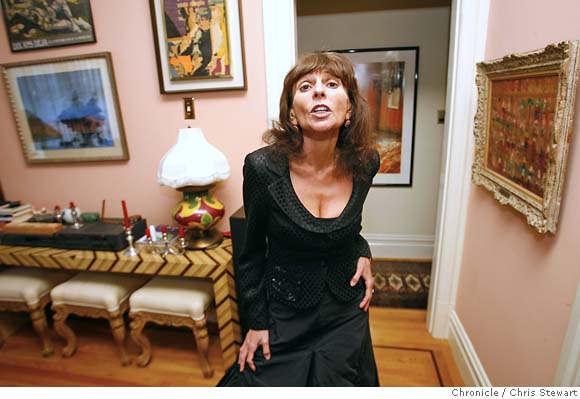
Kate Braverman photographed by Chris Stewart for the San Franicisco Chronicle In 2005, Michelle Richmond conducted this interview with Kate Braverman. Topics discussed: Braverman’s long career, experimentation in writing, book autopsies, San Francisco writers, revision, writing about climate, live audiences, and more.
Kate Braverman books: Lithium for Medea (1979), Palm Latitudes (1988), Squandering the Blue (1990), Wonders of the West (1993), Small Craft Warnings (1998), Frantic Transmissions to and From Los Angeles: An Accidental Memoir (forthcoming 2006, winner of the Graywolf Nonfiction Prize)
What are you reading right now?
In my new mission to build a critical apparatus for this region, which I think is lacking because we are a unique post-historical conceptual region–that’s our legacy and reality–rather than a 20th century area measured in miles and area codes. So I read the National Book Award offerings, particularly Vollmann’s Europe Central which I loved, and Didion’s Year of Magical Thinking which I loathed.
One is a revolutionary view and the other etiology of privilege. I want to make distinctions, from the text outward. A real political voice rises indigenous from the page effortlessly. A false one happens by inflicting the politics onto the page and then filling in a story. I can recognize the difference. I read Blaise Cendrares’s Prose on the Transsiberian for the pleasure, as I pick up one of the same half a dozen poets and just read out loud for the music and transcendent joy. Plath. Neruda. Paz. I re-read, recently books of the 70’s, beginning with Hunter Thompson, ‘Robert Stone’s Dog Soldier and A Flag for Sunrise, Tom McGuane’s 92 in the Shade and Panama. I like to be read to. My husband is re-re-re reading out loud the LaCarre Tinker Tailor trilogy for the 8 or 9th time. That trilogy is better than Grahme Greene. I read very little, as reading is a work activity for me, as demanding as writing. I don’t read a book, but autopsy it. With somebody like Vollmann, one of his novels is like receiving the schematics for literary wmd’s.
2. It’s the 25th anniversary of the publication of Lithium for Medea. Congratulations! Any advice to writers on how to hang in there for the long haul?
When I began pubishing in the early and mid 70’s, it was the publishing world. Then it became the publishing business, then the publishing industry. When I began publishing, it was “a hand shake” situation, it was daring to use a female name, as the chances of publication were automatically diminished. My first stories were sent out with just initals, as was the custom then. K.E. Braverman. Not overtly belonging to that unpublishable caste, females.
How to hang in for 25 years, doing experimental work and taking the chance that the increasingly random maketerplace will not delete you, the spreading dumbness and numbness of a reading public that wants tiny conventional restatements of what they already know rather than engage in the trek of ambiguity and complexity a real literary work demands?Agents and publishers who care least about the literary merit but most about sales? Marcel Duchamp said if you’re 20 and you write poetry, you are 20. If you’re 50 and you write poetry, you’re a poet. I write because I have a calling I’ve been practicing for 30 years and it is the way I interface with reality. I am addicted and can not live without it. I’ve burned all the boats back, so I am marooned on this island where there is only landscape, dialogue blowing in with the vanilla scented wind and a word processor. No seasons, no climate, no time zones, just the work. It’s not a question of hanging in, but rather chancing to survive.
Most of the writers I meet don’t have a calling. I’ll do another 12 drafts of a piece that’s been rejected because I know I can make it better, get deeper, find where there’s an intersection I missed. Many writers I meet are not writing for the acts of alchemy that can occur when the page is entered into by convenant, caress and sacrifice. They are not using the page as it is meant to be used, but inflicting other mediums onto the innocent surface–as tv shows or tv sized ideas in book format. This is not a book, but a desecration. Why don’t those people simply write screenplays or treatments? Essentially, I’ve been reading San Francisco writers and re-reading.
3. Your husband is a musician, correct? Do you write to music? If so, was there a soundtrack of choice while you were composing your latest book, Frantic Transmissions to and From Los Angeles: An Accidental Memoir?
My husband is a research scientist, a molcular biologist, genetic enginner, biomaterials, nanotechology visionary, and futurist. We tied for the Economist Prize in 2003, he wrote about the ethics of nanotech and I wrote a prose poem about growing up in LA and we were astounded to tie for the prize. He’s writing a book about the implications of the new technology on our collective human future.
He’s a musican by love. Over the years, we’ve experimented with putting his music behind or collaged with my poems. He’s in charge of all the music. Now we’ve got about 90 minutes of set music with poems and will be performing then for the Lithium for Medea birthday parties I’ll be having in NY, Paris, Instanbul and other cities. I’m using the 15 poems I arbitrarily chose that were written in the same voice, and then wrote a narrative for and between, the poems that were the spine and anatomy of LFM
4. What is the significance of the title of your forthcoming book, Transgressions to and From Los Angeles: An Accidental Memoir? Were there any other titles in the running before you chose this one?
The new Graywolf Prize book didn’t have a sound track but the 7 seasons that lashed me as I wrote it in a farmhouse in the Allegheny Mts. of remote rural western NY State, just above PA where our nearest city was Buffalo and there was an 8 month virulent winter. It had a brutal yellow glare, since it’s about growing up in LA, moving to the country for that mythic second life in buccolic rural America. Then I spent a month in Prague and soaked up Gothic architecture and the lavendar on the cobblestones and the reds and purples of acres of Bohemian crystal and gave the book a certain softening gilt, garnets on the fingers, neck and wrists.
There were no alternative titles, but there was a new ending I wrote after I’d won the prize which GW rejected. I wonder if it was censored and will be trying to identify those I can ask to read the ending I wrote and tell me if they think the real end was censored and if it damaged the political trajectory. I suspect it did.
I need to keep my living environment as bland, unobtrusive, quiet visually and audio as possible. I don’t have a tv or subscribe to any print publications. I delete popular culture completely from my writing life. I’ve been lisening to the same dozen albums for 10 years. I’m not interested in fashion, sports, the sport of politics. I pull the blinds when I write. I keep my back to the wall when I work. I’m a method writer, I live what I write (and so much more) so I’ve almost got my skin off, I’m using the loose tissue for sails, so I am always vulnerable and find transitions between the writing region and ordinary world extremely difficult.
5. You’ll be doing some events in Paris upon the publication of Frantic Transmissions in February. What does Paris mean to you as a writer?
I told my French publisher, Quidam, that I always wanted to be avant garde, but 25 years was more than I had planned on. When the books were published in Italy, it was information presented and received in so listless and posthumous a fashion, another publisher, another problem, that I didn’t see a way of partipating effectively. With the French, I sought contact and established a personal relationship by email. I offered to go and this has turned into a real tour. Turkey is publishing LFM in Jan and Palm Lat, my 1988 novel in May, and after Paris, I’m going to Istanbul for Univ readings, tv and media. I just found out about this and am very excited. Paris holds a significance not only in the conventional literary sense one ordinarily thinks of, but as a sign that my work must find a global audience, that the political intentions of my work might not be acceptable to American audiences (after 30 years) in the demand on the reader to engage in illness, marginalization, racism, the struggles of single mothers, anti-Semitism, the degradation of the 60’s asethetic entirely—I ‘ve always thought my books would be better read outside this country which continues to swing to right=Christian side in a suffociating, frightening way.
6. Okay, we ask this of everyone: what’s your favorite San Francisco eatery?
I am not interested in food as fashion. I hardly eat at all, don’t drink alcohol, work odd hours and don’t have a single favorite restaurant. I am not interested in food any more. A bowl of brown rice, oatmeal, fruit. I live on the milk in cafe lattes and vitamins. I just lost interest in food, selecting it, carting it in, preparing it, cleaning it up. In the Allegeny Mt exile, there were no restaurants and social life was the senior faculty inviting one another over for dinner. I learned to cook, grew my own foods, once made 3 pies a day for an entire summer to perfect my crust.
When our daguther left for college, I annnounced I was no longer cooking. When we moved to SF, I announced I was no longer shopping or washing dishes. The women’s arts are too time consuming–it takes me all day to make a dinner and clean it up. I don’t have six hours laying around like that. Or I chose not to. I have always resented the time and energy the correct wife and mother is supposed to give to banal unnecessary activities. I am disturbed by how easily women writers cave into the same traditional peer pressures, especially with children. I want to make a car bumper sign that says JUST SAY NO TO SOCCER.
I’ve dealt with these issues in the 2 collections of unpublished stories I have. Professional women are gutting their work and personal schedules for the new holy collective hallucination of soccer. My daughter, who is graduating from law school in May was raised by a feminist artist who was not a dillatante, but actually worked all the time. I told her my writing life was as much a real job as being a doctor or lawyer, that I had hours of work, that I wasn’t available for her every whim. We live in a society where every kid’s stray spasm of enthusiasm is met with an immediate new uniform and coach. It’s random. Like week of the “C”. Every kid has cello lessons, Chinese and calligraphy, canoe lessons. Then it’s “M” week. Mandolines, Mandarin study, Muslim awareness, micro something, Mars study. We give our children an enormous sense of entitlement by mutilating our professional and personal lives for childish passing whims. What kid actually possesses the plethora of gifts we routinely attribute to them? Virtually no one. It’s another passing fashion that I am passing on.
7. Climate is often such an enormous presence in your writing. Why?
I go native wherever I live. As a CA writer, as a writer without skin, I write on a molecular level using my synapses as tools, the external landscape is a character for me. I’ve been more intimate with certain landscapes than certain husbands. My aesthetics have an errotic compoenent. I love landscape in a profound way I can translate onto the page, which is a unique kingdom, with its own unique rules and seasons, like a continent, vast, mysterious, inexplicable and inexhorable. To be a CA woman, even more so in LA where I was based for 20 years. is to inhabit a non-traditional America, without seaons, closer to Mexico City or the Pacific Rim than Europe. In LA, it was always about keeping the indigenous out, that real art could actually be done by residents of the subliterate heathen masses was unthinkable when I began doing it. We have a different relationship to traditional anglo-europen writing. We don’t have Hawthrone’s dark forest, we’re not in opposition to our nature but coexist with it in harmony. Our cities are named for Spanish saints and butchers. Asia blows in our wind. It is a climate that encourages experimentation and a more confessional approach. That’s why SF has a legacy as an outlaw capital. We welcome the renagade, the outlawed, the visionary and eccentric here. LA does now, but only if the individual is carrying a pass from a studio and can prove they have a movie in a secondary phase of development. Climate has an impact that is defining. When I lived in rural isolation, where getting 12 miles to the town with a supermarket was often impossible, a certain smallness of ambition and possibility becomes an intrinsic compoenent of one’s actions and vision. I love SF, this port city built by desperate gold diggers and the adventuresome that have at least moored here at pivitol junctions.
8. Much of your work seems to beg to be performed. How would you describe the relationship between you and the audience during a live performance?
I began as a poet and one of the first poetry readings I attended was one I gave. As a poet and now a writer of incantory prose, such writing is intended to be read out loud. I have seen many opportunities during my career to put the work on stage. During the 70’s, when I came of age as a writer (I was a Haight Ashbury runaway at 15 and put myself through Berkeley High and Cal in LA (Hunter Thompson and the Beats are 20 and 30 years older then me) it was the time of Punk. Since many of the punk bands went through the Venice Poetry Workshop, which I was a director of at the time, poets and punk bands were performing together. I saw the change of dynamic becoming a performer would require and this did not appeal to me and my work on the page. I used to do readings with a pencil in one hand so I could live edit, feel the kinetics of where a piece was off. Trust your ear, not your eye. Trust the physical kinetics, not what the lines look like. I write music. I don’t write, I compose. I started to give live readings in SF after many years of not having a live audience and I loved it again, felt the thrill again. We would, over the years, do an occasional gig with music, but I didn’t want to put the energy into it—a form of washing dishes, dispensible. Now we’re doing it for fun, the classic poems with music written as for songs. The rush of connecting with an audience when you don’t have a book in your hand is up there with injecting drugs and sex. It’s an A list rush. Since moving to SF, I’ve become more experimental about the work in all forms, including considering stage and music, rythem, cadance, that which accentuates the incantory nature of the work. Our living room is now an ad hoc recording studio. We’re exploring a whole new terrain. I think I can write directly to the music and will be trying that as an experiment. Writers don’t experiment enough, take the wild chance, rearrange, restructure, re-experience, reinvent. Our approach with the sound collages is an entirely new synethesis. The possibilities are still unfolding.
9. Robert Polito, who judged the Graywolf Nonfiction Prize, called your prizewinning manuscript ” an enthralling mix of memoir, history, and fever dream.” What is the role of dream in literary creation? More specifically, fever dream?
Many answer, though few are called. To volantarily enter a sort of permanent house arrest, to live as though you are at all times engaged in a public psychoanalaytic session/AA sharing meeting, while feeling you are being interrogated by state police and confession to a priest is not for everyone nor should it be. To live with emotional malaria is not a wise decision and should only be taken if there is no alternative. They are graduating 10,000 certified MFA writers a year. That’s 10,000 unemployed writers who must get jobs teaching in MFA programs, of which few will be gainfully employed and fewer still will earn a living from the sales of their work.
In her great book on writing, The Writing Life, Annie Dillard observes that very few are writers and very little harm comes to them. I would add that the converse is also true. Looking at the artists of the last century in America, it’s a story of suicide, drug adiction, alcoholism, child abandonment, divorce, dysfunction, mental illness. Of course, when men engage in these behaviors, we say they not etching lives of brutal chaos, but are the embodiment of the mythic artist. When women engage in these identical behaviors, we call them mentally ill aberrations and degrade and dismiss their contributions. The fever dream, the complete surrender to a transcendent other has always been the province of males. When women enter this state of grace and vertigo, we call them mentally ill, promisicus, defective. Women are chained on the page as they are in life. The marketplace demands female versions of real characters that lack the epic dimensions males are permitted. This has not altered signifcantly during the 30 years of my work.
The new book is a complete experiment in subverting genre. It’s an “accidental memoir” and is, as all my work, rendered in my primary language, which is poetry, with its musical, incantory component. It’s real history, fiction, pure poetry, stand-up comedy monologues, essays I’d written for the LA Times during the Allegany exile, impressions by a CA woman on small town life. It’s about space, architecture, climate, region, identity, aging. It’s pushing the envelope on what nonfiction can do, and since Capote, Mailer, Didion and HST, nonfiction seems a fertile field, less fortressed, fewer crocodiles in the moats.I do wonder about the last chapter, which I may post on my web.
10: What’s in your attic?
Do you mean that metamorphically? My work is largely autobiographical, though the page requires a complete transformation of the original impulses. There are always 2 stories, the one you set out to tell and the dynamic that occurs when the page speaks. It’s a dance, you do some, the page does some. In this dynamic arises the discovery and revelation, the alchemy. My real life is much more exciting then what I’ve written in my 11 published and 5 still unpublished books. My life as a teenage runaway. My life in the LA Punk scene. My life in the barrio of LA where I had an illigitimate baby. My life on the run with my infant from prosecution by the authorities who wanted to decree that I tie my destiny to a stranger I didn’t want to know; most women wouldn’t run. I did. My activities as an anti-war activist during the 60’s. I think my attic has been open for decades. I invite the curious in.
author photo by Chris Felver
Visit Kate Braverman’s web site at www.katebraverman.com.
-
Landfill
flash fiction by Stephen Ausherman
Delores lived in a split-level ranch home set upon a landfill. She stored peach preserves in her storm cellar, but they didn’t taste right. Her husband, before he died, took good care of her. He built a shed on the property, a place where she could keep all the animals she liked to make out of corncobs and gumdrops, life-sized antelopes and ocelots with cellophane eyes and sugary hides. And he erected a satellite dish that pulled in a variety of shows on art, nature, and troubles in the world she could never have imagined on her own.
It stood out in the yard, an enormous unblinking eye that stared at the heavens and shared its visions on a 15-inch screen. It revealed a multitude of ministries from Florida to California, each in desperate need of prayer, forgiveness, contributions, whatever you can afford. Earth is so crowded, they said, and yet so empty. We need your help to fill the void.
Delores could afford little more than hunger, and so focused on the new forms of worship she learned from the TV. She meditated. She danced in circles with her hands in the air. She took a vow of silence and broke it by speaking in tongues. She tried fasting, only to end up with a vitamin deficiency that nearly blinded her. Light from the screen took on an unbearable glare. Soon even the softest glow seemed to sear her eyes.
She sought refuge in the storm cellar, moving in with the spiders and paint cans and peaches in mason jars. Her eyes remained shut, yet cracks of daylight crept in and spread like crimson webs pulsing in her eyelids. She spent days with her face pressed into her knees, just waiting for the night.
Six months of experimental rehabilitation at St. Luke’s inBirmingham restored her sight and relieved her pain. It also afforded her a detailed knowledge of the hospital, its prayer halls, operating rooms, and most of all, its disposal units and incinerators. She soon amassed an impressive collection of surgical leftovers: exhausted organs and severed limbs. She pickled them in formaldehyde and placed the amber jars on the bookcase in her bedroom to keep her ever mindful of the suffering of others.
As her collection grew, she made room in the shed, setting her gumdrop animals loose in the yard, where they blanched in the sun and decomposed in the rain. The satellite remained fixed upon heaven. The needful people on TV grew insatiable.
She retreated once more to the cellar, this time with her jars of humanity. There, in the darkness, her heart beat out its subterranean percussion, talking drums she swore would wake the world. Through the thundering rhythm, she spoke to the jars, whispered to the ears and bones, hands and hearts. She had all the pieces she needed feel whole again. She told them all, one by one, welcome to the family.
Stephen Ausherman’s first novel, Typical Pigs, was nominated for the Peter Taylor Prize and won the Llumina American Writers Contest. He is also the author of a collection of travel essays, Restless Tribes. View his profile on Psychology Today.
This story was originally published on Fiction Attic Press in 2005.
-
12
The Continuity of Light
by Brent Foster JonesRichard and I moved into the house on Sunday: a white, two-story in Marina Del Ray that had taken seven months to renovate. He left two days later.
He told me he tried to put her behind him, but he couldn’t. “I tried,†he said. “This house was your dream. Now it’s my turn.â€
I walked out onto the balcony and watched him drive away in the Mercedes.
Today is Friday.
There is nothing in the house. The furniture we ordered arrives next week. I wanted to stay in a hotel, but Richard thought it might be romantic to sleep on a mattress and eat take-out. “It might be romantic,†he said.
Now I’m alone.
I walk through the rooms at night, wandering, inhabiting. I step into the living room and run my fingers along the white walls, staring into the large, open space. I picture what it might look like when the furniture arrives: the contrast of the white with the dark walnut of the side chairs. I see the beige cashmere sofa and the silver legs of the cocktail tables. I imagine the sheer curtains, the muted Los Angeles light.
The palette we planned together cools and quiets me.
In the new kitchen – we gutted the previous one – there is a bottle of white wine, cigarettes, prescriptions. The room is white, blank – it has no history. I pour a glass of wine and take an Ambien.
I go out on the balcony in the chiffon nightgown, light a cigarette, and wait for the sleeping pill to set in. I look out towards the hotels, the yachts, the shimmering water, the lampposts. Marina Del Ray was a dream – the plan. This is a place for lovers, for companions.
I step back into the kitchen and turn the outdoor lights on, dimming the recessed bulbs. I get something from this – the glow. The light has an editing quality: it tightens and organizes the features of the doors and balcony. It enhances. It arranges.
I take refuge in false comforts, in constructions: in lines, in light – the shape of a bench, the limb of a small tree, the play of moonlight off glass.
It’s later, and I can’t fall asleep. I’m wide awake. I feel leveled, razed.
I’m standing in the redesigned bathroom, easing the nightgown off my shoulders, looking into the mirror at my breasts.
I turned 47 two months ago. My skin is fair. A friend suggested Botox this summer and now the lines on my face are faint, like traces.
Each month I go to a salon in Beverly Hills to have my hair colored—black.
This morning, I saw a photograph in a magazine of a Washington D.C. socialite whose hair is white, like alabaster. In the picture, she is wearing pearl earrings and a crisp, white blouse. I’m picturing my hair white like hers: elegant, confident, and wise.
I’m a decorator. I arrange things and plan patterns. I bring order to rooms. I pair things. Richard is an architect. He sketches. He creates structures and disrupts them. He rebuilds. We have a practice together, and I’ve agreed to dissolve it next month.
“What should we tell our clients?†Richard asked me yesterday in our office.
I didn’t respond, looking into the icy blue curtains.
“Are you all right?†Richard said.
“I don’t know,†I told him.
He walked over to me and touched my arm. “I want you to be okay,†he said.
“Don’t say that,†I said, angrily. “Don’t ever say that to me.â€
To temper what stings, what stuns me, I plan and envision. I pace the house and mentally blueprint each room – the arrangements, the lines. I think about the 1950s chrome lightning fixture for the hallway and the David Tomb charcoal drawing for the dining room. I wait for ideas, for images. I wait for a sense of things.
Now it’s 3:30 in the morning.
I go into the bedroom and lay down under the white sheets. I pull an Ivory cashmere blanket over my legs and stare out the large, rectangular window. I wonder how it happened, where things started to break down between us.
I decide it was either her or me, and he chose her. As I dull from the Ambien, from exhaustion, I imagine that things have righted themselves: that he chose differently – me.
A car door closes softly outside, and I pretend Richard is back. I wait for him to enter the house. I pretend he is lingering outside, admiring our home, his life.
I look down at the contours of my legs, the landscape of my body under the cashmere. I imagine my hair dramatic and white. I feel an earned sexiness – our intimacy – as I pretend he is walking up the stairs. I feel wanted as he reaches the second level, passing the rosewood credenza, moving towards the room. Then I look up. Nothing.
I cry and reason.
I look over at a print from a Japanese gallery that’s still on the floor. It was a gift from Richard. Two black brushstrokes against white. One of the brushstrokes travels across the other, arcing over it, and then it comes back down across it, through it, and to the corner of the print, away.
I turn off the floor lamp next to me.
I close my eyes, and I picture this: I am a line, a piece of light, a direction.
photo by Jason Fuges, photo design by Bernard Kyle.Brent Foster Jones was born in Texas and raised in Louisiana. He is completing his M.F.A. in writing at California College of the Arts. Brent is the recipient of a California College of the Arts All College Honors Honorable Mention for his fiction writing. He is currently at work on a collection of stories and a play.
Bernard Kyle is a photographer and independent curator and works for Other Minds, a
non-profit. He is a graduate student in the art history and museum studies programs at San
Francisco State University.Jason Fuges lives in San Francisco and works as the art director at Berkeley Rep.
-
9
Tie Goes to the Runner
by Debbie McCannTie goes to the runner, in baseball, anyway. Remember? All those hot summer nights on our old block, with parents on the porches and no reason to call us in until way past the slow-falling dark. The whole neighborhood played, teenagers high-fiving little kids and hardly ever any fights. Everything tempered under that blunt wet generous heat. Even the rough tar-and-gravel road softened, giving a little under our bare feet.
We both know it’s over at the very same moment. A tie. So whose ending will it be?
We met playing baseball. You were the new kid, wearing an old glove of your dad’s that was way too big on the wrong hand. We were nine. Our birthdays were a week apart and we both got long plastic rainbow streamers for the handles of our bikes. That summer, I taught you how to pop wheelies and how to skid through the hard-packed dirt gullies behind the houses on your side of the street, and my brother taught us both to throw. You sucked one lip up under the other and the ball flew out straight and hard. You still do that, when you’re concentrating. I taught you how to make a real fist. You got your period first, the only time you got to be the expert. You were always more of a girl.
We were best friends, lab partners, roommates, and then the rest. Everything. And now we are standing on opposite sides of an open apartment door, me on the porch, you on the carpet. You sigh. I am not breathing.
I want the old rules, giving the win to the one who runs her heart out, pounding hard towards the goal so singlemindedly she has to overrun it sometimes. That’s a rule too–they let you overrun it. That shows you how hard it is to get there.
I can’t even count all the things I suddenly long for about those days, before we knew what lay before us. Baseball. Nights that came on so gently it was hard to tell when they’d fully arrived, that dense heat blurring all the edges. The smell of tar on the soles of our feet when even the street wasn’t solid for sure. Back then, just trying hard counted as success. They graded us on it. “But you got an ‘A’ for Effort,†my mom used to say when report cards came home. “And that’s what counts.â€
It used to count. I used to be able to salvage any situation on will, on the strength of pure desperate charm. Make anything right by making you laugh.
But here we are with our toes nudged up against the same conclusion. Tie goes to the runner. I’m looking right at you, hurling my whole self at you. When you look down I know it will be like blinds yanked shut and you’ll be gone.
I look. You look away. You win.
Debbie McCann is a writer, performer, and social worker who lives, works, and writes in the San Francisco Bay Area. She is the author of the short story collection A House in Order (Blinking Yellow Books, 1994).
Photo by Robert McCann.
-
6
In the Kitchen
by Ilana Stanger-Ross

I entered the kitchen and found my father standing over the garbage can, grimacing, eating cheese.
“Your mother buys too much cheese,” he said, his voice dry with the salt of it, “and then you, with your crazy diets, don’t eat it and it goes bad and I have to eat it all.”
“Dad,” I said, with the easy smile of my privileged generation, “That cheese cost what, seven dollars? Less even. The money’s gone whether it gets eaten or not, so you might as well just throw it away.”
My father nodded as I spoke, leaving the cheese temporarily unmolested. “Yes,” he said, “This is true. You’re right, I don’t need to eat this cheese.” And with that he tossed the cheese, saran wrap and all, into the garbage.
I thought, Wow, look at that, I cured my father of the Great Depression.
We each ate a carrot in celebration.
But it didn’t last. My father went back to his old ways, eating his cheese from between the mold. Once I even found him biting into a kitchen magnet. It was made to look like a cookie, and glazed, and it had slid from the refrigerator onto the floor, where my father saw it lying, just being wasted.
The dentist fixed his chipped tooth, said, “Well, these things happen.”
I never gave my speech again, understood the futility. I knew my voice was clear and my father recognized its truth, but his mother’s voice was louder in his ear, whispering, “Ess, ess mein kind, die kinder geyen aus fun hunger in Europe.” Eat, eat my child, for in Europe the children are dying of hunger.
There are forty years between my father and me; there is so much we cannot explain to each other as we stand at separate ends of my mother’s kitchen, eating.
Ilana Stanger-Ross earned a Masters in Fiction from Temple University. She is the recipient of a Leeway Foundation grant for emerging artists, as well as a residency grant from the Ragdale Foundation. Her stories have appeared in Lilith Magazine, Red Rock Review, killingthebuddha.com, and The Bellevue Review. She lives in Toronto.
-
4
The Innocent
by Annee-e. WoodWhen they said ovens, she imagined the soldiers wearing enormous bakers’ hats as they filed people through. She imagined the people came out on the other end as gingerbread families, and the whole thing all just seemed so fake, like a cartoon or a ballet, and she imagined the soldiers as friendly as witches, grotesque and sad, just part of the plot.
She imagined the end, when if finally came, would bring sweet revenge for children and restful, dreamy nights. But she was older now, and losing innocence. So the first night they made love, the first night she made love to anyone, she listened. When she asked him where he came from, he told her he had been sent to England by boat and he didn’t remember what his father looked like and he didn’t remember what his mother looked like, only her smell: lipstick, meat, ash. He remmebered some human packed trains were going one way and some human packed trains were going another, and he remembered the last thing his father told him before he turned away: there are no good or evil people, only the very lucky and the dead. He remembered the snow, and the impossibility of comfortable warmth, only extreme chills and extreme blasts of heat. As he held her, he told her how he imagined the inside of the ovens. And the temperature at which flesh begins to sear.
When they said love she didn’t imagine the hurt. She didn’t imagine hiding naked in the sweat of blankets. She did not prepare for the sour smell of skin. She had not practiced the bareness of rubbing or the strangeness of eyes that held the pain of old ghosts. She did not imagine his cries of pleasure would sound so lost. She did not know the rocking wetness would be sore and tender or that his breathing would make her weep. Or that when he pulled out she would feel the empty space between her legs, and sense a cold abandon. Later, in the morning, she tasted salt. The bitterness of hair. She felt a cavernous scar on the small of his back. She wondered if somehow she had caused the burns, if their heat and friction and persistent touching irritated the skin. She promised herself she would remember every fold of his body, every mole, every line, she would take notes, she would write it down, she would listen, so that eighty years from now when she’d think of heat, she’d think of love, and never forget.
Anne-E Wood grew up in New Jersey and studied theater and writing at Macallister College in St. Paul, Minnesota. She now lives in San Francisco, where she is getting her MFA at San Francisco State University. Her stories have appeared in or are forthcoming from Beloit Fiction Journal, Cream City Review, and Other Voices.
-
Social Contract–by Stephen Elliott
originally published in Issue 11 of Fiction Attic: The Journal of Elegant Wit
“You have the right to bare arms,” she says, slipping the ropes through my fingers, and then around my elbows, pinning them painfully together and cinching them through the window handle above my head. “Just not these arms.”
Her skin is the color of pasta. She has large cheeks, a careful mouth.
“Harry Truman invented the national security state,” she says, my right leg pulled at the ankle by a long cord that finally connects at the base of a radiator. My other leg spread, the rope looped around the refrigerator. My legs spread akimbo, my body utterly vulnerable. “The people have to be afraid, Truman said. That was the way Harry Truman thought. We have to fear the communists. Franklin Roosevelt was dead. Long live Franklin Roosevelt.”
The nipple clamps hurt. The ball gag she has stuffed into my mouth makes it impossible for me to answer her, if there was an answer to be given. She didn’t ask me if I wanted this. She’s stronger than me, especially since my accident. I never fight her anymore. She does what she wants.
“The Geneva convention holds that you can’t torture prisoners. America is a signatory to the Geneva convention. Are you a prisoner?” I nod my head. She closes my nose shut with two fingers. I can’t breath through the gag she has forced into my mouth. There is a moment of peace. This is it, I think. I am going to die. And then my body starts to flop, the panic coming through me involuntarily, and she’s laughing, and she lets go of my nose, and the air rushes into my body in deep, sweeping breathes, and her laughter fills the room with its cruelty.
“We don’t care about treaties,” she says. “Hitler didn’t care about Versailles and they gave him Czechoslovakia, the Rhineland, and Austria. Anshlung. That’s what they call it. But Hitler had his problems. Repressed homosexual.” Her hand runs along my stomach and the top of my leg and then down beneath me, her finger touching my anus.
“Are you a repressed homosexual? You don’t seem to like sex very much. I think you are.” I feel her finger slip slightly into my anus and then out. “So he died in a bombed out bunker in Berlin in 1944, with his new wife. What the hell for?”
I watch as she stands and walks to the closet and dips through the door, rummaging through the sound of paper bags. She has such long legs. She’s a cyclist. Her long thin body is knotty with strips of muscles. Then she’s in front of me, between my legs,
looking gleefully into my eyes, forcing something large into my ass. I scream into the gag, a muffled gasp, a blunt dulled shriek. Whatever it is goes in and it burns and it stays there, throbbing slowly. The pain begins to subside. But she still has something in her hand and she squeezes it and an electric shock shoots through my bowels, my eyes bulging in my face, my body pouring sweat onto the sheets.“I was wondering if that would work.”
She smiles, warmly, happy, and content. It’s been twelve years now since the first day we met. A couple of waiters in a young restaurant on the edge of the city, working to make ends meet. We didn’t know what we had.
“We don’t care about treaties,” she continues. “In 1954 Eisenhower signed a treaty that provided for free elections in Vietnam in two years time. But when it came due he changed his mind. He said if Vietnam had free elections Ho Chi Minh would receive eighty percent of the vote. And that wouldn’t be good for America. So much for democracy. Do you feel cheated? Look at the Iranians. The Shah served us well for
twenty-five years. Then they took hostages.”She steps forward, her naked foot on my stomach, she walks over me, and then places her foot on my face. She rubs her foot over my face, back and forth, across my nose. She steps on the clamp on my nipple and I let out another involuntary dull scream. “Cheated by our vows, to have and to hold, to love and to cherish, to protect, till death do us part. Do you think we’ve parted too early? Did you think things would be different when you pledged your allegiance in school, and at the baseball games? That your country would protect you, while the bombs fell and U.S. installed dictators sent death squads into the villages of South and Central America to kill the women and children first. Here is your democracy.”
Her foot presses hard on my face, and my nose hurts, I think it’s going to break. With the heel of her foot she pushes the gag further toward the back of my throat. Tears spring from my eyes, soaking the fabric around my ears. “You should be able to answer some of my questions. You should. I’m not blaming America,” she says, sitting heavily on my chest, and then turning around, facing away from me. Her long back, straight and proud, the bulb of spine and her dark hair which she’s taken to wearing short. She’s wrapped a chain around my penis and balls and she’s slowly making it tighter. “I was born here, same as you. I’m not blaming anybody. It’s just that you have the right to remain silent, and maybe the Republicans really did win the election, and maybe they didn’t.
It’s too close to call. Both sides believed in three strikes you’re out. Life sentence, no parole. How many strikes do you have?” she asks, turning her head to me briefly and then going back to her task.
“There’s no welfare here. You’ll have to work for what you get.”
I’ve surrendered myself to the continuous pain. I’ve allowed the pain running through my body to numb my mind. This is my wife. This is what we have. Who would have thought we would have lived in this apartment all this time.
“And then the wars came.” Another shock rings through the electric plug in my ass, pain striking through me, her hand in my hair pulling hard, her other along my ribs, buckling forward as if she was riding a horse, her feet sliding back toward my cheeks. And then stopping. She’s loosening the chains. Gently wrapping her thumb and forefinger around
my penis and balls. “And they flew planes into our buildings and our buildings crumpled and fell to the ground. We have to defend ourselves. They would have done it anyway, whether we deserved it or not. That’s the way people are. And the president didn’t want to consult congress anymore. He asked them to dissolve themselves, to remove themselves from the conflict. And of course they did. Self-preservation, in the face of terror.She slides her body back, so her ass is just in front of my nose, the smell of her and her flesh totaling my vision.
“Do you remember Bukharin?” she asks. “It was 1936, and he confessed in a public address to the people. He turned on his fellow Bolsheviks, Kamenev, Trostsky, Zinoviev, all Jews. He wanted to save himself. But Stalin placed him under house arrest anyway. Koba, why do you need me to die? he asked in his unanswered letter to Stalin. But who was he to ask for forgiveness? All of the original Bolsheviks subscribed to a doctrine of terror, of starving their own people. It was merely the rooster coming home to roost.” Her hand is in my mouth, fishing out the gag, plucking it from between my cheeks. She rubs her fingers inside my lips, massaging my gums. And she’s right, I breathe so much easier now.
She undoes the rope at my ankles and my knees slide together, my legs bending on their own will. She undoes my hands from the window and releases my elbows but keeps my hands tied together. My hands tied, I curl into a ball, pulling the tear soaked sheet with me. And she curls behind me, her body circling my body, her knees forcing between my
knees, one hand underneath my head and across my chest, the other between my legs, gripping my penis. I can feel her body, her strength which seems to increase everyday even as mine declines. Her body is so firm, intent and purposeful.“My darling,” she says, a whisper, her voice like the cars on the street, penetrating into the darkness. Thank God for the evenings, when the sun is down. “I’ll protect you.” Her breath swimming across my ear, searching through my hair. “You don’t have to worry. Never worry. Never ever worry again. I am here. I will keep you safe.”
Stephen Elliott grew up in Chicago, where in his teens he was made a ward of the court and placed in various State run homes. He attended the University of Illinois and received his Masters from Northwestern University. Currently Stephen Elliott is the Marsh McCall lecturer in Creative Writing at Stanford University. His books include Happy Baby, What It Means To Love You, A Life Without Consequences, and Jones Inn. He also edited the fiction anthology, Politically Inspired. His web site is www.stephenelliott.com.
-
14
Giacomo’s Seasons
by Mario Rigoni-Stern
translated by Elizabeth Harris-Behling
One evening at the end of May, Irene told Giacomo she wanted to go to the foot of the mountains where her family had fled in ‘16. They’d stayed in a tiny house in a meadow–Giglio’s Meadow–surrounded by alders, birches, and wild cherry trees. For three years they’d lived there, dirt poor, in that tiny house no bigger than a stall. Her sister Orsola had died there, a little girl Irene never knew. Her brother had talked about this place; so had her grandfather before he died. “I’d really like to see it. How about the two of us going by bicycle one Sunday?â€
“We’d have to figure out the road,†Giacomo said, “and we don’t have bicycles.â€
“We could rent them from Toni Folo. They won’t cost much.â€
“I’ll see what I can find out. I’ll ask your father what road to take.â€
And that’s what Giacomo did. The road in the best shape went through Costo and Caltrano; then from Caltrano they’d ride to Calvene and ask someone how to get to Giglio’s Meadow. But the shortest route was up and over Barental, Granezza, Malga Mazze and Calvene’s Mountain. The round trip would be around forty kilometers. Renting two bicycles would cost four lire. They decided to go one Sunday in June, taking the Barental road on the way down and the Costo road on the way back.
To get an early start that Sunday, they went for the bicycles Saturday evening. Toni Folo asked where they were headed and for how long; from the dozen or so bicycles he had available, he chose two with multiple gears and good tires.
“The roads you’ll take are full of sharp gravel,†he said. “You’ll need good, solid tires, good gears, and good brakes. And I’ll throw in a pump and patch kit in case you have a flat.†He turned to Giacomo. “You know how to fix a tire?â€
“Sure, I’ve seen my friends do it. Looks easy.â€
“So what’s below the mountains? You going for fun?â€â€œWe want to see where my family went during the war–near Calvene,†Irene said.
“My sister died there of the Spanish flu.â€
“Ah, those were hard times, children–hard times! My family went to Noventa. I was transferred from the Alpine forces to the air force. Because I was a mechanic. Listen, go slow downhill and pedal hard uphill. Bring the bicycles back anytime Sunday. You can pay me then.â€
They took some small loaves of rye bread with them, some garlic salami, and some cheese. There would be springs to drink from along the way. Barental was cool, still in shadow; they hurried past Luka and the British cemetery. They had to walk their bicycles up Lapide, and they stopped to rest on the stone bench where–so the story went–the Hapsburg Archduke Eugene once sat waiting to go down to the plains. But then the Italian Infantry had arrived.
When Giacomo and Irene reached the Granessa Tavern with its grass enclosure out back, they stopped once more, this time for a lemon fizz. The Pûne sisters ran this local tavern from May to October; after the snow closed the roads, they’d return home with their four cows and two calves. Refreshed now, Giacomo and Irene set off again, pedaling hard for the Granezza Plain. At Mazze, on Mount Boccetta, they could see the Brenta and Astico Rivers, twisting and disappearing over the plain, and the air was flooded with the intoxicating smell of narcissus. The meadows were so white with them, you could barely see the green of the grass. The children stopped and stood there, holding hands, looking out over that new, unknown world–the meadows full of narcissus, the districts farther down, all the red tile roofs, the distant towns with their bell towers. Maybe those dark spots out there were cities. And far, far away–beyond the plains–what were those hills, blurring into the sky?
“The world’s so vast,†they both were thinking.
“Wait,†Irene said. “I want to pick some narcissus for my sister.â€
They left the bicycles lying by the road and climbed to the nearest meadow.
“Pick ones not fully bloomed,†Giacomo said. “They’ll last longer.â€
“I’m picking the prettiest ones that smell the sweetest,†Irene answered. “It’s all so beautiful!†She threw her arms wide, as if she wanted to hug the world.
They picked two large bunches, and Giacomo tied the flowers to their handlebars with twine. Then they started the downhill ride to Calvene’s Mountain. Along the way, they crossed paths with some shepherds who were moving their flocks to the Altipiano. The children stopped to let the men go by. They were from the Dalla Bona family; Giacomo had met them when he’d gone for recupero, scrap weaponry, with his father at Blackberry Hills. The shepherds recognized him, too. “Hey there!†Guerrino called. “What’re you doing in this neck of the woods?â€
“We’re headed to Giglio’s Meadow. This girl’s family was there in ‘16–they were refugees.â€
“We were just there this morning. Now we’re making our way up to Peloso Meadow, Reitertall, then Galmara. Little by little. Should take a week. We’ll see you later.â€
And shepherds and flock moved slowly on, lambs bleating to their mothers, ewes bleating to their babies. Now and then a sheep or two would stray off the road, tempted by the tender meadow grass; then a shepherd would give a wave or whistle, and a dog would sail off to herd the animals back. The rams stayed in the middle of the flock; one in particular, his strong, curved horns held high, kept his eyes riveted on the backs of the ewes. Donkeys–jacks, jennies, and foals–were mixed in with the sheep. Some of the donkeys carried the new lambs born overnight in Giglio’s Meadow in their saddlebags. The strongest donkey carried the kettle for polenta and the flour and salt, another the tarps and skins for the shepherds’ bedding.
When they’d all gone by, Giacomo and Irene got back on their bicycles. Once on Monte, they asked directions, then again up in the Capozz Mountains and on Malso. Finally, past the little valley, they reached the abandoned house where Irene’s family had lived. There were still coals in the fireplace from the shepherds. The house smelled of sheep.
How sad it must have been, this poverty. Their house, the gardens and meadows of home, forgotten. A miserable fireplace, sky showing through the roof, nettles and brush up to the kitchen door, windows sagging on rusty hinges.
“My nonno said you could hear the fighting in the mountains from here,†Irene told Giacomo. “But our neighbors were good people. A lot of them tried to help as best they could.â€
“They were poorer around here than by us,†Giacomo said. “Because rich people own the land here.â€
“My brother, Matteo, told me he left here to work for the military engineers. He was just a little boy.â€
They stood quietly, looking around the small, filthy kitchen. They climbed to the room at the top of the narrow stairway; a straw mattress still lay on the plank floor. From the broken-out windows, the children saw the mountains to the north, the plains to the south. “Nina and Orsola slept in here with my mother,†Irene said. “Nonno and Matteo slept in the next room. My father joined them after the war.â€
They left for the cemetery, asking directions from some peasants out picking cherries. The peasants told them, then asked where they were from.
“So, you lived at Giglio’s Meadow,†one man said. “Come. Come have some cherries. We’re the Nicolis. Do you remember us?â€
The children had only heard about the Nicoli family. They’d been born after everyone returned to the Altipiano. Irene explained that they’d ridden down here to look around and to lay some flowers on her sister’s grave. The Nicolis remembered Orsola, that she’d died of the Spanish flu, and they remembered Matteo, her mother, her father. They asked after her family, and so they learned that Matteo had left for Australia with his new wife and that her grandfather had died. “Come back here after the cemetery,†they said. “Come have a bowl of soup. We’d love to visit.†Giacomo and Irene exchanged glances, then agreed.
They rode their bicycles to the cemetery. They looked for the smaller graves; the children were buried along the wall, in the sun, a row of graves marked by small iron or wooden crosses. On some of the crosses, you could still read the names. On others, they’d faded or disappeared. The children couldn’t find Orsola’s name–maybe it was covered in grass and wild flowers. So they laid the two bunches of narcissus in the grass and flowers.
“Like soldiers who died in combat,†Giacomo said.
It was noon by the time they got back to the Nicolis’. In the big kitchen, there were two extra places at the table and soup to eat and polenta with beans. The Nicolis talked about those times, about Irene’s family fleeing to the meadow and the war in the mountains, the British soldiers, the Spanish flu that also took their Caterina. They wanted to know about Matteo, if he was doing well in Australia. Giacomo and Irene felt a bit dazed by all the attention. The Nicolis insisted they take along a bag of cherries. “Put them in your haversack. Eat them when you get to the top of Costo. It’s warm out today.†And they gave Irene a bottle of their sweet white wine. “For your mother,†they said. “Tell her it’s from the Nicolis.â€
The family stood in the courtyard, waving goodbye as the children left. And they pedaled along, not talking, until they reached Caltrano and started the push uphill.
Then Giacomo said, “Good people, those Nicolis.â€***
Summer dragged on. The first of the tourists arrived after the hay harvest; most of them were ill and had come up to the woods to clear their lungs. And, in spite of the sign posted outside town that said no begging allowed, there were always poor people downtown, knocking, begging, at the doors of the houses.
When the soldiers arrived and set up camp or held field maneuvers, children would grab whatever container they could find for the leftover rations. Or they’d run errands for a half-loaf of bread: mail a letter, buy cigarettes, carry laundry back from the washerwomen. The enormous Fascist-Youth camps had either closed down or been moved, but the provincial Fascist-Party meetings were still held around here. There was always the one world, the official world that ran the communities, the gymnastic exhibitions, military maneuvers, and ceremonies, and then there was the other world of emigrants, the unemployed, the starving. Families counted themselves lucky to scrape up two meals a day. In the stores, the bills on the books just kept growing.
Now and then some temporary job helped pay for things like a pair of shoes, a pair of pants, two hanks of wool for knitting a jersey, a tooth to be pulled by the doctor–necessities that otherwise wouldn’t have been possible.
And raspberry season started. For two to three weeks, if heavy rain or hail didn’t ruin everything, the women and girls would leave at sunrise to gather the raspberries; then they’d bring the fruit to the local distillery, which used them for syrup or resold them to Zuegg of Bolzano. Carrying baskets and wooden tubs, the women and girls would head for the wide clearings left from the war.
Irene went, too, with her mother and the other women. They’d climb one of the mule-tracks leading to Mount Wassagruba or Peeraloch, and they’d chat on the way, telling one another their stories and small secrets–there were more secrets to tell picking raspberries. Sometimes they sang the song about the miner returning from the mine or the one about the young man’s house that was full of stones and spider webs but that to his love was a palace with embroidered curtains. The women’s serene voices spilled over those places where not long before, the crash and din of battle could be heard, along with the groans of the dying.
There was a female grouse hanging about to eat the berries; some mornings, she’d explode into flight–a jump back, heart pounding–then the women would sigh and laugh together. When they each had around two kilos of fruit in their baskets, they emptied the berries into the tubs they’d set under the shady fir trees, or in a cool tunnel. They all met by a spring to eat and figure out how much fruit they’d gathered. Old Nina would light her pipe. The girls stretched out and napped for a half-hour while their mothers whispered together about their men or the latest gossip. Sometimes during this midday break, the raspberry women were joined by the recuperanti who’d been digging for scrap weapontry nearby and heard the singing. Then the talk grew more cheerful, more lively–the Pûne brothers’ bashful, off-color jokes had something to do with that.
Later in the afternoon, the women would head back down the mule-path, their tubs brimming with berries and swinging on the poles they carried between them, across their shoulders. The horse and cart would be waiting for them at the Austrian captain’s headstone, and they’d load the day’s harvest, then all walk together to the distillery on Via Mount Ortigara, to weigh the fruit and collect their pay. Mario would be waiting for the women; sometimes he’d ask Irene for a handful of berries. Raspberries paid from eighty centesimi to one lira and twenty centesimi per kilogram. If a girl was quick enough, she could gather ten kilos’ worth, and so those ready to marry could buy something for their dowry, hemp or flax, for spinning that winter.
Mario Rigoni Stern is from Asiago, Italy, in the Veneto. He is one of the most prestigious writers of northern Italy and has published fifteen works of prose with Giulio Einaudi Editore and Il Melngolo. His Il sergente nella neve (1953), The Sergeant in the Snow, is considered one of the great novels about the Italians at the Russian front during World War II. His works have been translated into twelve languages, and he has won numerous awards, including the 1978 Campiello Prize for the novel, Storia di Tonle (The Story of Tonle) and the 1999 Pen Club Prize for the short story collection Sentieri sotto la neve (Paths Beneath the Snow). Le stagioni di Giacomo (Giacomo’s Seasons) won the 1996 Grinzane Cavour Prize and has been translated into French; it was also adapted as a play in Italy.
Elizabeth Harris Behling grew up in Arizona and Kentucky and now teaches creative writing at the University of North Dakota. For her translations, she has won several awards, including the Dudley Fitts Award and the Gary Wilson Award. Her stories and translations of Italian prose and poetry have been accepted in Other Voices, Denver Quarterly, Florida Review, Northwest Review, Alaska Quarterly Review, and other magazines. She has had fiction-residency fellowships at the Blue Mountain Center and the Ragdale Foundation.
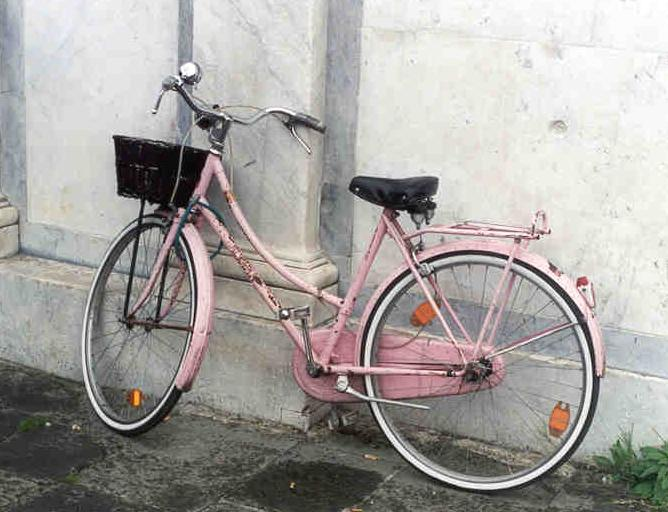
Roger Boyle is Professor of Computing at the University of Leeds in the UK. His skill as a photographer is as limited as his skill in bicycle maintenance (that’s according to Boyle himself…we happen to love this photo!) He has a deep affection for southern European countries, in particular Itlay.
-
17
loner’s valentine
a short story by Julie Gard
I was in love once, with a man not many could appreciate. I watched him fix cars while eating dinner with the family, back when I was an enthusiastic middle school science teacher in plaid polyester and nuclear warhead-proof glasses. We had a shining picture window and I took in Buford Paulson while chewing well-ketchuped meatloaf and forkfuls of canned corn.
Buford never finished college. Pedants! he cried with a wrench in his hand. He didn’t have a wife because they demanded too much, he told me in a muffled voice from beneath an aqua Corvair. He was pure, a modern-day suburban Thoreau living off of social security and a modest inheritance hidden beneath box springs (or so neighborhood lore had it), a proto-Unabomber sans violent streak. I admired a man who didn’t compromise.
My wife and I made the most of 1960’s life in suburban Cincinnati. After the kids were in bed, she lay on the couch and swooned to Janis Joplin and I retired to the attic to “grade papers.†I had a fine view of Buford from there, since he spent evenings working on odd projects in his own cluttered attic space. He burned a single bulb that hung on a cord from the ceiling like a make-believe moon, casting a double of him against the slanted wall.
When I got up the nerve I’d stand next to Buford while he worked on one of his junkers, breathe him in while making up questions about brakes and engines. He seemed to enjoy the company; he never had a lot of friends.
I always had a lot of lab reports to grade.
You’re a science teacher, he said to me one particularly sweaty summer evening. Can I show you something.
We went into his home, dim and fantastically cluttered, and down narrow basement steps. I tripped over a wooden ski jutting out into the cleared path. Buford reached for my hand to steady me, and he held it. His eyes were two starless nights.Jim, he said.
I ran my fingertips along his palm as I pulled away, felt lifelines blur into calluses and a swooning heat. I turned and walked through the clutter, up the stairs, into a glittering slice of freshly mown July. It was 1971.
My wife left me in ‘74. The children were grown at that point, at least as much as they’d ever be. I purchased a townhouse in an eclectic part of the city where I still live now as a feisty old man in vintage plaid. I can’t complain about my late introduction to the lifestyle; I had my share of fun in the fading days of my youth. Through all the fun, though, I never forgot about Buford.
He refused to talk to me after the incident; his eyes never met mine again, not even through glass kitchen window. A few years back, I heard from my ex-wife that his home had been condemned and he’d moved into a boarding house in the city.
I thought you should know, she said.
Until yesterday, I hadn’t seen Buford for 28 years. I knew right away it was him, those same stolid biceps and funneled gaze. His hair has gone white. I saw him riding a rickety Schwinn along the riverfront, determined among wandering families. I closed my eyes as he disappeared and could still sense the darkness, cool scatter of lab reports, and bite of scorched sawdust from Buford’s workroom just ten feet away.
I have always been careful, with a closet full of well-ironed shirts and one clean gin and tonic a night. I think of the young maple growing through a rusted Chevette in Buford’s yard, in a neighborhood of polished Fords that knew nothing of nature. The tenuous passageways between stacks of newspapers in his living room, the basement full of broken record players and half-finished model airplane kits. And I can’t explain my longing for the wildness of it all.
I will search for him in a hopeless section of town; I will teach him what it is to love an old body like mine, an old body like his. I will show him what has changed and how nothing has, as I slip my hand under his wrinkled white T-shirt and the heat of my palm burns into his chest.
Julie Gard is an assistant professor of English at Bismarck State College in Bismarck, North Dakota. Her writing has appeared in Clackamas Literary Review, Crab Orchard Review, and a number of other literary journals and anthologies. After completing an M.F.A. at the University of Minnesota, she lived in Vladivostok, Russia as a Fulbright Fellow from 2000-2001. -
7
I Am Screaming at the Top of My Lungs
By Chet KozlowskiThe first time you meet him it’s at that crazy corner of 23rd and Broadway, where that building that looks like a long piece of layer cake comes to a point. It’s where the streets are the widest, where they all come together and cross over each other and split apart every which way. It’s late afternoon: lights switching, horns honking, pedestrians pedding, cell phoners barking. So much hubbub it’s amazing more don’t collide. It’s a very complicated place, and you just watch your shoes and go with the herd. You’re small enough to glide through, young enough to go unnoticed. What’s more invisible than a girl with a skateboard? You mutter lyrics and scratch your itchy nose. You’re heading home after doing the bag in the park with Demo and the crew. Who cares about the chaos? The bag makes it all a warm blur.
You’ve been hearing him without even knowing it. His voice is just one of the street sounds, until you get closer. Then it slices through: “Can somebody please assist me? Won’t somebody give me hand?†A chant, clear and patient, over and over.
You’re not one to be curious, but you look up now. There he stands, in the middle of the sidewalk. “Won’t somebody just help me, please? I need assistance.†Nobody answers him. The crowd surges past, breaking around him.
You’re not one to stop, but you do now. The herd behind you jostles and swears. He stands rooted against the tide. “Can’t anybody help me here?†He clutches a stick to his chest. “I am screaming at the top of my lungs,†he says, which makes you giggle, because he’s not. He’s just talking loud and clear, like a teacher leading a fire drill.
You’re not one to help, but now you’re standing in front of him. Up close, he’s a big guy, maybe as old as your dad, crewcut, khakis, sneakers and a yellow tennis shirt. He stares over and past you, straight ahead.You clear your throat. “What do you need?†you say. Your mouth is gummy — that’s the bag — and your voice sounds like it belongs to somebody else.
He cocks his head and peers down. “I need help crossing the street,†he says. His eyes roll around, knuckles in brine. When you don’t answer he asks, “Are you there?†He can’t see you. He’s blind.
“I’ll help,†you say.
“Good.â€
You don’t know where to touch him. “Take you by your arm?†There’s a food stain on the front of his tennis shirt. The collar’s all twisted.
“Let me put my hand on your shoulder,†he says. You come around. “Short,†he says. You walk him to the curb.
Traffic lurches and whooshes past. “Busy corner,†you say.
“Tell me about it,†says the blind man.
“Gotta wait for the light,†you say.
“You’re a kid,†he says.
You shrug.
“Not many kids stop for me.†The light changes.
“You’re a good kid,†he says.
“Cross,†you say, and you lead him into the street.
The crowd comes at you. No ducking and weaving now, you’ve got this guy in tow. A straight path is what’s called for here. Make way.
“Folks stop for me, but not many kids,†he says. “I’m at this corner every day. I ask for help and sometimes I can feel somebody right next to me, not saying anything. I hear them breathing. I say to them ‘Can you help me?’ and they just don’t answer.†His hand is soggy on your shoulder. “What is it with people?â€
You shrug.
“What’s your name?†he says.
“Abra.â€
“Abra?†He snorts. He gazes up blankly; his eyes roll. “What’s your last name, Kadabra?â€
Ha ha. Like you never heard that joke before. “It’s short for Abigail Ramona,†you say. “That’s my whole name. Abra’s my nickname.â€
“Pick up your feet.â€
“What?â€
“You shuffle your feet.â€
“Do not.â€
“I can feel it.â€
“Curb,†you tell him. “Step up.†You two made it to the other side.
He lets go of your shoulder. “There’s a restaurant right here, right? A Keough’s or something?â€
You look around, see nothing but a stone wall with windows. “It’s a hotel, I think. No restaurant.â€
“Yeah?†He flicks out the stick he’s carrying; it telescopes into a cane. “Oh well. You should stand up straight, you know.â€
“I do.â€
“You slouch.â€
“Do not.â€
He clicks the skinny cane on the sidewalk. “It’s never too early to develop self-respect. Stand tall.â€
Your shoulder twitches where his hand was. You still feel it there.
He cocks his head. “Hey, you’re not coming from shop class, are you?â€
“No.â€
“Making model airplanes?â€
“No,†you say, but you know what he means. You sniff your shirt.
“I just picked up a whiff off you. Strong smell. Like turpentine. Or glue of some sort.â€
That’s the bag, you want to say. Demo sprayed a lot this time. The smell clings to your clothes. It’ll wear off by the time you get home, but right now, whew.
“Oh well,†he says. “Better hope nobody lights a cigarette near you.†He turns and starts tapping his way up Fifth. “Thanks for the help, Abigail Ramona,†he calls back. “See you around.†And then he’s gone.
On the walk home you go back to watching your shoes.
What’s he say, the blind man? He needed help and you helped him and he starts talking trash. He’s wrecking your high with this hoohah.
What’s he mean, self-respect? You got it, as much as you need to.
Short? Maybe, for your age. Slouching? Makes it easier to slip through the cracks. Shit, what’s he know about anything anyway? He’s blind. Goodbye, Buddy, you should’ve said. Don’t walk into any walls. That’s one thing you know. There are walls everywhere. If he could see, he’d see them there.
Walls to get over, walls to get around. You try to be the smartest, the fastest, the best, but the walls always come up in front of you.
There’s the wall of how much you know and how much you don’t. The wall of how pretty you are and what clothes you wear. The wall of not understanding no matter how much it’s explained. That’s why being with Demo’s so good for you.
Demo says chill, you chill. Demo says run, you run. Demo sprays inside the bag, says breathe deep, you breathe deep. Take a whole headful, Demo says. Demo says and you do.
The bag doesn’t break down these walls, or get you over them. It just makes you not care they’re there. So what does the blind man know? Some walls you can’t get over, no matter how much you don’t shuffle or slouch or have self-respect. All you really need is the bag. The bag makes things better.
By the time you get home you’ve got yourself convinced.
You see the blind man again, weeks later, in a bus shelter. You’re with Demo and the crew and he taps in. Everyone goes quiet. He folds up his cane and stands to the side. He holds it to his chest. You ignore him.
“Can somebody tell me when the #42 comes by?†he asks.
Nobody answers. Demo and the crew snicker, and you do, too.
“Can any of you assist me? I know you’re there.†That calm request.
But something’s in the air and he sniffs it. That’s the bag.
“Abra?†he says, but you don’t answer. “Abigail Ramona?†Demo and the crew wonder and nudge. But you just look away and watch your shoes. ï®
— 7/21/03, New York City