Your cart is currently empty!
Author: Editor
-
literary hot spots
Author and editor Jordan Rosenfeld (Make a Scene: Crafting a Powerful Story One Scene at a Time) pays tribute to San Francisco’s “literary hot spots” in this article for Writer’s Digest. Jordan mentions the historic Caffe Trieste (this is the place that local writer Junvenal Acosta, among others, sometimes refers to as his office), the Mission-district watering hole The Makeout Room (home of the Progressive Reading Series), and Vesuvio. While Caffe Trieste and Vesuvio are in North Beach, Jordan’s pick for the most beloved bookstore is Green Apple (see my “found at Green Apple” posts) on Clement. Living as I do in the Richmond district, Green Apple is my neighborhood store. (I couldn’t help but give it special mention, gnome and all, in my new novel!)
-
Doris Lessing on Winning the Nobel in Literature
as reported by Publishers Weekly
“I can’t say I’m overwhelmed with surprise. . . . I’m 88 years old and they can’t give the Nobel to someone who’s dead, so I think they were probably thinking they’d probably better give it to me now before I’ve popped off…This has been going on for 30 years. I’ve won all the prizes in Europe, every bloody one, so I’m delighted to win them all. It’s a royal flush.”
-
On the Difficulty of Editing Well
“I would have written a shorter letter, but I did not have the time.”
Blaise Pascal -
A Toy and an Amusement
Writing a book is an adventure. To begin with, it is a toy and an amusement; then it becomes a mistress, and then it becomes a master, and then a tyrant. The last phase is that just as you are about to be reconciled to your servitude, you kill the monster, and fling him out to the public.
~Winston Churchill -
Divisadero, by Michael Ondaatje
I’ve just finished reading the ARC of Michael Ondaatje’s extraordinary new novel Divisadero, which will be published in May. The book begins with a harrowing familial violence on a farm in Petaluma and ends in another country at another time. San Francisco residents will recognize the title, which is the street where the novel’s overriding consciousness, Anna, lives as an adult. I say “overriding consciousness” because, while Anna narrates some portions of the novel, there are also large swaths of omniscience, as well as points at which the omniscient narrator collides, unexpectedly, with Anna’s voice.
Years after the violence that shatters her family, Anna moves to France to temporarily inhabit the home of Lucien Seguro, a famous French poet. After a detailed and arresting account of the lives of Anna, her sister Claire, their father, and a cardsharp named Coop who was raised alongside the two girls, the novel’s focus shifts to Lucien: his upbringing in the French countryside, his affection for a neighbor woman, Marie-Neige, and her husband Roman, his childhood. Slowly and brilliantly, these stories intersect, held together by a man named Rafael, who becomes Anna’s lover in France.
This is a story about orphans, and about events that drastically alter the landscape of family. It is a patient, gentle book. Ondaatje writes truthfully and unflinchingly about desire. One of the most memorable aspects of the novel is his portrayal of parent-child relationships, particularly between mothers and sons. (more…)
-
Over There
by Steven Gillis
The man next door, our neighbor, is behaving badly or so it seems to me. This is not a good thing, I think. How can it be? “It can’t,” my other neighbor says. We decide to have a meeting, invite our other neighbors from farther down the block. Some come, some don’t. Those who don’t show we talk about as well.
We are a community of strangers, made friends by our proximity and the necessity of getting along. Of the neighbor to my left, we wonder, “What’s he up to?” and ask as well, “What about the others? Why aren’t they here?”
Chub Weinman says he saw my neighbor and one of those not with us now talking the other night. He says they looked serious and friendly.
“Ah-ha,” Marty Ferril waves his corn dog.
“Which was it?” I want to know. “Serious or friendly?”
“Both,” Chub Weinman says. “Seriously friendly.”
We nod at this, all of us gathered in Fergie Feckles’ basement show solidarity by tapping our chests and cursing a bit.
We’re worried about the future, we say. Worried about our pensions and our tv shows, things that continue to change beyond our control. Our neighbor in question pretends to be above all this. He drives a blue Saab with tan leather seats, wears stone washed jeans and teaches Humanities at the University. I work for BellSouth, outdoors fixing and setting lines. Chub and Marty and the others, too, work in jobs the same as mine. We know what it means to face adversity, have seen our status and security fucked with, have had to struggle and shift to adjust. To have stuck it out and at the same time, apart from the exceptions caused by human weakness, to remain decent fellows, that is what has made us hard. Our refusal to buckle, this is a page of glory in our history, I tell the others, “This is as we choose to be.”
I’ve tried to explain the situation to Jenny Darne, my buddy Earl Darne’s wife, have told her in no uncertain terms as we undressed in our room at the Tuckit Inn, how conformity is not a dirty word, is the measure of a man’s worth, his willingness to fit in and become part of the whole. “There are certain things a man can’t do,” I flip her over and make sure she gets my point.
Fergie’s wife, Lydia, has made the corn dogs and brought them down to the basement. We have beer and chips. I wonder if its such a good idea to drink during our meeting. Some of my neighbors agree while others don’t. Those of us who do not drink take note of those who do. Those who drink eventually gather together on one side of the room, near the deer head which has come off the wall, too heavy for the mock-wood panels Fergie used to refinish his basement. Andy Futts can’t resist and turns to the deer after a second drink, rolls his hips and says, “Talk about getting head.” Those of us on the other side of the room, not drinking, take note of this as well.
As we are a democracy, I ask the others to vote on what they want to do. I give them a list of four suggestions from which to choose and after some discussion I tell them, “Here’s what I think’s best.”
The neighbor we’ve come to talk about has a son who plays football with our boys on the Renton Eagle’s team. He’s the punter which says it all, I think. My neighbor comes to the games from work, stands by himself, down by the fence, and doesn’t sit up with us in the bleachers. I watch my boy at tackle go and drive the other team’s end into the ground. Jenny Darne never comes to the games. She says football is a brutal sport but she likes it when I slap her rump. I ask her to go away with me for a weekend, say that we can fish and hunt and camp under the stars. The idea makes her laugh. I blush and curse, but as I do she only laughs some more.
All is risk and danger. I feel the threat at work when I hold two ends of a severed line, feel it when I lay in bed and my own wife at a distance snores. I have heard that in his classroom my neighbor lectures on Aglaia, god of charity, Themis, god of justice, and Ares, god of peace. I see him with his own wife walking in the evenings, holding hands in the center of the street. What can such a man be thinking, I wonder? “You see how he’s not like us?” There’s talk he plans to keep his son at home for school and not let him fight in the war. I hear other things about him, strange and unsettling. I’ve shaken his hand before and his skin is soft even as he tries to make his grip hold firm.
“What sort of man is this?” I warn the others. “He isn’t like us.” He’s thin and placid, without spirit and refuses to bay at the moon. “No,” I say and tell them then, “It can’t go on. This sort of bull among us is a danger. We stand and fall on our weakest link and how can we as neighbors rely on such a sorry guy? No, no, no,” I say again and touch my chest, “There’s something we can’t swallow going on over there.”
Steven Gillis’s novel The Weight of Nothing (Brook Street Press, 2005) was a finalist for both the Independent Publishers Book of the Year and ForeWord Magazine Book of the Year.) His first novel, Walter Falls, was published in 2003 and was a finalist for National Book of the Year. He is currently at work on a new novel, Temporary People. A collection of Steve’s stories, Gifaffes, will be published this fall by Atomic Quill Press. Steve teaches writing at Eastern Michigan University and is the founder of 826 Michigan, a nonprofit mentoring and tutoring organization for public school students specializing in reading and writing and a chapter of Dave Eggers’ 826 Valencia. All author proceeds from Steve’s writing go to his 826 Michigan foundation. Steve lives in Ann Arbor with his wife Mary, and children Anna and Zach. Steve is also the co-founder of Dzanc Books.
Image by this issue’s feature artist, Ira Joel Haber. You can find more of his work here.
-
Bugaboo
by Jenny Pritchett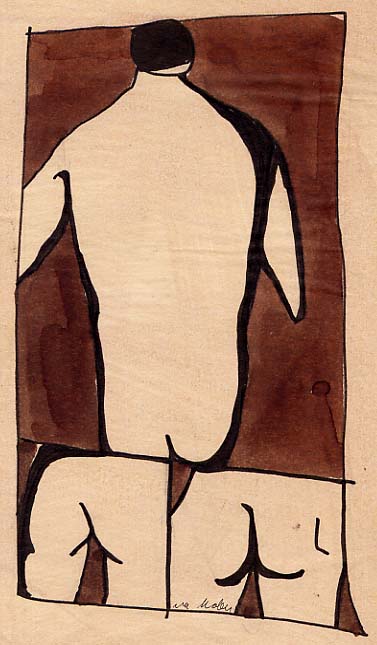
At first Antonia thought of a shipwreck. The boy and the girl peeled off their clothes, but they were on their knees in the middle of a bed with the bedclothes hiked around their thighs, and the sheets were red so she thought of a sea of blood and had to focus on the pale flesh of their bodies–his concave chest and half-erect penis bobbing like a mole from its burrow of dark hair, her low breasts and a raised, flesh-colored birthmark at the verge of her hip. They began to make love, him thrusting his tongue, him gripping her wrists. They turned toward Antonia, and as the black fringe of the girl’s hair shuddered Antonia imagined her tongue heavy like a whale in the girl’s mouth. They stood before her, the girl’s skin glazed and tiny beads of sweat standing out on her nose, and she grasped the back of Antonia’s chair, one hand over each of Antonia’s shoulders. The girl’s face swung close, her mouth like a sucker, her tongue like a dove, and Antonia watched all the ugly things rush from those lips, the ghouls and headless children and her impenetrable faith in her husband, and she slid her thumb into that crevice, enveloping her nail and knuckle, and felt a vacuum as the girl pursed her cheeks. In this way Antonia, full of spume, stopped the flood of bugaboos and sent it back into the night.Jenny Pritchett is the editor of Fourteen Hills. This is her second appearance in Fiction Attic.
Image by Ira Joel Haber, featured artist. View more of his work here.
-
Delectable Waters
by Anita GarnerShe stands on one leg at the front door in the heavy dusk, balances the paper bag of groceries on her knee, and fumbles for the key. She has knocked, three times, and now listens for movement inside, peers through the dark window, unsurprised to find no lamps on.
Just inside the doorway, the bag crashes to the floor. A tin of water chestnuts rolls across the hardwood. She gropes for the light switch.
From the back room, his studio, he calls her name. His voice is weak, hoarse, gravelly from lack of use. “Is that you?”
She does not answer.
Nothing is left to say.
Either he’s been sleeping and is now in a black fog or else he’s been sitting in the dark again, half finished sculptures littering the tables, house dust collecting on top of the clay dust that already covers all the surfaces. For months now, he has let her clean the kitchen and bathroom, let her vacuum the rooms and hallways, but his studio is off-limits, his cave when he needs time to think. Or not think. From her distance, it’s hard to tell.
She turns on the kitchen light and sees that everything is just as she left it the night before, the dishcloth left to dry on the sink divider, the clean cup towel folded and on the counter. When she opens the refrigerator to get out the vegetables, it is almost empty, the small containers of last night’s leftovers exactly where she left them, untouched.
“Come here.”
The flatness of his voice never fails to hurt her, although she knows she should be accustomed to it. He rarely looks at her, never touches her.
A couple of months ago he finally commented. “I think I may be coming down with the flu.”
“For six months?” She slammed the table with the coffee spoon she had held in mid air. He’d hardly blinked, as if her anger were not worth registering.
She looks around at the floor only she mops, the table only she wipes down.
When she gets out the cutting board and begins to chop the vegetables with a large cleaver, hitting the surface in loud thuds, he calls her name again, his voice no stronger than before. She pauses, listens.
“Please,” he calls to her. “Come here.” And then, when she is silent, “I need you.”
That’s rich, she thinks, too numb to laugh. All these months she’s swallowed her pride, given and given to him, only to have him call her less, need her less. In the car, she made up a haiku: “Women give and give/ and give and give and give and/ Men don’t give a shit.” In her mind, she makes excuses for him. He is tired. He has a big show approaching. One day she whispered, “I think you’re depressed.”
He was quiet, thoughtful. “I’m not depressed,” he said. “I’m just stiff.”
“Stiff?”
“Like I’m changing,” he said. “My eyes aging. Like I’m seeing in texture, everything grainy.” He seemed sad, distant.”Like my eyes are turning to wood.”
That’s so like him, she thinks now. Always the artist. Special. Ordinary depression too common. Him, he’s turning into wood. She attacks an onion with the cleaver and hears the thwack echo from the inch thick oak of the cutting board. He hates it when she’s loud in the kitchen, claims it disturbs his concentration. She opens a cabinet door and slams it shut for good measure. The noise ricochets throughout the house.
It was not always this way. She remembers in the beginning his aloofness was part of the charm. The lonely artist. His work shown in a top tier gallery, his agent dealing with the day to day. His studio: a refuge of intense meditation. His art: his thoughts 3D, tangible in clay, in sand, then bronze. Lately: just clay. Over and over, the same forms, little variation. His hands for weeks in clay.
She puts two plates into the oven to warm. She will tell him tonight that she’s leaving, wash the dinner dishes, and quietly leave. No scene. He will hardly miss her. She folds the napkins and gets out the salt and pepper. Dinner is almost ready. She puts the kettle on for tea.
“I need you,” he says, his voice rattling, “to see.”
Maybe he has finally made his masterwork, something substantial and lasting. Her job in the kitchen is almost complete, just waiting for water to boil. She wonders if it is a large piece, something new, something he has spent his energies on. She steps toward the hallway.
“See what?” she asks.
Now it is his turn to be silent.
“See what?” she repeats.
Her heels click on the bare wood; the copper bottom of the kettle complains of heat.
“I need you.” His voice: weaker, scratchy. “I need you to come here and see.”
She walks with care down the dim hallway and turns to enter his studio. She was correct. He’s in the dark. Since she never comes into this room, she does not know where to find the light switch. She feels the wall with one hand, then both. She stumbles over a chair, almost falls.
“Never mind about that,” he says, his voice little more than a whisper. “Come here.”
“Where are you?”
“Follow my voice,” he says. “Here. Over here.” His voice: raspy. “I’m right here.”
She reaches him, and, in a turn of heart, holds her arms out to him.
“Give me your hand,” he says, grasping her arm, then her right hand. “Now feel this,” he says, guiding her. “Feel my eyes.”
She feels first the wetness of a tear on his cheek. When she leans to kiss it, she smiles to taste the salt of his tears.
But then, to her surprise, when her hand reaches his eye, beneath her fingertips roll the tiny raised ripples of grain.
A.M. Garner’s fiction has appeared in INTRO, the Black Warrior Review, and other magazines and anthologies, most recently in storySouth online. A collection of her short stories was selected as runner-up for The Virginia Prize. She has taught creative writing at Virginia Commonwealth University and currently teaches creative writing and a course in Southern fiction at the University of North Alabama.Image by Ira Joel Haber, featured artist. View more of his work here.
-
Sharper
by Jackie Shannon-Hollis
The list of the things I did for him is inside the black silk envelope. The black silk envelope is in the top left drawer of the desk from Italy. The desk is empty, except for the envelope. The desk is in the bedroom. The bedroom is large and the desk is far from the bed. It’s next to the window that looks out on the garden.
The first item on the list is the first thing I did for him. The second item on the list is the second thing I did for him. And so on. Each item on the list is in his words.
First on the list: Please, tell me your name.
Second on the list: Please, let me take you to dinner.
Third on the list: Please let me open the door.
Fourth: Please, let me order for you.
Fifth: See me again.
Sixth: Wear a dress. I like blue.
Seventh: Stay the night.
The black silk envelope has a silver clasp; the silver clasp is in the shape of a ballock dagger. It’s a miniature version of the antique dagger hanging on the wall of his den. Sixteenth century he told me. He put the hilt of the dagger in my hands. It was a larger version of him, down there. Phallic. Larger and sharper.
Tenth on the list: Make it with two sugars, no cream. I’ll stir it myself.
Twelve: Not an omelet. Have two eggs. Scrambled in unsalted butter. Moist. A bit of fresh dill on top. Dry toast.
Fifteen: Yes, like that. Slow.
Sixteen: Never cut your hair. Except. You could trim yourself here. Closely.
Twenty: I’ve made an appointment for you. A manicure. A pedicure. Weekly. Don’t miss it.
The list is on unlined linen paper. The paper is ecru. It smells of citrus. The ink is blue.
Twenty-seven: Close the door when you’re in the toilet.
Thirty-one: Marry me.
Thirty-nine: Ah. Excellent. A private moment. Put this on under your dress. Wear it for the rest of the reception. It’s my wedding gift to you. It won’t hurt much if you move slowly.
The list is twelve pages. Seventeen items to a page. No two items are the same.
The blue ink on ecru paper echoes our time together.
Forty: If you wake in the night and I’m hard, go down on me, even if I’m asleep.
Fifty-five: Now that we’re married, there is no need for you to work. Resign tomorrow.
Sixty-one: Wear stockings. No panty hose. Ever.
The envelope was the last thing I bought for myself. After that, everything was either from him or for him.
There was only the one black silk envelope on the shelf at the store. The tip of the dagger was pointed up. It seemed fitting. It was exactly like the ballock dagger on the wall of his den. The list was just two pages then. They fit nicely, folded once. There was room for more.
Seventy: No panties on Tuesdays.
Eighty-two: Go to that man at the end of the bar. Smile and speak softly to him. If he wants to touch you, let him. I’ll be here. Watching. Don’t look over.
Ninety-four: Put on the black lace panties and the red bra. Get on your knees and tie my shoes for me. Tie the laces in small bows. Left over right. Don’t look up.
One-hundred one: It’s a Tuesday. Time to climb. Don’t look down.
The ballock dagger on the envelope could be pointed in any direction. Depending. The silver became tarnished over time. I did not polish it. The dagger on his wall was pointed up and to the left. He kept it polished and the silver caught the light.
One-hundred twelve: Tell me your plans for the day.
One-hundred twenty-seven: End your friendship with Cleo. She’s coarse.
One-hundred thirty-one: Don’t eat garlic again. Nothing with garlic in it. You smell bad.
One-hundred forty: Leave your phone on at all times. I’ve set it so you know my call. You must always pick up when the Beatle’s play, “I Feel Fine.”
One-hundred forty-nine: Tell me what you did today. Every detail. Every thought. Every move. But first, put these on. Press them until they click.
One-hundred fifty-six: Say you’re sorry. Tell me how sorry you are.
He never looked in the desk. He never looked out on the garden. But the rest of the large bedroom, he used well.
One-hundred sixty-two: Don’t call or visit your mother, unless I’m with you. Same for your sister.
One-hundred seventy-five: Say please. Say it louder. Say it like you mean it.
One-hundred eighty-seven: Don’t cry.
Two-hundred four: Come to me, marching up the driveway, at 8:58 p.m. wearing a red drum majorette uniform with gold epaulets on the shoulders and white boots that come to just above your knees and a tall hat with a black chin-strap and a shiny silver baton that will catch the light when I take it from you and use it.
His final request.
The drum majorette uniform was fire engine red. I charged it to him.
The ballock dagger was heavy but I was strong. In its place I left the baton that came with the uniform. Temporarily.
From a distance, at night with the garden lights on, with me coming up the sidewalk marching in 4/4 time, the dagger looked just like a baton. When I threw it in the air and caught it in my white leather gloves, the dagger caught the light.
It was simple. The knife was in his hands when he fell, it was like he used it on himself. That’s what everyone believes.
His ashes are in the black porcelain vase. The black porcelain vase is on the desk from Italy. It is the only thing on the desk. The desk is far from the bed. It’s where I have my tea and look out onto the garden.
Jackie Shannon-Hollis lives in Portland, Oregon, and is working on a collection of short stories. Her work has appeared in MARY, Rosebud and the South Dakota Review, and will be in an upcoming issue of the Oregon Literary Review.Image by Ira Joel Haber, featured artist. View more of his work here.