Your cart is currently empty!
Author: Editor
-
Spine Sketchbook by Claire Lynch (5): I’ve Got You
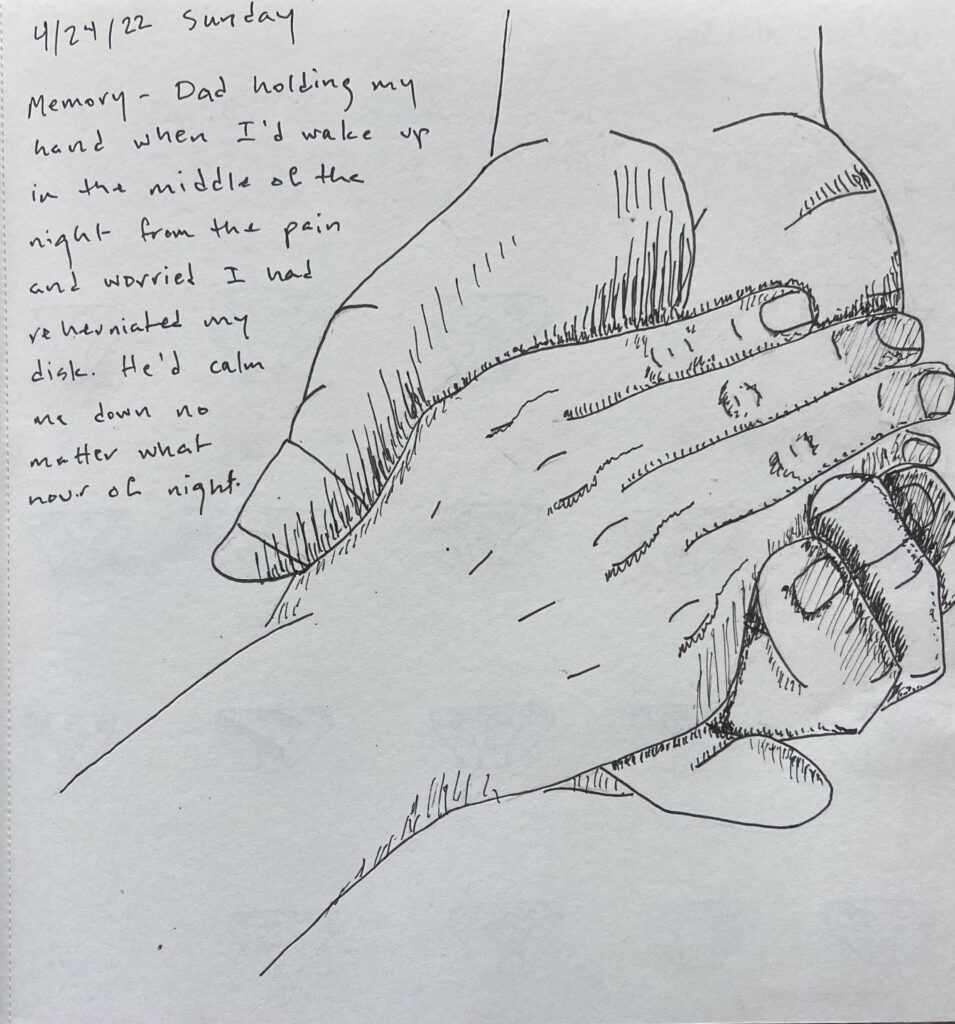
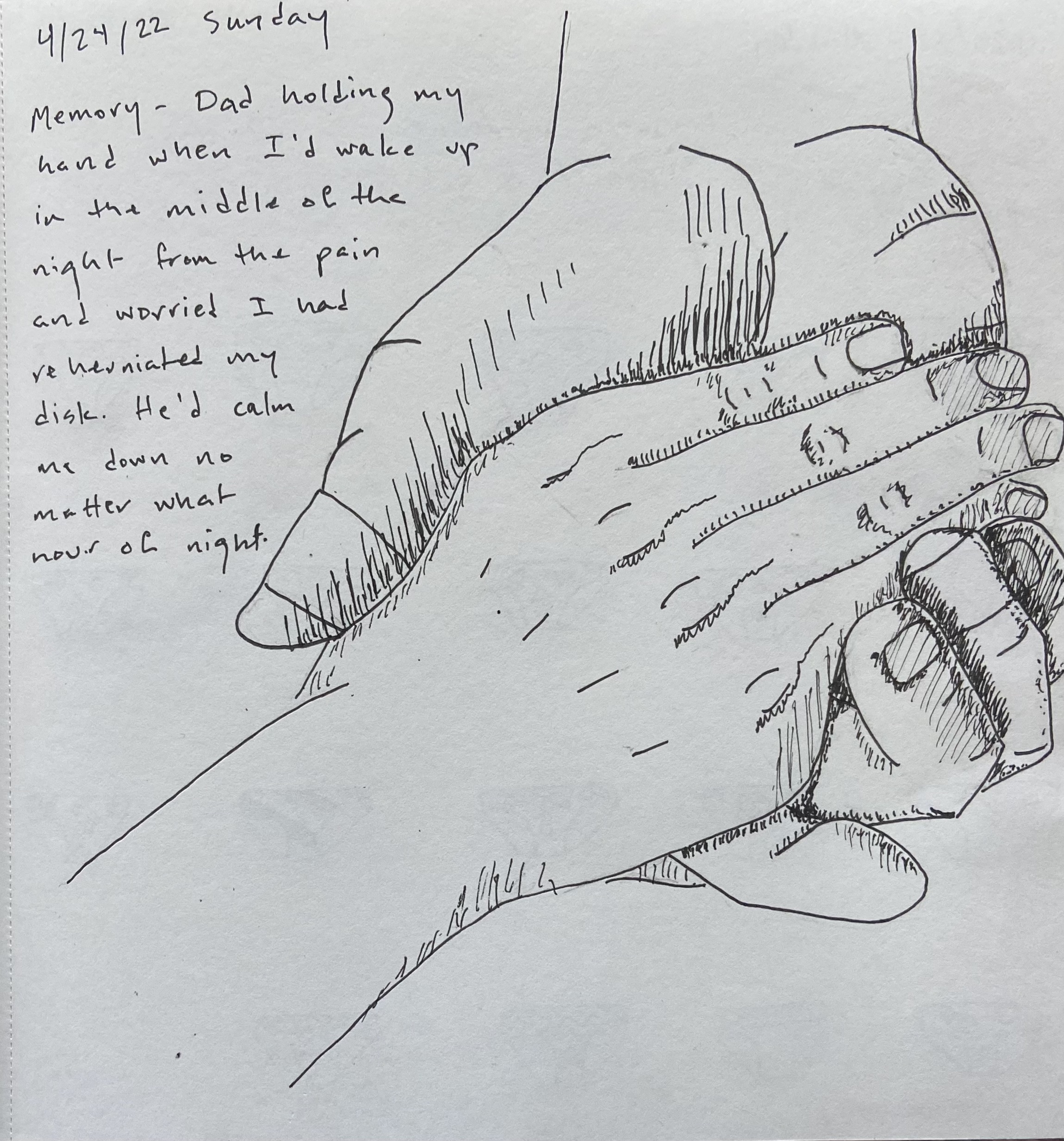
I’ve Got You. Claire Lynch, Spine Sketchbook, 5 Memory – Dad holding my hand when I’d wake up in the middle of the night from the pain and worried I had reherniated my disk. He’d calm me down no matter what hour of night.
-
Spine Sketchbook by Claire Lynch (4): Mom’s Favorite Words
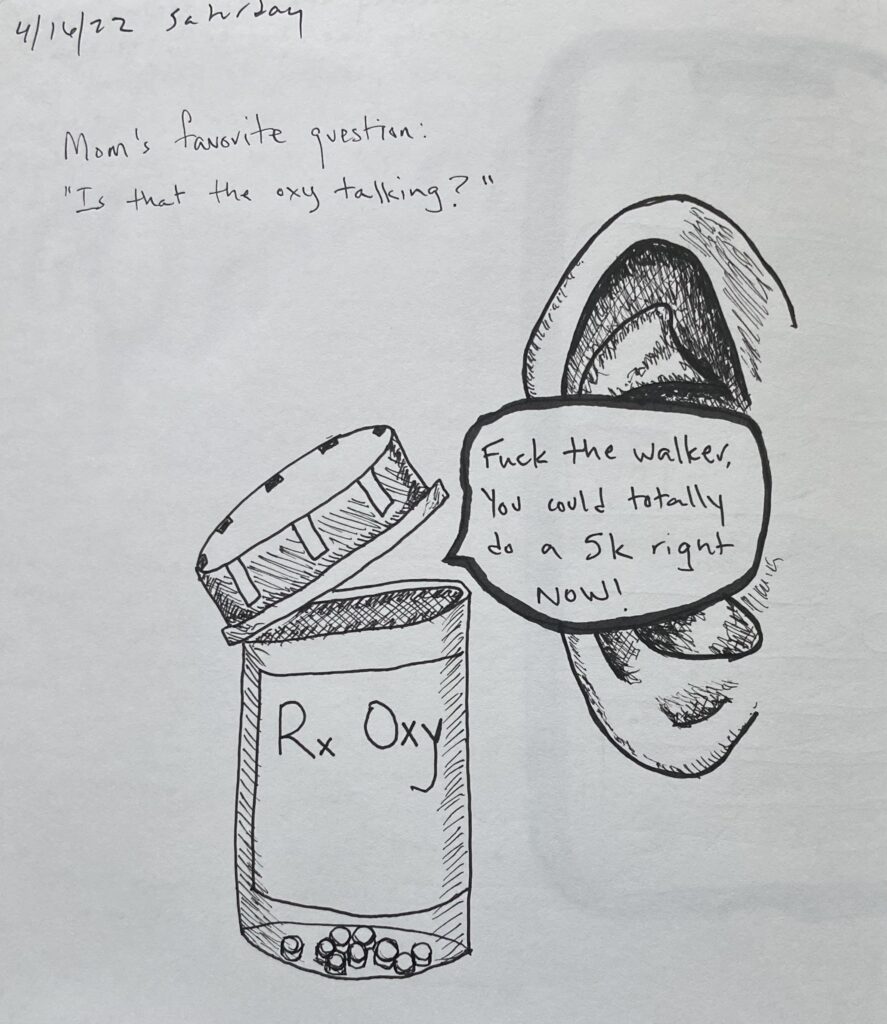
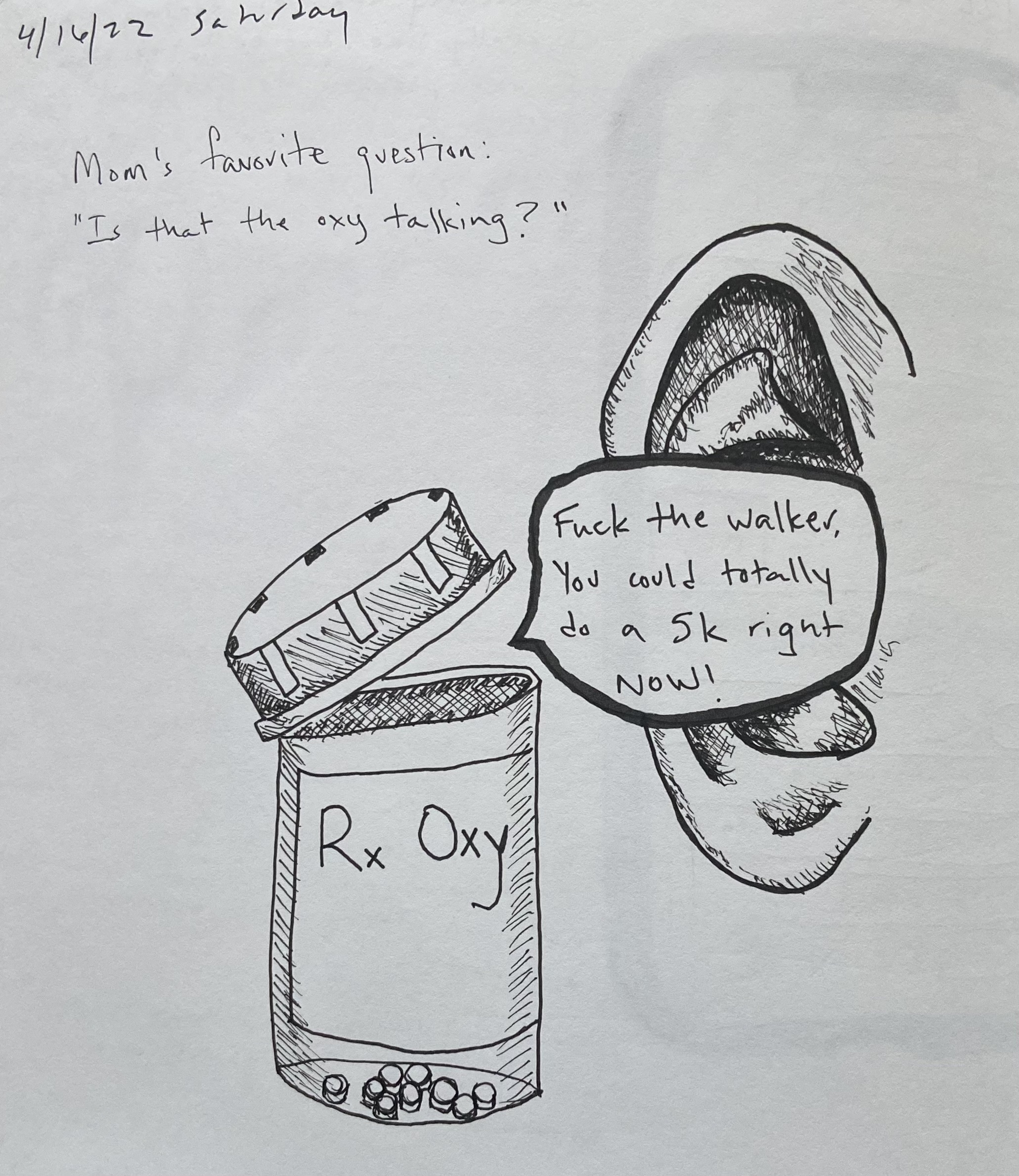
Mom’s Favorite Question. Claire Lynch, Spine Sketchbook, 4 “Fuck the walker. You could totally do a 5k right NOW!”
-
Spine Sketchbook by Claire Lynch (3): Forehead Kisses
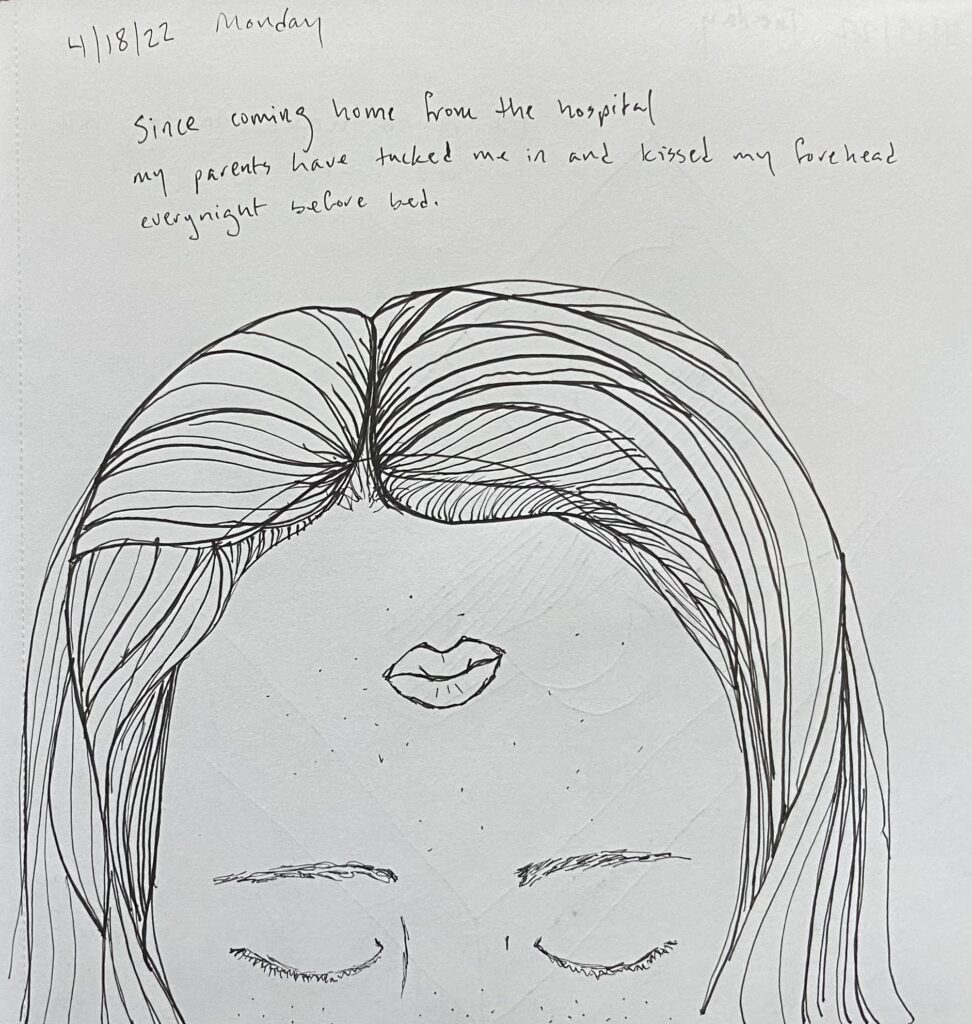
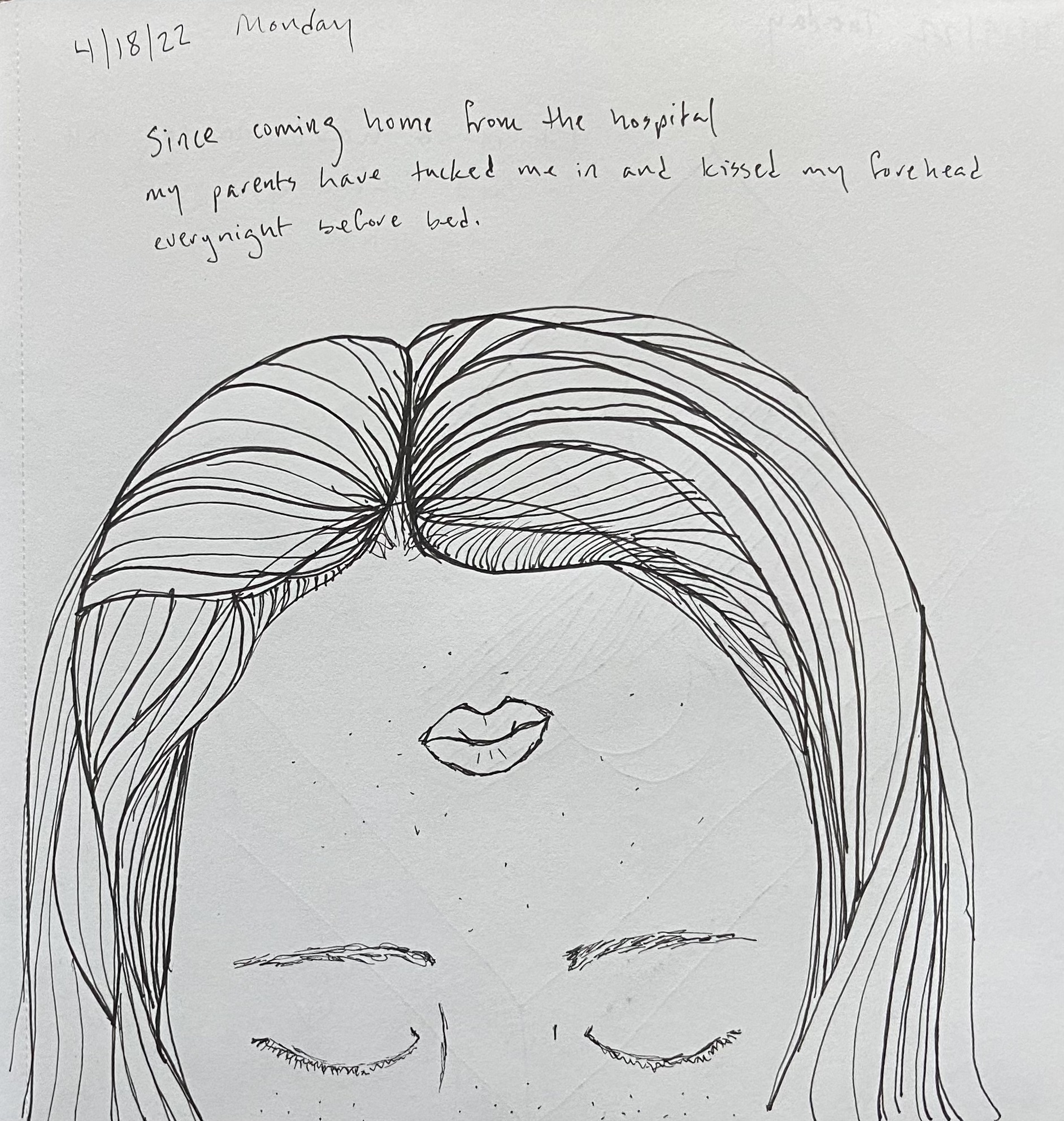
Forehead Kisses. Claire Lynch, Spine Sketchbook, 3 Since coming home from the hospital my parents had tucked me in and kissed my forehead every night before bed.
-
Spine Sketchbook by Claire Lynch (2): Pots and Pans
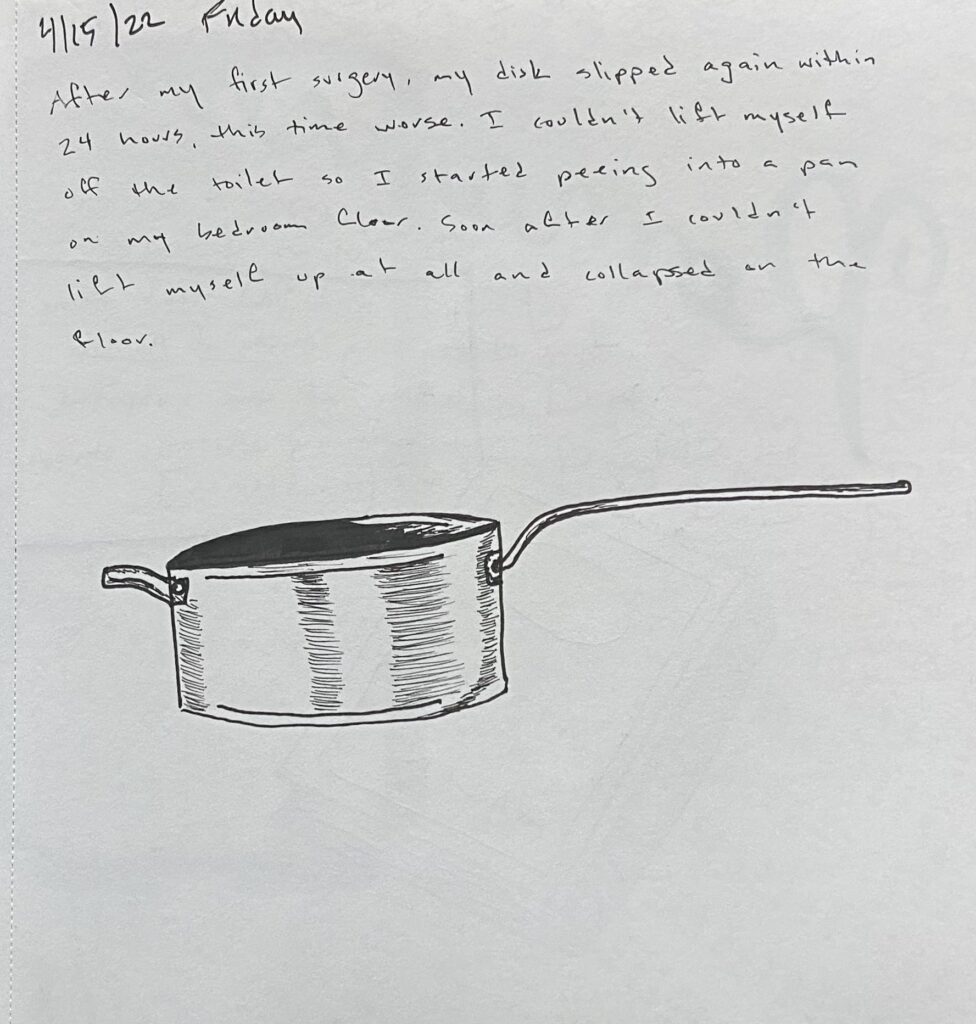
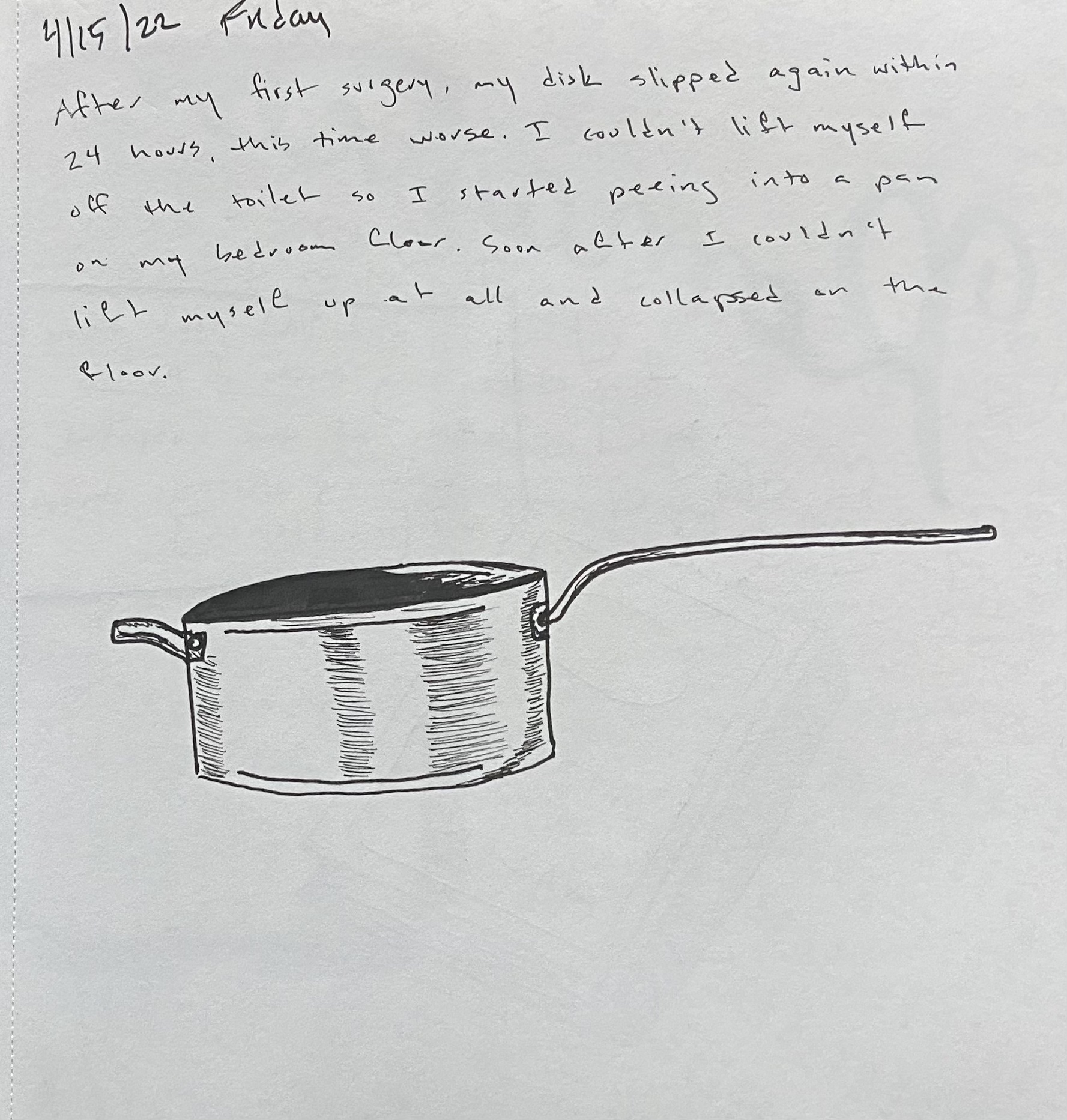
Pots and Pans. Claire Lynch, Spine Sketchbook, 2 After my first surgery, my disk slipped again within 24 hours, this time worse. I couldn’t lift myself off the toilet so I started peeing into a pan on my bedroom floor. Soon after, I couldn’t lift myself up at all and collapsed on the floor.
-
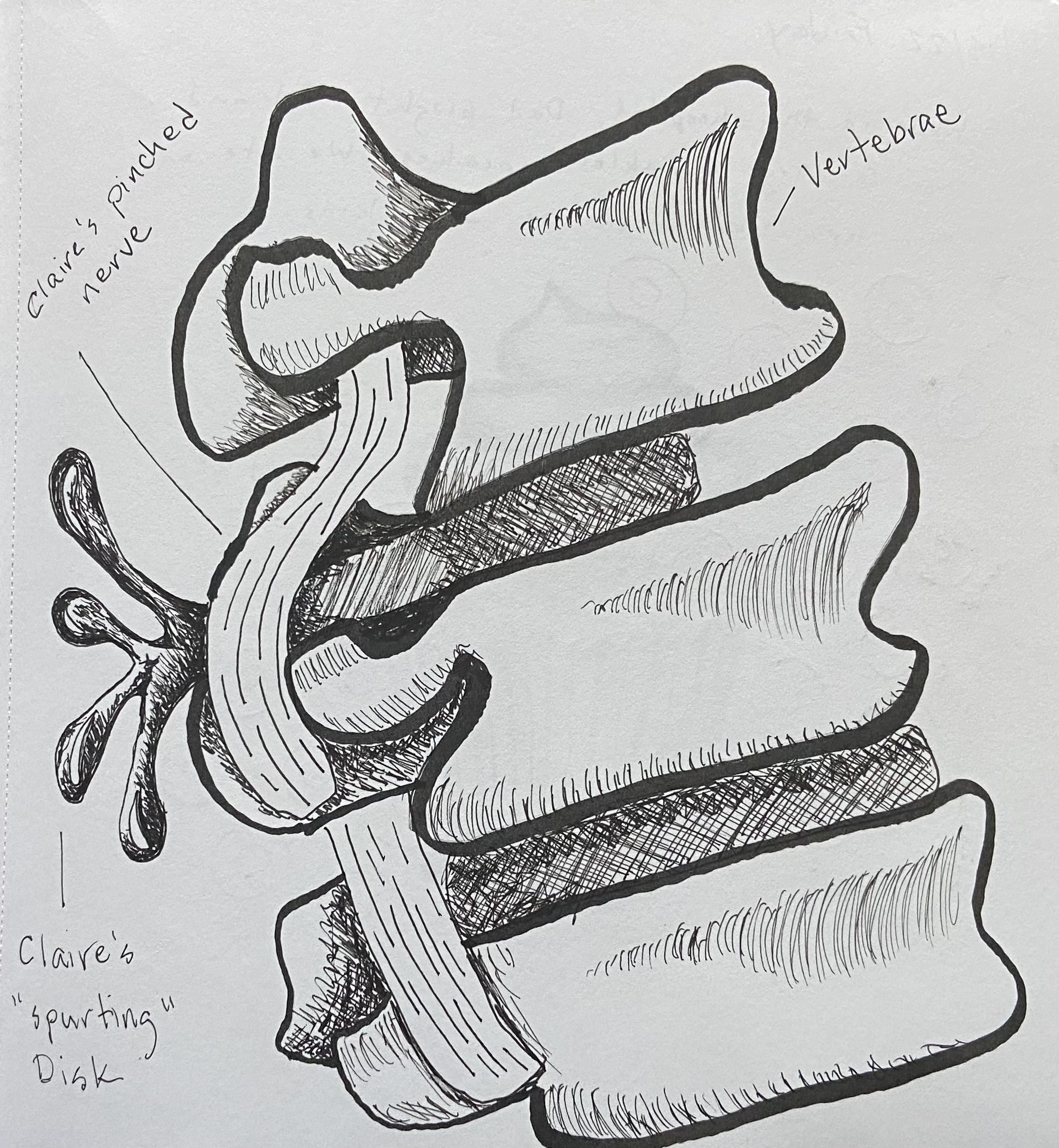
Spine Sketchbook: A Story in Illustration by Claire Lynch
Claire’s Spurting Disk (1 of 6)
Claire R Lynch is an artist and teacher based out of the Washington DC area. At the age of 31, Claire underwent two unexpected and rapid spinal surgeries for a recurring herniated disk within the span of 3 days. This series was inspired by the spontaneously ridiculous, traumatizing, and heartwarming moments of her surgical recovery.
Continue to the next panel of this sketchbook in 6 illustrations.
-

The World Is Ending in Tampa, Florida! by Paige Blackburn
That’s what the news warned. Everyone but the doomsday planners and the resolute old men evacuated long before it happened.
From luxury boats or the local news, the greater population of Tampa watched their city shift, then sink, Atlantis-style, and slide deep into the only darkness we do not know.
Hundreds of Tampa children watched in wonder and asked their mothers if octopuses were going to sleep in their beds. Hundreds of Tampa mothers didn’t know how to answer that question. Only one Tampa child asked her mother where they were going to live now. Her name was Judy. Judy’s mother finished her cigarette, flicked it into the ocean, and replied simply, “Somewhere else.”
And they did live somewhere else. Judy and her mother lived so many places else. They moved around every six months or so, flicking cigarettes into bodies of water all across the country.
A year after the Tampapocalypse, the people built another bridge over the newly-expanded Tampa Bay.
Ten years after the Tampapocalypse, Judy’s mother died, and Judy returned to Tampa Bay to live with her aunt. By this time, she was seventeen, and about to graduate from a school she’d been inside exactly twice.
One night, she asked her aunt if there was a community college she could attend (she’d been saving her money), and her aunt looked away from her black television screen and screeched—the first words Judy had ever heard her speak:
“There’s nothing for you in this world, kid! Stop looking forward! Nothing comes next!” And she crumpled up an empty can and threw it at Judy’s head.
Judy left.
“Nothing comes next?” Judy thought as she walked down the recently-newly-defined coast. Really?
Because as far as Judy could see—and she could see for miles out from here, without Tampa in the way—there was plenty that came next.
And what came next would be plenty.
Paige Blackburn is a young writer, poet, and college student from Illinois. When she is not working or attending class, she is reading a fantasy story, or writing one, or thinking about writing one. Her work has appeared in Unbroken Journal. You can find more of her poetry on Instagram @blackinkburnedpaiges.
photo courtesy of Julie Tupas
Subscribe to get Fiction Attic stories in your inbox every other week.
Submit your flash fiction, memoir, short stories, essays, or sketchbook stories.
-
The Truth Is — by Stephanie Buesinger
1. Ingredients
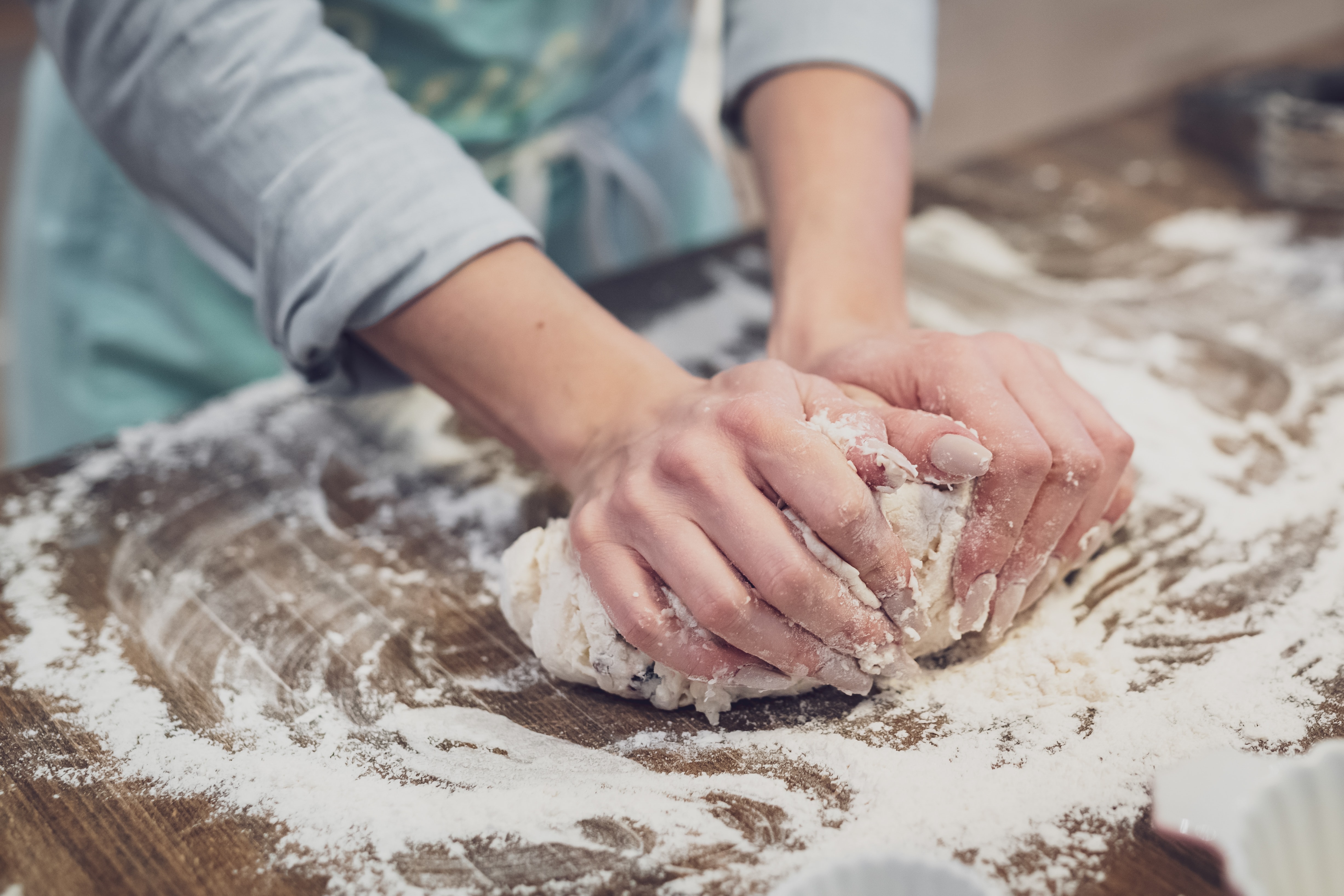
I try to find solace in the little things. Making bread, for example. The refuge of repetition as I knead the dough, fingers sticky, folding, pressing, then folding again, the enforced patience of setting it aside to rise, damp cloth laid carefully over the top. The letting go when you slide the formed loaf into the oven. Growing up I watched my mother bake sourdough and buttermilk biscuits, blueberry muffins, and apple pie, which she served a la mode with a large scoop of vanilla brought home from Swenson’s. I packed her recipes in my carry-on when I moved to this country.
2. ProcedureThe truth is, I found the recipes in a hinged wooden box in the attic of this cottage by the lake. The recipes are not for blueberry muffins or pie but for kreplach and noodle kugel and kasha varnishkes. The real estate agent that rented me this house told me they were left there by a German Jewish woman who abandoned the house and its contents during the war. The previous owners left the box in the attic. No, that’s not true either. The recipes are for borscht and pelmeniand were handwritten on lilac-colored stationery and given to me by the Russian ballerina who lived in the apartment above me in New York, compensation for her hosting late-night dinner parties. Tanya knew I liked staying in and reading Tolstoy. She preferred Chekhov. I’m sorry, I lied to you again. I found the recipes on the internet and took a screenshot of them on my iPhone.
3. Serving
I don’t like to cook, and I would not make any of those things. I’m confident my mother would have cooked all those things if she had ever lived here, in this cottage by the mountains. I mean house by the lake. If I had a mother who baked warm loaves of apple strudel and told stories as you lay on a blanket under the apple trees and blue sky. If I even had a mother who baked strudel so tender it melted on your tongue. The truth is, I had no mother.
Stephanie Buesinger writes fiction and children’s literature and enjoys illustration and photography. She is Photo and Blog Editor at Literary Mama and her work has appeared in Literary Mama, Women on Writing, and The Bluebird Word. She lives in Florida with her family and pets.
-
Here, from Outer Space–by Mackenzie Singh
photo by Zeke Whiteout At the sculpture park we fail to connect. By connect, I mean recover. And so, we stack rocks. In silence we balance them without great effort but still, they stay, an allegiance or maybe obedience to an effort we lack. It’s in the fit. I like the precarious ones, she, the uniform. Our creation — it tickles us. We have surpassed the other stacks and, look: we are still stacking. When the leaning begins, we abandon it, this bowed spine, which, hey, call it a benediction.
Above, honey bees. They fly and fly and —
I tell her I envy insects. How capable they are, how sturdy the things they make. Me? I’d be a spider, my home spun in the yawn of a boot, a constellation against the sole of a sky.
We carry on over the dry-stone ramp and toward the garden. In the shade of a tree the teeth of a scar wink white from her calf. The first time I saw it she said the owner claimed the dog just wanted to play. I said it was like that joke about the — but then she kissed me and I managed only to say, “ — off my lawn.”
Prospects are hospitable. It’s a misconception that a happy present makes a future when one has only to imagine a future to want the present. As for the joke? That’s what I mean. Of course she laughed.
And, now.
Now we arrive at the quarry where, supposedly, two can work out whispers from opposite ends. Here, we are on another planet. We are aliens attempting contact. We cup our telescope hands around our mouths. Diligently, we hum: “Hello?” And then we listen, we listen before trying once more: “Can you hear me?”
Mackenzie Singh’s work has appeared in SAND Journal, SHiFT, Maudlin House, Lithub, and The Rumpus. She lives in Brooklyn.
Subscribe to get new flash fictions in twice a month in your inbox.
Submit your flash fiction or personal essays to Fiction Attic (we pay our writers).
-
Single Family Home– by Cathy Cruise
“Everything falls apart eventually.” His words are a car on a hill, climbing gradually, curving at the top, racing down to dismal nothing. “What else is there to say?” The skin along his jaw quivers as he shrugs.
The bearded counselor looks at me as if I should know. But a dome has sealed itself about the room. If I say anything, the words will sound muffled, unable to break through to the outside. I rub the polished arms of the chair as the air conditioning kicks on, blasting cold across my shoulders, and listen to its hum.
Forty-five percent of marriages end in divorce. Men and women remarry, on average, three years later.
Statistics, I suppose, are comforting. Why else would the counselor rattle them off so serenely before we stand and shake his hand a last time?
Silence on the ride home. Because the dome has engulfed us here too in the small car, the once happy car, the Hyundai Sunday Funday car, he called it when it was new, and we took the children out for drives. He always hums when he drives. He hums everywhere. But not on this ride home from the end of our marriage, in this now, as it turns out, piece of shit car with oil leaks and faulty tire pressure sensor.
He turns on the radio, to the oldies station. “Wichita Lineman” is playing. A sappy song, I’d always thought, but now I know I’ve never listened before. A lineman hearing his lost love singing in a phone wire. It is the saddest song I’ve ever heard.
At home, drawers emptied, folded shirts and pants stacked on his half of the bed so there’s no question where he’ll sleep tonight. In the morning, thermos of coffee and a question when he walks into the kitchen. Am I okay? I take thermos and keys outdoors, to my blue Honda with realtor magnets on the sides, hatch already filled with suitcases, enough clothes and shampoo to last a few weeks. One day when he’s at work I’ll gather the rest. Somehow, I know how he’s standing there on the porch, hand raised in a wave, even though I’m staring straight into the rearview mirror as I back onto the street.
At the end of a long drive lined with silver maples, just outside of town, stands the secluded white house with green shutters. My new listing: five-bedroom, four-bath colonial. The owners live up north and won’t return until end of June. I park around back, open the lockbox, and let myself in.
Houses hold on to time. This one has stood vacant only a few weeks, but smells of heat, of dust from the sparse furnishings left by previous renters. I bring my things inside, adjust the AC, pour a glass of wine, and head out back. I ease down to the side of the pool and slide my feet in the cool water, the sun’s warmth gripping my shoulders.
Seventy-five percent of marriages that began as an affair end in divorce.
A parting shot, speared toward us on our way out the door. Yes, we’d both left previous spouses for each other. But we’d lasted these ten years, parented two sets of kids to adulthood. Wasn’t that validation enough that what we’d done was right? True?
But then here we are, ten years of overstepping, resentments, misdirections behind us, so maybe not. Blending is hard—a road trip split in two—his family in one car, mine in the other, cheerfully waving across the dotted line, but struggling to keep pace. Always knowing that once the children were gone, we’d travel together. But once they were gone, it turned out, the journey was over.
Ringing phone again, which I answer finally because my sister has called all last night and today.
“I was about to call the cops,” she says. “Are you okay?”
My jaw needs to loosen before I can respond, and I’m aware that it’s been ages since I’ve spoken. I wet my lips. “I’m fine.”
“Where are you?”
“Mom’s.”
“I just talked to mom. Why are you lying? Are you with a guy?”
I cough out a chuckle. Should I be happy I can laugh? No, because it’s more like a strangled clearing. “I meant I’m heading to mom’s. When I check out.”
I swirl my hand through the blue water, heavy with chlorine smell.
“Come stay with us. There’s the sofa bed in the basement.”
“I’m fine.”
I say it again after we hang up, again while I shower and settle onto the couch for the night (I may lie and trespass, but I won’t occupy a stranger’s bed). “I’m fine,” I whisper to the shadows, to the moonlight falling across the thin blanket.
If yesterday hadn’t happened, if he’d never said how everything falls apart eventually, I’d be hearing him now—showering, brushing his teeth, humming all the while. I used to think his aimless tunes were meant for me, but now I understand it was only habit, something to do while puttering about the house, working in the yard, driving.
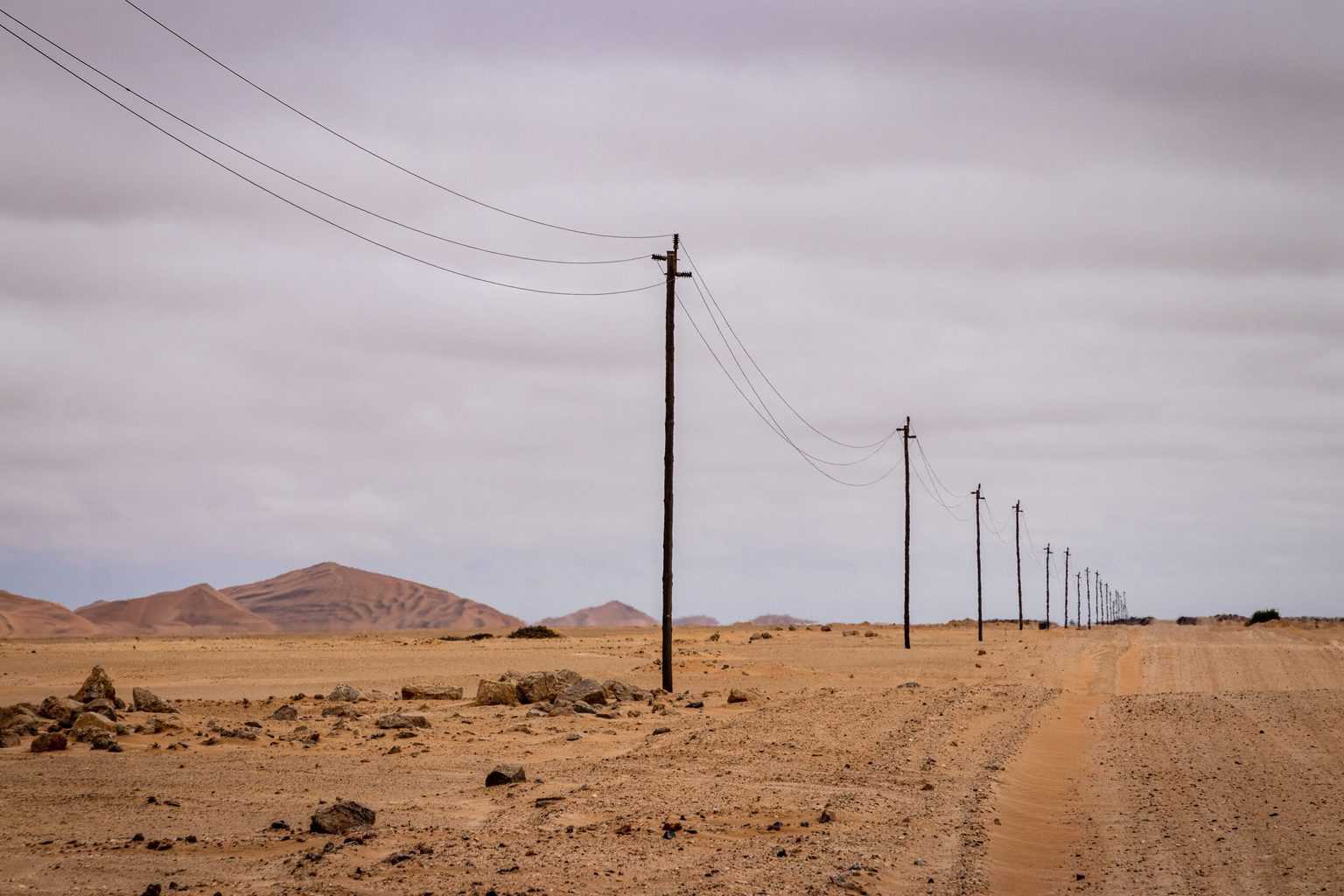
Sleep, then a vivid, barren dream. I’m somewhere out west, high above yellow desert split by gray highway, as far as I can see. I breathe fresh air at last, but it’s like breathing mist, and anyway there’s a job to do, trouble on the line, and I have no clue how to fix it. I stare into a metal box of wires, try to trace a coil from one point to the next, but I lose it in the mass of cords, and everything falls apart eventually anyway. High above rocky slopes, road below framed in phone lines, shimmering with heat, his voice is the only sound. He’s humming, there in the wire. But not to me. To everyone, to no one at all.
Cathy Cruise is the author of the novel A Hundred Weddings, and short stories that have appeared in journals like American Fiction, Appalachian Heritage, Pithead Chapel, Vestal Review, Michigan Quarterly Review, and others. She has a master’s in writing and a bachelor’s in English and has received a few writing awards you’ve likely not heard of. When she’s not busy with freelance writing and editing, working on her second novel, or walking her dogs, she can be found reading, begging her kids to play Rummikub, and watching far too much TikTok. You can visit her online at www.cathycruise.com.
Subscribe to get new flash fictions in twice a month in your inbox.
Submit your flash fiction or personal essays to Fiction Attic.
-

Story in Blank Space #1–by Kris Broughton
(the writer asserts that the empty space above represents all the stories of the known universe. He recommends that you stare at the blank white space for at least five minutes to see this particular story in its entirety.)(If you are having trouble discerning where one story ends and another begins, the writer suggests that instead of trying to interpret this particular story through reading it one word at a time, you should concentrate instead on the physicality of the story, taking the requisite information about plot and characterization and theme from the amount of space this particular body of words displaces.)
(If you are trying to read this while an annoying, undersized dog is barking at you, you have the writer’s sympathies, as he was similarly aggravated by a diminutive, deballed mongrel of mostly Chihuahua origin during the creation of this piece.)
(By the end of the second minute of staring, you should begin to get a picture in your mind’s eye of the main character. You are not surprised to find that he is an anti-hero, inasmuch as this particular story is on the cutting edge of being an anti-narrative. You are also not surprised to find that the protagonist, in a vague way, resembles the you of yesteryear – a slimmer version of you who has more hair and whiter teeth, with a morose disposition you do not recall. The only surprise, if you are not African American, is that this you is black.)
(Just when your eyes begin to tire of focusing on these few square inches of blank screen, the story you have been waiting for appears in your mind. You have chosen to begin in the middle, as you are not overly fond of settings, mood, or tempo. This brown skinned character who resembles you is enmeshed in an imbroglio between his lover, who represents societal propriety, and his secretary, who represents individual desire. After three minutes of staring at a blank screen, this business of your likeness being black is no longer perturbing. In fact, it sparks possibilities in your mind. You wonder if this character’s jump shot is better than the one you have in real life. To be more accurate, the one you used to have – in real life, you haven’t played basketball in ten years.)
(This is not the life you would have imagined for yourself if you were black. The protagonist has a doctorate in appliquéd physics. His lover has a doctorate in voodoo economics. The scene you have entered in progress shows our anti-hero and his paramour standing on the balcony of his loft apartment, eating canapés of fish flavored tofu and sipping white wine spritzers. Dr. Voodoo has convinced herself that our protagonist is involved with his secretary. Dr. Appliqué is stuffing his mouth full of tofu canapés, in hopes that he will not have to talk to Dr.Voodoo about his voluptuous secretary, Pogo Tatuopo.)
(This is not what you expected from characters who look like this. Dr. Appliqué’s eyes, you feel, should hint at a well of violence, at a past filled with pain and suffering and self-loathing instead of radiating the self-satisfied gleam of the intellectually well-endowed. Dr. Voodoo should be angry and aggressive instead of confused and disappointed. Now Pogo’s broad South Pacific Islander cheekbones come into focus. The blouse she is wearing is unbuttoned to her breastbone. When you see the lush curve of Pogo’s hips, there is no question of Dr. Appliqué’s guilt or innocence – only how many times it has happened. As the action within the story begins to rise, you close your eyes, because the protagonist is an anti-hero, and it is pretty obvious to you where this story is headed. You begin to feel faintly ridiculous at having spent so much time staring at a blank space.
Your shift to anger is sudden, swift – you would murder the writer if you could get your hands on him for wasting your time! Then you blink your eyes and all of a sudden the blank space seems larger. The whiteness of it seems to be fluid, as if you are staring into the top of a freshly opened can of Chantilly Lace housepaint. Wait! Is this the same story you have been staring at? The same protagonist you have been watching? He can’t be…you didn’t expect him to…holy shit!)
(Although you have not forgiven the writer, the story has improved immensely – that is to say, the direction in which the story is headed is not what you would have expected. What is utterly amazing, moreover, is that the writer has been able to capture your imagination so vividly with two Black PhD’s, a tray of fish flavored tofu canapés, and a woman named Pogo. The recommended five-minute viewing time is almost upon you, but the tale has become so engrossing, you are tempted to try to go back to the beginning to see how this all started.)
Kris Broughton has had stories published in Carve, Exquisite Corpse, 3AM Magazine and Eclectica. Kris lives in John’s Creek, Georgia, where he toils ceaselessly in the IT industry as a channel sales professional. Kris is at work on a contemporary novel about Black men.
Subscribe to get new flash fictions in twice a month in your inbox.
Submit your flash fiction, personal essays, or illustrations to Fiction Attic.