Your cart is currently empty!
Tag: gloria frym
-

No for an Answer – flash fiction by Gloria Frym
Listen to this story read by the author.
I once knew a woman of a certain age who loved her last dog like she loved her last boyfriend. I say last, because her age played a big part in these relationships. At this stage in her life it was unlikely that she get another dog nor another man. She might get another car but it too could be the final one. Who knew?
As a culmination to a long love life, she loved her last boyfriend as friend and companion. But she did not love him deeply or passionately or madly, and she was content with that type of love, at her age. He was not. He wanted more affection than she could offer. The last dog she would have was a bit like the man. He was the most friendly dog in the world which did not sit right with her. His discriminatory powers seemed to be missing. He loved every dog he encountered and every person. Unless another dog bared his teeth, he was ready to play. Even then, he would try and try again to gain the teeth-baring dog’s attention only to be foiled each time. When they were alone, he was full of kisses for her and when they sat on the couch together at night in the same spot where she once sat with her former man, the dog would lick her arms, even her pants, and move as close as he could to be next to her. If he could have held hands throughout a movie, he would have. This rather diluted her love for him. Also, he was a creature who constantly wanted to do something, rolling around on the floor barking as if to say, What’s next!, wanting to go outside in the most inclement weather, ringing the chimes that hung from the back door handle. He would paw the bells endlessly whether or not he actually needed to go out. He would not take no for an answer. If she did not respond to this signal, true or false, he would cry mournfully until she let him out.
It chagrined her that she did not love this dog as much as her previous dog who was independent, even standoffish. He was more like a cat. He could, as someone said, take care of his needs. He never kissed or licked her. She got used to the understanding between them, she adored him more than some friends, and attended to his modest requirements in exchange for his close presence. He never had a destructive period when he was a puppy, whereas this last dog chewed up the wand to the DVD player; macerated her expensive prescription glasses; ate up several covers of the Paris Review; dug up the newly planted and chomped the irrigation system; fileted several of his plush toys; unraveled two oriental rugs, etc. She often screamed No! at him and spanked him several times with the destroyed object, contrary to the advice of dog trainers. She wondered if her reaction to his early destructive tendencies left an enduring mark on either of them. But no, he remained intractably loving; she was a forgiving person. She had forgiven the men whose infidelities had once caused her unbearable anguish. She had forgiven or forgotten anger toward other persons who had diminished her. No, it was this ultra loving dog. She could not love him fully because his love took up more space than she had for dog love. He was excessive, as though he were sent to her to make up for all the partial loves she had experienced, even the lukewarm love from her children. She almost hated him for exceeding her limits. Though she would often say to him, I love you, as she did to her last boyfriend.
Gloria Frym lives in Berkeley. Her most recent book is How Proust Ruined My Life & Other Essays (BlazeVOX, 2020). The True Patriot, a collection of proses, came out from Spuyten Duyvil. She is the author of the short story collections–Distance No Object(City Lights Books), and How I Learned (Coffee House Press)–as well as many volumes of poetry. Her book Homeless at Home received an American Book Award. She is professor in the MFA Writing Program and the Writing & Literature Program at California College of the Arts.
Editor’s note: When I started Fiction Attic in 2005, I put out a call to friends and colleagues whose work I admired, asking if they would be so kind as to send me something. Frym sent me the flash fiction More Lies, which you can read in the wayback machine on our original website. As with every story Frym writes, I was hooked by the first line: “Rumor has it, this woman goes through dogs,”
Frym remains one of my favorite writers to this day, and I’m honored to be able to publish her work once again. I highly recommend her 2020 essay collection How Proust Ruined My Life. You will find two more stories by Frym in the coming weeks. M.R.
-
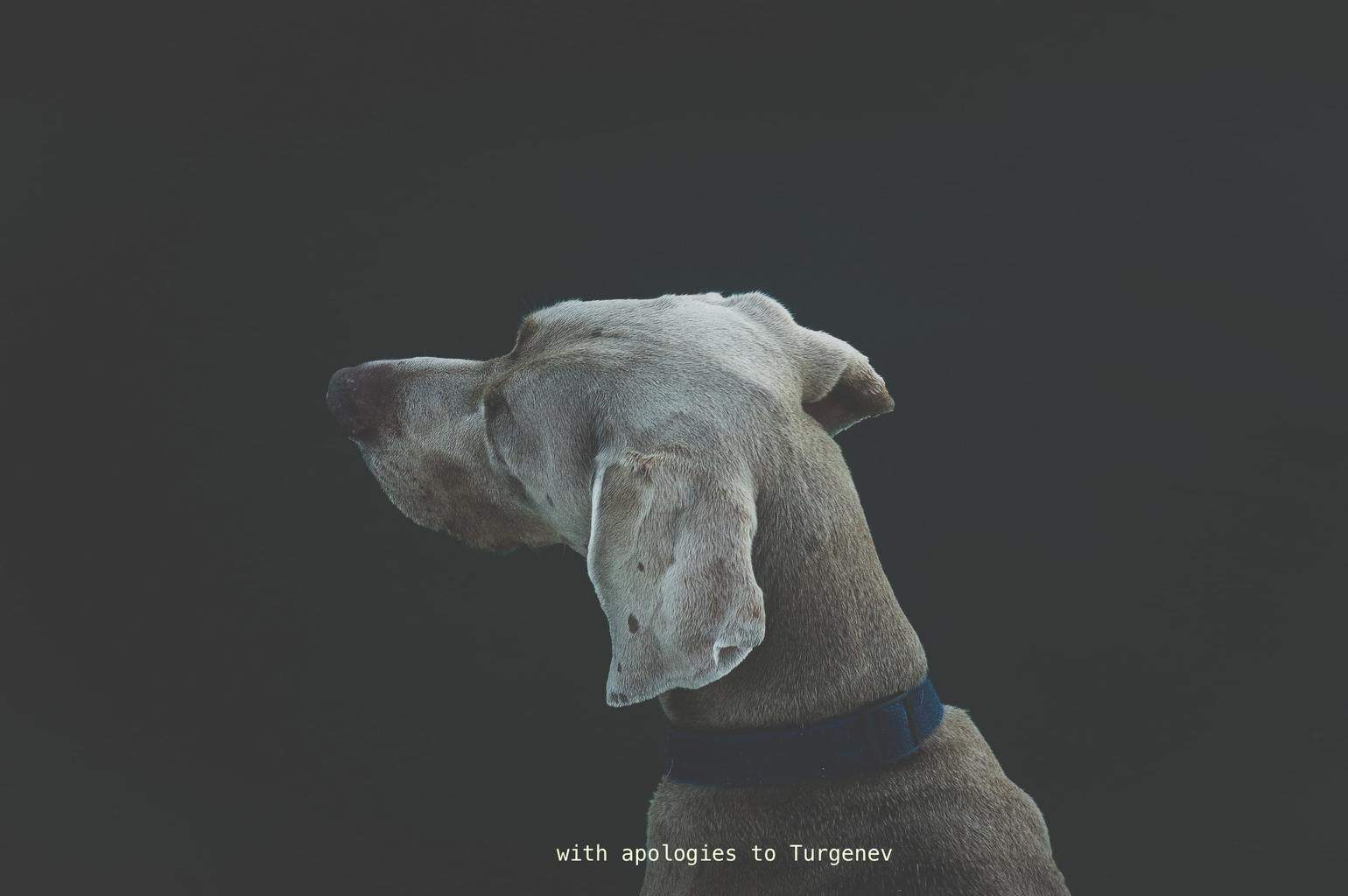
CSI SUV – by Gloria Frym
I was taking a bath when the idea first occurred to me—the phone call which deprived me, forever I believe, of the good opinion of several friends. I have heard it said by others that they laughed so hard they wanted to do it themselves. Since I am not in possession of a great amount of free inventive powers, I always felt the need of some firm ground in the form of idea in my work. The same thing happened with this.
At the basis of it lay a story I had been greatly struck by just as three pit bulls in the dog park happened to rush by me, each yelping at the same pitch. In that remarkable moment I could watch the embodiment of a principle that had scarcely come to life but was just beginning to stir at the time, the principle which later received the name of ***.
Though very powerful, the impression this incident left on me was still rather vague. At first, I could not quite make out what the pits were after except one another.
I kept returning to the park to observe and listen to everything around me as though wishing to check the truth of my own impressions. I was worried by the following fact: not in one work of literature did I ever find as much as a hint at what I seemed to see everywhere. At the dog park, there was a woman who was endowed with an impressive nose for everything—namely, the ideas of our time. I told her what I was thinking of and what interested me so much and was astonished to hear the following remark:
Did you get this from something you saw in the movies? I said nothing.
These words produced such an effect on me that for several days I tried not to think of the idea I had in mind. However, at some point, it matured in my head. In order to sort the curds from the whey I accidentally returned a call from a dear friend. What was I after? An embodiment of the idea.
I pressed Send and when I did not hear her voice, I put the phone aside. Then I turned on the television. Nothing but crime shows on four of the few free channels left. I stretched out from a long day; my dear dog leapt onto the couch to sit beside me in order to be stroked. I was not entirely certain that this creature loved me for who I am or simply loved to be stroked and fed. Is that love? I wondered, further enlarging the sub-idea that was involved in this account. Also, my dog is not particularly affectionate and does not always run with others. Nor does she lick my face unless I should have some leftover meal or the scent of it besmirching my cheeks.
Sirens blared from the flat screen speakers, alerting my bitch’s ears, not to mention my own, and I summarily mistook the sound for 1)the emergency alert system at last in action; 2)medical aid rushing to the scene of a neighbor’s heart attack. The story on TV involved a dead body, a sharp-tongued detective, and a pert sarcastic set of female coroners who compete for excellence in their work as well as the attention of the same man.
She’s toast, the detective says, poking a campfire stick at the victim’s elbow.
She was burned like a marshmallow.
Ok, says one of the coroners, let’s do a work up. You never know the time of death with these sorts of SUVs.
No, you don’t, says the other coroner, removing her 5-inch heels to dump a pebble that had inadvertently crept its way into her arch.
What are you doing? screams the first pert coroner in concert with the detective. You’re occupying the crime scene with your crap.
What are you calling crap? And who is you? Who am I? Why?
A long silence ensued while the medics hoisted the charred body onto a stretcher.
Crispy, ya think? said one of the medics.
Lucky her lips are still intact, said the other.
Just as this pronouncement was made by the television medic, fire trucks pulled up to my house. I certainly had not asked for them. My landline phone rang. It was her, dear friend. Are you there? she yelled over crackling static. Am I where? I said. She seemed to not hear me.
After that it was all a blur. The television medic, the pert coroners, the sirens, the phone calls, the knocks on the door, the boyfriend, the girlfriends, the clerk in the mini-mart with whom I had exchanged ideas about capitalism. All rotating before me like a spinning globe. We heard what the police said, we feared, we rushed over because … .we love you, each said in their own voice, except all the voices became a chorus and the chorus stood by my couch and my dog barked a bark I had never heard before.
How utterly wonderful! I love you too, I said in the ensuing group hug.
Except that instantly the pedestal on which I stood among these dears had been destroyed chiefly by the chief medic combing through my home and discovering my cell phone, which was still blithely speaking to my friend who was standing right in front of me, not hearing it anymore, half-crazed at the thought that someone had put me on a spit and roasted all but my face.
Would they understand or forgive me? Not me, but my idea. The excuse of being an unloved child no longer held any caché among the best of them who had, well, let’s leave it at that. That it might have been an accident lingered in the minds of some of those present, except the boyfriend of my girlfriend who did not believe in accidents. They did not, have never got quite the right idea of what took place in the mind of a person, or of what exactly her joys and sorrows, her aims, successes and failures are. They do not, for instance, even suspect the pleasure that consists of castigating one’s self and one’s faults in the actions one commits. Now they seem quite sure that this was a little prank, even if the reality of life has been correctly and powerfully reproduced, even if this truth does not coincide with my own sympathies. In the words of Goethe, “if these are roses, they will bloom.”
Gloria Frym was born in Brooklyn. Her new collection of prose, THE TRUE PATRIOT, is just out from Spuyten Duyvil. Her recent books of poetry are The Stage Stop Motel and MIND OVER MATTER (BlazeVOX books, 2011). She is also the author of two short story collections—DISTANCE NO OBJECT (City Lights Publishers, 1999) and HOW I LEARNED (Coffee House Press, 1992). She teaches at California College of the Arts in the San Francisco Bay Area.
Photo courtesy of Will Langenberg. Visit the artist at willlangenberg.com.



-
More Lies–flash fiction by Gloria Frym

Rumor has it, this woman goes through dogs. Some women go through husbands, some men go through women, some kids go through clothes, ballerinas go through toe shoes, spendthrifts go through money, overeaters go through cookies. And so forth. But this woman, this is her sixth dog in a short time. Longer, of course if you count it in dog years.
The porch gossips say, and who knows if they can be trusted, who really knows what’s what, that she might have a disease. You know the kind they feature on a 60 Minutes or “ER.” The kind that glues people to the TV because they’re horrified and compelled like they’d be at a bloody accident or a building on fire. So long as it’s not them or theirs.
Dog #1 died suddenly.
Dog #2 died suddenly after a brief illness.
Dog #3 died slowly after a slow illness and many vet visits.
Dog #4 died some way, no one remembers.
Dog #5 rolled over and died.
Dog #6 is okay now but was sick as a small puppy.The gossips are crossing their fingers. After all they live in the same vicinity. The woman says the veterinarian says that there’s something toxic in the soil in her backyard. What if there’s something toxic in all their backyards? What if her house and their houses were built over old gas stations or car repair shops? It’s hard to believe that this woman would ever let her dogs out in her backyard. Dog #6 she carries in a baby front pack because he is very little. He’s not going to get much bigger, either. But now, she says, he’s better, and she lets him move around on a leash. In fact, she walks him. So, say the gossips, and she probably never puts him outside alone. That’s why they’re suspicious.
It could be that this woman simply has bad luck with pets.
It could be that this woman makes her pets ill so she can nurse them, right up to their death.
She has no children and no husband.
The gossips say, Thank God for that.
It is very hard, given the circumstantial evidence, when one is told of such events, not to believe them. They sound so plausible, even if there is no proof. Why do they appeal to one’s instincts rather than one’s reason? Juicy bits of information about a woman who is rather nervous and neurotic, who strolls down the street with a different dog every year or so.
Goes to great lengths, far away places to buy the dogs, after long email conversations with their breeders. Always a pure-bred dog. Always from out of state. The facts start to pile up, right? Something, if one had nothing else to do, one could take to a private investigator. He’d solve it, all right.
Can you go to jail for murdering a dog? It’s a misdemeanor. The law considers dogs “chattel.” But you remember that guy who threw a dog off the freeway? That was cruelty. That got him jail time. How about murdering someone else’s dog? That would also get you jail time.
Somewhere there is something called an Animal Patrol. Not like they take animals to the pound, but they remove abused pets from homes. Kind of like Child Protective Custody Services.
Yesterday, I lied.
A good lie, told spontaneously, is a piece of art, though it makes person like me guilty. It could be addictive. It worked that well.
It all started after I’d heard about the woman with the succession of dogs.
The car wouldn’t start. The battery dead, again.The operator at triple A says, 45 minutes.
Forty five minutes, I say, oh no! I have to pick up a child!
From school or from daycare? the operator asks.
From daycare. If you’re late, they just take the kid to Child Protective Custody Services.
Oh my God, the operator says, greatly alarmed. Is that what they do these days?
Oh yes, I say, they just don’t want to wait.
In two minutes, a tow truck arrived.
So your little car won’t start, hon?
Yeah, it’s always the battery.
He did his jumping magic with great dispatch.
When I thanked him for arriving on the scene so quickly, he said, Oh, you deserve even faster service.
How could it be faster, I thought?
Of course, he said, What you deserve and what you get are two different things in this world.
Yeah, I know I said. I mean I was just laid off, I lied again.
You in the tech biz?
No, I’m a school teacher.
A teacher! For Christ’s sake, the bastards. It will come back to them. Some kid will kill a dog because nobody taught him the right way to behave.
This piece was originally published in 2005.
Gloria Frym is the author of How Proust Ruined My Life and Other Essays (2020), The True Patriot (2015), How I Learned (1992), Distance No Object (2001), and several other volumes of poetry and prose, including By Ear, Back to Forth, Impossible Affection, and Homeless at Home. She is also the author of a book of interviews, Second Stories: Conversations with Women Artists. Since 1987, she has been a member of the core faculty of the Poetics Program at New College in San Francisco. She also teaches in the MFA Program in Writing at California College of the Arts.
Subscribe to get new flash fictions in twice a month in your inbox.
Submit your flash fiction or personal essays to Fiction Attic.