Your cart is currently empty!
Blog
-
The Spoken World
memoir by Brett Garcia RoseHere are the rules: You must begin every sentence or phrase with a vowel. Any word beginning with a consonant is considered high risk and must be preceded without pause by a vowel ending in a higher tonality. This is the roller-coaster. The letters M, B, G and V are especially troublesome. Avoid them, substitute with words beginning in a Z or TH or another soft consonant where possible (hint: you can get away simple letter substitution within a word if you fake a yawn or hiccup), but if you need to use them you will always and carefully place them towards the end of the sentence, when you are out of breath and have the necessary speed and force to break through. This is the run. You can never use words that begin with T, S, Y or a hard C, and you can never use any word containing an audible W or a soft U. These sounds are unavailable to you. Find alternatives.
Now construct a paragraph describing what you did today. You have 2 minutes.
A stutterer learns to do this at five years old. By the time we reach nine we can do it in around half a second. At 12 we have the mental equivalent of a college-level thesaurus and will often use three or four syllable words or entire phrases in place of a single word containing a letter we cannot use. A common example is for us to say ‘I’d prefer not to agree at the moment,’ instead of a simple ‘no,’ if the word stutters in the internal rehearsal that takes place in the moments prior to verbalizing.
We speak the way writers write, and we edit in real time. And even though the lag lessens with time and practice, a stutterer will likely go his or her entire life without ever having a real conversation. We are three steps ahead of ourselves at all times. We cannot enjoy the present because you can’t bear the silence. We love and fear and respect language in way the fluents could never imagine. We think in words, not images, because we are necessarily obsessed with the delivery of our thoughts more so than their contents, and we are so preoccupied with our verbal puzzles that there is no room for anything else. And although we may only speak 30 or 40 words in a given week, we have a constant stream of dialogue running through our minds. Life, for us, is an ongoing rehearsal.
School is a problem beginning at a very early age, but not because of the social abuses put upon us. Those are not unique to stutterers, and we learn to take it just as any other outcast groups of children do. Fat, ugly, pimply, speechless, it doesn’t make a difference. Children are mean, and there is never a shortage of targets. No, we are inevitably undone by our own cleverness, our self-cures. We develop many simple and complicated ways to avoid speaking. The survival of a young stutterer depends on his or her ability to avoid attention, to eliminate the reasons and opportunities to speak. As long as we’re allowed to keep silent, we believe we’re just like everyone else. Much of this involves simply becoming smaller; if we cannot get something on our own then we just learn to not want it. We spend our entire lives going around things others take for granted, things they look forward to.
We don’t make friends. We don’t date. We don’t fall in love. We take whatever jobs we can find, because we don’t interview.
But we do speak, and we are proud when we speak well. One sentence well delivered means as much to us as an entire graduation speech means to the valedictorian. Our speech is funny, sure, stilted and put together wrong even when properly rehearsed and delivered, but it’s the only speech we have. And no, we are not grateful when you complete our thoughts for us. We want to murder you. My father, of all people, understood this. People were routinely thrown out of our house for less.
Stuttering is not a handicap. There are no stickers or scholarships for us. We get the opposite of special treatment. Teachers often take it upon themselves to cure us of this annoying and disruptive problem, either by brute force or shame. And so, predictably, we fail, and then we rebel to justify our failures, and eventually succumb to the escalating, negative descriptors put upon us. I could not speak, so I learned to pick pockets and locks. Such was my story, and it is a common one among stutterers. We fail, yet we are not failures.
After nearly dropping out of high school, my father gave me the typical ultimatum of the day, either go to college or get out. It was understood that I was basically retarded and would go no farther. My family was tired. I was tired. We’d all had enough. I’d find a good life as a mechanic or line cook somewhere. I’d live the same blue-collar life the rest of my family did before me. I’d learn a trade. There was no shame in this.
Only, I didn’t. Perhaps it was my lifelong anger at stuttering, at my father, at the world. Perhaps it was just fear of leaving. I still don’t know. But I never felt stupid, regardless of all evidence and assurances to the contrary. I wasn’t book smart in any sense, but I could think. So I applied to the only school that would take me, a local two year community college with no admission requirements and cheap tuition. I enrolled for one semester, five classes, and received a perfect score in every one. Another interesting fact about stutterers; we don’t really need to study. We spend our entire lives listening to others speak, and we do it well.
Much to their credit and my own minor astonishment, my family was not surprised at all, and faithfully supported me throughout my difficult college career. Without their unyielding, unforgiving strength I’d have gone no further than high school. There were still many important classes where I received unsatisfactory grades, or simply removed myself and failed when presented with forced participation. And worse, instructors easily notice students who underperform and either go hard or give up. To the sensibilities of the outside world, we are either retarded or rebellious, and sandbagged accordingly. University is not so different from grade school in this respect. But I trudged on. For my father, mostly. Sometimes I excelled, often I failed, but I never received an average grade. And I never quit.
I stumbled onto writing by accident. Classes with heavy emphasis on written assignments were easy for me, so long as I did not have to read aloud (I often got the flu and lost my ‘voice’), yet I did not think about writing until I began to keep a journal; well, really, until someone important to me discovered my journal and read it in secret. She confronted me a hundred pages in, laughing and crying and questioning. She’d never known I had so much to say. Anything, really, to say. She was, and remains, the most beautiful person I have ever met.
We were engaged to be married a few months later. Several months after that I was the youngest person ever to publish a column in The Sunday Newsday Magazine. Three times.
Thus began my brief career in journalism. At my second school, after a year of no friends, no parties, nothing, I wrote a goodbye story and slipped it under the door of the campus newspaper’s office late one night, a sad farewell to people I’d never known but desperately wanted to, people I’d watched with envy and admiration and genuine warmth. I wrote a goodbye letter to the student I’d never be, to the people who I would never know. By the time it was published I was long gone. At my next school, a larger, state school, I’d publish a weekly column for two years under a pen name. I discovered, then, that I was not just writing for one person; I could write for everyone. That person was famous. People wanted to know me. They’d invite me to parties, ask for my thoughts, for my friendship, for my love. Everyone wanted to know that person. But I’d never have anything to say. The person they wanted to talk to didn’t exist yet. It was time, again, for me to go.
And so I’d transfer again, just leave in the middle of the night, no one to say goodbye to, no one to wish me well or to hold me back. I’d transfer again. And again. At each school I’d publish fiction for the college literary magazines, essays for the journals, columns for the newspapers. At Northeastern University, where I finally graduated, I kept a part-time job cleaning the newsroom, ever aware of my mounting debts. After each production cycle, I’d work overnight scraping the wax from the floors and layout boards for seven dollars an hour. When someone finally connected me as the wax guy to me as the columnist in the same paper, to the fiction writer in the literary magazine, to the essayist, I was offered leadership editorial positions of increasing responsibility, and one of the few regrets I carry with me was that I never accepted any of them. I was becoming a good writer and an excellent researcher, sure, but the inability to use a telephone made the task all but impossible. No one texted back then. No one emailed. I was tired of failing.
I was good with computers, however, and my last few months in school I was instrumental in budgeting and implementing a conversion to full electronic publishing. My advisors thought I was autistic, but they accepted my plan wholesale, and I made it work. Three months later the university newspaper, one of the largest student papers in the country at the time, was fully electronic. No more wax. My job was done. My final effort as a journalism student was to shed my weekly column and write a three part, front page investigative series on animal research and abuse on campus, resulting in a suspension of federal funding for the university biology department, and significant disciplinary action against me. I’d been funny in the past, literary, romantic even. Now I had teeth. But it was worth every word. I went on to become an underground writer and researcher for the animal rights movement, and eventually became production editor of the Animal’s Agenda, the international magazine of animal rights activism. My journalism, however, would go no further. Eventually, someone would always ask me a question. And laugh at my non-answer.
At the same time I also entered general electronic publishing, designing layouts for Popular Mechanics, Redbook, Windows Magazine, MacMillan trade books and other publications, but this, too, was a short-lived career. I was summarily ejected due to another small handicap I had kept hidden; I am colorblind, and inevitably made a costly mistake on a central layout. Colleagues covered for me initially, but people only go so far. Thus ended my career in writing and publishing.
So I went to a trade school on a federal assistance program and learned software engineering. I studied database theory at Columbia University in the evenings. In 1995 I started my own company, inventing a system called Concept-Tel for the wholesale telecommunications industry. I am the sole employee, designer, developer, salesperson and CEO, and continue in this capacity today. My closest competitor has nearly forty employees, and yet I succeed well enough, and often excel. Other times I fail, go broke, work for other companies. But I’m used to that. A stutterer learns failure at about the same time other children learn Lego.
Still, all these years later, I wish I had found a way to stay the course. I wish I had kept writing every single day, as I did then. I wish I had the courage to not bend to the world. I wish I could still talk to that young woman who discovered me, who gave me my first chance to communicate with the world. It was not my stutter that ended my writing career. It was not the misinformed teachers and counselors and therapists. It was not the meanness of my peers. It was not my parents. It was me. The world had not beaten me. It had challenged me. What everyone saw as my success was, to me, a profound failure. I’d spent a lifetime avoiding the very thing that had saved me. My writing.
Like so many others, I began writing out of despair and a sense of disconnectedness from the world, out of loneliness and fantasy. In my writing I was fluid and fluent, I could be charming or terrifying or wise. In my writing I had friends and purpose and value. I was someone to talk to, someone to love. In my writing, I discovered myself. In discovering myself, I came to know the world.
Eventually I overcame my stutter and evolved into the speaking superhero that I had so often fantasized about, but I still write for the same basic reason. Like someone who moves into a new home and renovates it to their liking, I recreate the world I inhabit through my fiction, and although my changes are often small and subtle, when I am finished and read back what I have written, that world seems like a better place than before. My characters are lonely, though. They don’t talk much. They don’t need to. But in all my work, and my life in general, there is that unyielding, ever-present loneliness that all stutterers share, and the profound power that accompanies its presence. I do think this is a common path that many writers take; it begins as a curiosity, then an art, then an outlet, then an addiction and finally an immersive way of life. To a stutterer, it is a lifeline, no less important to us that air or water or love. For me, though, the real world is indistinguishable from fiction, and the more I write, the greater control I gain over that fictional world, which directly translates into greater power over my own life.
I learned to shed the thick skin I’d developed as a stutterer. I overcame all of that tremendous anger that all stutterers bear. In the end, it served no purpose. I deserve and demand from the universe no less than anyone else. After many years I’d come to learn what others accept as children. All you have to do, is ask. The world is only as frightening as you allow it to be.
So two years ago I’d finally done what I’d always feared, what I’d always found a way around and made silent excuses for. An editor of a magazine that published some of my work asked me to read in public. I said no, but he just told me the date, and how long I was to read for. I was a writer, he’d said at the time. This is what writers do. He knew nothing of my stutter, and still doesn’t, but assumed that this was a fear all new writers had to deal with. I was to compete in Literary Death Match, next to successful writers, in front of famous judges. I had weeks to prepare, and seven minutes to read.
I invited my family. I’d memorized every word of my story so I would not have to deal with paper. My plan, all along, was to announce up front that I was a stutterer, that I was nervous, that I would do my best. I would ask for patience, for lenience and acceptance. Once on stage, however, I did no such thing. I looked at the lights and the judges, at the hundreds of waiting faces in the audience, at my family. I just started reading, and I read slowly, confidently. I read well. When it was over, I’d expected my family to be astonished, to be proud and amazed at the words coming from my mouth, for no such thing that had ever seemed even remotely possible to me. My mother commented that I sounded like I had a southern accent. People talked with me late into the night and, for the first time, I answered. The next morning, the Miami Herald published excerpts from my story. There was no mention of any horrible speech problems or people laughing or booing. None of it happened. And I realized, at that moment, that I was no longer a stutterer. My family had forgotten. My audience never knew. Even the journalists couldn’t figure it out. I was, simply, a writer. The stutterer was gone.
I read my work in public now from time to time, and am heckled and critiqued as all writers are, but never for my speaking. Every word I utter is a profound victory. I am a writer and a speaker, no better or worse than any other. No one need know I was ever a stutterer. And I have no more pity for those who stutter than for those who can’t write. Personally, if I had to choose, and I remember when I was forced to, I’d choose writing. Every time.
I have the same insecurities as any other person now. I feel unprepared, at times unworthy and exceptionally lucky, and yet I know there is more to it. For no matter the success I find in software, it is insignificant to the pride I take in writing, and the pure exhilaration I feel when I am able to write well, to finish a good story or even a page in one, and to know that it is mine, mine alone and hard-won. I give no further thought to speaking. Whatever I have to say, I say.
And so I return to my beginning as a writer. To write regularly, to understand the craft and trade more completely. To become, finally, a writer, as corny as that may sound. It is difficult and at times frustrating and disheartening; I am a young writer and largely self-taught, with all of the bad habits and insecurities that come with that meandering and unstructured effort. Yet I continue, I persevere, in the same way I have in my career in activism, in my software, in my stuttering, and in my life.
I’ll never be that person who comes through my writing. None of us ever are. We pass one another at times, these two eager selves, we nod and acknowledge each other as peers, as equals, distinct and ever distant yet, in the end, friends. The spoken world is bigger than I had ever imagined it to be, wonderful and relentless and unforgiving, and to be a part of it was my grandest childhood fantasy. I don’t know what the world sees me as now, just another guy trudging along the same road, at once careful and reckless as we all are. I still don’t speak much, and I find the world every bit as mean as I did when I was a child. Inside I will always be a stutterer, with all of the wonderful gifts and peculiarities and sadness earned as such. But outside? In the big real world I had hidden from so well and for so long? Outside, I’m just another writer, struggling to find words, to be heard and understood and absorbed. Searching, at long last, for something to say.
Brett Garcia Rose is a software entrepreneur, fiction writer, former animal rights soldier and stutterer. His work can be found in literary and consumer publications around the world, including Sunday Newsday Magazine, The Barcelona Review, Opium, Lit Up, Rose and Thorn, The Battered Suitcase, and The Lascaux Review, in which this essay originally appeared. Awards/nominations include the Million Writer’s Award, Best of the Net, The Pushcart Prize and Opium’s Bookmark competition. His first novel, Noise, will be available in Summer 2014. Find the author online at BrettGarciaRose.com.
-
Telegraphing the Fox
In a drawerful of correspondence, I found a slew of cards addressed to my dour, sour father dated a few years previous, from one Gloria Greenberg on East 88th Street. Each message contained some sort of thank you – for flowers, a night at the theater, the card he’d sent her, and for being such a wonderfully kind and generous man on her birthday. What were his gifts, I wondered. Dinner out? Jewels? Art? From the handwriting, I deduced that Mrs. Greenberg–she used the title on her return address–was close to his age; each letter was carefully formed, slanting just so, her numerals curvaceous. Clearly, she’d studied penmanship, a skill dropped from the latter twentieth century curriculum. Naturally, I was glad to discover that this romance–how many were there?—had not been with some young gold-digger, though she might have been an old one.
This is an excerpt from a flash fiction by Annie Dawid.
Read this story in its entirety when you subscribe to Fiction Attic Press.
-

On the Nightwalk
by Mark Sheerin
He was on the road when they picked him up and it was night. There he was, large as life, in outsize Day-Glo, a coat like they used working on the motorways, except he worked for a fashion magazine.
The coat was bought second-hand.
“Can I ask you where you’re going?”
The police had the car window down. From all the vehicular markings and the lights he could tell this was a serious business..
“To the station,” he said.
He did not say he was leaving the country. That was surely understood.
“At this time?”
There was no mirth in the car, no flexibility, no grounds for argument.
“I was heading down there on the off-chance.”
“You’ve missed the last train now.”
The police said so with a kind of omniscient clarity.
“There’s always tomorrow’s first train.”
Said with a shrug, but they did not take kindly to him waiting for dawn, even though there had been a lot of that recently, a lot of nights spent vigilant against an enemy. It got so he was happy only on the move, remaining one step ahead of police, doctors, parents, special agents, white slave traders. Which is where this coat might really have helped, a high-visibility anti-kidnap strategy, in theory if not in fact.
“Where d’you live?”
He was not in the habit of fighting or lying. His strain of delinquency wasn’t up to it.
“You’d better get in, son.”
Son, he thought, Sonny Jim, Sunbeam. So let the re-oedipalisation process begin, he thought, then opened the passenger door like a lamb. The rear seat smelled of leather and he thought once again of the minotaur and his labyrinth and the darkness with which he was locked in combat. The radio crackled as the police upfront called in their report.
“Caucasian male. Aged around 20”
By god though, he was alive. While parents and peers slept he was under arrest, the subject of a radio report.
“Inappropriately dressed,” came the voice.
And he could never understand that final comment. There he was, on his way to Europe, where the jacket would make him famous. Tell me officer, he wanted to say, is that really such a crime?
Mark Sheerin is a journalist from Brighton, UK. He covers art for, among others, Culture24, Hyperallergic and his own blog criticismism. His fiction has appeared in Litro, Metazen and Pages Of magazine. He also runs a spoken word event in local gallery CAC.
-
Winners & Finalists – First Novel Contest
Winner
Congratulations to Karen Guzman, whose novel Homing Instincts was selected as the winner of the Fiction Attic Press First Novel Contest.
Karen will receive $500 and publication.
First runner up
Congratulations to Rena Rossner, whose novel Framing the Sea was the first runner up.
Finally, congratulations to our finalists:
Giano Cromley, for The Last Good Halloween
Avital Gad-Cykman, for Desert Symphony
Jennifer Pieroni, for Danceland -
Where to Find Pre-designed Ebook Covers
These sites offer quality pre-designed ebook covers:
Literra Designs: covers starting at just $35. Literra keeps costs low by using free stock images. You can customize the cover text for free. Back-of-the book and spine designs cost extra.
Beetiful.com is much pricier, at $165 per cover, but the covers tend to look a bit more professional. If you’re serious about marketing your work, I recommend Beetiful.
Fostering-success.com has pre-designed covers starting at $99, plus an additional $85 for full wrap. Don’t let the weird website name turn you off. They have some decent covers at a mid-range price.
CCRbookcoverdesign skews more toward sci-fi and horror. If genre is your thing, these could work. Very affordably priced at $45-$75. (The primary image for this post is from CCR)
Damonza.com offers very good-looking, unique, artistically inclined covers, but at a heftier price than the others–$195. If you don’t mind spending more, this site is worth checking out. Unfortunately, some of the covers, while arresting, have titles that aren’t as readable as you might like them to be.
Goonwrite.com has covers starting at $30. The brightness of the images definitely gives the covers a pre-packaged look, but that doesn’t mean they’re not eye-catching. If you scroll down you’ll find searchable genre categories on the left hand side of the page.
Author Marketing Club features covers by a number of designers. You choose the design, and AMC hooks you up with the designer. Covers are affordably priced, although some look a bit too formulaic. AMC offers is a membership of $105 per year, which gives you free access to all of their ebook cover designs.
-
A Tale of Two Writing Spaces (or my dream writing room)
A South Korean furniture maker has designed this desk for kids to help them focus while they study. It could also serve as a writing room for smallish adults. Emok sells the nifty little space in South Korea for about $2,200 U.S. How much would you pay for a little bit of zen?

 I love the built-in shelves and lighting, and the window that (perhaps cruelly) allows kids to gaze out on all the fun other members of the household are having while the student is locked in his homework prison.
That footrest below the desk is a massage bar for tired feet. It may be the only thing in the room to keep you from totally losing your mind.
In this photo you can see the white board, great for writing, “Get me out of here!” or “Why did I ever think I could write this novel?” Or maybe you could play hangman solitaire.
I both love this space and hate it. Theoretically, it looks like a great place to write The Next Great American Short Story (I can’t imagine staying there long enough to write a novel). On the other hand, it might make you go a little Yellow Wallpaper.
Photos via Design Taxi.
This micr0-cottage by Tengbom Architects in Sweden (via Contemporist by way of DesignTaxi) is more to my liking. At ten square meters, te eco-friendly space, conceived as a complete student flat in collaboration with students at the University of Lund, is truly museum worthy. Though it’s not for sale yet, I’m pretty sure that if it ever is produced, it will be out of my price range.


-
3 Myths That Are Killing Literary Culture
1. Writers just want to be read.
I recently heard a young woman at a party say that writers don’t mind when their books are downloaded for free on the internet, because “writers just want to be read.”
As a working writer who pays my mortgage and buys groceries and sends my kid to summer camp with the proceeds from my books, I can tell you that this isn’t true. While I do want to be read, that isn’t my primary concern. My primary concern is making a living.
2. Writers don’t need to be paid for their work.
Let’s say you design and produce a T-shirt. Let’s say you sell the T-shirts for $20 each, and with the proceeds from these T-shirts, you pay your rent, buy coffee, pay off your student loans, pay the electric bill,go to the movies, buy a beer at the corner bar, etc.
Now, you may give your shirt to a few friends in order to drum up business. That’s called marketing, and it’s not much different from when publishers send out review copies of books to newspapers, magazines, and influential bloggers. You’re willing to give away a few shirts in the hopes that it will lead to sales.
Let’s say a bunch of people—a thousand, two thousand, ten thousand, half a million—come to you and say, “Hey, you should give us that shirt, because we’ll wear it, and when we wear your shirt, it’s going to be good for you.” What would you say? You’d probably turn them down. You’d probably point out that creating the shirt took time, effort, and resources. Maybe you studied graphic design to learn the skills that went into making that shirt. Maybe you worked at the mall for a few dollars an hour while you were figuring out how to arrange your life in a way that would allow you to do more fulfilling work. You’d probably point out that you didn’t make that shirt just to give it away. You need to sell the shirt, because that’s how you make a living, and the fact of someone wearing your shirt does absolutely nothing for you. It’s good for the person who gets the free shirt, but it is most definitely not good for you.
Don’t like the T-shirt example? Make it an app. Let’s say you spend time, money, and intellectual capital developing an app that you sell for $1.99. If thousands of people were to say to you, “Give me that app. I want to use it, but I don’t want to pay for it. If you give it to me, it will be good for you,” would you agree?
Authors make a living by selling our books. We write books that we hope will be good, books that we hope will be meaningful, but we also write books that we hope people will buy. We do not go to the store and walk out with a new pair of shoes or a new baseball bat or an ice cream cone without paying for them. We don’t expect the taxi driver to drive us to the airport for free, and we don’t expect the tech guy to fix our computer for free, and we don’t expect the piano teacher to give our kids piano lessons for free. We understand that when a service is provided, it is good practice to pay for it. We hope that others will show us the same courtesy.
When increasing numbers of readers decide they’re going to get our books for free by illegally downloading them, and when increasing numbers of libraries lobby for the “right” to lend digital copies of our books to anyone, anywhere, forever, without compensating the creators, authors don’t make a living.
In “The Slow Death of the American Author,” an opinion piece for The New York Times, Scott Turow points to the offshore pirate sites that offer illegal downloads of copyrighted books. Google and Bing serve ads to these pirate sites, and subscribers pay a fee to download content, so both the pirates and the mega-corporations are making big money off of the books they had no role in creating. Kim dot com gets another Rolls Royce, Google tops off its multi-billion dollar coffers, and PayPal gets a huge chunk of the pie. The only ones who aren’t being compensated for those books are the people who wrote them. The people who are downloading books and music illegally don’t mind paying the pirate, and they don’t mind sending a percentage to paypal; these entities are often praised as innovators. It is strange that the same people who happily to give money to the pirates believe that the writers and musicians who created the content are wrongheaded or selfish to ask for compensation. (The Trichordist has been writing on this subject for the music industry for some time now.)
If I stood on a corner telling people who asked where they could buy stolen goods and collected a small fee for it, I’d be on my way to jail. And yet even while search engines sail under mottos like “Don’t be evil,” they do the same thing. ~Scott Turow
The only people who can legitimately say, “Authors shouldn’t be paid for their books,” are people who happily go to their jobs for free. There’s a rallying cry among certain academics, librarians, and journalists that copyright is anti-culture, that all books should be free to all people, but I don’t know a single professor or librarian who doesn’t get paid to show up to the university or to the library. The same journalists who lambast authors are often salaried employees of newspapers and magazines that a)charge a subscription fee and b) pay the journalists for their content.
Traditionally, libraries purchase a hard copy of a book, which they then lend out to their patrons. I happen to be a longtime fan of libraries and the services they provide to the community. As an author, I have accepted the fact that I receive a royalty only on the copy the library purchases, not on the lending (although in Europe, authors do receive royalties each time their books are lent). It’s a model that American authors have by and large come to terms with, and, traditionally, there has been a friendly relationship between libraries and authors. Unlimited e-book lending, however, is an entirely different ballgame. For one thing, a physical book has a shelf life and must eventually be replaced, while an e-book may be lent forever from any location. By effectively ensuring that no reader will have any incentive to purchase an e-book, ever, it erases a huge chunk of the author’s royalties.
If you happen to be a professor or librarian who believes that information, including copyrighted books, should flow freely with no compensation for the creators of that information, or that publishers should offer books to libraries for free or next to free, or that soft copyright laws are essential to democracy, I urge you to put your money where your mouth is: the next time you receive a paycheck, return it. You are just happy to be able to go to work, right? You don’t do it for the money. (It also bears saying that libraries need content, and the content comes from somewhere, so when libraries lobby against fair compensation for authors, and when they remove the incentive to actually show up at the physical library to get a book, they are lobbying against their own existence.)
3. Writers make so much money, they shouldn’t mind if their books are illegally downloaded.
Advances for mid-list authors—that is, the vast majority of authors—are far from a living wage. The advance for my first book was $2,000. As I wrote the stories in the collection over a period of eight years, I wasn’t exactly raking it in. My second book, which took a much more reasonable three years to write, received an even smaller advance of $1,000—or about $333 per year. My third book, which took me more than four years to write, received an advance of $25,000, as did my fourth book, which, fortunately, only took one year to write. Obviously, during those years of writing I was making a living in other ways—from wiping down the beds at a tanning salon to selling credit processing machines all over New York City to teaching creative writing. For my next two books, I received a much bigger advance, but this only happened after one of my books, through some alchemy of good fortune and good timing, sold half a million copies. (Obviously, I did not do this alone; my book sold well because I had the support of booksellers and my agent and my editor and publisher, the very entities that piracy threatens to put out of business.)
My point here is that very few authors are making the big bucks. There are the mega bestsellers, of course, but the vast majority of authors make far less per hour than the barista at Starbucks or the person flipping those admittedly amazing burgers at In n’ Out. So when you say, “If I download this book for free, it doesn’t really hurt anybody,” you’re wrong. It hurts the person who made it.
I assume that most of the people who read this post do not illegally download books, music, or movies. But if you are a person who does that, I ask you to do one thing before you download the next book or song from a file sharing site: take a moment to visualize yourself reaching into that author’s purse, or that musician’s wallet, and stealing money. Are you comfortable with that image of yourself? If so, go ahead; download away.
Why this should matter to you.
If you’ve read a good book in the past few years, if you’ve read a book that moved you,a book that enlarged your world-view, a book that changed you, if you have ever read a book that made you want to be a writer or inspired you to be a reader, then remember where that book came from: an author who lives in the same world in which you live, an author who cannot download lunch, blue jeans, or an apartment for free.
-
Why It’s Sometimes Okay to Quit
 As a child, I hated horseback riding. I took lessons, though, because my mother wanted me to, and because I was under the impression that girls were supposed to like horses. The day after my twelfth birthday, during my riding lesson, our horse reared back, and I fell off. I landed on my back on the ground, but that was just the beginning of it. I can still remember watching the horse struggle in the air above me before she fell backward, her body slamming down on top of me, grinding the bulky Western saddle into my eighty-pound frame. She rolled around on top of me, trying to get up. Looking back, I’m amazed that I suffered only a broken pelvis and fractured hips.
Months later, after my body had (for the most part) healed, I confessed to my mother that I was not and never had been enamored of horses. I did not like the way they smelled, I didn’t like mucking the stalls, I hated the clouds of dust rising from the horse’s flanks when I brushed her. Most of all, I did not like lying beneath a horse while it rolled around on top of me. “I don’t want to ride anymore,” I said, lying flat on my back in a hospital bed, my legs in traction. “I quit.” Fortunately, she did not tell me to “get back in the saddle.” I have lived a relatively horseless life, and that has not bothered me one bit.
My high school career began at Mobile Christian School (Mobile being a city, not a state of being). A few weeks into the first semester of my freshman year, I got sent to the office for wearing orange socks.For this offense, I was shut in a room with the varsity football coach who, acting on the orders of the principal, told me to bend over. The coach, clearly mortified, gave me a couple of weak smacks with the wooden paddle that was reserved for juvenile offenders like me. The school called my mother only after the corporal punishment had been administered. “I quit,” I said. “I’m not going back.” The next day, I enrolled in the public school, Murphy High. A couple of months later, Murphy made national news because the district was so underfunded, students had to bring our own toilet paper. Despite the financial difficulties, it was a terrific school. My teachers were amazing. Did I ever regret quitting the private school that meted out spankings to girls in short plaid skirts? I did not.
In tenth grade, I quit youth choir because the songs they made us sing were terrible. “Contemporary Christian,” it was called. All pep, no feeling. Lots of poorly thought-out rhymes. Bad robes in unappealing shades of burgundy and pink. I told the choir director I’d stay if he’d let us sing Madonna’s “Like a Prayer.” He was tolerant but unconvinced. Have I ever regretted my decision to quit the youth choir? Not once. Eventually, I quit the Baptist church altogether. I discovered that life is better with more wine and less guilt.
In college, I had a string of odd jobs. One involved pulling auto parts at a warehouse for $3.75 per hour. It was sweltering hot, the ladders were rickety, and at five foot two, even with the ladders, many of the parts were beyond my reach. I hung in there for a week; then I quit. Remorse? None.
Another college job involved opening a convenience store in Northport, Alabama, at five in the morning. For this I was paid the more amendable sum of $4.25 per hour. One morning, alone in the convenience store, I heard shots ringing out from the crack house across the street. That day, I quit. I never looked back.
I briefly worked at a small airport in Tuscaloosa, Alabama. My responsibilities included calculating fuel for small aircrafts. Math has never quite been my thing. Fuel, as it turns out, is important. It only took a few days for me to realize the folly of this situation. I quit; the pilots did not complain.
Right after college, I quit a waitressing job in Knoxville, Tennessee, after the owner slipped something in my drink and the chef took humiliating photos while I was unconscious in the storage room. Soon thereafter, I found a job as a copywriter at an advertising firm. Quitting a bad thing led to a good thing. Once again, no regrets.
Over the years, I quit a variety of things for a variety of reasons: I quit the pill because it made me fat. I quit Bikram yoga because it made me stink and did not bring me anything akin to peace. I quit Moby Dick, three times. In the early nineties, I quit an engagement. Thank goodness. I quit the MFA program at the University of Arkansas and transferred to the University of Miami, because I wanted to live on the beach. I loved living on the beach; I did not love living in Arkansas. I knew then, as I know now, that life is too short to live somewhere unappealing.
While I was living in New York City, I quit wearing shoes that hurt. My husband and I quit New York City to live in San Francisco, because San Francisco has good air and good food and good views, and it made us very happy. A couple of years ago, I finally quit trying to do fancy things to asparagus, because, as it turns out, most vegetables, including asparagus, taste better steamed, with a little butter and salt, without the bells and whistles.
A few years ago, I’d been struggling for two years with a novel I was writing on contract, unable to find my way, when I finally confessed to my editor that the book just wasn’t working. “Do you think you could write something else?” she asked. Strangely, that simple solution had never occurred to me. After all, I had invested 300 pages and hundreds of hours in the book, and the thought of abandoning it seemed obscene. But I took my editor up on her offer. I quit the failed book, the bad book, the book that simply was not working. Days later, officially released from the unwieldy mass of my failed manuscript, I started from scratch. Blank page, new premise; new characters, voice, and setting. The freedom proved exhilarating, and the result was a much better novel than the one I’d been tied down to, the one I had been so reluctant to quit.
Our impulse as human beings is to finish what we started, to overemphasize our investment and continue along the path to which we’ve committed, no matter what. Our impulse as writers is to attempt to salvage the words, to make good on the promise we made to ourselves when we penned the very first line. While there is beauty in perseverance, and while there are, of course, some things you shouldn’t quit, some things that are more than worth the long and arduous journey, sometimes the best thing you can do, in stories as in life, is let something go, and give yourself the freedom to begin again.
Think of one thing in your life that isn’t working. Not something that is simply difficult, not something that is challenging but worthwhile. No, I mean something that adds no meaning to your life, something that adds unnecessary pain or unhappiness or outright despair with no hope of self-improvement or valuable public service or future positive return. Now, repeat after me, “I quit.” Commit to the end of this thing you are quitting. Watch the space open up in front of you. Begin again.
-
5 Great Tools for Writers
 The only way to be a writer is to sit down and write. It doesn’t matter how many terrific notebooks and apps you have, or how gorgeous your desk looks, or how supportive your writing group is: if you don’t actually sit down and do the work, you can’t really call yourself a writer.
But if you’ve committed to sitting down and doing the work, there are some great tools to make the process run a bit more smoothly. Here are four of my favorites.
1. CREATAVIST
What it is: a free platform for writing and publishing your books.
Why I love it: Not so long ago, if you wanted to publish an ebook across different platforms, you had to perform a whole lot of formatting voodoo. Every major platform–Kindle, Nook, Kobo, ibooks, and Smashwords–had different formatting rule. The toughest part by far was creating a linkable table of contents. With Creatavist, you insert your text chapter by chapter, choose the formats in which you would like to publish, and then download a separate file for each platform.
Cost: free
Go to Creatavist.
2. CREATESPACE
What it is: Amazon’s free platform for designing and publishing print books
Why I love it: Createspace makes it easy to design a good-looking cover by inputting your title, image, cover copy, and author name. Once you’ve created your cover, you can upload the interior of your book as a PDF or .doc file. You can either use the online proof to make sure everything looks the way you want, or, to see exactly what your printed book will look like, you can order a proof. Once your book is ready for publication, it just takes a few clicks to put it up for sale on Amazon. You choose the price and distribution options; you can offer it for sale on Amazon, in bookstore chains, and for libraries. You can also order deeply discounted copies to sell or give away.
Cost: free to join, free to sell. Pay only for the books you purchase for yourself.
Go to Createspace.
3. SCRIVENER
What it is: an app to help you organize your writing into chapters, research, scenes, and more
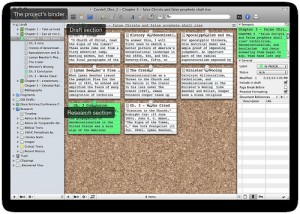
Why I love it: the corkboard interface is really attractive and intuitive. The highly customizable, hierarchical ranking of folders, files, and research is a great fit for anyone using The Paperclip Method to write their novel. Several years ago, I was so impressed by Scrivener that I bought a Mac laptop so that I could use it. I wasn’t disappointed! You can get the Scrivener app for Mac here. While Scrivener has, unfortunately, not available as an ipad app, you can download the Index Card app ($4.99) on your iphone or ipad and sync it with Scrivener. Scrivener is far from free, but I find that it’s very much worth the price.
Cost: $44.99 for the app
4. SUBMITTABLE
What it is: a free tool for submitting your work to literary journals and other magazines
Why I love it: Submittable allows you to submit work to any one of the hundreds of high-quality literary magazines that use the service. It will also keep track of all of your submissions in one place. It is currently becoming the most popular submission tool for everything from The Atlantic to McSweeney’s. Currently, the only way for writers to sign up for Submittable is to submit to a magazine that uses the service. Boo. Once you’ve done that, however, it will keep track of the status of all of your Submittable submissions–accepted, rejected, in progress, etc. As an editor (over at Fiction Attic Press), I use it to communicate with submitters and to run contests. By the way, once I’ve accepted someone’s work and it’s time to put together a book, I head over to Creatavist.
Cost: free
What it is: a series of workbooks designed to help you figure out the heart of your story and write your novel from start to finish
Why it works: The Paperlcip Method series includes four workbooks: Story Starters, The Complete Character, The Paperclip Method: The No-Outline Novel Method, and Next Draft: Tools for Revision. The series is designed for anyone who wants to write a novel but isn’t sure where to begin, or anyone who has tried to write a novel but can’t get all of the threads to come together. You can download the entire series instantly, or purchase individual workbooks.
Why I believe in it: I created this series based on my years of writing practice and teaching private classes and gradate-level writing workshops. The method outlined in these workbooks is the same method I have used to write four novels, including a New York Times bestseller.
Price: $14.99 for one workbook, $39.99 for all four
-
The Copyright Problem: Three Myths That Are Killing Literary Culture
-

via Wikicommons 1. Writers just want to be read.
I recently heard a young woman at a party say that writers don’t mind when their books are downloaded for free on the internet, because “writers just want to be read.”
As a working writer who pays my mortgage and buys groceries and sends my kid to summer camp with the proceeds from my books, I can tell you that this isn’t true. While I do want to be read, that isn’t my primary concern. My primary concern is making a living.
2. Writers don’t need to be paid for their work.
Let’s say you design and produce a T-shirt. Let’s say you sell the T-shirts for $20 each, and with the proceeds from these T-shirts, you pay your rent, buy coffee, pay off your student loans, pay the electric bill,go to the movies, buy a beer at the corner bar, etc.
Now, you may give your shirt to a few friends in order to drum up business. That’s called marketing, and it’s not much different from when publishers send out review copies of books to newspapers, magazines, and influential bloggers. You’re willing to give away a few shirts in the hopes that it will lead to sales.
Now, let’s say a bunch of people—a thousand, two thousand, ten thousand, half a million—come to you and say, “Hey, you should give us that shirt, because we’ll wear it, and when we wear your shirt, it’s going to be good for you.” What would you say? You’d probably turn them down. You’d probably point out that creating the shirt took time, effort, and resources. Maybe you went to university to learn the skills that went into making that shirt. Maybe you worked at McDonald’s for a few dollars an hour while you were figuring out how to arrange your life in a way that would allow you to do more fulfilling work. You’d probably point out that you didn’t make that shirt just to give it away. You need to sell the shirt, because that’s how you make a living, and, no matter how good-looking or smart or self-contented these free-culture advocates are, the mere fact of them wearing your shirt does absolutely nothing for you. It’s good for them, maybe—free shirt—but it is most definitely not good for you.
Authors make a living by selling our books. We write books that we hope will be good, books that we hope will be meaningful, but we also write books that we hope people will buy. We do not go to the store and walk out with a new pair of shoes or a new baseball bat or an ice cream cone without paying for them. We don’t expect the taxi driver to drive us to the airport for free, and we don’t expect the tech guy to fix our computer for free, and we don’t expect the piano teacher to give our kids piano lessons for free. We understand that when a service is provided, it is good practice to pay for it. We hope that others will show us the same courtesy. When increasing numbers of readers decide they’re going to get our books for free by illegally downloading them, and when increasing numbers of libraries lobby for the “right” to lend digital copies of our books to anyone, anywhere, without paying author royalties, authors don’t make a living.
In an opinion piece for The New York Times, The Slow Death of the American Author, Scott Turow points to the offshore pirate sites that offer illegal downloads of copyrighted works. Google and Bing serve ads to these pirate sites, and subscribers pay a fee to download content, so both the pirates and the mega-corporations are making big money off of the books they had no role in creating. Kim dot com gets another Rolls Royce, Google tops up the multi-billion dollar coffers, and PayPal gets a huge chunk of the pie. The prize goes to the middleman. Yay for them. The only ones who aren’t making money off of those books are the people who wrote them.
If I stood on a corner telling people who asked where they could buy stolen goods and collected a small fee for it, I’d be on my way to jail. And yet even while search engines sail under mottos like “Don’t be evil,” they do the same thing.
The only people who can legitimately say, “Authors shouldn’t be paid for their books,” are people who go to their job for free. I don’t know many people who do that. Actually, come to think of it, I don’t know any. There’s been a rallying cry among certain academics and librarians who say that copyright is anti-culture, that all books should be free to all people, but I don’t know a single professor or librarian who doesn’t get paid to show up to the university or to the library.
Traditionally, libraries purchase a hard copy of a book, which they then lend out to their patrons. I happen to be a longtime fan of libraries and the services they provide to the community. As an author, I have accepted the fact that I only receive a royalty on the copy the library purchases, not on the lending (although in Europe, authors do receive royalties each time their books are lent). Unlimited e-book lending is an entirely different ballgame; by effectively ensuring that no reader will have any incentive to purchase an e-book, ever, it erases a huge chunk of the author’s royalties.
If you happen to be a professor or librarian who believes that information, including copyrighted books, should flow freely with no compensation for the creators of that information, or that publishers should offer books to libraries for free or next to free, or that soft copyright laws are essential to democracy, I urge you to put your money where your mouth is: the next time you receive a paycheck, return it. You are just happy to be able to go to work, right? You don’t do it for the money. It also bears saying that libraries need content, and the content comes from somewhere, so when libraries lobby against fair payment to authors, they are lobbying against their own existence.
3. Writers make so much money, they shouldn’t mind if their books are illegally downloaded.
Advances for mid-list authors—that is, the vast majority of authors—are far from a living wage. The advance for my first book was $2,000. As I wrote the stories in the collection over a period of eight years, I wasn’t exactly raking it in. My second book, which took a much more reasonable three years to write, received an even smaller advance of $1,000—or about $333 per year. My third book, which took me more than four years to write, received an advance of $25,000, as did my fourth book, which, fortunately, only took one year to write. Obviously, during those years of writing I was making a living in other ways—from working at a tanning bed salon right out of college to selling credit processing machines all over New York City to teaching. For my next two books (neither of which has been published yet), I received a much bigger advance, but this only happened after I had proved myself by turning that $25,000 advance into a book that sold nearly half a million copies.
Just for the sake of argument, let’s pretend $50,000 is the average advance for a book by a midlist author (in fact, the average midlist advance is rapidly declining). Let’s say the book for which you receive a $50,000 advance takes three years to write—which is fairly normal among writers. You receive your advance in increments—upon signing, upon delivery of the finished product, upon hardback publication, and upon paperback publication—so the advance is spread out not only over the years it takes to write the book, but also over the years when you are waiting for it to be published, and then waiting for the paperback release. So if it takes you three years to write the book, the advance is spread out over a period of about five years.
That makes the annual income for that book $10,000. With that, you need to pay for child care so you can write the book, pay your mortgage, buy the groceries, etc. In order to make this work, of course, you need another job, although that other job is the reason it takes you three years to write a book. It also helps to be married and to therefore be in a two-income family. If you’re a trust fund baby, like most successful writers were until fairly recently, you’ll be fine. (There’s a reason that only independently wealthy people wrote and published books before the mid-twentieth century.)
Only after you have earned out your advance do you begin earning royalties. For a $50,000 advance, you’ll have to sell close to 50,000 books to earn out the advance. If you don’t earn out the advance, you don’t get royalties. Also: if you don’t earn out the advance, the publisher doesn’t see you as a viable investment, and your next advance is a) much smaller or b) nonexistent.
The fact is, very few authors are making the big bucks. Stephen King is, of course, and so are Danielle Steele and J.K. Rowling (which is not to say that these authors are not also losing huge sums of money each year to illegal downloads), but the vast majority of authors make far less per hour than the barista at Starbucks or the person flipping those admittedly amazing burgers at In n’ Out. So when you say, “If I download this book for free, it doesn’t really hurt anybody,” you’re wrong. It hurts the person who made it.
I assume that most of the people who read this post do not illegally download books, music, or movies. But if you are a person who does that, I ask you to do one thing before you download the next book or song from a file sharing site: take a moment to visualize yourself reaching into that author’s purse, or that musician’s wallet, and stealing money. Are you comfortable with that image of yourself? If so, go ahead; download away.
Why this should matter to you. If you’ve read a good book in the past few years, if you’ve read a book that moved you, a book that enlarged your world-view, a book that changed you, if you have ever read a book that made you want to be a writer, then remember where that book came from: an author who lives in the same world in which you live, an author who cannot download lunch, blue jeans, or an apartment for free.
-