Your cart is currently empty!
Category: Uncategorized
-
View From the Top – a Jiri Kajane Story
by Bill U’Ren and Kevin Phelan
Leni and I are on the floor, hunched over the rusty safe. I hold the light, while Leni dabs the solution of white vinegar and salt with a handkerchief. He wrings out some excess liquid, then applies the cloth directly onto the rusted metal, wiping from left to right. The mixture works like an eraser. As Leni moves his hand, new letters reveal themselves.
Zolotaya Seledka, it says.
This is the old Soviet brand of safes, infamously known for their nine-number lock combinations. As a child, I’d heard many stories of bankers and generals and business magnates making the arrogant assumption that they’d never forget their safe combinations. Nine numbers! Many of us at school practiced memorizing sequences. I’d made one with the birthdates of me and my brother Janos and our parents.
“How naïve,” our teacher would laugh. “First, you don’t get to choose the numbers. The safes come with them already installed! And second, it is not just the numbers! It is also the order of the dial spin on such a safe! Two times left, three times right, then two more each direction.” She held up both hands, her fingers flashing the numbers as she spoke them. “Sometimes, it is four spins right, then five left. And sometimes, it is all nine the same way. Every lock is different! They designed Zolotoyas to foil even the most seasoned safecracker.”
Leni wipes the engraved area one more time, brushes away the debris. The vinegar solution is making the metal look new, fresh from the factory.
“Are your assistants busy?” he asks.
“Yes.”
“Could they check the archives for Zolotaya Seledka manuals? Doesn’t it seem like something that would be there from the old days?”
“Filed in the archives under ‘S’ for safe?” I laugh.
Leni’s expression remains earnest, focused. “You’d have to give them a cover task—some other item they could requisition to distract the archivist. One of them could retrieve the fake cover item, and the other could find the real one.”
“Wouldn’t it be easier if I just went myself?”
“Don’t be crazy,” he says. “We can’t let anyone know what we’re doing. What would people say if the Deputy Minister of Slogans walks right into the Archives of the Ministry of Paper and demands a safe manual?” Leni dabs the cloth once more into the solution and starts wiping the top corners. “Within minutes of some clerk gossiping, we’d have a whole team knocking down the door, trying to take this gem away from us.”
“From you,” I say.
“From us. You were here when I found it,” he says. “Whatever’s inside belongs to both of us.”
I remember for a moment Leni’s strange, excited yelp yesterday. Across the room, he was pointing at the hidden safe in stupefied silence. A childlike excitement washed over me, and I immediately knelt and spun its dial. The satisfying clicking of the tumblers made us both look at each other and smile.
“Listen,” he says, “just think of something else you might need in the office that begins with the letter ‘S,’ and then send your assistants!” He’s scrubbing harder now. “I’ll stay here and keep working.”
We’re on the top floor of the Hotel Dajti, in the executive suite of the Hotel Director, which, for now, is the domain of Leni.
Since the day I’d first joined the Ministry as a junior officer, the Hotel Dajti had been overseen by Klodian Sulejmani, whose name I noted from time to time on official meeting minutes, rosters, directory listings. I’d never met him nor even seen him, but I kept thinking we would one day cross paths, especially considering how much time I’d been spending at the hotel these last few years since Leni started as its sous chef. Klodian Sulejmani, however, seemed to have figured out the enviable skill of keeping the place running without ever being there himself. This was what I had assumed, at least, until we entered his glorious penthouse office.
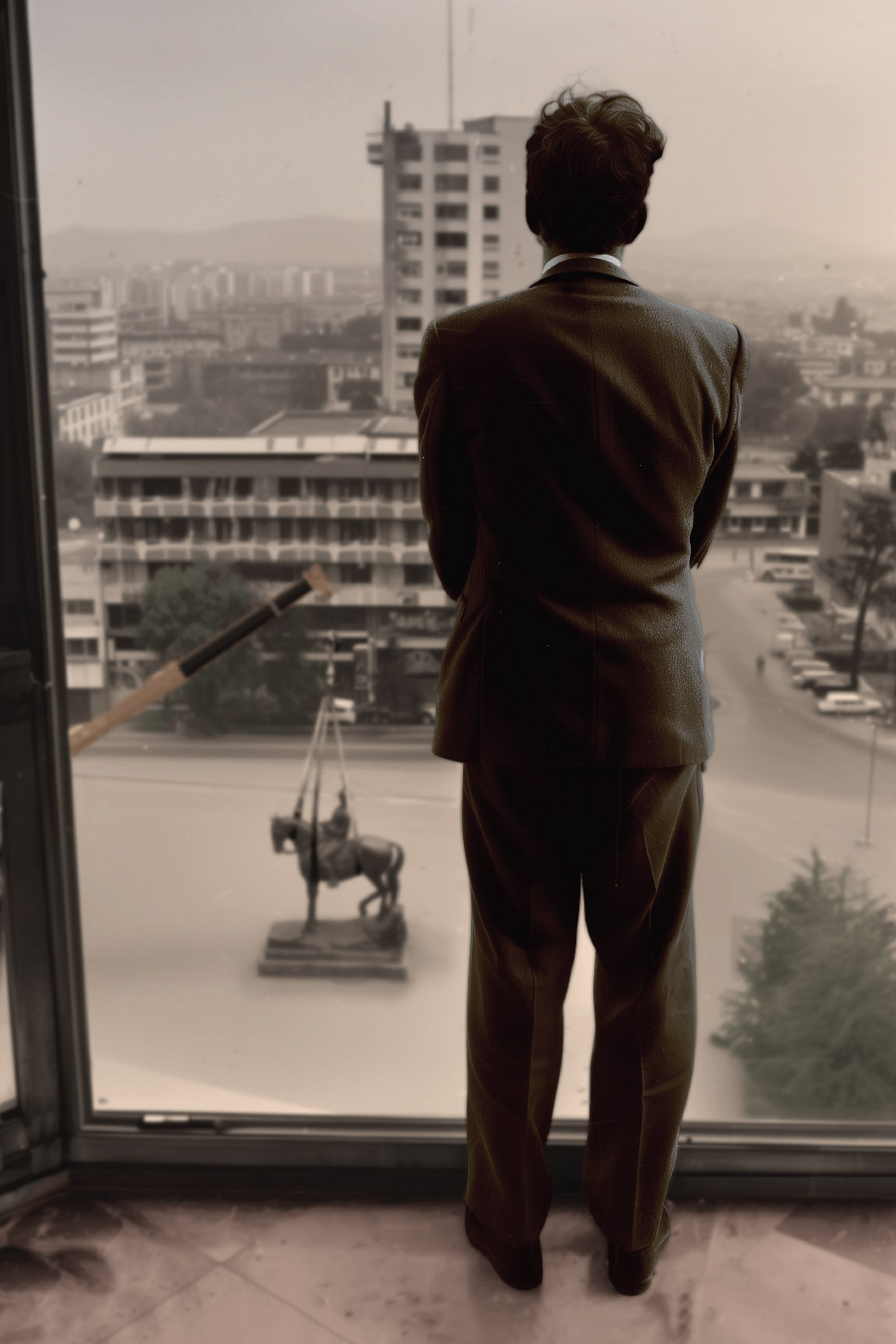
The view of Skenderbeg Square down below was breathtaking, of course, and I wondered if he had watched every day—and every night—the protests from this amazing vantage point. His office resembled a mini-apartment, with its own sink, toilet, and shower. In the back of the linen closet, situated in the hall connecting the office and the bathroom, Leni had found the safe underneath an old floor rug.
Leni told me that he himself had seen Klodian in the flesh only once. It was when Leni was new to the job, and he had arrived at the kitchen an hour early to begin baking a massive cake for the Minister of Transportation’s daughter’s wedding. Leni was the only one in the dark, cold building, or so he thought. And then, around four a.m., a figure appeared at the far end of the kitchen. Leni grabbed a chef’s knife and tiptoed carefully toward the stranger. When he popped out from behind the walk-in, Klodian’s eyes lit up, as surprised to see Leni as Leni was to see him. When their adrenaline subsided, Leni offered to make Klodian an omelette.
“With spinach and onion?” asked Klodian, hopefully.
“Whatever you like,” said Leni.
At a small table in the dining room, at four in the morning, Leni and the Director enjoyed omelettes and a pot of tea. It was a scene that should’ve been weird, but it wasn’t, Leni said, because Klodian was gregarious and generous, full of stories about the history of the hotel and funny anecdotes about its visitors, like the time the Yugoslavian prime minister demanded sheep’s milk yogurt. Eventually, Leni asked why he had never seen Klodian in his months of working there. Klodian got a long face. He talked about how he used to love wandering around the hotel, interacting with the workers, helping out in reception, assisting in the engine room. But later, as the hotel grew in stature, as the guests became more important, as the staff ballooned in size, he found that he couldn’t do it anymore. “No one wants to see the boss,” he said. “It makes people nervous, anxious, accident prone. So now,” he shrugged, “I am left to wander the halls only very late at night or early in the morning.”
Leni wipes off more rust from the safe and then turns back toward me. I realize I’ve been staring.
“You’re going?” he says, gesturing at me with the handkerchief.
“I’m going.”
In a moment, I am down the hall and pressing the round button of the service elevator. It lights up a warm, reassuring yellow. Across the square, up the block, I take the back stairs to my third-floor office. I have two assistants. One is efficient, loyal, and charismatic. This is Endrit. The other, Dritan, is efficient, loyal, and utterly forgettable. His parents, sadly, gave him a face that disappears in the crowd. He once told me that the two women in accounting across the hall had introduced themselves to him nine times, each forgetting that they had met him before.
I select forgettable Dritan to lead this mission. I explain to him the importance of going unnoticed while procuring the manual for the safe.
“You can count on me, sir.”
I detail the simple plan. He and Endrit will enter the Archives together, then split into two different directions in the “S” stacks. Dritan must be the one who is front-facing and does all of the talking. Endrit will get the safe manuals. In the meantime, I will busy myself in the office with paperwork, which actually I am behind on anyway. On their way out, the two of them salute me, and I cannot tell for certain if they are joking. Arguably, it is sort of a secret mission to them. Did I use the word “secret” when I laid out the plan? Probably I did, and this makes me think I should have saluted back.
An hour later, I’ve made it about a third of the way through the stack of my inbox when they return, their faces full of glee.
“Success?” I say.
They each hold up a report folder. Dritan’s says, “Marshimi i Kripes,” on the tab—a slogan campaign my office assembled in 1951 following the great salt shortage. To gain Archive access, they chose SALT for the cover request to get us into the “S” stacks. Endrit steps past him and presents his folder, calmly laying it on my desk. Inside are receipts for the purchase of the state hotel’s Zolotaya Seledka, some approval forms from processing, and, in the back, the faded paper operations manual, which appears to be written in three languages, none of which is ours. I quickly flip through, hoping I will find a section or a page—a little indented box, perhaps—which contains its factory-set combination. Numbers transcend language barriers, after all. Yet, there is nothing. The combo must have been on its own separate sheet, and who knows what the Director did with that.
“New assignment,” I say to them.
“Sir?”
“Take this manual and translate it.”
“It’s in Russian,” says Endrit.
“And Georgian and Latvian. Or Ukrainian. I can’t tell.”
“I don’t speak Russian.”
“Neither do I,” adds Dritan, eyeing me somewhat nervously.
“You don’t need to speak a language to translate it.” They look at me, dumbfounded. “Treat it like a code,” I shrug. “Get out one of our Russian language manuals and break it down. Consider yourselves codebreakers.”
“Codebreakers!” grins Endrit, turning toward Dritan. Their faces light up with excitement. I sense a general giddiness that often surfaces on days when we’ve completed particularly fruitful sloganeering sessions, brainstorming lists of options for whichever Ministry has engaged our team. They salute me once more, and this time I salute back as they leave, kind of clicking my heels without meaning to.
I examine the remainder of the materials in the safe folder. Apart from the primary requisition forms and original receipt, there’s another packet with some specs about the Dajti. When I get to page three, I grab my coat and head back across the square. In the top, rear corner of the hotel, I find Leni still huddled over the floor safe, tapping on different parts of the metal door. I sit down in the leather office chair, switch on the light, and pull out the paperwork.
“Leni,” I say, “did you realize that this model wasn’t designed to be part of the building?”
“Really?”
I start reading directly to him: “Gio Ponti, the Italian industrial designer who drew the original plans for the Dajti, was enamored with the brilliance and security of the Chubb Brothers’ British safes. He specified one for this office, but then after construction started, funds ran low, compromises had to be made, and they decided to substitute this Soviet imitation.”
Leni glances up at me. “Easier to get, of course.”
I nod.
He gestures toward the folder of paperwork in my hands. “And the code?”
I shake my head “no,” and as I am about to explain the language problem of the manual, there is a knock at the door. I hop up, peer through the peephole, and open the latch. There is no one there, just the sound of the elevator doors closing. At my feet, there are two trays, each with a bowl of red stew, a crusty roll, and some sort of dessert. Inside, I place them on the desk.
Seeing my confusion, Leni explains, “They’re still following Klodian’s rules. Every day, a tray magically appears at my door, and every day, I eat Klodian’s prescribed lunch order.”
I smell the stew. The thick squares of lamb look better than anything I’ve eaten in the Dajti’s main dining room.
“Two trays,” Leni says. “They must’ve seen you come up. Now you will get to enjoy Klodian’s lunch with me.”
Leni washes his hands, then sits opposite me at the desk. We begin eating, and I detail the Soviet language codebreaking mission I’ve given to my assistants. Impatience glows from Leni’s eyes.
“You could go outside and throw a stone randomly in the square and hit someone who speaks Russian.”
“Leni, you said yourself that we can’t have anyone else knowing what we’re up to. I couldn’t just take the manual down to the Translation Centre in the Ministry of Languages. That would have been a red flag for certain.” I set down my fork and adopt a look of patience. “We needed an in-house solution.”
“And your two assistants aren’t a risk?”
“Endrit and Dritan?” I laugh. “I know more about those two than their own parents.”
“So, they’re afraid of you.”
“Maybe just enough,” I say.
He nods, and then the two of us resume eating. I’m adding butter to a corner of the bread when I find myself thinking about the instructions to the safe, the manual.
“Leni, if not a combination, what exactly are we looking to get from that manual?”
“At the very least,” he says, sipping some of his lime water, “we’d know if it’s left first or right first.” He sets down his glass. “Imagine memorizing nine numbers and then, on top of that, nine dial directions.”
“If it’s me, I’d have to write them down.”
“Agreed.” Leni slices a bit of the lemon pastry. It’s sprinkled with powdered sugar in a zig zag design. “I doubt Klodian Sulejmani has a better memory than either of us.”
“What do you mean?”
“It’s got to be written down on something somewhere in this office. Don’t you think?”
I begin eating my own piece of the pastry. It’s flakey, yet soft, cooling on my tongue. Across from me, Leni slides away his food tray and opens the desk drawer. He starts rifling through its contents, setting aside pens, paper clips, staples.
“Aren’t you going to help me look?”
“In a minute,” I say. “I’m enjoying Klodian’s lunch.”
After I finish, I move over to the front of the office. On the wall, there is a row of photos of the square below. Handwriting on each in fine black marker indicates the various distances from the window to spots on the square. Beneath the photos, there is a camera on a tripod. I recognize the Russian insignia on the front, another one on the long lens.
Standing there in front of the massive window, I look away from the photos and stare down upon the square itself, watching the people cross back and forth, the late afternoon sun dappling the ground with flickering shadows as they step. From here, everything seems so small, so inconsequential.
For many years, twice a day, I crossed that exact spot on the square. From home to the Ministry, and then back again. Shortly after Ana and I met, my office not far from hers, we began making that walk together. Years spent walking back and forth, home to work, work to home. How did we look from this window? How would we have looked to Klodian, or his predecessor, or his predecessor’s predecessor, as they peered down upon us? And would they have noticed the day Ana moved out, or the first day afterwards when I made that walk alone? I remember it so well, the anger, the confusion, the loss of spirit. But from this window, it probably looked as if nothing had changed. I was still the same speck, moving in a straight line, a splotch of color on the palette, ambling briskly, no longer in tandem, but otherwise the same.
Leni’s voice from the corner surprises me. It’s filled with disappointment. “Every folder and file here is just requisitions and lists and procurement approvals.”
“It sounds like my office.”
Skepticism washes across Leni’s face. “Your office? The land of brainstorming scratchpads and failed slogans? That’s far more fun than anything I’m seeing here.”
“I guess it’s understandable why Klodian spent so much time up here,” I say. I gesture toward some binders on a side table. Local Vendors A-F. Grain Suppliers. Machinery Replacement Parts. “The hotel won’t run itself.”
Leni’s eyes narrow. “Look around. There’s nothing that belongs to him. All that time he spent up here, and what’s left are the same supply forms and the same kitchen lists of the people who ran things before him.” He moves to the bookcase, flipping through the volumes, pulling each one out for a second. “Just lists and checkmarks and ledgers!”
I can tell that Leni, interim hotel director, is imagining his own future if he stays in the position. And yet, as I know all too well, once things are arranged, it is quite difficult to undo them. Has the Dajti ever had an interim director who went back downstairs and returned to work in the kitchen?
Dinner arrives: two trays again. This time, it’s plates of lamb stew atop rice. There are small salads and little ramekins with a golden pudding dusted with cocoa. We eat mostly in silence, taking turns expressing with a sigh or a frown the continued troubling absence of a human life in this place. Yes, hands have touched these forms, and filed these completed lists, and crossed out the names of vendors no longer delivering, no longer operating, no longer alive. But nothing is written anywhere that makes me see Klodian. He is like a strange, efficient ghost.
Stomach full, I am now at one of the four corner bookcases, seated next to the bottom shelf. Leni is dabbing his lips with a napkin. He stares at the dinner tray, then looks up at me, his eyes filled with distress.
“This food is all I really know about the man,” he announces. “He must have really loved lamb — that’s what I’d have to say in his eulogy. ‘Here was a man who loved lamb.’”
“But, Leni, the omelette with spinach and onion.”
He tries to hold back a smile. “The omelette was pretty good.”
I hold up a ledger pulled from the bookcase. “I’m going to start flipping through these to see if he left any notes inside any of them.”
After a moment, I realize Leni has not responded to me. I look over. His face is frozen, as if he is reconsidering some point he had made earlier in an important conversation. He pushes his hands through his hair, wipes his forehead with his sleeve. I sense he’s maybe realizing what it’s like to try on Klodian’s shoes, a job that seems like it has no days off, no time off, no room for personality. The thought of Leni in such circumstances puts a pit in my stomach; he is almost all personality. I think better of saying anything, and resume flipping through the books, left to right.
“Look at this,” Leni says, holding up a heavy book with both hands. “More photos. Dozens of them.”
I walk over to where he has now cleared a spot on Klodian’s war table, where he is laying out the various binders—not books, but photo albums filled with small photographs. All are from one vantage point: the very spot where I was standing earlier. They’re simple shots, looking down on the square. We flip through the first binder. Pages of sunny backdrops give way to pages of clouds, then pages of rain and snow. Throughout the seasons though, one thing remains the same—the people. Dressed for work, dressed for school, the crowds all cross the square with purpose.
“Days, weeks, months,” says Leni, flipping through. He hands me a small optic, a photo magnifier, that he has found inside the drawer. I lean down, my eye to the optic, sliding along each of the pictures, looking for myself, looking for Ana. As I move along the rows, however, I don’t recognize any of the people. I flip the pages forward, trying a different season, but still, I have no luck. I move to the next album. Still nothing. Men, women, children, all non-descript, all moving in unison, all unaware of the camera high above them. “Months,” Leni mumbles, flipping the pages.
And then in the fourth album, in a line of people moving past the horse statue, towards the Ministry, I spot Teodor Marku.
“Teodor Marku!” I say to Leni, looking up from the magnifying glass. Leni gives me a blank look. “He held my office three people before me.” I smile, happy to have found some perspective in these pictures. I haven’t found myself, I haven’t found proof that I exist, but I have found a link to my existence, a simple context. Nothing can be either good or bad until it is placed in context.
Leni says, “I think Marku was Kiti’s grandfather’s brother.”
Kiti and Leni dated long ago. Funny, creative, a cute girl with an odd haircut, Kiti had always been my favorite of Leni’s former girlfriends. For years, as he worked his way in and out of lesser relationships, we were not allowed to speak of her. Only recently, when it became apparent that Leni’s new relationship was something different, something above all others, perhaps the final one, did he allow the mention of Kiti to return to our daily conversations.
I skip ahead many volumes to find that the square is the same, though the statues are now gone. The people, however, still press forward, going to work, going to school, continuing with their daily business. Pages and pages, people and more people. I flip through the volumes, occasionally recognizing some of the people below. Edmund Spaho is there; Hansa Splite too! Ana’s cousin’s wife is there, carrying a bag of produce.
“Kind of a strange hobby,” Leni says, “these photos.” He’s idly thumbing through another binder. “It’s almost like no one took them, like a timer was set for random shots.”
A knock on the door snaps me from my daze, making me realize I have been turning the pages without anything registering, the images just a blur. Leni moves to the door and finds a cart with two trays of food.
“Supper?” I say.
“Lamb kabobs.” He wheels the tray over to the war table.
“I think I’m still full.”
“Come on,” Leni says, sliding the food toward me.
I eat with one hand and flip the pages with the other. I’m getting a sense of what Leni meant by the photos and a timer. Some of the pictures don’t even have a subject in the center, only random shoulders and heels coming and going, the motion of people but not people. And then it occurs to me.
“Leni, where’s that very first book you found?”
He looks up at me, eyes narrowing with confusion. “You mean this one?” he says, handing it over.
I flip it open. On the first page, there are three rows of photos, three shots in each row, in the background, the clock tower.
“Look,” I say. Leni sets down his half-eaten bukë shtëpie roll and moves around the table. I slide the binder in between us. “Now compare it to the rest.”
“First day on the job, first time with the camera,” he says. “Of course, these are different.” He shrugs, uninterested.
“But the clockface in each!” I point at the three photos in the top row. The dial hands point to exactly one o’clock in the first picture. Then exactly nine o’clock in the next, then six o’clock.
Leni lifts up the binder and looks closer, his eyes scanning quickly.
“All of them are exact hours on the dot,” he says.
“And the sun and shadows aren’t in order. Dusk is near the beginning and not at the end. Morning is last when it should be first.” I point to the seven o’clock photo at the bottom of the page.
“These are pictures of the safe combination,” grins Leni.
“Opening day on the job, like you said.” I grab my jacket. “He was making sure he didn’t forget the numbers.” I turn and swing open the office door.
“Hey,” says Leni, “where are you going?”
“My assistants have been translating that manual. They’d better be done.”
I enter my office in the Ministry and find Dritan and Endrit at my desk, the former seated in my chair, and the latter on the edge of the desk itself, a nearly empty bottle of raki between them. Their faces fill with alarm, a commotion erupts, and suddenly they are standing at attention.
“Deputy minister!” yelps Dritan.
“You’ve been gone so long, we didn’t expect you,” says Endrit.
“Clearly,” I say.
“Deputy minister, we were celebrating.”
“It’s very good news,” Endrit blurts out. He holds up the manual, and Dritan holds up a notepad full of scribbling and markings.
“We didn’t stop until we finished. It took us hours but we were determined not to let you down.”
“No breaks?” I say. “You haven’t gone home?”
“How could we?”
“That means you’ve been drinking on empty stomachs.”
A sheepish grin comes across Endrit’s face.
“I guess that’s true,” he says.
Dritan hands me the notepad and points at various markings as he speaks: “The most important part was buried in the middle. A section that reads left 3, right 3, left 3.” He sets down the manual and the notepad side by side. I study the markings for a moment, but then he flips the page and indicates more writing at the bottom: ?????? ????????????? ? ????. His fingers trace the Cyrillic letters as he pronounces what they say: “Vvsegda vozvrashchaytes’ k nulyu.”
“Always go back to zero!” Endrit yells, proudly. He holds up one of the Russian dictionaries. “Technically, it means ‘always return to zero.’” He smiles. “You get the meaning.”
“We’re translators now,” adds Dritan, suppressing a smile, “or better yet, we are interpreters.”
I take the bottle of raki, swallow a quick swig, then hand it back to them.
“Well done, you two.” I gather the manual and notepad, then produce a batch of lek notes from my wallet. “Dinner is on me,” I say. At first, I hand all of the money to Dritan, then realize how foolish this is. I take it back and begin dividing it up. “Silly of me to put you in that position of eating together. You have lives, homes to go to. Yes, very silly of me, indeed.”
“Oh, no, sir,” says Endrit. “You had it right the first time. We eat together.”
“Okay,” I say, then I shuffle the lek notes back into a single stack and push them all into Dritan’s hands. “And take tomorrow off.”
Up in the office of the hotel director, at the top of the Dajti, I find Leni sitting right on the floor, next to the Zolotaya Seledka safe. It’s as if he’s been guarding it, waiting for it to wake up. Next to him is the binder page with the nine clockface photographs which are the combination.
“Leni, you’ve been here like this the whole time?”
“I thought about trying the numbers, spinning the dial,” he says. A light smile surfaces on his face. “But I didn’t.”
“That sounds exactly like the will power needed to run a place like the Hotel Dajti,” I say.
“Don’t,” he frowns.
I set down the translation notes from my assistants next to the binder page of clockface photos.
“Prepare to be rich,” I laugh.
Leni’s eyes widen, and he kind of freezes in place. A moment passes without him moving. Is he even blinking?
“Leni?”
“I was just so focused on opening the safe that I kind of forgot what that might mean.”
“How so?”
“Just to be clear,” he says, holding up his palm toward me. The other hand is resting on the safe dial. “We split it all fifty/fifty.”
“Do we know if Klodian has a family? A widow?”
“He lived here like a ghost.” Leni looks at me, and I can tell from his expression that announcing this, putting it into words, has made it even worse than when we were both just thinking it in silence.
I read out loud the left, right, left directions from Endrit and Dritan, while Leni dials the numbers. Each time he spins, I remind him, “Back to zero.” At the end, there is a satisfying click, and Leni pulls the lever and lifts open the lid. While I didn’t expect gold bars or piles of coins, I am still surprised when Leni pulls out only a thick, leather-bound journal, wrapped in a belt. He sets it down on the ground, then peers deeper into the metal hole of the safe.
“That’s it,” he says, reaching around. “Nothing else.”
“So, it’s a diary?” I say.
“Or maybe letters.”
“Open it up.”
Leni sets the journal on the war table and unfastens the belt. He flips the cover open. I feel my pulse quicken. He looks at me, turns the pages, scans, then looks back at me again.
“Everyone we know is in these,” he says.
They are pictures, taken from the same vantage point as the others, here from the top of the Dajti, but these photos show Skenderbeg Square during the protests. April 2, 1991. April 3. April 4. They are all marked with time and date.
In the photos, some of our friends are holding flags, others are holding makeshift signs, others are holding torches. The presence is unmistakable. You can almost feel the tension, the anticipation, the weird combination of excitement and dream. At some point, everyone’s faces came into the clear light of the hotel director’s camera tripod, and their image was recorded. I think of Ana. How many pages I will have to turn to find her here? A shiver rushes through me. I sit back and take a deep breath, trying to get my bearings.
“Leni, I think now we know a bit more about Klodian the person than just his love for lamb,” I say, forcing a laugh.
“Why does he have these?” Leni scowls. “Why did he take them?”
“They were hidden in the safe, though,” I say, pointing to the shelves where the other photobooks were. “Tucked away.”
“Maybe to blackmail with later, in case things had turned out differently.” A strange expression of betrayal crosses Leni’s face.
“Or he was protecting the people in these pictures so that no one would find them. Who knows who he was answering to during those days. The safe might have been the best place to hide them.”
Leni sits in silence, the leather-bound journal still open.
“Now I don’t know what to think,” he says.
“If he was going to do something bad with them, doesn’t it seem like that already would’ve happened?”
“I don’t know,” he says, his voice trailing off. He folds his arms across his chest.
I move over to the leather-bound ledger and begin flipping through it. I flip the pages quickly, recognizing some people, but not stopping. The book crackles as I turn the pages. Finally, I find a picture with Ana, hand in hand with her sister, their faces lit by the streetlights, protesters all around them. I unfasten the picture from the page and roll it into my pocket. Then I slide the book back to Leni.
“What are you going to do with that?” he asks.
“I don’t know,” I say. “Maybe give it to her.”
A strange chuckle escapes from Leni.
“Maybe we should give them to everyone,” he says.
Our eyes lock, and I realize there’s a sense of seriousness, conviction, in his phrasing. I sense my own discomfort at an earnest Leni.
“And how would we do that? Set up a table in front of the hotel?”
I’m trying to smile, to illustrate the joke, the absurdity of all of it. I can imagine the pleasure of emptying the journal of its compromising photographs, handing each one back to its rightful owner, all now wonderfully free from fear. In a different time, proof of guilt might have wrecked many lives, but instead, as I imagine us sitting at a table, me and Leni, a line of people waiting, us flipping through the pages, finding the photograph of each person in the square, handing it to them to do as they see fit, it occurs to me that some might burn them, sure, yet I can imagine others might frame them and put them up in the hallway for their children to admire.
I look back at Leni, who’s sitting there, frozen. He nods, and he seems to be asking me to help him find a way out. I turn and scan the office, tilting my head toward the many ledgers and manuals and receipts and order forms. In the hours, the days, we have been focused on this mystery, the envelopes in Leni’s inbox have grown. The daily, endless turmoil of the dedicated hotel manager awaits.
In front of us is the leather-bound ledger, liberated from the safe. While I have been envisioning a way to redistribute every page of its contents, wipe away history, Leni has been focused on a more pressing problem. Clearly, he is thinking of a different immediate future where the view from the top is perhaps the greatest trap of all.
Down the hallway, I hear the ding of the elevator, footsteps, and the rattle of two trays of food being placed in front of Leni’s office door. Then the elevator dings once more.
Bill U’Ren is an associate professor at Goucher College, where he teaches fiction writing and other narrative design courses. He earned his B.A. from UCLA and his Master’s from the Johns Hopkins Writing Seminars. His work has won the Donald Barthelme Award, the C. Glenn Cambor Award, and an IFP No Borders Prize.
Kevin Phelan lives in Northern California, where he has spent more than thirty years perfecting his chocolate chip cookie recipe. His work has appeared in Glimmer Train, Christopher Street, and elsewhere.
Christine U’Ren is a graphic designer and illustrator in the San Francisco Bay Area
The Jiri Kajane stories have been published in The Chicago Review, Glimmer Train, Michigan Quarterly Review, and Alaska Quarterly Review, among other magazines and anthologies. A new volume including never-before-published stories is forthcoming from Fiction Attic Press.
-

The Lifeguard
a short story by Jennifer Dickinson
Eleanor dragged a chair underneath the palm tree farthest away from the pool. She started a crossword puzzle, but after a few minutes, the pool seemed to be calling to her. “Eleanor, come swim in me, please.” She walked to the edge, feeling in her tank suit that she was naked in front of strangers. A sensation she hadn’t experienced in decades. It wasn’t entirely bad. Even though each hair on her head was silver, she still had a nice rack. She dipped one foot in, then the other. She sat down and lowered herself into the water. It was at once an icy shock and a warm embrace. She lowered herself in even more, until her whole head was wet.
“Daniel, I’m going to eat you up!”
A red-haired woman stood a few feet away hugging a little boy, who was probably no more than four. He screamed with joy. The woman play-bit his chubby cheeks. Eleanor swam away. Even though her face was wet, she didn’t want anyone to notice she was crying.
Daniel reminded Eleanor of her son, Frank, who’d wanted to go to the pool every day when he was little. In the summers they’d lived with shiny splotches of aloe vera on their pink shoulders and cheeks. Those days were the best because Frank hadn’t put a pill in his mouth yet. Frank had come home for Sam’s funeral, taken one of his suits and a pair of cufflinks, and then disappeared. One night Eleanor had seen Frank sitting at the entrance to the highway, holding up a sign that said: “Out of Work, Please Spare Some $ For A Starving Artist!” He wore Sam’s suit and she’d wanted to stop, but seeing his bleary eyes and his skeletal frame had made her cry harder at the funeral than her own husband’s death. She drove on.
The red-haired woman was there with Daniel every day. Eleanor soon learned their routine. The mother would play with him for a bit, then she’d go to her chair and text, or take selfies. Some days she had another woman with her who vaped even though there was a no smoking policy. Daniel’s mother hardly looked at him after their initial playing. He mostly set on the steps or clung to the sides. Sometimes he played with other children.
The day that Daniel didn’t come up for air, Eleanor was drinking a Diet Coke and finishing up a crossword puzzle. She’d had a headache all morning and looking at the bright light bouncing off of the pool made the headache worse. It was the first day she hadn’t been watching Daniel. His mother’s friend wasn’t there and she’d been more attentive to her son, which made Eleanor feel better about not looking.
An audio version of this story is available to paid subscribers on Substack.
Jennifer Dickinson’s fiction has appeared in Beloit Fiction Journal, The Florida Review, Blackbird, Juked, JMMW, Maudlin House, Isele Magazine, and elsewhere. She is the recipient of a Hedgebrook residency and a grant from the Barbara Deming Memorial Fund. She is a book coach and lives in Los Angeles.
-

What We Give to Our Kids
a short story by Kyle W. Davis
Eighteen Years Ago
I’ll do anything for him. Celeste paced in the softly lit clinic room and felt that statement’s truth about Chase—their future son. As a math professor, she relied on step-by-step proofs to establish truths. Yet she couldn’t explain this premonition. But like gravity to the ancients, she knew it to be true.
Colorful pictures of plump, beaming IVF babies decorated the clinic’s walls. The room was made for conversations, not operations. She watched Mason as he swiped through the colorful pages on the clinic’s tablet. She knew another thing: they would be getting a gene—some gene to improve things—no matter Mason’s opinion. Years ago, her sister had received an experimental gene therapy to cure a would-be fatal condition, and it worked. Thirty years later, gene transplants weren’t for only saving life, but improving it. A marketplace for the rich, famous, and talented sprung up to sell copies of their genes to hopeful parents wanting the best.
“This stuff is impossible to understand,” said Mason. “Except the price. They have a lot of options, just—”
She completed his thought: Nothing for an associate math professor and a junior real estate agent after IVF costs.
“We have to do it,” said Celeste. “This is what parents do for their kids. It’s the smart thing to do.”
“If I sell 38 Stratford.”
Celeste read the tablet over Mason’s shoulder. Each page featured a celebrity, a pithy bio, details about their special gene, and colorful cartoons of a looping and twisting protein, impossibly complicated and yet perfectly calibrated.
“What’s this one?” said Celeste.
“Actin. From that Serbian tennis pro. It’s twelve thousand.”
He scrolled past a clip of the lanky Serb whipping his racket around with speed and grace, the ball skipping past his winded opponent. Actin, it stated, was involved in muscle contraction and movement. The Serb’s reaction times were one-hundred-and-fifty-two percent faster than average due to rare genetic changes that improved muscle strength and quickness.
He tapped the screen, another gene. Something sensible: a blood group antigen for type AB blood, RH positive from a famous actor. Chase could be a universal recipient, and every blood transfusion would be acceptable. Eight thousand. Mason tapped on others: a Michelin-star chef with superior taste buds; a Grammy-winning pianist with long fingers.
-

Backroad
flash fiction by Brigid Ives
I remember when I thought that racing down backroads was dangerous. Maybe it was my years living in the city that made the winds and curves seem like a rollercoaster ride—your heart racing at the ever-present possibility of going off the tracks. It took years for me to glance down at my speedometer and notice that I was going above the speed limit, expecting the next move before it came.
Familiarity came gradually, over time. The same way you learn a person’s body, where one day, when you’re both comfortable with total nudity, you find yourself not staring, not feeling surprised by their physiology.
Sometimes, when I lay in the bathtub, I feel unmanageable. It takes a while of marinating in what has surely become dirty water to really look and see your body. My earliest memories consist of the intimate relationship I had with my parents’ physical forms. I could tell you where their freckles landed on the back of their thighs, how their ears fit into their heads. I remember thinking that they were too much—too big, too much skin, too many pieces and parts that they couldn’t even see. I enjoyed the feeling of being compact, of knowing where everything was. When’s the last time I’ve really looked at my pinky toe, anyway?

I find it hard not to think about him. And then I think about myself thinking about him. “Cut yourself a break,” my Mom used to say, “your brain is too busy.” Isn’t everyone’s brain busy? Can anyone’s head really stay silent? These are the kind of things I’ve find myself spewing to my therapist. They’re all collected in a bucket like rainwater for her to reply with just one seemingly thoughtful response—“I think you’re asking the wrong questions.” Which, as it turns out, isn’t an answer.
Forgiving myself. That’s what I’m trying to do. Forgive myself. It’s no one’s fault. There’s no one to blame. But we all know there’s always someone to blame. I genuinely believe that all feelings need a target. Anger, love, loss, blame, dreams don’t just dry up like a raisin in the sun (they all definitely explode).
The same way you learn a person’s body, where one day, when you’re both comfortable with total nudity, you find yourself not staring, not feeling surprised by their physiology.
What I want to know is, when you pass people on the street, or have a brief interaction with a person in some commonplace location, do you fill in the blanks? I always do. I’m not sure if it’s because that helps me treat them like a person. Susan at the Deli married her high school sweetheart and he’s never cheated but she has, just once, ten years ago. They worked through it for the sake of their son. Jon, the mailman, has a passion for sci fi novels and ramen noodles, which is why he named his most recent cat Ishiguro, which he mispronounces purposefully when repeating it to women—their eligibility ultimately hanging on a correction.
Maybe this is why I work at the National Park. As people drive in, I can put down my book and take a peak into their lives. Otherwise, it’s peaceful (read: solitary). I’m alone with my thoughts on the drive back. “Just turn on the radio,” my mom advised. She’s excellent at minimizing.
“I don’t think it’s good for your psyche to drive that road every day.” Au contraire, it’s the only way for me to maintain any psyche at all, I tell my therapist. “You must feel forced to relive it. I think you’ve done your penance.”

Photo by Zach Miles on Unsplash The memory is like a cheap piece of gum you’ve put in your mouth five hours ago. It’s disgusting and falling apart and been stretched and pulled every which way. Worn. It’s worn. You’ve tried a million different ways—a million different combinations. It always ends up the same way. You never make any progress.
Was I looking down at my phone? Or was that the moment before? Would I feel better or worse had I been responding to a text message? Does the truth even matter at this point? It was a summer job, and I remember the playlist I’d selected for my evening drive home: “Summer 2k17 Jamz.” They say that, during incidents of trauma, you recall the tiniest of details. And once we’d made contact, everything seemed to go in slow motion.
Jon, the mailman, has a passion for sci fi novels and ramen noodles, which is why he named his most recent cat Ishiguro, which he mispronounces purposefully when repeating it to women—their eligibility ultimately hanging on a correction.
I never saw him—inside the car, I mean. I didn’t see what his face looked in his last moments, I couldn’t discern whether he knew what was about to befall him. I didn’t see the car flip, and it took a few minutes after we made contact for me to come to. It’s a weird combination of feeling frantic and calm. It’s as if there’s so much that you need to do but nothing that can be done. The still of the night matched by the cacophony of bugs, frogs, owls.
In my most dramatic moments, I want to cry and take responsibility—take the blame—for the life I took. A life that I had the inability to mourn. It seemed uncouth to attend the funeral. His family wouldn’t feel appeased by an apology. I wasn’t drunk, I wasn’t asleep. It was an accident. That’s what everyone says—it was an accident.
The English language—no, all language—is so painfully imprecise. In those most profound moments of feeling, words are so inadequate to express what’s going on behind the scenes. Take the word accident, for instance. Accident provokes images of spilled milk, a skinned knee, coloring outside of the lines, a fender bender, a wet bed. You don’t think ambulance, police investigation, body bag, shouts of rage, flares lighting the night.
When I meet new people, I want to confess. I’m a murderer. It was me. And then here I am, back at the start of the circle, angry that I’m still thinking and worrying about me. How this whole incident reflects on me. What about them? What about him? How can I ever possibly fix this?
I imagine myself laying in bed one night, beside a new lover, staring at the ceiling and sharing this story again. Re-telling, reliving. Feeling the person beside me soaking up the details, formulating questions, processing, processing. I can hear it underneath my words. They’re probably wondering if this is something they can live with—living with me like this. They’re lucky that they have a choice.
How many bodies have you really known—including your own? Roommates’, maybe. Siblings. There’s a comfort that comes with knowing the shape of someone’s fingernails, how the hair runs down the back of their neck, their ankle bone. You can press the gas pedal a bit harder.
-
Great Political Fiction in 2 New Editions
Fiction Attic Press is delighted to announce to new editions of the strange, funny, and deeply relevant stories of the enigmatic Jiri Kajanë. Both are available in beautiful, complimentary paperback editions – great for giving to the politico or propagandist in your life, the one who just can’t shut up at the dinner table. Smart, irreverent, and surprisingly moving, the adventures of Albania’s fictitious Deputy Minister of Slogans are more relevant that ever.

Winter in Tirana: The Stories of Jiri Kajanë (Volume 1)
Winter in Tirane: The Stories of Jiri Kajane, brings together six intertwined tales of bittersweet love, absurd politics, and comic hijinks by the enigmatic Jiri Kajanë. Set against the final days of the Albanian empire, the stories follow an unnamed narrator–the Deputy Minister of Slogans–and his young friend Leni as they attempt to navigate a landscape of shifting political alliances and unsettling personal affairs. By turns funny, profound, and deeply moving, Winter in Tirane is an exploration of the meaning of identity, the power of suggestion, and the complex relationship between a story and its creator. Winter in Tirane presents a startlingly imaginative take on the notion of the author as fictive construct.Some Pleasant Daydream: The Stories of Jiri Kajanë (Volume 2) BUY THE BOOK
Some Pleasant Daydream: The Stories of Jiri Kajanë (Volume 2)
Continuing where Winter in Tirane leaves off, SOME PLEASANT DAYDREAM features six stories by the enigmatic Jiri Kajane. The collection follows the adventures of the Deputy Minister of Slogans and his best friend Leni. By turns hilarious and poignant, the stories examine what it means to be immersed in a culture of propaganda and doublespeak in which what one says and what one means are often two very different things. BUY THE BOOK
About the Author
Time Out Scotland once named Jiri Kajanë “the second greatest living Albanian writer,” after Ismail Kadare. But who is Kajanë?
According to some accounts, Kajanë was raised in Kruje, Albania. His satirical drama, Neser Perdite (Tomorrow, Every Day), is rumored to have received great acclaim in a singular 1981 performance before being banned by the Albanian Ministry of Culture. Due to Kajane’s allegedly precarious standing before the revolution, his work has never been published in his home country. Kajane has never been photographed.
-
Contributors to Flash in the Attic: 44 Very Short Stories
CONTRIBUTORS
Neal Allen’s story Mayan Calendar appeared in the first Flash in the Attic anthology. He has won awards from Fiction Attic Press and Glimmer Train. He is currently completing a book on the Platonic forms. Neal lives in Lagunitas, California.
Geraldine Birch’s work has appeared in the Christian Science Monitor, the Arizona Republic, and Opium Magazine. She lives near Sedona, Arizona
Neal Bonser received his MFA in creative writing from Antioch University Los Angeles. He was an associate editor for the online literary magazine, Splinter Generation. He was a general contributor at the Bread Loaf Writers’ Conference in 2011. His work has appeared in Word Riot, The Oklahoma Review and Two Hawks Quarterly, among others. His story, “Punch Confessions,” was named runner-up in the 2010 Flatmancrooked fiction contest and was published in Mixer Publishing’s debut fiction anthology in 2011.
Stace Budzko’s essays and fiction have been published or are forthcoming in Southeast Review, New World Writing, Versal, Upstreet, Necessary Fiction, Hint Fiction, Press 53, PANK, Hobart, elimae, The Los Angeles Review, Night Train, The Collagist, Field Guide to Flash Fiction, Brevity & Echo, Flash Fiction Forward and elsewhere. Screen adaptations of his work, “How to Set a House on Fire”; “North End, 2010”; and “Why I Don’t Keep A Daily Planner” have received numerous awards and showcases. He is a writing instructor at Emmanuel College as well as Grub Street, Boston.
Agustín Cadena was born in Ixmiquilpan, Hidalgo, México. and currently teaches at the University of Debrecen, Hungary. Essayist, fiction writer, poet and translator, Cadena has won numerous national prizes for fiction and poetry. He has published 26 books, among them collections of short fiction, essays and poetry, novels, and young adult novels, most recently La Sed de la Mariposa, 2014, and Fieras adentro, 2015. His work has been translated into English, Italian and Hungarian. The story published here is from Dibujos a Lápiz, (Penicl Sketches), 2016. Cadena blogs at elvinoylahiel.blogspot.com.
Mathieu Cailler’s work has been widely featured in national and international publications, including Epiphany, the Los Angeles Times, and The Saturday Evening Post. A graduate of the Vermont College of Fine Arts, he is the recipient of a Short Story America Prize for Short Fiction and a Shakespeare Award for Poetry. He is the author of Clotheslines, Shhh, and Loss Angeles, a finalist in short-story fiction for the 2016 International Book Award.
Frank Carden is the author of the novel The Prostitutes of Post Office Street, and has published more than 30 short stories.
Barry Charman is a writer living in North London. He has been published in various magazines, including Ambit, Firewords Quarterly, The Literary Hatchet and Popshot. He has had poems published online and in print, most recently in Bewildering Stories and The Linnet’s Wings. He has a blog at http://barrycharman.blogspot.co.uk/.
Lucian Childs divides his time between Toronto, Ontario and Anchorage, Alaska. He is the winner of the 2013 Prism Review Short Story Prize and was a Peter Taylor Fellow at the 2015 Kenyon Review Writers Workshop. He is an editor of the anthology, Building Fires in the Snow, forthcoming from the University of Alaska Press. His short fiction has appeared in the literary journals Grain, Jelly Bucket, Quiddity, Sanskrit, and The Puritan, among others.
Madison H.C. is a preschool teacher and German student in Portland, OR. She is currently working on her first larger piece of fiction and focusing on her love of early childhood education at the Wild Lilac Child Development Community.
Anne Colwell is an Associate Professor of English and Creative Writing at the University of Delaware. She published two books of poems, Believing Their Shadows (Word Poems 2010) and Mother’s Maiden Name (Word Poems 2013) as well as a book about Elizabeth Bishop (Inscrutable Houses, University of Alabama). She received the Established Artist in Fiction Fellowship and the Established Artist in Poetry Fellowship from the Delaware State Arts Council, as well as the Mid-Atlantic Arts Fellowship at the Virginia Center for the Creative Arts and three Work-Study Fellowships to the Bread Loaf Writers Conference. Her chapbook, Father’s Occupation, Mother’s Maiden Name won the National Association of Press Women’s Award for Best Book of Verse.
Patricia Cosgrove comes from a small coastal town in North County Dublin. As a child, she was told that her constant tale-telling would turn her tongue black. Undeterred, she continues to make things up. This is her first piece of published fiction.
Daniel Coshnear works at a group home, teaches through UC Berkeley Extension and is author of two story collections and one novella: Jobs & Other Preoccupations (Helicon Nine 2001) winner of the Willa Cather Fiction Award; Occupy & Other Love Stories (Kelly’s Cove Press 2012) and Homesick Redux (Fiction Fix 2015). This story originally appeared online at Penduline Press.
Annie Dawid has published three books of fiction: And Darkness Was Under His Feet: Stories of a Family (Litchfield Review Press, winner of their Short Fiction Prize); Lily in the Desert (Carnegie-Mellon University Press Series in Short Fiction) and York Ferry: A Novel (Cane Hill Press). York Ferry won the 2016 fiction prize from the International Rubery Book Awards. She is the recipient of the 2013 Northern Colorado Writers Award in the Personal Essay, the 2013 New Rocky Mountain Voices Award for her short play, “Gunplay,” the 2012 Fall Flash Fiction Orlando Award from A Room of One’s Own Foundation, and the 2012 Essay Prize from the Dana Awards.
Patricia Dubrava (translator, “The Mourning of the Russian”) chaired the creative writing program at Denver School of the Arts, where she also taught Spanish. She has two books of poems and one of stories translated from the Spanish. Recent translation publications include fiction by Agustín Cadena in Café Irreal, 2013 – 2015 and Mexico City Lit, 2016. Her translation of a Mónica Lavín flash fiction appeared in Norton’s Flash Fiction International, 2015. Dubrava blogs at www.patriciadubrava.com.
Lila Dunlap is from New Orleans, and currently lives and works in the Hudson Valley.
Patrick Faller graduated from West Virginia University with an MFA in fiction in 2010 and teaches writing at Kent State Tuscarawas. His writing appears or is forthcoming in Inwood Indiana’s Salem Cemetery issue and at Prick of the Spindle, Souvenir Lit, FunnyinFiveHundred.com, and Apeiron Review. He blogs semi-regularly at Fallerideas.com.
Thaisa Frank is the critically acclaimed author of Enchantment, Heidegger’s Glasses, Sleeping in Velvet, and A Brief History of Camouflage. Thaisa has received two PEN awards and her stories have been widely-anthologized—the most recent of which are in A Dictionary of Dirty Words, Harper/Collins Reader’s Choice and Rozne Ksztatly Milocsi. She has published critical essays on writing and art and is the author of the Afterward to Viking/Penguin’s most recent edition of Voltaire. Her poetry, which she writes secretly, appears in small publications.
Moneta Goldsmith is the co-founder & editor of When in Drought, a literary journal based in Los Angeles. He eats at mostly regular mealtimes in front of his typewriter & when he is not eating he ruffles his feathers & preens for Satan.
Susie Hara Susie Hara’s first novel, Finder of Lost Objects (Ithuriel’s Spear Press), was a finalist for a Lambda Literary Award and winner of the 2015 International Latino Book Award for Popular Fiction.
Rebecca Harrison sneezes like Donald Duck and can be summoned by a cake signal in the sky. Her best friend is a dog who can count. Through the WoMentoring Project, she was chosen by Kirsty Logan as her mentee. Rebecca’s been nominated for Best of the Net, and was a finalist in the first Wyvern Lit flash fiction contest. Her stories can also be read at Quantum Fairy Tales, Maudlin House, Luna Station Quarterly, and elsewhere.
Tamsin Hopkins writes poetry and fiction. Her collection, Shore to Shore: River Stories, is published by Cinnamon Press.
Travis Hubbs is a Ph.D. student in English & Creative Writing at Louisiana State University, where he teaches undergraduate courses in literature, rhetoric and composition. His writing has appeared in A Cappella Zoo, Blue Lake Review, Fiction Attic Press, the Journal of Texas Women Writers, North Texas Review, Specter Magazine, and the American Literary Review blog. He holds an M.A. in Creative Writing from The University of North Texas.
Martin Jennings earned an MFA from Spalding University. His work has also appeared in Five on the Fifth, Sick Lit Magazine, and is forthcoming from MilkFist Magazine. He lives in Louisville, KY.
Jonathan Jones is a freelance writer currently living and working in Rome. He qualified in 1999 with his M.A. in Creative Writing from Bath Spa University College and in 2004 with an MRes in Humanities from Keele University. He teaches writing composition at John Cabot University in Rome.
Ksenia Lakovic is a native of Serbia and a graduate of the University of Belgrade. She also studied at UCLA, where she completed her PhD. She lives in the San Francisco Bay Area, where she is currently completing her first novel.
Nathan Alling Long’s work has appeared in over a hundred journals and anthologies, including Story Quarterly, Tin House, Glimmer Train, and Crab Orchard Review. He lives in Philadelphia and teaches at Stockton University. “Buried” is part of a fifty story collection of flash fiction seeking publication. More can be found at https://blogs.stockton.edu/longn/.
A.W. Marshall’s work is published in Red Wheelbarrow, theNewerYork, The Oklahoma Review, Fiction Attic, Austin Review, Appalachian Heritage, Vestal Review and The Fiddlehead. His flash fiction piece, “The Lover” was nominated for a Pushcart Prize in 2014. “The Crush” originally appeared in his collection of short stories, Simple Pleasures, which was published in 2015 by ELJ press. His play Pan was published in 2015 by Mead Hill. You can find him at awmarshall.net.
Gypsy Martin lives with her family in Camas, WA. Her work has been published by the Journal of Microliterature and VoiceCatcher Journal, and appears in Madroad: The Breadline Press West Coast Anthology. Gypsy was a cast member of the Portland 2015 Listen To Your Mother show, and her story expounding the indignities of homemade underwear won 4th Place, Memoir, in the 2012 Writer’s Digest Writing Competition.
Kit Maude is a translator based in Buenos Aires. He occasionally writes reviews in English for the Times Literary Supplement, and in Spanish for Otra Parte, Perfil and Clarín.
Geoffrey Miller’s fiction has been published in Ginosko Literary Journal, The Journal of Micro Literature, Ilanot and Labletter, Pank, and elsewhere. His photography has appeared most recently in Paper Tape Magazine and Weave Magazine.
Yasmin Khan Murgai’s work is influenced by the stories of her Irish mother and Pakistani father, her work as a journalist, and her home-town on the south coast of England. In 2015 she has had a play read at The Space in London, a short story published in an American print anthology, and flash-fiction published online. Yasmin recently completed her first novel “Pleasure Palace” and is seeking representation.
Sophie Nunberg graduated from the University of Chicago in 2012. She lives in San Francisco and is the Communications & Content Manager for the anti-trafficking division of the Alameda District Attorney’s office. She previously interned for McSweeney’s. In her free time she manages and edits a music blog that currently has over 350,000 followers.
Andrew O’Kelley uses an old laptop to arrange words in the best order he can manage. Having tried similar feats with photography, wood working and guitar, his results may vary. He does all this in Minnesota. His stories have appeared in Emerge Literary Journal, Eastern Iowa Review, Vines Leaves Literary Journal, Fiction Attic and BoomerLitMag.
Robert Perchan’s poetry chapbooks are Mythic Instinct Afternoon (2005 Poetry West Prize) and Overdressed to Kill (Backwaters Press, 2005 Weldon Kees Award). His poetry collection Fluid in Darkness, Frozen in Light won the 1999 Pearl Poetry Prize and was published by Pearl Editions in 2000. His prose poem novella Perchan’s Chorea: Eros and Exile (Watermark Press, Wichita, 1991) was translated into French and published by Quidam Editeurs (Meudon) in 2002. He currently resides in Busan, South Korea.
Casey Pycior earned his MFA in fiction writing at Wichita State University and his PhD in Creative Writing at the University of Nebraska-Lincoln. He was awarded the Charles Johnson Fiction Prize at Crab Orchard Review, and his stories have also appeared in Beloit Fiction Journal, Midwestern Gothic, Harpur Palate, Wigleaf, and Yalobusha Review, among many other places. His short story collection, The Spoils, is forthcoming from Switchgrass Books in late 2016.
Michelle Richmond (editor) is the author of four novels, including the New York Times bestseller The Year of Fog, and two story collections, including Hum, winner of the Catherine Doctorow Innovative Fiction Prize, and The Girl in the Fall-Away Dress, winner of the AWP Award for Fiction. Her new novel will be published by Ballantine in 2017, with foreign editions forthcoming in 23 languages. She is the founder of Fiction Attic Press.
Bobby Sauro’s short fiction has appeared in Connotation Press, Fiction Southeast, elimae, Burnt Bridge, Corium, Dew on the Kudzu, and Red Fez. He resides in Atlanta but can often be found at www.sauromotel.com, a literary motel that houses short stories and articles about Kafka, Springsteen, sweet potato vendors and the occasional 1980’s vending machine. He once worked for a Chinese professor who knew Stalin and in a nail polish factory, but not at the same time.
Jasmine Sawers’s work has previously appeared in Artvoice, Construction, Ploughshares and PANK.
Mark Sheerin is a journalist from Brighton, UK. He covers art for, among others, Culture24, Hyperallergic and his own blog criticismism. His fiction has appeared in Litro, Metazen and Pages Of. He also runs a spoken word event in local gallery CAC.
Ellie Stewart studied English and Philosophy at the University of Leeds and her flash fiction, short stories and poetry have been published in various places online and in print. She won The Writer’s Village ‘Best Writing Award’ Winter 2012 and came runner up in the IdeasTap Editor’s Brief competition with her poem ‘Rising’. She lives in South East London and works for King’s College London.
T.D. Storm lives in Madison, Wisconsin, where in addition to writing, he freelance teaches and critiques fiction (tdstorm.com and stormwritingschool.com). He has been a finalist in multiple contests, including Black Warrior Review’s, and he is the winner of Salem College’s Reynolds Price Short Fiction Award. He has two toddlers, who, like his writing career, both inspire and frustrate him on a daily basis.
M. Kaat Toy (Katherine Toy Miller) has published a flash fiction book, Disturbed Sleep (2013), at FutureCycle Press where “Tableaux Vivants” appears, a prose poem chapbook, In a Cosmic Egg (2012), at Finishing Line Press, novel selections, short stories, creative nonfiction, and journalism. She also publishes and presents scholarly narratives on D. H. and Frieda Lawrence, Aldous Huxley, and Georgia O’Keeffe, mutual friends who lived in Taos, New Mexico, her permanent residence.
Elizabeth Varadan’s stories and flash fiction have appeared in The Rockford Review, Word Riot, Art Times, Long Story Short, Flash Me Magazine, Epiphany, Melic Review, Whim’s Place, Laughter Loaf, Banyan Review, C-Oasis, and Notes Magazine. Her middle grade mystery novel, Imogene and the Case of the Missing Pearls, was published in June, 2016 by MX Publishing. Her short story, “Kidnapped,” was published May, 2016 in the anthology, Beyond Watson. She and her husband divide their time between Sacramento, CA and Galicia, an autonomous region in Spain.
Christopher Woods is a writer, teacher and photographer who lives in Houston and Chappell Hill, Texas. He has published a novel, The Dream Patch, a prose collection, Under a Riverbed Sky, and a book of stage monologues for actors, Heart Speak. His work has appeared in The Southern Review, New England Review, New Orleans Review, Columbia, and Glimmer Train, among others. His photographs can be seen in his gallery -http://christopherwoods.zenfolio.com/
Gerald Yelle Gerald Yelle’s books are The Holyoke Diaries (Future Cycle Press) Evolution for the Hell of It (Red Dashboard Press), Mark My Word and the New World Order (The Pedestrian Press) and Restaurant in Walking Distance and Everything (Cawing Crow Press).
-

Some Realizations after Ten Months in Texas
Memoir by Alyssa Sinclair
1.
My apartment door opens to a hallway lined with three other brown metal doors. An oversized patchwork owl hangs on my neighbor’s door, and a plastic waterfall—four tiers of fake rocks cascading down—has sat empty for weeks next to their welcome mat. Otherwise the hallway is a beige blur—cement floor, off-white walls, white light fixtures filled with dead bugs. The landing of the wide cement stairs affords a view to the outside. Standing at the railing, painted the same brown as my door, I can see the tall fence with its attenuated ribs separating the parking lot from the road, and the expanse of dusty, sparsely vegetated desert. Beyond that the highway loops around the limits of the town. The edges of the highway overpass are lined with birds nests, packed in wing to wing, like a Japanese hotel.
The stairs lead down to the lower hallway. The cement floor bleeds into the sidewalk and then the parking lot. The manager of the apartment complex refers to this whole hallway-and-staircase area together as “The Breezeway”. There is a brown film clinging to everything: the floor, the stair railing, the faux-wood paneling covering the walls, the bottoms of my shoes. I moved here in January. It is now October and the film of dirt has had four seasons in which to accumulate.
In the lower hallway there are belly-up cockroaches scattered across the cement floor. The numbers have grown since January. They are a red-brown color, their legs curled in “S” shapes, a trail of breadcrumbs to the stairs. Whenever I step on one a shiver of disgust runs from my flip-flopped feet up to my throat. Sometimes, at the base of the stairs, there will be one or two stuck between life and death for hours on end. Suspended on their rounded backs, their tiny, grasping legs pedal all day long. The movement rocks them back and forth, but it is not enough to fully flip upright. When they die it then takes a few days for them to disappear. Once, at midnight, I saw other cockroaches lingering around a dead one, and in the morning there was just a crumbly black substance left behind. More than once I have seen two ants dragging a dead cockroach down the sidewalk.
Upstairs, outside my door, spider webs dangle from the cream-colored paneling. Balls of lint and fuzz are caught in the silky threads. Occasionally I’ll spot a black spider curled in its web. It is either hibernating from the heat or dead from the heat. The bend of its legs is shiny and sharp, forming a basket around its underbelly. If I spray it with Raid it will die and fall to the ground, and I can check for the fatal red mark on its underbelly in the shape of an hourglass.
This summer the bugs began to enter the apartment. Since then I am often bitten in my sleep. I wake up to scabs pulled tight across itchy lumps on my ankles and nail marks up my thighs. For a few weeks in August there were small beetles buried in the beige carpet, and at least twenty tiny black bugs on the windowsill each morning.
The pest control man told me it’s all because I sleep by a northern facing window. “All that open land and the wind blowing in,” he said, “I’ll tell the manager to put a dimmer bulb in the light outside your window.”
The next night I walked my dog past that bulb at the corner of the building, and tried to tell if it was dimmer. Moth wings fluttered against the light and other, earth-ridden bugs twitched on the pavement. All of the movement made me jumpy. I didn’t think they had changed the bulb. A white truck, its tires lifted up high and a crane in the bed, pulled in and parked behind me. A young man got out wearing a fireproof jumpsuit. There were black smears down the fronts of his thighs. It was about ten o’clock. He was getting in from the oil field. He said hello and entered the Breezeway. The heavy knocking of his steel-toed boots echoed out into the parking lot. I could hear the gap between his steps as he climbed two at a time. I thought about taking two stairs at a time at my parent’s house, the thick runner beneath my feet. The darkness to the north suddenly seemed like a dream pulling me away from here. I heard the slam of his door come from the top floor. My dog tried to catch a giant sand-colored cricket in her mouth. It bounced away suddenly, sharply, almost as high as my hipbones. It seemed it could jump as high as my face if it really tried. I stepped away, pulling on the leash.
Alyssa Sinclair graduated from the University of St. Andrews in Scotland with an M.Litt in Creative Writing. Her thesis, a collection of short stories entitled This House of Bones, was based on stories of her father’s life. She is the recipient of the Dan Hemingway Short Story prize for her story “The Deposition.” Her nonfiction has been published in Salon.com and TheDailyBeast.com and has been short-listed for the New Writing section of Mslexia Magazine. She lives in Midland, Texas, the far-west center of the Oil and Gas industry, where she writes and teaches yoga.
-

Urban – by Lila Dunlap
Smiling Whalecourtesy of © Carol Trammel | Dreamstime And then Urban plopped down in the seat next to me, filled it up with her rolls and rolls, tight in her tight T-shirt and tight black tights. I couldn’t see much of her then—I only dared to look out the corner of my eye at her rustling figure, and the theater was so dark… a few lights and colors flashed onto the crowd. Some blue sheen slid over her big face, over her cheeks, her wide chin, over her round lips and the head of a drip dripping juicy sucker that went entering, exiting, entering, exiting, glassy red in that strange dimness full of silent people breathing and clapping and eating and all staring.
Out of my left eye, I suddenly glimpsed a thick mahogany whale surface her mouth—and then disappear. Almost instantly, my throat jumped and hardened, closed up, and my hairline got hot hotter and damp. My attentions were now completely absent from the performance. I sweated and sweated and sweated; my eyes darted back and forth from the irrelevant stage to my new neighbor, whence I noticed a squash of a hand with long hard nails clutching a shiny plastic purse, like a dead animal in her lap—its teal waves were spotted with rough studs glittering and rhinestones writhing but Urban paid no mind!—just every once and a while during a squirm, readjusted the bag, but no, never looked down.
By then my throat was very tight indeed, and I was in dire straits to sit still. My legs and arms executed over/under weaving maneuvers but I pretended to not notice and assumed a nonchalant expression. I wanted so badly to appease the restless snakes, to stand up and stretch (I could have run a marathon), or at least stand and touch my toes, but, God, I couldn’t let my new friend notice me.
I closed my eyes (just for a moment; had to remain alert) and took a deep breath. I re-opened, looking straight ahead, limbs still calm, controlled, behaved. I even thought for a moment about the show and was able to catch a whiff of plotline or clever social commentary, but, oh, my thoughts weren’t to be reigned in so easily: had she seen me acting silly? Making such a goddamn dirty fool of myself? No, goodness I must stay still. All at once, one of the performers must have made a joke—she burst a harsh laugh (deep, too!). Wet beads flew; the whale emerged.
-
Call for Submissions
 Fiction Attic Press is seeking submissions for our upcoming anthology, Tall Tales: Weird and Wonderful Stories From Fiction Attic Press.
If your story is strange and tantalizing, thought-provoking and mesmerizing, we’d love to read it! Think Julio Cortazar, Ursula LeGuin, Kelly Link, George Saunders, Ray Bradbury, Count Olaf…and you! We’re open to magical realism, fantasy, science fiction–anything that is tremendously well-written and deeply engaging, and strange.
Prizes:
The winning story will receive $100, publication as a single story ebook, and publication in the anthology.
19 additional stories will be be selected for publication in the anthology. The authors of these stories will receive both the print and digital editions of the book.
All entrants will receive a digital copy of the anthology. Authors will be paid $10 for stories published online.
Deadline: December 30, 2014
Submission fee: $7.00
-
Literary Contest Winners
Click the links below to see the results from previous Fiction Attic Press contests.
Short Memoir Contest 2 (results pending)
2014 Short Story Contest (results pending)
Flash in the Attic 3 (results pending)