Your cart is currently empty!
Category: Memoir
-
Planting Trees: A Life in Houses and Backyards – Memoir by Alyssa Kilzer
Planting Trees: A Life in Houses and Backyards
Memoir by Alyssa Kilzer
Part 1
When I was born, my parents were living in a neighborhood called Hunting Trail, just outside of Raleigh, North Carolina. On our street tall trees shaded the curving cement road. There was a country music star with horses living in the neighborhood. I’ve seen photos of the Hunting Trail house, a gray colonial, probably chosen because it reminded my mom of the colonials around Boston, where she grew up. From one of these photos stems a memory of our dog, a collie, running around in our back yard, and sitting on the low wooden back porch, her tail wagging. I can almost see my nursery now—a small white room with white carpet and a rocking chair, the dog sleeping beneath my crib. I feel so certain that the collie slept beneath my crib. “That wasn’t you,” my mom says. “The collie was hit by a car before you were born.”
We spent the summer of my first birthday at my mom’s family house in Cape Cod, which she went on to inherit, when I grew older. The house is located in a peculiar neighborhood called Scraggy Neck—a small island connected to the mainland of Cape Cod by a causeway, thus taking the shape of a scraggly, wooly-haired head with a thin neck. A looping road circles the whole island, just over two miles around. There are no stores on Scraggy Neck, only houses, woods and beaches, three small anchorages, and tennis courts.
As you drive or walk around the island there are thick woods to your left, and breezy ocean views beyond grey-shingled houses and car-filled driveways to your right. Our house is a small split-level, tucked away between the ocean and the main road. It was built in the 1960’s by my grandfather, and sometimes deemed the “Mildew Manor” by my own dad.
My brother Steve was born in July, before my first birthday. Somebody must have driven me to the hospital from Scraggy Neck, the day after his birth. There is a photo of me nestled next to my mother on the hospital bed, Steve in her arms. I have always been told that I immediately stuck a bottle in his ear when my mom placed him in my arms. After that first summer at Scraggy Neck we spent one more winter at Hunting Trail, before moving to Nashville, Tennessee.
In Nashville Steve and I liked to play on the swing set and in a blow-up pool filled with water. There is a series of photographs of me wearing a raccoon skin hat, standing atop the wooden swing set. The land is completely flat and treeless behind me. I can remember looking over that treeless expanse from the top of the slide, imagining what it was like to be Johnny Appleseed, the caretaker and explorer of the land. Was he overwhelmed, I wonder now, with the responsibility of filling up the vastness? It dwarfs me to think of all of America, naked and treeless, a single pioneer setting out by foot to plant all the trees, personally.
My sister Amy was born in Nashville, the year I turned three years old. I am told that I charged into the hospital after my sister’s birth, calling out “I am family and close relatives!”, not letting any nurse deny me access to my mother’s room. I remember entering the room, and being in awe of the small baby lying on my mother’s chest, asleep. Everyone was whispering. I stood on tiptoe and carefully looked at her squished face. When I think of the Nashville house I can almost feel the care I took to not touch the top of her head where the soft spot lay beneath her wispy hair.
The stairs of the Nashville house bent in an L shape, with a landing in the middle, and extended down to the front door. A month after Amy was born my mother fell down the stairs and broke her leg. I was with her when it happened. She held Amy up away from her head as she fell, perfectly preserving her as if she was a glass of water that couldn’t be spilled. “Go outside,” she gasped, “And tell the neighbors to call 911.” I had never been allowed to cross the street on my own. I paused at the edge of our front lawn, looked both ways even though it was one of those slow suburban streets with no traffic and no trees to obstruct your view, and knocked on the neighbor’s front door. That summer at Scraggy Neck my mom was on crutches, Amy on a carrier around her neck.
We moved back to Raleigh, North Carolina after my fourth birthday, but this time into a large white stucco house, again atop a hill with a sloping front lawn. The side of the house was very textured and perfect for scratching your back on, just like the bear in the Jungle Book cartoon. My dad planted three saplings in the front lawn, in a row down the hill. Their branches were skinny and just budding and I can remember the smell of the mounds of dirt around their trunks, as my dad showed me how to plant a tree.
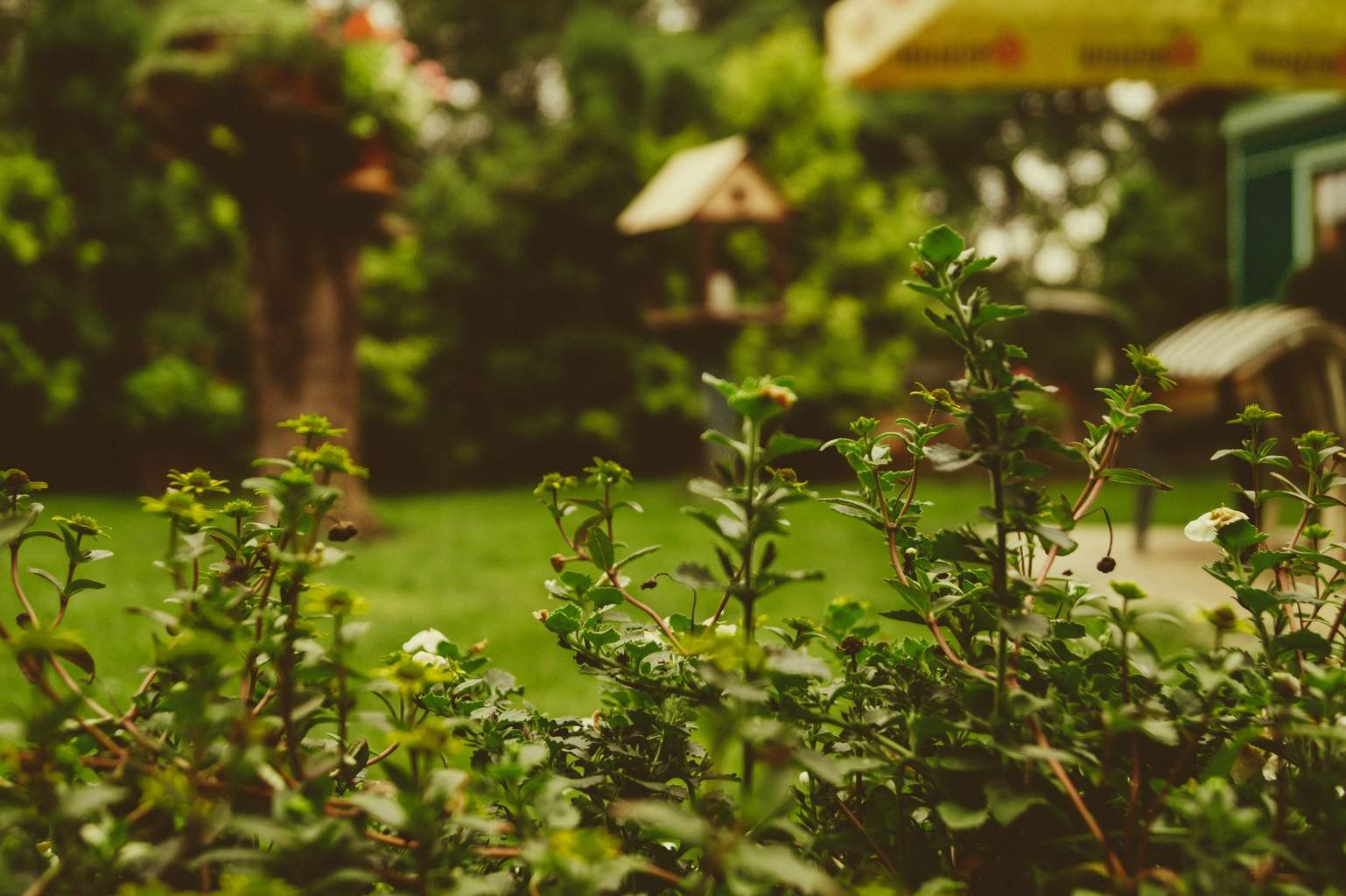
There was a wooden fence built to surround the large backyard and separate it from the woods and hill beyond. It was stained a cherry color, even and consistent across all its planks and edges. I remember it like it is still new enough to be free from any water spots or fading. The black hinges of its gates stick out in my mind: their flat black paint, the curved edges screwed flush into the wood. As a child they marked where I shouldn’t go. I didn’t want to explore the woods beyond the fence, because my dad told me that the Boogie Man lived at the top of a pine tree there, and that pictures of him were occasionally printed in the newspaper. Sometimes my mom would let me cross the street out front and smell the honeysuckle bush that grew there. I can still remember that bush, the image of it sun bleached—a tumble of branches like my sister’s tangled hair when she was three, the white flowers taller than me, their scent wafting down.
Our backyard swing set had expanded to include other playthings. We also had a little gray castle and a miniature plastic house. The castle had its own small turret you could climb up, and the house had a countertop, a toy telephone, and shutters that opened and closed. During the year I was five I convinced my parents to buy me a Cocker Spaniel puppy I named Sparky, a green parakeet I named Tweety, and also a rabbit, christened Peter, after the Beatrix Potter character. Peter had downy brown and white fur and ears that stood straight up. My dad built a hutch in the furthest corner of the yard, and that was where Peter lived. I would carry food out to him twice a day, and worry about him if it rained or was ever cold enough for frost.
Once I took Peter for a walk around the back yard, but I had left the gate open. Peter hopped away and around the fence. His little nose would sniff the air, and then whenever I would reach down to catch him he would hop a little bit further away, rustling the long grass. He hopped all the way to the edge of the woods, where I followed him and cornered him against a rock. I picked him up. The trees swayed in the wind and I imagined the Boogie-man leering down at me. I ran back to the yard and secured Peter in his hutch.
We drove from North Carolina to Scraggy Neck each summer, not an inconsiderable drive. We would always stop at the same all-you-can-eat buffet restaurant along the highway, where all the tables were in booths and you had to peel the plastic seat from the back of your legs when you stood up. Because of the heat, Mom would leave Sparky tied up in the shade, Peter and Tweety on either side of him. I had an intense fear that somebody would steal my pets while we were eating and I always sat by the window so I could watch them and any strangers in the parking lot.
At the end of these long journeys, my dad would drive the car up onto the lawn so that it was as close to the front door as possible. From there we would all help unpack. The air was damp and musty and my mom would throw the windows open, so the ocean air could filter in. When we first arrived I would walk up and down the creaky, uncarpeted wood stairs over and over again, breathing in that smell.
The winter I was six we went to Boston to look at new houses. We drove out to a town called Sudbury, to see a house my dad loved. There was a nature reserve at the end of the street, and a river that had a weir many years ago. From that came the street’s name: Weir Hill Road. The house had a huge backyard of seven acres that included a field and thick woods that backed up to the river. My whole family took a tour of the house, but what I remember most vividly is walking down to the nature reserve. The bare trees waded in the snow, at least four feet deep, the narrow path shoveled and icy. I sledded down each hilly part of the walking path. We walked to where the trees parted to reveal a river so frozen I could walk out on the edge of it and pretend I was skating with my snow boots.
My parents made an offer on the house shortly after. Tweety, Peter and Sparky were given away to neighbors before we moved in that summer. The Weir Hill Road house was built into the side of a hill. From the end of the driveway I could run straight down the hill, gaining momentum that would propel me almost all the way to the end of the field. We still had the swing set, toy castle and house, but here they were one fraction of the backyard. I could pick dandelions and look for salamanders under rocks. I developed a love for catching frogs, holding them gently in my hand and feeling the bumps on their cool skin.
Any opportunity I got I would go out into the woods. I wasn’t allowed to go alone, but would take a few steps in anyways and peer around at the brush, and wet leaves, the trees stepping one behind the other, further and further away. I liked to imagine that I was an explorer, cataloguing the frogs and salamanders and discovering new species. I hadn’t learned much about animals in school yet, but I would make up facts about their life expectancy and families and tell anybody that would listen. Soon we got a miniature poodle, named Gracey, who was my companion and ran with me from the top of the hill out through the field, her tongue wagging and ears flapping behind her.
In the autumn the Weir Hill Road house was repainted from mustard yellow to cream. I took piano lessons and attended girl scouts. On weekends my dad would take us for walks in our woods and the nature reserve. I remember the day Dad took us all the way through the woods and out to the river, where the ground became swampy and the water was up around our boots. My feet sank deeper into the mud and he told us a story about being a child and going fishing in a swamp with his dad. Around that time of the year the leaves were turning, and we emerged from the sweeping half circle of reds and auburns and yellows and trudged back to the house. I liked to imagine living forever in the woods, making lean-tos from saplings and pine needles and surviving on swamp fish in my dad’s canoe. I still dream sometimes that I walk out to the edge of those woods to find an old broken down house, where somebody has been living all this time.
At the nature reserve we followed the many walking paths by the river and up over the hill. Sometimes during hunting season we could hear the sounds of gunshots in the distance. My dad has always been a lover of history, and as we walked he would talk about how the gullies in the sides of the hill were formed in the ice ages, when huge glaciers melted and cut into the side of the land. I imagined blue glaciers as big as our house melting away into the river, and for the first time started to comprehend the life span of trees and land.
We would run down the steep sides of these valleys, our gloved hands reaching for branches to slow us. In bad weather we would hurry home and I would stand by the long windows in the kitchen and watch it raining all the way out to the edge of our woods.
Three days after my eighth birthday my brother James was born. For two days Amy, Steve and I were left with a babysitter on Scraggy Neck. I spent some time sitting out on my favorite rock. I lay back and watched the sun flickering through the trees above. My bare feet pressed into lichen and moss and dirt. He could be anything and anyone, I realized.
Continue reading this story on Beacon.
Alyssa Kilzer graduated from the University of St. Andrews in Scotland with an M.Litt in Creative Writing. Her thesis, a collection of short stories entitled This House of Bones, was based on stories of her father’s life. She was advised and mentored by John Burnside.
Kilzer is the recipient of the Dan Hemingway Short Story prize for her story “The Deposition.” Her nonfiction has been published in Salon.com and TheDailyBeast.com and has been short-listed for the New Writing section of Mslexia Magazine.
She lives in Midland, Texas, the far-west center of the Oil and Gas industry, where she writes and teaches yoga.Photo courtesy of Martin Knize via unsplash.com
-
Flamingo Pink
Memoir by Laryssa Wirstiuk
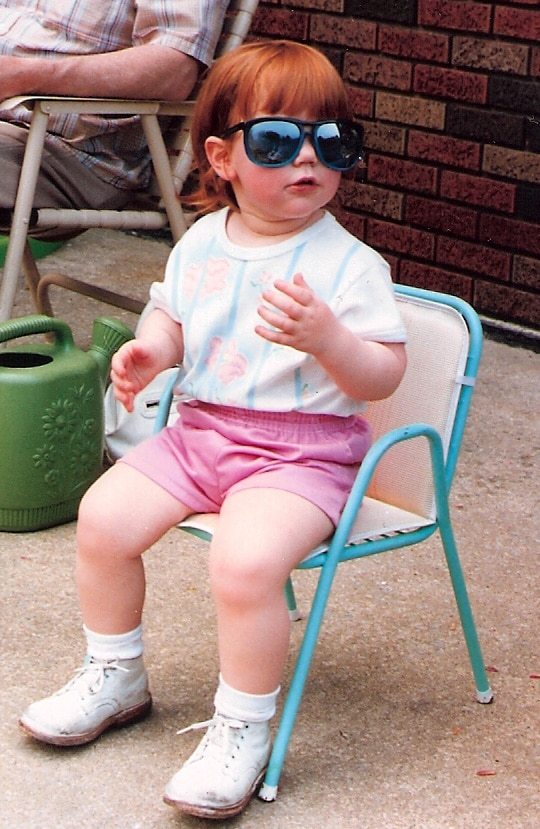
The cruelest word was “orange,” which my best friend in Kindergarten had used to describe my hair. The time was story hour, and our teacher was reading aloud one of many stories about young girls with “golden” locks: “Rapunzel,” “Goldilocks,” whatever.
“Do any of you know someone with ‘golden’ hair?” The teacher finally asked.
I raised my hand.
“My hair is kind of golden,” I said.
My so-called friend challenged my statement, while the other kids just stared. Alright, I guess my hair wasn’t golden. In my defense, however, my hair also wasn’t the color that everyone else called it: “red.” Not the color of firetrucks or blood or Valentine’s Day. I definitely didn’t resemble the mascot from the fast-food chain named after its founder’s daughter.
Maybe my best friend was right about “orange” being the most appropriate adjective. But it’s the color of October, the last month of the year before the weather in New Jersey goes to shit. Broken orange pumpkins destroyed by vandals signified anger over summer’s undeniable death. Orange tries to be natural, but it’s not. The closest thing to orange that I can stand is Orangina, the sparkling citrus beverage, but even that is more “yellow.” Language is so futile.
Growing up, my hair ignited passionate, unsolicited responses from other people. As a result, I had to bear the burden of that energy for years to come. Nearly 30 years after one incident, my grandmother still recounts the story every chance she gets.
“When you were a baby, I was pushing you in your stroller, and a stranger mumbled to himself when he saw you, ‘Stupid people. Who dyes a baby’s hair?’”
I inspired denial. I was unbelievable.
Even worse, I could never hide. In elementary school, I might as well have sported a scarlet letter on my head, “scarlet” being more specific than “red,” but still not at all accurate. In classes and at summer camps, especially with substitute teachers or absent-minded adults who couldn’t be bothered to learn anyone’s names, I would get, “Hey you, yes, you with the red hair.” I’d always be the one causing trouble. I was too easy to identify.
My hair was like religion or politics; everyone had an opinion about it. Unlike religion or politics, though, my hair as a subject was never off limits. Of course, I couldn’t get a haircut without someone at the salon cooing.
 Laryssa Wirstiuk lives in New Jersey with her mini dachshund Charlotte Moo. Laryssa’s collection of short stories The Prescribed Burn won Honorable Mention in the 21st Annual Writer’s Digest Self-Published Book Awards. Her poetry, fiction, and creative nonfiction have been published in Gargoyle Magazine, Word Riot, Barely South Review, and Up the Staircase Quarterly. http://www.laryssawirstiuk.com
 -
Recovery
A Memoir by Jason A. Ney
This is a story of a VHS tape.
It’s not a story—not primarily, at least—about how, because I attended the same tiny Christian school from kindergarten through twelfth grade, I had limited options for making friends, but how by my junior year, five of us had found each other and settled into a mix of friendship and the occasional on-again, off-again romantic pairing, spending almost every weekend at one of our houses: watching movies at Christina’s, swimming at Candace’s, hanging out at Dan’s, sitting around a bonfire and falling asleep on the trampoline at Jon’s. Forming a bond we all thought would last forever.
It’s not about how, after high school, we scattered to different colleges in different parts of the country and then settled into our adult lives, or about how we all, to various degrees, still keep in contact with each other—with one exception.
But this is not a story about Christina. It’s not about how after she went to college, she left the faith in which we’d all been raised. It’s not about her slow but steady slide away from every one of us. It’s not about how she got pregnant out of wedlock by someone none of us knew and then bailed out of being one of Candace’s bridesmaids by cutting off all communication with her weeks before the wedding. It’s not about how she willed herself off the grid, deleting our voice mails, ignoring our e-mails, acting as if all those years, the thousands upon thousands of hours we spent together, were nothing more than a chapter of a book she wanted to tear from its spine and set ablaze.
It is, however, about why, four days after Christmas, I’m fidgeting in a car outside her parents’ house in the dark, ratcheting up the nerve to ring their doorbell and worrying about how this unannounced visit—my first contact with any member of her family in over a decade—will be received.
– – –
I grew up in the analog age of cassettes, VCRs, and theatres that projected 35mm film. By the time I hit my teens, our family’s home movies—recorded by a video camera so big, whoever used it had to mount it on either a shoulder or a tripod—took up two entire drawers of our entertainment center. Since the digital era of video-capturing cell phones, Facebook, Twitter, Instagram and selfies was still years away, I took all my pictures with a Canon point-and-shoot loaded with a roll of film that, once finished, I would give to my dad. He would take it to the one-hour photo lab in Boscov’s department store, and after the lab developed it, he would pick up my photos—24 or 36, depending on the size of the roll—and bring them back to me in a glossy paper envelope. I’d shuffle through them, keeping the pictures that had turned out well and throwing out the bad ones, the out-of-focus blobs I’d shot at the wrong F-stop or speed.
When capturing a moment on film or on tape, I budgeted my resources. Each roll of film cost money, and once I shot it, it was done—no “erase and retry” button, no ability to take dozens of the same moment and leisurely shuffle through them later to pick out the best version. Once a VHS tape was filled with two hours of footage, I had two options—keep it or tape over it. If I lost a roll of film, making duplicate prints became practically impossible. So compared to today, when a single smartphone can hold more HD video than the fifteen years of grainy footage in our entertainment center drawers, my rolls of film and VHS tapes seem dangerously ephemeral, their inherent frailty compounded by a rapid onslaught of technological advances that have made accessing their content—the touchstones of my adolescence—increasingly difficult.
These technological archaisms have forced me here. They are why I’m sitting in this driveway, debating whether or not to just go home and give up the search for a tape that might no longer even exist.
 Jason A. Ney holds a Ph.D. in English from the University of Denver. His work has also appeared in Noir City and Little Did She Know. He is currently writing a memoir about growing up in Christian fundamentalism.
 -
The Electric Discharge Corona
photo courtesy of Tom Eversley @TomEversley Memoir by Anne-Marie Yerks
The things you don’t know about a house when you buy it: The leaks, the bugs, the dark and cold corners and warped walls. A stove that refuses to hit the right temperature, the driveway that isn’t shaped right, the too-loud clank of the mailbox door, a backyard too shady to grow vegetables. But the good things too: The porch with tall windows, the wood around the windows, the deep sills where the cat sleeps. Watching people stroll the sidewalk ? there are the dog-walkers, the power walkers, bottle deposit seekers, partiers, the carless, the insane. They go by as we look on from the enclosed porch of our ninety-four year old house of mysteries, the most compelling of which happened less than five years ago. A woman died here, and we don’t know why.
I don’t know why, but I know when. And I know who she was. Her name was Renee Galinyan, and she was 37 years old on her last day of life. She was in love with the man we bought the house from, and she liked belly dancing, comedy clubs, Renaissance festivals, and dogs. She was overweight, pretty and sparkly, with straight dark-brown hair and optimism shining from her brown eyes. An Armenian church prayed for her the week before she died, and a group of people from a medical lab donated $81.31 to the church in lieu of flowers for her memorial. Other people donated thousands. She had a tattoo on her shoulder ¾ one I didn’t look at closely because I dislike tattoos ¾ and, interestingly, an active account on MySpace. She had a brother not much older or younger than her, handsome in the way she was pretty, and a mother who liked the man she loved. All of this I learned from an Internet session of many hours. I combed search engines and Facebook profiles and photo albums, typing and retyping keywords into different combinations to learn more. Eventually, I had enough information that I could like Renee instead of fear her, but nowhere did I learn why she died. The final days, what were they like? Did she know it was coming, or was she still hoping for recovery?
With this question, the ghost made itself.
The Electric Discharge Corona won first place in the Fiction Attic Creative Nonfiction Contest and will appear in our forthcoming anthology, Modern American Essays. This is only an excerpt.