Your cart is currently empty!
Category: 2022
-
A Good Time – flash fiction by Kayla Czaga
So I finally phoned the number in the bathroom, the one that promises a good time. I’d been going to the pub for several weeks before I got up the courage, drinking pints of amber and working through this biography of Stephen Hawking. It wasn’t what I wanted to be doing. I wanted to be out running, but I’d injured my ankle and the pub seemed to be a good backup activity until I’d healed. I saw the number on my third or forth visit, my preferred stall being OUT OF ORDER. I looked at it, the number, scrawled just above the toilet paper dispenser along with the words for a good time call and it made me realize I wasn’t having a good time. Not at all. I was actually very depressed. About the ankle and the breakup. Here I was sitting in some pub by myself while the love of my life went on with our running group and was probably going to do her best half-marathon yet.
Shortly after 8 p.m. I got to the end of the biography, which had inspired me to do something bold, to make my fate my own, so I shuffled into to the second stall and brought my phone out of my pants.
“Hello,” a female voice said. She sounded impatient. I didn’t know how old she was, only that she wasn’t a child or an elderly person and that she probably wasn’t in her twenties either—her impatience sounded more of the “I’m tired of this” variety rather than the impatience of youth. Which meant she was somewhere in the ballpark of 30-60.
“I’m calling from the bathroom of the Sylvia,” I said.
“Is this some kind of joke?”
“No,” I said, trying to convey how serious I was with my tone. “Your number is written here.”
“Yeah, and?”
“I’d like a good time.”
“I’m sure you would,” she said. “You and every other drunk.”
“Look, I’m not drunk, I promise.” I wasn’t lying; I’d only had two thirds of my pint at that point. I’m not really much of a drinker, I’d just been sipping to pass the time.
“I’m sure you’re not.”
“I promise. I’m only here because my girlfriend has left me. And I may never run again. I’ve only had half a pint. I can send you a photo.”
I could hear the ragged edge of desperation in my voice and, evidently, she could too because her own voice seemed to soften somewhat. “So you’re looking for a good time?”
“Yes,” I said, finally we were getting somewhere.
“Ok,” she said. “Give me a minute.”
I waited. Through the line, I could hear a variety of sounds. First it was like she was beating a stack of DVDs with a hairbrush. Then it was like someone sorting through a giant bin of cutlery. Finally there was the brief droning of a leaf blower. As I listened, I became more and more excited about my good time and what it might entail: balloons and cake, or whips and insults. Maybe a gentle hike, I mused, rubbing my ankle.
“1:47 p.m..” she said, the line suddenly quiet except for her voice.
“What’s the address?”
“No address.”
“Ok, well, what day? Should I wear anything in particular?”
“Look, maybe you don’t understand. There are other numbers I can give you if you’re looking for a date or an adventure. But this is the time line. I give people good times.”
“Ok,” I said.
“So, should I put you down for 1:47 p.m.?”
I ran my mind over the time. “It’s kind of in the middle of the day,” I said.
Her voice grew harsh again—“Do you want a good time or not?”
“Yes, sorry. Absolutely. I’ll take 1:47 p.m..”
“Ok. Good,” she said.
She walked me through entering my credit card information. Once the transaction was complete, she said, “Have a good time,” and the line went dead.
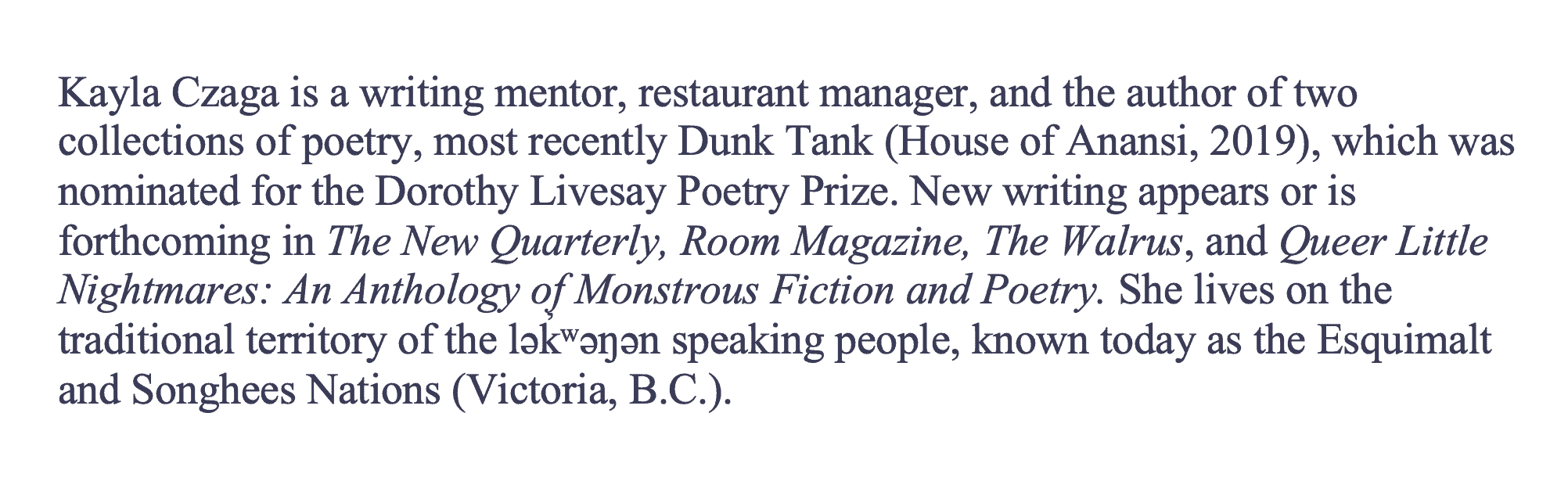
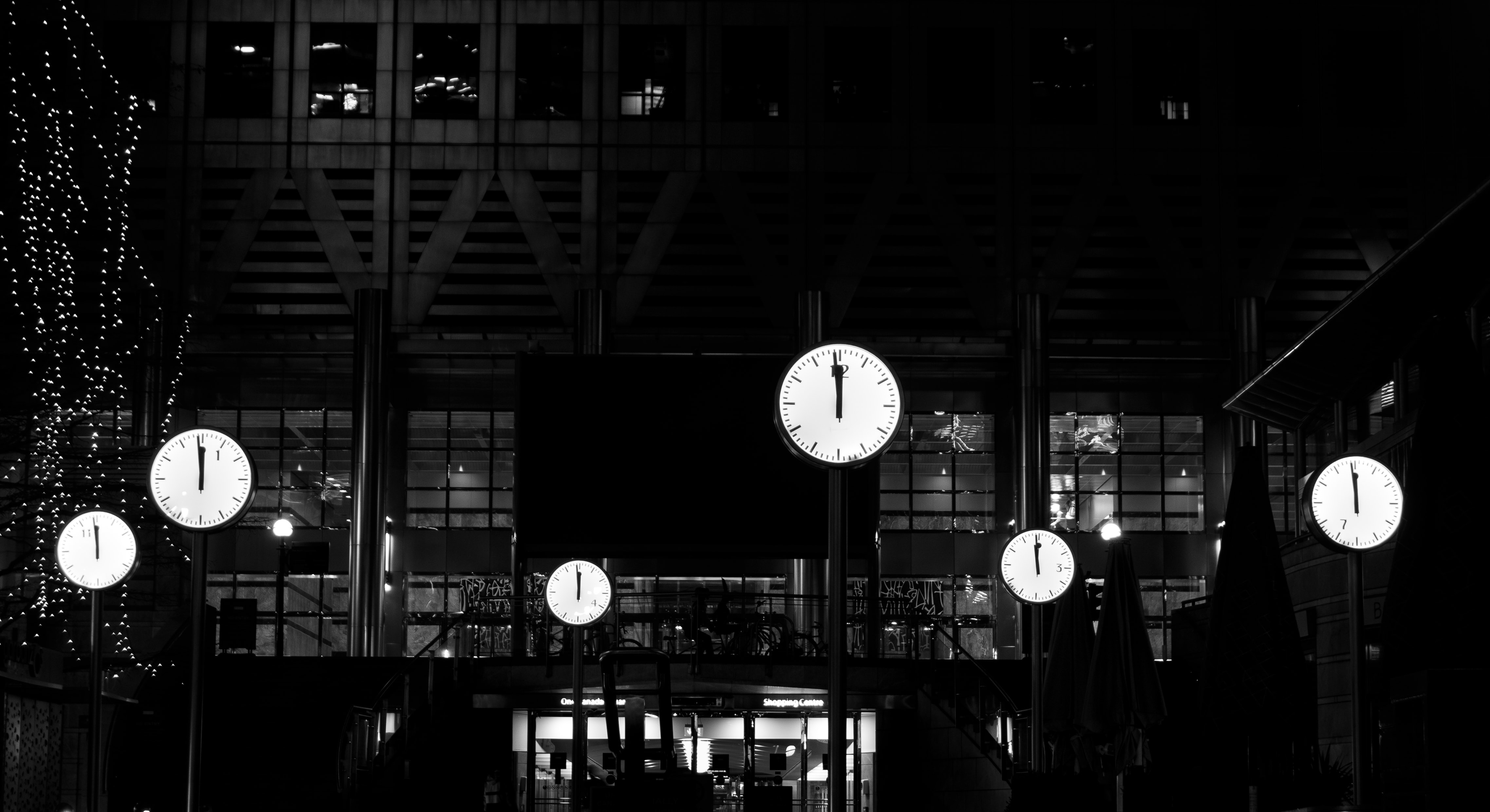
It’s just past 1 p.m. now, a day later—1:03, actually—I’d expected the weather to be better, but maybe rain is good, it means I won’t miss it, that my good time won’t be competing with the sunshine. It almost feels like it’s here already, but I know it’s not. It could’ve been any number of times—4:11 p.m. or midnight or half past nine, but it isn’t, it’s 1:47 p.m..
Buy Kayla Czaga’s books, Dunk Tank and For Your Safety Please Hold On, at bookshop.org.
-
Spine Sketchbook by Claire Lynch (5): I’ve Got You
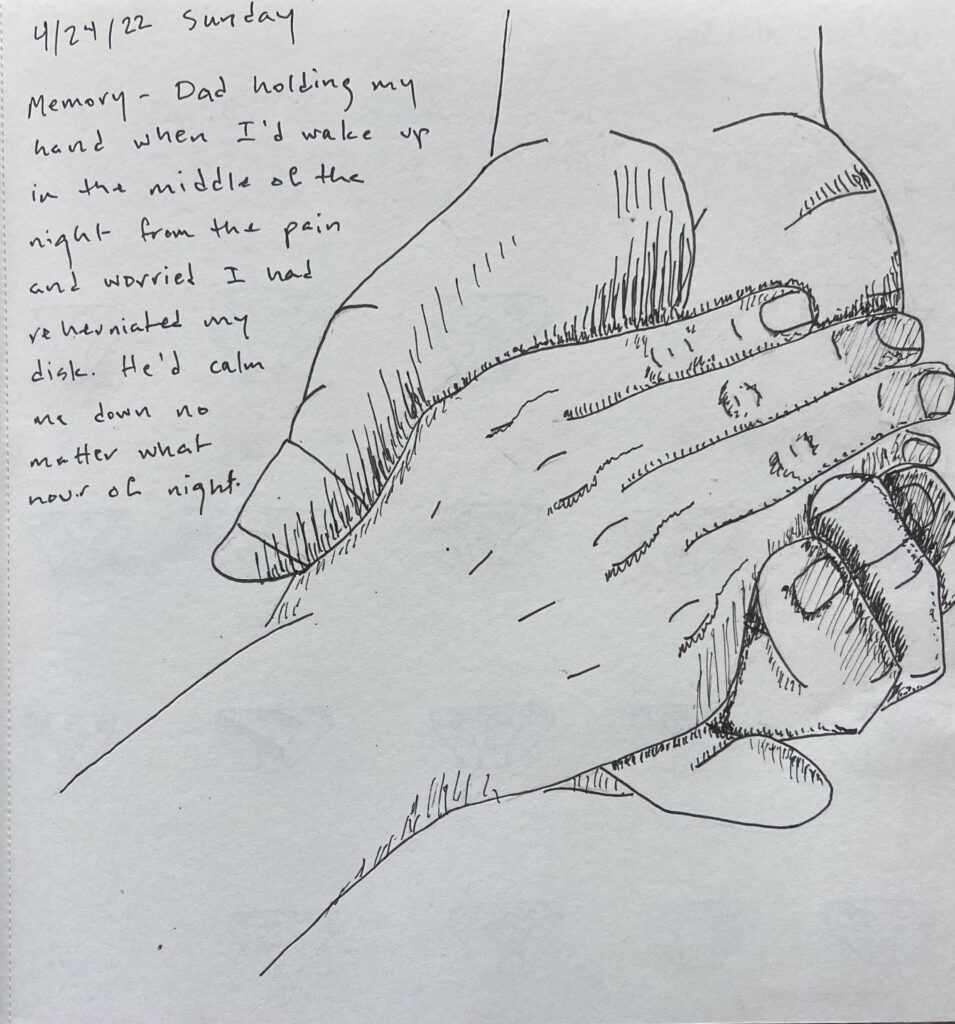
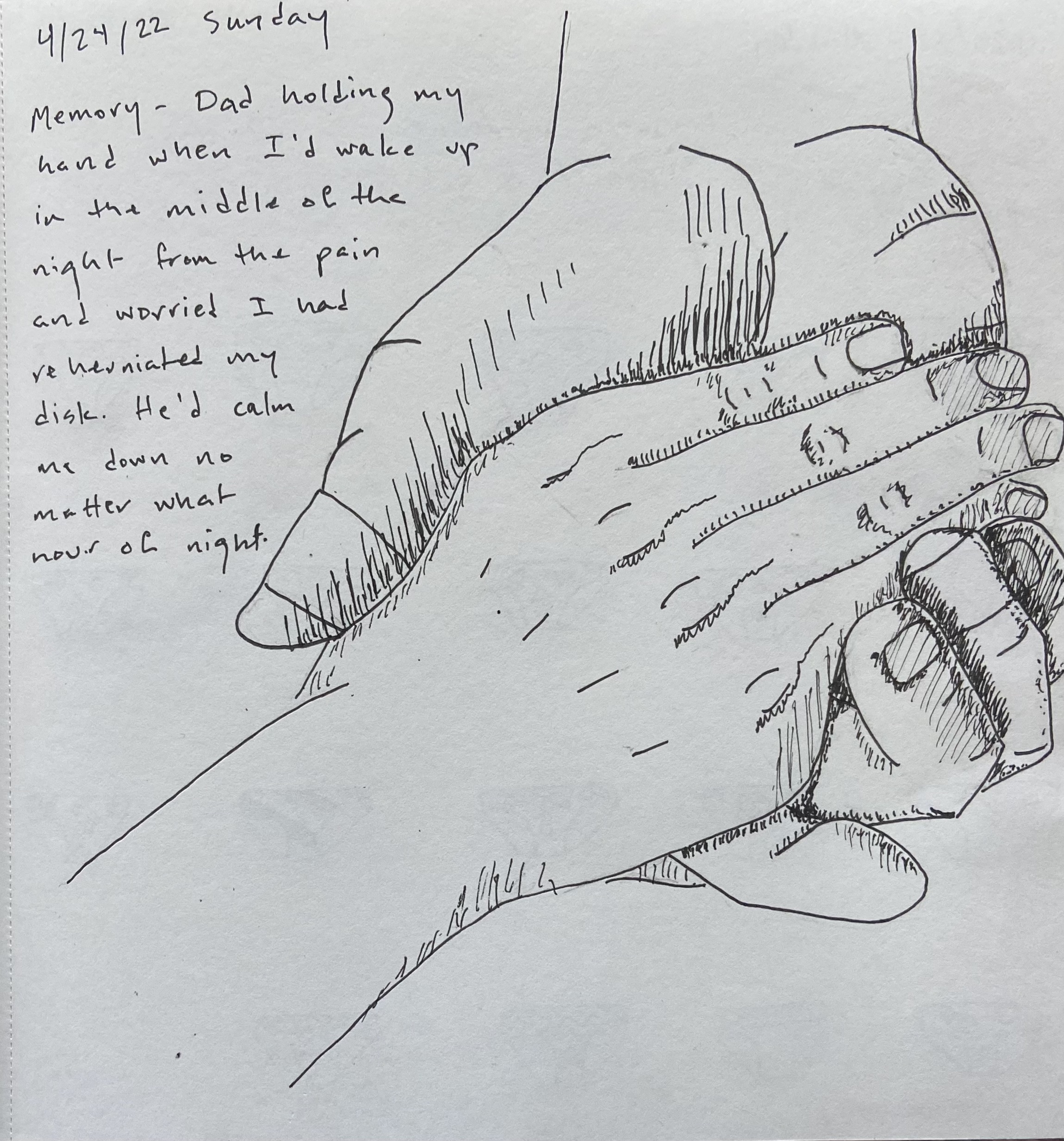
I’ve Got You. Claire Lynch, Spine Sketchbook, 5 Memory – Dad holding my hand when I’d wake up in the middle of the night from the pain and worried I had reherniated my disk. He’d calm me down no matter what hour of night.
-
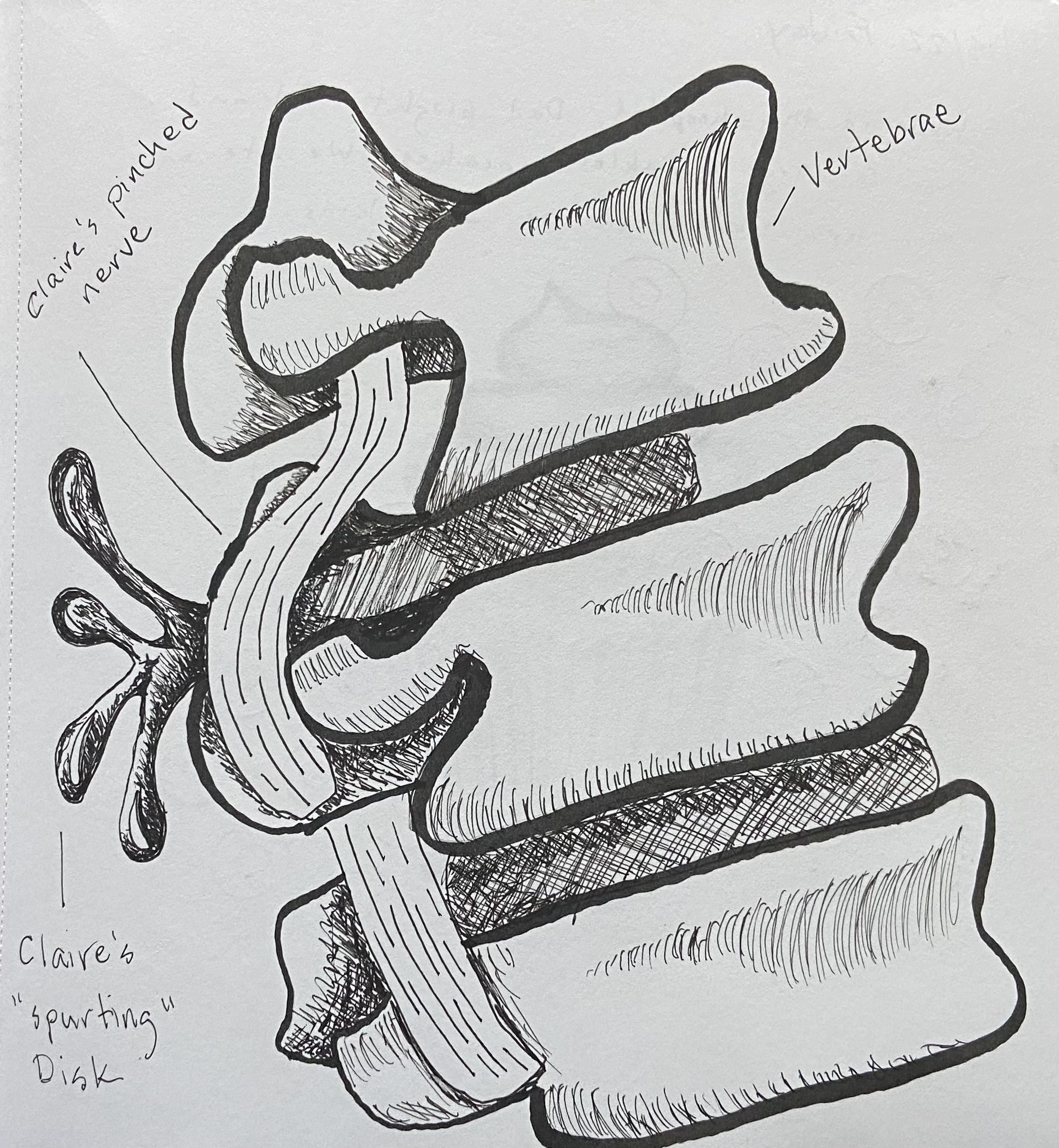
Spine Sketchbook: A Story in Illustration by Claire Lynch
Claire’s Spurting Disk (1 of 6)
Claire R Lynch is an artist and teacher based out of the Washington DC area. At the age of 31, Claire underwent two unexpected and rapid spinal surgeries for a recurring herniated disk within the span of 3 days. This series was inspired by the spontaneously ridiculous, traumatizing, and heartwarming moments of her surgical recovery.
Continue to the next panel of this sketchbook in 6 illustrations.
-

The World Is Ending in Tampa, Florida! by Paige Blackburn
That’s what the news warned. Everyone but the doomsday planners and the resolute old men evacuated long before it happened.
From luxury boats or the local news, the greater population of Tampa watched their city shift, then sink, Atlantis-style, and slide deep into the only darkness we do not know.
Hundreds of Tampa children watched in wonder and asked their mothers if octopuses were going to sleep in their beds. Hundreds of Tampa mothers didn’t know how to answer that question. Only one Tampa child asked her mother where they were going to live now. Her name was Judy. Judy’s mother finished her cigarette, flicked it into the ocean, and replied simply, “Somewhere else.”
And they did live somewhere else. Judy and her mother lived so many places else. They moved around every six months or so, flicking cigarettes into bodies of water all across the country.
A year after the Tampapocalypse, the people built another bridge over the newly-expanded Tampa Bay.
Ten years after the Tampapocalypse, Judy’s mother died, and Judy returned to Tampa Bay to live with her aunt. By this time, she was seventeen, and about to graduate from a school she’d been inside exactly twice.
One night, she asked her aunt if there was a community college she could attend (she’d been saving her money), and her aunt looked away from her black television screen and screeched—the first words Judy had ever heard her speak:
“There’s nothing for you in this world, kid! Stop looking forward! Nothing comes next!” And she crumpled up an empty can and threw it at Judy’s head.
Judy left.
“Nothing comes next?” Judy thought as she walked down the recently-newly-defined coast. Really?
Because as far as Judy could see—and she could see for miles out from here, without Tampa in the way—there was plenty that came next.
And what came next would be plenty.
Paige Blackburn is a young writer, poet, and college student from Illinois. When she is not working or attending class, she is reading a fantasy story, or writing one, or thinking about writing one. Her work has appeared in Unbroken Journal. You can find more of her poetry on Instagram @blackinkburnedpaiges.
photo courtesy of Julie Tupas
Subscribe to get Fiction Attic stories in your inbox every other week.
Submit your flash fiction, memoir, short stories, essays, or sketchbook stories.
-
The Truth Is — by Stephanie Buesinger
1. Ingredients
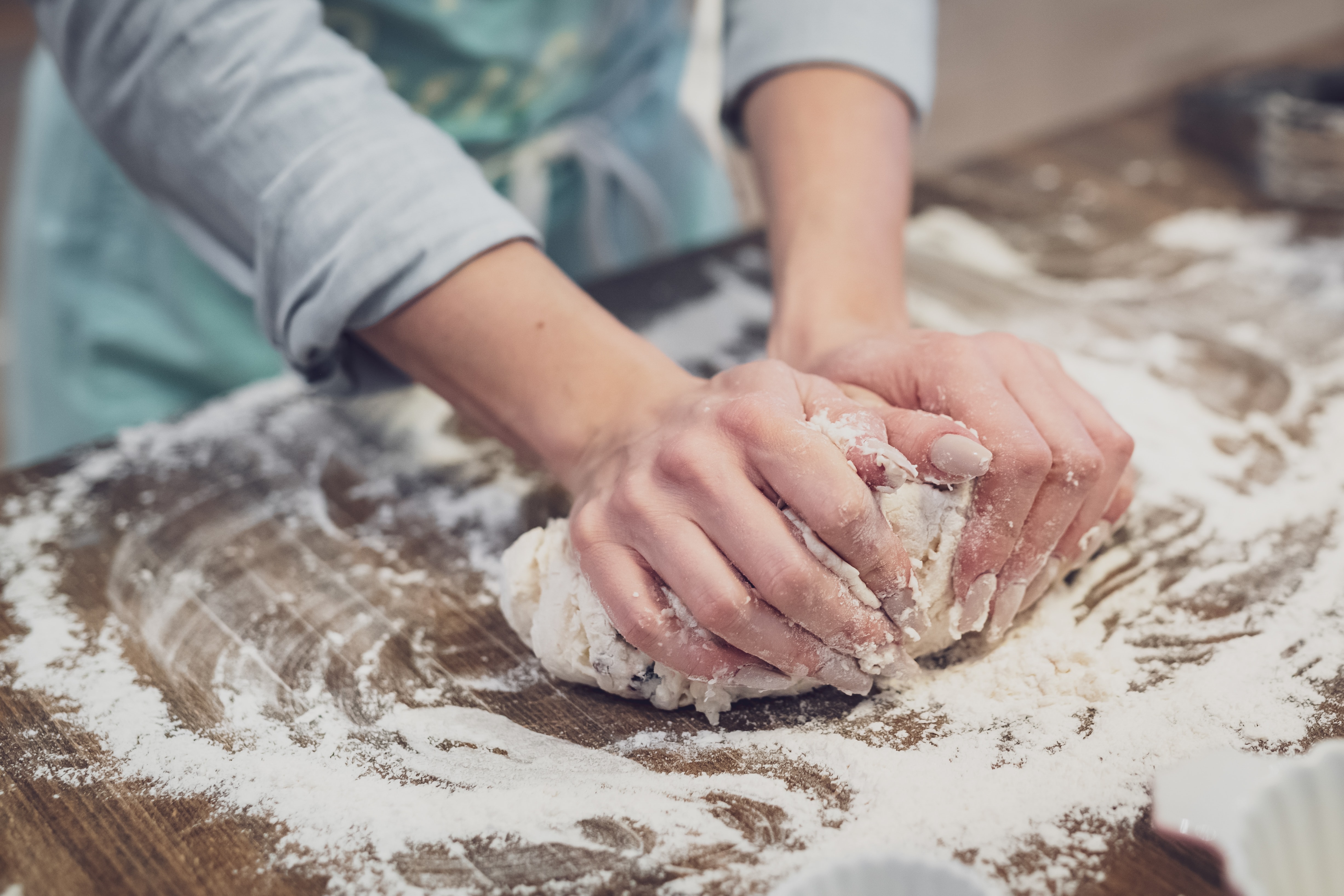
I try to find solace in the little things. Making bread, for example. The refuge of repetition as I knead the dough, fingers sticky, folding, pressing, then folding again, the enforced patience of setting it aside to rise, damp cloth laid carefully over the top. The letting go when you slide the formed loaf into the oven. Growing up I watched my mother bake sourdough and buttermilk biscuits, blueberry muffins, and apple pie, which she served a la mode with a large scoop of vanilla brought home from Swenson’s. I packed her recipes in my carry-on when I moved to this country.
2. ProcedureThe truth is, I found the recipes in a hinged wooden box in the attic of this cottage by the lake. The recipes are not for blueberry muffins or pie but for kreplach and noodle kugel and kasha varnishkes. The real estate agent that rented me this house told me they were left there by a German Jewish woman who abandoned the house and its contents during the war. The previous owners left the box in the attic. No, that’s not true either. The recipes are for borscht and pelmeniand were handwritten on lilac-colored stationery and given to me by the Russian ballerina who lived in the apartment above me in New York, compensation for her hosting late-night dinner parties. Tanya knew I liked staying in and reading Tolstoy. She preferred Chekhov. I’m sorry, I lied to you again. I found the recipes on the internet and took a screenshot of them on my iPhone.
3. Serving
I don’t like to cook, and I would not make any of those things. I’m confident my mother would have cooked all those things if she had ever lived here, in this cottage by the mountains. I mean house by the lake. If I had a mother who baked warm loaves of apple strudel and told stories as you lay on a blanket under the apple trees and blue sky. If I even had a mother who baked strudel so tender it melted on your tongue. The truth is, I had no mother.
Stephanie Buesinger writes fiction and children’s literature and enjoys illustration and photography. She is Photo and Blog Editor at Literary Mama and her work has appeared in Literary Mama, Women on Writing, and The Bluebird Word. She lives in Florida with her family and pets.
-
Here, from Outer Space–by Mackenzie Singh
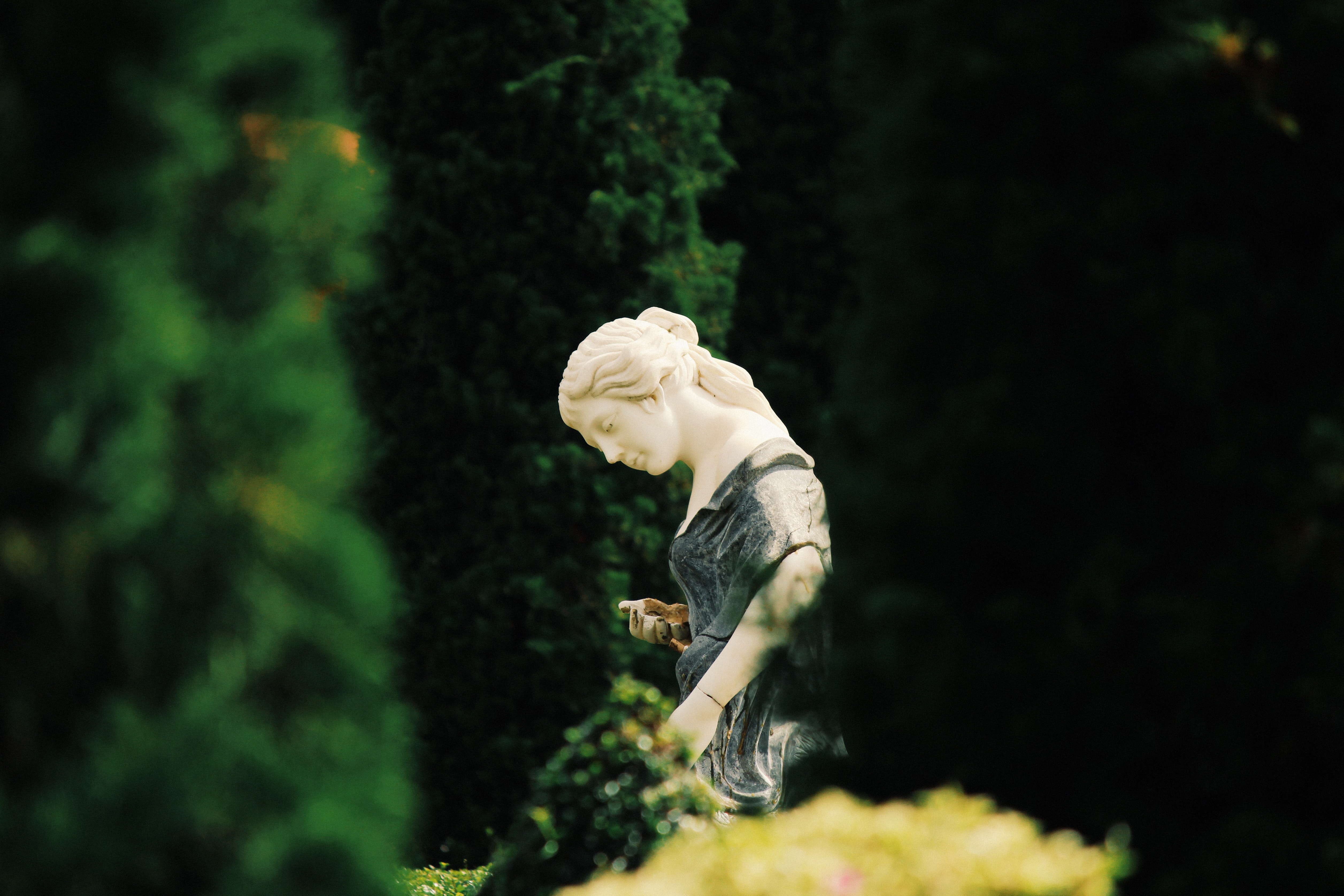
photo by Zeke Whiteout At the sculpture park we fail to connect. By connect, I mean recover. And so, we stack rocks. In silence we balance them without great effort but still, they stay, an allegiance or maybe obedience to an effort we lack. It’s in the fit. I like the precarious ones, she, the uniform. Our creation — it tickles us. We have surpassed the other stacks and, look: we are still stacking. When the leaning begins, we abandon it, this bowed spine, which, hey, call it a benediction.
Above, honey bees. They fly and fly and —
I tell her I envy insects. How capable they are, how sturdy the things they make. Me? I’d be a spider, my home spun in the yawn of a boot, a constellation against the sole of a sky.
We carry on over the dry-stone ramp and toward the garden. In the shade of a tree the teeth of a scar wink white from her calf. The first time I saw it she said the owner claimed the dog just wanted to play. I said it was like that joke about the — but then she kissed me and I managed only to say, “ — off my lawn.”
Prospects are hospitable. It’s a misconception that a happy present makes a future when one has only to imagine a future to want the present. As for the joke? That’s what I mean. Of course she laughed.
And, now.
Now we arrive at the quarry where, supposedly, two can work out whispers from opposite ends. Here, we are on another planet. We are aliens attempting contact. We cup our telescope hands around our mouths. Diligently, we hum: “Hello?” And then we listen, we listen before trying once more: “Can you hear me?”
Mackenzie Singh’s work has appeared in SAND Journal, SHiFT, Maudlin House, Lithub, and The Rumpus. She lives in Brooklyn.
Subscribe to get new flash fictions in twice a month in your inbox.
Submit your flash fiction or personal essays to Fiction Attic (we pay our writers).