Your cart is currently empty!
Tag: short stories
-
Buried – Flash Fiction by Nathan Alling Long
You dropped it in the ocean so as hide it. But no, that’s not quite the right word—for hiding implies from someone, and no one was looking for it or would think to find it here. Hiding also suggests a temporariness. One hides something only later to reveal it. To hide something for good, one buries it.
Yet it seemed wrong to think of drawing the small parcel from your coat pocket as you leaned over the rail of the whale watching boat that afternoon, letting it slip out of your fingers into the water, to think of that as burying. You looked around, worried about being seen. But everyone else on deck was looking off in the distance for a tail or a spout of water.
You watched as the parcel floated a moment, then sank unceremoniously. As the boat pressed on, you could imagine the small wooden box swaying downward until it rested on the ocean floor. Yet all that water did not exactly bury the thing. Not made of earth, the ocean could not truly put it to rest.
As a child, you had been unsettled by the phrase ‘a man buried at sea’; you couldn’t understand how anyone could dig a grave at the bottom of the ocean, how they could pull the casket down, then cover it up. Wouldn’t the currents wash the dirt away and reveal the body? When you learned that it meant they simply let the body slip off the ship into the ocean, you were repulsed by the thought, the slothfulness and incompleteness of the act.
But you now have done the act yourself, buried but not buried, let the parcel fall into the immense anonymity of the sea. And since then, you have not spent a day without thinking about it. Sometimes you imagined the parcel jostled by the waves or the tail of a large fish. Other times you pictured it catching the hook of a fishing line or the net of a trawler. Or you imagined it scuttling across the ocean floor, incrementally, pushed by the currents so that it seemed almost a living thing again.
They told you before he was out of the womb that he would not live long. The arrhythmic pulse, a tell-tale heart. You said no matter, you would care for until it stopped. Then return it to a watery place, where it might feel comfort.
But now you find yourself going to the shore each day, as though the thing might wash up on the beach. You believe it is not comfortable, alone on the ocean floor. It is trying to come back to you, even though it is only ash in a box. You imagine that if you do not find it, it will be discovered by a fisherman or an early morning collector of shells. Then, years later, you will see it in someone’s living room or alone out on the curb.
When you are not at the shore, you find yourself watching what flows from faucets, as if your box might come through the small metal opening. You come to believe that all water is part of the same body, one endless being, like a grove of aspens connected by the roots. You believe it might return to you from any source. You look at the sky when it rains, wondering if it might fall from a cloud. You look for it in a glass of water at a restaurant, in a street puddle, in your own tears.
Soon it feels certain that you will find it, that you alone will find it, for you have buried it from everyone but yourself.
One day you wake from a frightening dream. In it, your tiny wooden box is still lying on the ocean floor, still as a stone, wedded to the floor like a shipwreck. It has not gone anywhere at all. You see then how well the sea, with its thick salty water, preserves the things it collects. Your box will never disappear. It will always wait for you.
That morning, you return to the shore, certain that it will never wash up at your feet. Still you feel the thread that tethers it to you. You place a hand in the salt water, feeling the tug. Without taking off your clothes, you step in the water, feeling you are a mother all over again, the cold sacrifice of everything. You start walking, then swimming. By effort or current, you will return to it. You know eventually you will be pulled under and sink down until the two of you are rejoined, there on the ocean floor, your body beside your tiny box, almost as if buried at sea.
Nathan Alling Long’s has appeared in over a hundred journals and anthologies, including Story Quarterly, Tin House, Glimmer Train, and Crab Orchard Review. He lives in Philadelphia, and teaches at Stockton Univeristy. “Buried” is part of a fifty story collection of flash fiction seeking publication. More can be found at https://blogs.stockton.edu/longn/.
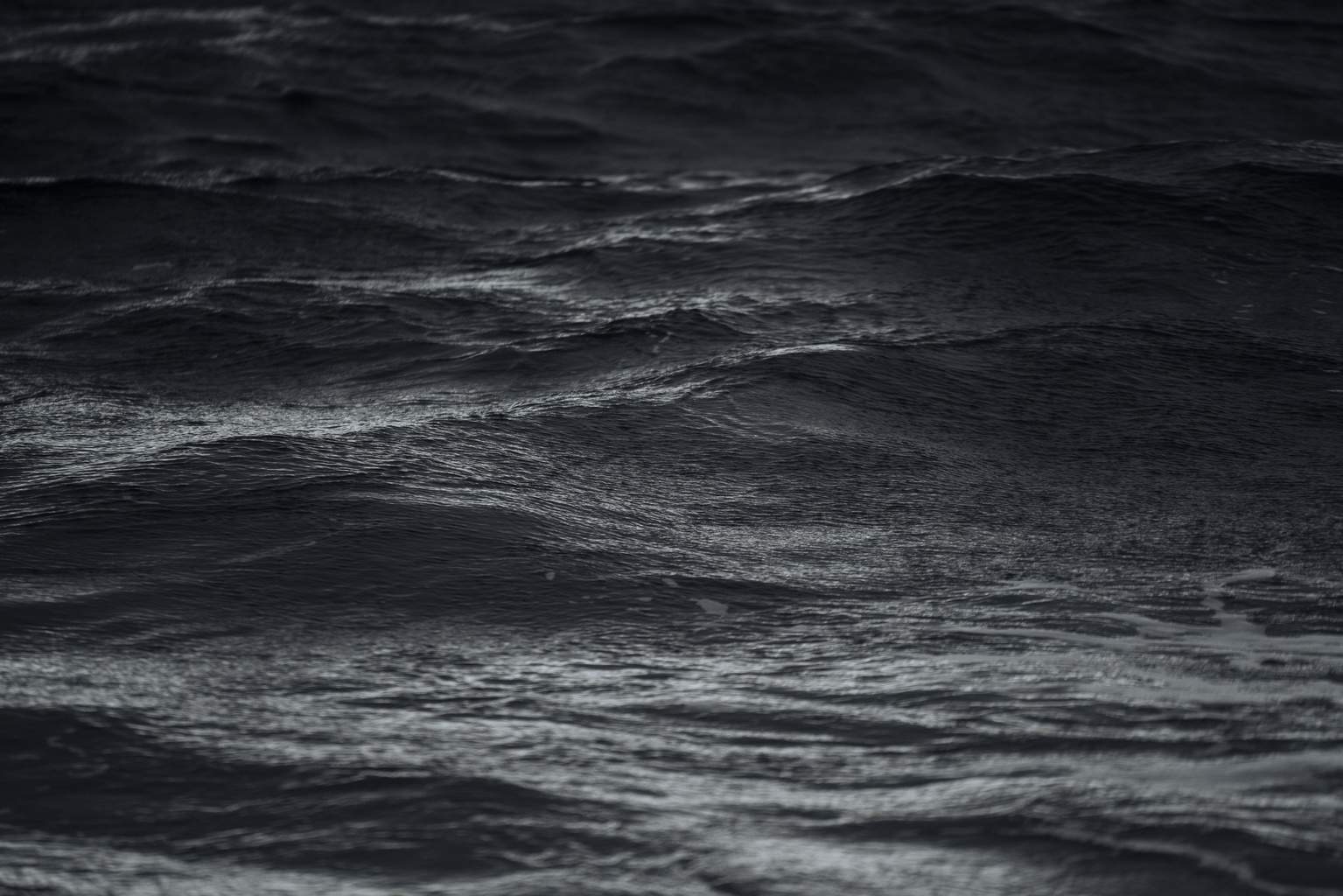
Image by Tobias van Schneider via unsplash. -

The English Translation of the Story of the Hero Who Named Many Places
A short story by Will Kaufman
He named this place the Apple Grove of Hope for Love, because it was in this apple grove, as a youth, that he came upon a horse, a dappled grey, and befriended it. In that time the people of our land lived far apart, and often wandered. How else to find love than on a horse?
This hill the hero named Horse-Thrown Hill, because he could not ride over it without his horse throwing him. Sixteen times in the course of the hero’s many travels he was thrown. Sixteen times as he crossed our land, looking for his love. Perhaps he should have named it Stubborn Hero Hill, for he could have ridden around it. It is not a very large hill. But he always thought, maybe this time. He would be thrown still had his horse not died.
I have never owned a horse, though I have seen several. Wild horses, even. A small herd, chestnut and white in a stretch of grassy valley too far from the city to be worth developing, and too narrow to farm. Its name on the map is Narrow Valley. I witnessed the wild horses of Narrow Valley grazing by the freeway, the E-244. Such are the names given now.
Professor Padarak drove me down that road, in her rusted Lada, to interview a retired truck driver whose father had a reputation as a great storyteller. We brought tape recorders and notebooks and maps, and meant to recover old stories and old names. Professor Padarak and Aydas the Research Assistant, seeing in each landmark that presented itself outside the streaked windows of the Lada a space for an old name to be scrived.
The truck driver told us the stories his father told him, of the great hero who gave many names to the places in our land, and other stories, too. He spoke a patois of the old dialect and the new—though not like the kind taught in classrooms—and trucker-words. In English he knew “distance” and he knew “horse” from “horsepower.” Then he offered us the use of a cot next to his iron stove.
I considered the shack’s concrete floor. “I’ll sleep in the car,” I said.
“Don’t be daft,” said Professor Padarak. “You’ll freeze.”
And this is the Best Tree for Sitting Under, with its twisted roots that make beds and chairs, and its dense leaves that shelter and shade. The hero sat here many times on his travels, stopping even if he was not tired, just because it is so good a place to sit. While he sat he thought about finding his love, about finding a woman with whom he could name a place Home, and how they would have many children, and he would ask her to name each one, then he would name a place for each one. This was a sad thought, too, because he would not need his horse any longer, having found love, but he loved his horse. He had spent so long with his horse, and needed his horse, and his horse held all his hopes in the thunderous chambers of her heart. Would his hopes still be thunderous once he found love?
He could have named the tree Where Happy Thoughts Become Sad Thoughts, or Where Joy and Sadness Forget Why They Are Different, but that was not necessary. Sit for long enough and all things come and go, so being a place one could sit for a long time was a much better recommendation for the tree than any such nonsense.
So why didn’t the hero sit and wait for his love, if all things would come and go? When he thought that, he knew he had sat too long, and he leapt onto his horse, and after leaping one such day he meant to tell his horse how, even though she was a means to love, he loved her for herself, but he could not speak to the horse for he did not know the horse’s name.
So he said aloud that he would find someone to name his horse, and hoped his horse heard him, and understood.
And the University library was a kind and warm place, gentle in spite of the efforts of its builders to harden it with linoleum and fluorescent tubes and steel shelves. We surrounded ourselves with reference books and set about making all the truck driver’s words English words so we could publish in English…
(EXCERPT) Continue reading this story on Beacon.
Will Kaufman’s work has previously appeared in The Collagist, PANK, Unstuck, Lightspeed Magazine, McSweeney’s Internet Tendency, and a number of other journals. He received an MFA in Creative Writing from the University of Utah in 2010.
Image courtesy of Patrick Tomasso via unsplash
 This story will appear in the anthology 20 Tall Tales: Weird and Wonderful Stories. Go here to pre-order the ebook.
 -
Indian Classroom
a short story by Darlene P. Campos
students in the choir at Flandreau Indian school. Image courtesy of the Library of Congress I avoided going to Flandreau Indian Boarding School for a long time because I was great at faking sickness and death. If Ate ever said, “Son, you throw up right here,” I could. And if Ina ever said, “Son, you play dead right now,” I could. My older brother Gray Mountain was sent to Flandreau when I was 10 and never came back. He died of tuberculosis and we didn’t know until two months after his burial. He was 17.
The bus stopped in front of our house and I watched through the window, seeing the school officials shout they were here for students. Isabella Little Elk lived next door to me with her grandparents. Her ina worked in Rapid City and her ate ran away, so she was almost an orphan. I saw Isabella step out of her house with her hands up, saying she was ready. If the beautiful Isabella was going, I was too.
“James Eagle, you’re supposed to have typhoid,” Ina said when she saw me get out of bed. She tried to put me back down, but I shoved her out of the way and ran outside. I told the school officials I was ready too.
“Son, you’re going to that place over my dead body,” Ate said when I went in the house to grab some clothes. I told him I’d kill him if he wanted me to and he slapped me.
“I’m going,” I said. I swung my bag on my back, said goodbye to my parents, and went out to the bus.
When I got to Flandreau, my hair was cut short, my clothes were taken away, and I was told to speak nothing but English. My family only knew Lakota, but they knew a few English words like ‘Mother,’ ‘Father,’ ‘and of course, ‘Beer.’ My English wasn’t perfect, but it was better than theirs.
“James Eagle Red Wolf?” the administrator said. “That’s no name for a boy.”
“Yes, I am a boy,” I said, not really knowing what to say. He tossed a uniform at me and showed me my room. There was one other boy around my age in there – Byron Thunderclap from Rosebud Reservation. I greeted him in Lakota and then the administrator grabbed me by my hair and threw me against the wall.
“English only,” he reminded me and left.
“If they want to swing us, it’d be easier on them if we had our long hair,” I said to Byron and he laughed. There was one bed in the room, but he said it was his, so I had the floor. Back home, I had only been sleeping in a bed for a year, so the floor was nothing new.
At six in the morning, the hall monitors woke us up for breakfast – a piece of bread with a cup of water, or so they claimed it was. One of the monitors grabbed my arm and took me to an office where other students were putting a newspaper together.
“You work here now,” he said and left. I looked ahead and there she was, Isabella Little Elk, at a typewriter. She was literate because her ina went to Haskell Indian Boarding School and taught her. Isabella loved writing more than anything else. I always wanted to get a love note from her, even if I wouldn’t be able to read it that well.
“Good morning, beautiful,” I said.
“Go away,” she told me, as usual, and got up from her chair. She’d always stomp her feet whenever I was around her, but to me, her footsteps sounded like they were calling my name. James, Eagle, James, Eagle, James, Eagle.
end of excerpt
Read this story in its entirety with your free trial subscription to Fiction Attic Press.
About the author: Darlene P. Campos is an MFA candidate at the University of Texas at El Paso’s Creative Writing Program. In 2013, her story “The Fork” won the Glass Mountain magazine contest for prose and her story “The Bullet” was awarded the Sylvan N. Karchmer Fiction Prize. She is from Guayaquil, Ecuador but has lived in Houston all her life. Her website is www.darlenepcampos.com.
About the image: Flandreau Indian School choir, photographed between 1909 and 1932, courtesy of the Library of Congress. Photographer unknown. View details here.
-
Little Big Death
a short story by Mark Pritchard
When the doctors ask me what I remember, I close my eyes and repeat my story: Tired of life in the ruins of Western society, of living in a cramped dormitory with hundreds of other sad, middle-aged men, I signed up for Superdeath. I went expecting that, like nearly everyone else who takes the drug Shiny, I would experience ecstasy, super strength, complete transcendence and freedom from guilt and the past, and death, all within 48 hours.
That is the purpose of attending Superdeath: a final, superhuman blowout of dancing and sex, ending in blissful slumber from which the attendees never wake up. Because Shiny kills 99.999 percent of those who take it.
It wasn’t hard to decide to join them. After the pandemic of the early 21st century, the economic collapse that accompanied it, and the ecological catastrophes that followed that, I had been unemployed for years. Me and hundreds of millions of others. Great legions of us were in prison, legions more were dead. Most of the remainder were, like me, housed in cheap dormitories that had been constructed in dead malls and superstores. There they fed us cheap, disgusting food, permitted us one hour of exercise per week, and prevented us from reading, writing or consuming any media other than a single television channel. Blaring in every room, wall-mounted televisions showed a supposedly calming montage of nature scenes taped during the late 20th century, set to music from the 19th. The montage lasted exactly 18 hours without repeating. When it flicked off, you went to bed. When it flicked on, you got up and ate. That was life.
If that seems bad, consider: someone has to cook that food. Someone has to clean the toilets and do the laundry. These tasks are not done by residents, as we were called. They are done by workers, government workers. These workers have their own restrictions; they are forbidden to interact with the residents. In any case, they don’t–or pretend they don’t–understand English.
Getting one of those jobs was not possible, because the workers were foreign. Going to work for anyone else was not possible, because there were no other jobs. Wandering the streets had become less and less possible, as police tended to pick people up and take them to the dormitories, or to jail. If they didn’t detain you, you were sure to be attacked by roving gangs before you made it out of the city. And if you made it out of the city, there was nowhere to go. It was said there were groups in the mountains, living outside the system and surviving. But I knew this was not true, because in my final job I had worked for a mining concern, and I learned something that was hidden from everyone: Thanks to the mining concern, the mountains no longer existed.
So, despair. And among the many ways of killing yourself–suicide by wall, by self-strangulation, by cop–the alternative of Superdeath is immensely preferable. Not only is it pleasurable, and certain. It’s free. The authorities support it, even though it costs money to stage Superdeath once a week. Because it’s cheaper to kill people by the thousands and incinerate their bodies than it is to feed and house them. There’s nothing sinister about it, it’s not like they turn us into pet food or something. It’s just economics.
After going through the month-long intake process, during which I signed countless forms acknowledging I wanted to kill myself, and being shriven from my few possessions and my legal existence, I received a message giving a time and place: The Astrodome, Thursday, April 5, at 4:00 pm. A bus took me there, from the WalMart I lived in. No one said goodbye.
end of excerpt
Read this story in its entirety, along with other exclusive fiction by emerging and established writers, when you subscribe to Fiction Attic Press.
 Mark Pritchard is the author of two novels, Make Nice and How They Scored, and two books of short stories, How I Adore You and Too Beautiful and Other Stories, both from San Francisco’s Cleis Press. His story “Instrument” recently appeared in New Lit Salon Press’s “Southern Gothic” anthology, and his story “Woebegone” in Crony. He is the former co-editor and publisher of Frighten the Horses, a sex-and-politics zine that came out from 1990 to 1994, and has lived in San Francisco since 1979.
 -
Merciless Daylight, Hot into the Night, Summer 2004–by Michelle Tea
 Should have run upstairs to thump on Georgie’s door, I would have seen the note pinned to the wood alerting the world that she’d been selected for the sleep-study and was in seclusion at a medical compound somewhere in the city. Instead I walked the grassy parkway in the warm night, my tattoo radiating heat like a sunburn. The breeze felt like the dry air that rushes out from a baking oven when you lower the door, it didn’t help at all. Only marginally better than the cramped apartment and my pathetic fan whirring its futile breath around the room. I walked the parkway and it was lively with others escaping their sweltering homes, lots of dogs in the grass and beer on the benches. I turned down the cobblestones to UqBar and shoved the swinging doors open.
The stink of old kegs and a century of spilt liquor smacked me in the nose. I understood that to adjust to the cigarette haze hanging like a cloud cover I would be forced to smoke one myself. At least a cigarette would have a filter, you know? UqBar was packed. Not what I expected, but I guess the heat was making everyone nuts, making everyone crave a beer and respite from the terrible warm of their apartments. And if there’d only been the usual four or five people slumped on the bar, UqBar would have been pretty cool, a darkened cave, the walls black, a trough of ice behind the bar. But all the yahoos and their body heat and sweaty t-shirts had ruined it. They were crazy with the relentless summer and were drunk already and dancing, going mad, their bodies’ humidity rising into a human smog that made the air swampy. I was hoping Georgie showed up soon so we could split, maybe plant our asses on the smooth green grass of the parkway and play with other people’s dogs or something.
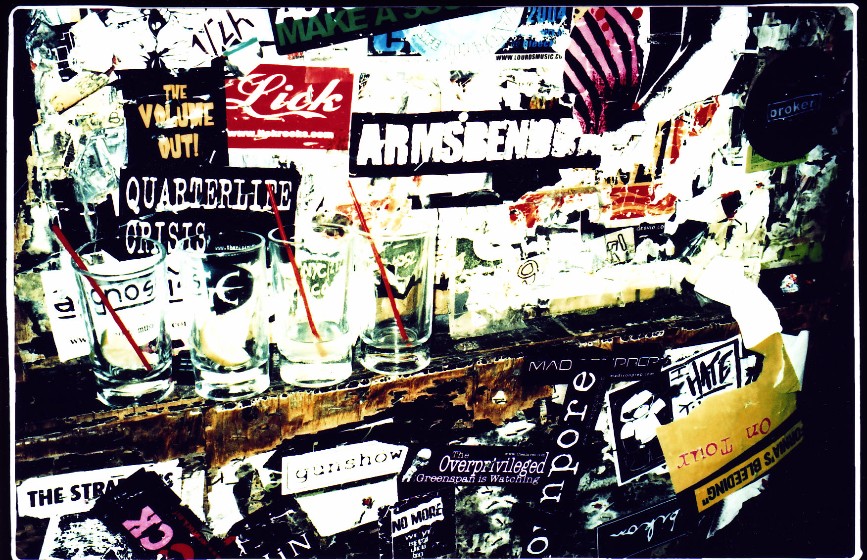
I found a tall stool alongside the wall and got to absentmindedly picking at the band stickers plastered all over the place. The narrow ledge was cluttered with empty cocktail glasses, their little red straws dry and lonely. Willie the bartender looked seriously stressed out, his ruddy Irish face even redder and splotchier with this bad weather and the motion of keeping up with the throngs banging on his counter for their drinks.
Wednesday nights I meet up with Georgie and we drink soda waters Willie throws down for free, fizzing them up as we empty them, plunking a fat wedge of lime into the bubbles. Typically he settles down at the far end of the bar, giving me and Georgie our privacy, and gets to work writing a play based on his dramatic Irish alcoholic family. Wednesday nights are a funny at the UqBar: me and Georgie with our non-drink drinks, a scattering of olde tyme boozers, hard-drinking senior citizens whose cauliflower noses burst with gin blossom bouquets. They resent the bar’s switch from a dank townie sports bar to a hangout for bike messengers and artists with bands on the weekends. They hate change generally and change that affects their drinking in particular, but instead of scuffling over to Dapper’s or Patâ’s for their watery whiskeys they keep an allegiance to a long-past time, their tired asses hugging the busted barstools, getting tanked, glaring at everyone and starting sad little fights on occasion. So there’s us, there’s them, and somewhere in the middle is William, tossing back a shot of something every so-many-pages, never complaining about the utter lack of tips because Wednesday nights leave him alone. No customers to yank him out of the flow of his story, no visits from his dad, both the owner of the establishment and the star of Willie’s play.
I felt bad bothering Willie tonight. He was so hectic, and he hates to work. His orange hair was tugged into a messy ponytail, I was jealous of the teensy breeze it must have created as it swung against his neck. I wanted a water but I didn’t want to hassle him and I didn’t want to get up and lose my seat to a looser. I sniffed at the glasses in the lineup before me. Sniff sniff, the supposed smell-less smell of vodka cut with a juice. Sniff sniff, the sickly sweet stink of gin. The glasses with a bit of syrupy brown pooled at the bottom I ignored, they were obviously whiskey dregs, or rum and cokes. This is my favorite bad game to play with myself. Sniff out an abandoned drink, do my best–my very best–to discern its contents and, sure it’s just a harmless shot of water, toss it back. A sort of Russian roulette, if you will. But I haven’t been wrong yet. As it is an obviously twisted game for a recovering drunk like myself to play, nobody in my life lets me indulge. Like a teenage girl hiding out in her bathroom with a razor, I do my secret sniffing on the rare occasions I’m alone at a bar. Georgie, wise to the fucked-up customs of my head, even goes so far as to arrive at UqBar fifteen minutes before my arrival, so I’m under her watchful stare the whole night. But I wouldn’t do it around anyone, anyway. It’s a private ritual, like nose-picking but really, really bad for you. Bad for me.
Anyway, Willie must have spotted me with my snout in a glass cause he came swaggering over, pushing through the loaf of people globbed throughout the bar, and sloshed me a nice, clean glass of water. Water bubbling pure, honest bubbles. Water hugging a green jewel of lime. Thanks, Willie I said. He clanked the empty glasses together in his huge paws, knocking the straws to the ground. Fuckin’ Crazy In Here, he bitched. Can’t Keep Up With These People. Where The Fuck They Come From? We looked around at the townies, dudes you’d more likely see throwing darts over at Dapper’s, ladies with badly bleached mops of hair and tiny terry cloth outfits; weekend regulars drinking mid-week beers–quiet indie kids sweating in their black jeans, hairspray melting on their black hairdos. And the old guys, the geezers. It’s too hot for them in here, I motioned to death row, the curve of the bar closest to the door, where they clustered like moody crows. One of them’s gonna kick it someday, I told him. Then what’ll you do? I Got Practice With That Sort Of Thing, Willie shook his ponytail. They’ll Be In Good Hands. Willie clapped me on the shoulder and I flinched. Shit, he drew back his fingers gummy with my tattoo medicine. What’s This? He tried to back up for a look and rear-ended a frat-looking kid in a tight white baseball hat. Whiteheads, me and Monica called them. Monica being my incredibly recent ex-girlfriend but you, being my diary, already know that. The whitehead started honking, like Willie was trying to freak him on the dance floor and make him a fag or something. When Willie pulled himself to his full height, hands filled with glass, the Whitehead realized he was the bartender and got friendly again. Sorry, Bro! Can You Pour Me A Guinness?
Yeah, Willie gave a sharp nod, all the niceness sucked dry from his face. He turned back to me. We’ll Talk About That Later, Right? Holler When Georgie Shows Up, I’ll Bring Ya’s More Water. I watched him squeeze between a thick wall of flesh and disappear.
And then there was Monica. I think she’d been in the corner behind death row since I got there, but a guy who’d been hunched over the bar straightened up, and in the gap between his undershirt and the drooled-upon bar below, I saw her there and in that instant she saw me. I felt a rush of hot and cold badness, I think it was anxiety, anxiety and anger, like what the fuck was she doing in my bar, she knows me and Georgie hang out here every Wednesday, were we going to have to do that stupid fucking thing where you negotiate where and when we can and can’t go to the various bars and coffeehouses that make up our lives? I’d thought we could do better then that, thought that common sense and basic kindness would keep her out of my few regular haunts and there she was, her intensely curly hair pulled into a knot on the top of her head, sweat shining the makeup from her face. And I felt a plain swell of sadness and simple fear. The first few days of a breakup are crucial alone days. The risk of getting back together out of basic fear, neediness and habit are strong and it was my plan to avoid Monica until I was stronger then all my most pathetic inclinations.
That’ Water, I Hope? She was there before me, being little and wily and able to slink and shove her way through a crowd with relative grace. And I said, Yeah, Of Course and was annoyed that she’d think I’d be so dramatic as to get drunk over her when I was the one that ended the whole thing. I didn’t need her mothering me or framing me as some fragile alcoholic. I wondered if she’d seen me sniffing the glasses earlier. Her fingernails were painted with elaborate leopard landscapes, pink and red leopard. The tiny rhinestone on her longest pinky-nail flashed and I remembered the balls of soggy cotton she’d leave around my apartment, stinking like poison and nail polish melted into the fiber, and I felt a wash of regret. I’ll never see those cotton balls again. Unless I find one, weeks from now, under the sink in the bathroom, behind the toilet, and am made unbearably sad by it. But this is what I wanted, right? Something to feel, some sort of life, even the life of a miserable and heartsick fuckup.
Why are you here? I asked her. I know I was pouting or talking in a fight-starting voice but I couldn’t help it. It was so loud at UqBar. Willie was blaring some awful CD, real slit-your-wrist tunes, depressing Radiohead or something. The mournful keens filled the bar and still the drunk girls on the stage danced,a s if to some Britney Spears track on endless repeat in their heads. Why was Willie playing such bleak music? It was like we were all in some indie film about grim alcoholic drama and this was the soundtrack.
I Came With Tracy, Monica said, and I looked but the old drunk had resumed his face-first plunge into the bar, blocking my view. Why Are You Here? Well, I’m not drinking, I snapped defensively. I’m waiting for Georgie, like always.
Georgieâ’s Gone, she told me. Georgie’s Doing a Sleep Study, She’ll be Gone All Week. How do you know? I asked. I was sounding more and more like a child, but it was a downhill movement that I couldn’t quite stop. I don’t want to talk to you when you’re drunk, I told Monica, even though I did rather like her when she was drunk. She got extra silly and tended to take her clothes off in public. Well, Talk To Me Now, Then, she said, tinkling her glass. Before I Get Drunk. By the toxic green of her glass and the sweet and sour odor emanating from the rim I guessed it was a Midori melonball. A Midori melonball, I scoffed. This was stupid, this was terrible. This was why we’d broken up–a whole lot of numbness punctuated by useless bickering. Tracy’s Drinking Irish Car Bombs, she snarked, If That’s More Real For You.
Listen, I said, how did you find out Georgie’s gone, and who’s watching the bees? Georgie made part of her money renting out her body to various medical studies, and she made the other part by embarking upon short-lived entrepreneurial experiments. Currently she is keeping a hive of bees in the backyard, in hopes of starting a honey dynasty. I’m Watching Them, Monica said. Why you? I felt totally betrayed. Georgie takes off to some sleep torture and recruits Monica to baby the bees? So that means you’re going to be at the apartment all the time?
Not Yours, she said. We Won’t Have To See Each Other.
You’ll be in the yard, I accused. I’ll totally see you.
Pull The Blinds, she shrugged. Don’t Look Out The Window.
I’ll know you’re there, I said. Don’t act like it’s not a big deal.
Georgie Asked Me. Now she was whining.
I can do it, I said. It’s my fucking yard. Why don’t I just do it.
Because You Hate It, Monica said. You Hate The Bees. You’re Scared Of The Bees.
It is true that the bees stung me repeatedly last time I tried to care for them, when Georgie had gone in for a speed study, totally ruining her so-called sobriety by having medical technicians administer government-issue crystal meth straight into her veins. It is true that I almost killed the bees, much as Georgie almost killed herself, submitting to such a jackass experiment. There Was A Fifty Percent Chance That I’d Just Get The Placebo, she’d rationed. Georgie’s Russian roulette. A whole lot dumber then mine, if you asked me. But Monica, it’s true, Monica loved the bees. She was fucking Snow White with them, they buzzed around her like she was their one true queen, they let her pet the fuzz of their backs with her littlest finger.
I Don’t Know Why Georgie Didn’t Tell You, Monica went on. When Did You Last Talk To Her? And I thought and I thought and I realized that I hadn’t talked to Georgie all week. Even our usual Wednesday the week before had been cut short. Hmph, I snorted.
What’s This? Monica said, her voice a rush of alarm and surprise. I Got A Tattoo, I said proudly. Life goes on, right? Here I am, freshly tattooed, part of the flow of life itself, giving myself a little hurt, just a human, hurting. I smiled.
I Thought You’re Broke, Monica accused. She squinted at it. “Joy and Monstrosity.” She paused. That’s From That Song. You Got A Tattoo Of The Song We Broke Up To. And You Have No Money.
I quit therapy, I explained. It was my therapy money. The tattooist gave me a deal. Timotha? You know her?
Monica was staring. She took a hard suck on her straw and swallowed. Her leopard nails tapped the glasses in swift little taps. You Think That’s Smart? Quitting Therapy? Quitting Therapy? Breaking Up Like This? She swallowed hard again even though her mouth was opened. She swallowed like she was going trying to swallow her very throat turn it inside-out like a crazy magician’s trick. Are You Sabotaging Your Life, Annabella?
I don’t know, I said. I really might be. We stared at each other and I saw a moat of tears flooding up behind her eye makeup and I grabbed her wrist. She clutched her drink harder and shook me off.
Jesus, I don’t want your fucking drink! I yelled. Probably I did want her drink, but that’s not why I grabbed her wrist. I grabbed her wrist to say, you don’t want to cry here, you don’t want to cry in front of me, go back to Tracy. I didn’t grab it because I’m some sort of booze fiend with no self-control. I got a sickening flash of Monica talking to someone–her next girlfriend, maybe a boyfriend, maybe just someone we both knew together, saying, “Oh yeah Annabella is such an alcoholic, it’s really intense, it was so hard to be with her . . . you didn’t know? No, she has no control, it was really, really difficult.” And the new girlfriend or maybe boyfriend would hug her tight and smooth her wild curls and they would all feel safe in their lack of alcoholism, or our mutual friend would cluck and say that’s awful and the pity would slosh back and forth between them.
You Are Such An Asshole, Monica said.
This makes it easier, I said. Just hate me, then. Sure. Then there can be a bad guy, I’ll be the bad guy. And my alcoholism can be the reason and now you’ve got a whole little story to tell everyone about why we broke up. To tell yourself. Good-bye. I slurped my water. The carbonation felt violent, seared my throat, made me choke a little. Made my eyes tear up. I waved my hand. Really, I said. Go back to Tracy. You left her in the corner forever ago. This is stupid. I’m outta here. I felt dumb for having used the phrase “outta hereâ” but really I was shaking.
You Got A Tattoo Of The Last Song We Had Sex To, Monica said.
I know, it looks really bad, I said.
You Mean It Seems Crazy? she asked.
I nodded. Yeah.
Because It Looks Really Beautiful. But It Seems Really Fucked Up.
I left the bar. I slammed and shoved my way past Monica and into the mix of people. The bad sad music howled and the drunks chattered and I chucked the swinging door out into Boston and the hot hot air hit me in the face. I had nowhere to go, so I went home.
Should have run upstairs to thump on Georgie’s door, I would have seen the note pinned to the wood alerting the world that she’d been selected for the sleep-study and was in seclusion at a medical compound somewhere in the city. Instead I walked the grassy parkway in the warm night, my tattoo radiating heat like a sunburn. The breeze felt like the dry air that rushes out from a baking oven when you lower the door, it didn’t help at all. Only marginally better than the cramped apartment and my pathetic fan whirring its futile breath around the room. I walked the parkway and it was lively with others escaping their sweltering homes, lots of dogs in the grass and beer on the benches. I turned down the cobblestones to UqBar and shoved the swinging doors open.
The stink of old kegs and a century of spilt liquor smacked me in the nose. I understood that to adjust to the cigarette haze hanging like a cloud cover I would be forced to smoke one myself. At least a cigarette would have a filter, you know? UqBar was packed. Not what I expected, but I guess the heat was making everyone nuts, making everyone crave a beer and respite from the terrible warm of their apartments. And if there’d only been the usual four or five people slumped on the bar, UqBar would have been pretty cool, a darkened cave, the walls black, a trough of ice behind the bar. But all the yahoos and their body heat and sweaty t-shirts had ruined it. They were crazy with the relentless summer and were drunk already and dancing, going mad, their bodies’ humidity rising into a human smog that made the air swampy. I was hoping Georgie showed up soon so we could split, maybe plant our asses on the smooth green grass of the parkway and play with other people’s dogs or something.
I found a tall stool alongside the wall and got to absentmindedly picking at the band stickers plastered all over the place. The narrow ledge was cluttered with empty cocktail glasses, their little red straws dry and lonely. Willie the bartender looked seriously stressed out, his ruddy Irish face even redder and splotchier with this bad weather and the motion of keeping up with the throngs banging on his counter for their drinks.
Wednesday nights I meet up with Georgie and we drink soda waters Willie throws down for free, fizzing them up as we empty them, plunking a fat wedge of lime into the bubbles. Typically he settles down at the far end of the bar, giving me and Georgie our privacy, and gets to work writing a play based on his dramatic Irish alcoholic family. Wednesday nights are a funny at the UqBar: me and Georgie with our non-drink drinks, a scattering of olde tyme boozers, hard-drinking senior citizens whose cauliflower noses burst with gin blossom bouquets. They resent the bar’s switch from a dank townie sports bar to a hangout for bike messengers and artists with bands on the weekends. They hate change generally and change that affects their drinking in particular, but instead of scuffling over to Dapper’s or Patâ’s for their watery whiskeys they keep an allegiance to a long-past time, their tired asses hugging the busted barstools, getting tanked, glaring at everyone and starting sad little fights on occasion. So there’s us, there’s them, and somewhere in the middle is William, tossing back a shot of something every so-many-pages, never complaining about the utter lack of tips because Wednesday nights leave him alone. No customers to yank him out of the flow of his story, no visits from his dad, both the owner of the establishment and the star of Willie’s play.
I felt bad bothering Willie tonight. He was so hectic, and he hates to work. His orange hair was tugged into a messy ponytail, I was jealous of the teensy breeze it must have created as it swung against his neck. I wanted a water but I didn’t want to hassle him and I didn’t want to get up and lose my seat to a looser. I sniffed at the glasses in the lineup before me. Sniff sniff, the supposed smell-less smell of vodka cut with a juice. Sniff sniff, the sickly sweet stink of gin. The glasses with a bit of syrupy brown pooled at the bottom I ignored, they were obviously whiskey dregs, or rum and cokes. This is my favorite bad game to play with myself. Sniff out an abandoned drink, do my best–my very best–to discern its contents and, sure it’s just a harmless shot of water, toss it back. A sort of Russian roulette, if you will. But I haven’t been wrong yet. As it is an obviously twisted game for a recovering drunk like myself to play, nobody in my life lets me indulge. Like a teenage girl hiding out in her bathroom with a razor, I do my secret sniffing on the rare occasions I’m alone at a bar. Georgie, wise to the fucked-up customs of my head, even goes so far as to arrive at UqBar fifteen minutes before my arrival, so I’m under her watchful stare the whole night. But I wouldn’t do it around anyone, anyway. It’s a private ritual, like nose-picking but really, really bad for you. Bad for me.
Anyway, Willie must have spotted me with my snout in a glass cause he came swaggering over, pushing through the loaf of people globbed throughout the bar, and sloshed me a nice, clean glass of water. Water bubbling pure, honest bubbles. Water hugging a green jewel of lime. Thanks, Willie I said. He clanked the empty glasses together in his huge paws, knocking the straws to the ground. Fuckin’ Crazy In Here, he bitched. Can’t Keep Up With These People. Where The Fuck They Come From? We looked around at the townies, dudes you’d more likely see throwing darts over at Dapper’s, ladies with badly bleached mops of hair and tiny terry cloth outfits; weekend regulars drinking mid-week beers–quiet indie kids sweating in their black jeans, hairspray melting on their black hairdos. And the old guys, the geezers. It’s too hot for them in here, I motioned to death row, the curve of the bar closest to the door, where they clustered like moody crows. One of them’s gonna kick it someday, I told him. Then what’ll you do? I Got Practice With That Sort Of Thing, Willie shook his ponytail. They’ll Be In Good Hands. Willie clapped me on the shoulder and I flinched. Shit, he drew back his fingers gummy with my tattoo medicine. What’s This? He tried to back up for a look and rear-ended a frat-looking kid in a tight white baseball hat. Whiteheads, me and Monica called them. Monica being my incredibly recent ex-girlfriend but you, being my diary, already know that. The whitehead started honking, like Willie was trying to freak him on the dance floor and make him a fag or something. When Willie pulled himself to his full height, hands filled with glass, the Whitehead realized he was the bartender and got friendly again. Sorry, Bro! Can You Pour Me A Guinness?
Yeah, Willie gave a sharp nod, all the niceness sucked dry from his face. He turned back to me. We’ll Talk About That Later, Right? Holler When Georgie Shows Up, I’ll Bring Ya’s More Water. I watched him squeeze between a thick wall of flesh and disappear.
And then there was Monica. I think she’d been in the corner behind death row since I got there, but a guy who’d been hunched over the bar straightened up, and in the gap between his undershirt and the drooled-upon bar below, I saw her there and in that instant she saw me. I felt a rush of hot and cold badness, I think it was anxiety, anxiety and anger, like what the fuck was she doing in my bar, she knows me and Georgie hang out here every Wednesday, were we going to have to do that stupid fucking thing where you negotiate where and when we can and can’t go to the various bars and coffeehouses that make up our lives? I’d thought we could do better then that, thought that common sense and basic kindness would keep her out of my few regular haunts and there she was, her intensely curly hair pulled into a knot on the top of her head, sweat shining the makeup from her face. And I felt a plain swell of sadness and simple fear. The first few days of a breakup are crucial alone days. The risk of getting back together out of basic fear, neediness and habit are strong and it was my plan to avoid Monica until I was stronger then all my most pathetic inclinations.
That’ Water, I Hope? She was there before me, being little and wily and able to slink and shove her way through a crowd with relative grace. And I said, Yeah, Of Course and was annoyed that she’d think I’d be so dramatic as to get drunk over her when I was the one that ended the whole thing. I didn’t need her mothering me or framing me as some fragile alcoholic. I wondered if she’d seen me sniffing the glasses earlier. Her fingernails were painted with elaborate leopard landscapes, pink and red leopard. The tiny rhinestone on her longest pinky-nail flashed and I remembered the balls of soggy cotton she’d leave around my apartment, stinking like poison and nail polish melted into the fiber, and I felt a wash of regret. I’ll never see those cotton balls again. Unless I find one, weeks from now, under the sink in the bathroom, behind the toilet, and am made unbearably sad by it. But this is what I wanted, right? Something to feel, some sort of life, even the life of a miserable and heartsick fuckup.
Why are you here? I asked her. I know I was pouting or talking in a fight-starting voice but I couldn’t help it. It was so loud at UqBar. Willie was blaring some awful CD, real slit-your-wrist tunes, depressing Radiohead or something. The mournful keens filled the bar and still the drunk girls on the stage danced,a s if to some Britney Spears track on endless repeat in their heads. Why was Willie playing such bleak music? It was like we were all in some indie film about grim alcoholic drama and this was the soundtrack.
I Came With Tracy, Monica said, and I looked but the old drunk had resumed his face-first plunge into the bar, blocking my view. Why Are You Here? Well, I’m not drinking, I snapped defensively. I’m waiting for Georgie, like always.
Georgieâ’s Gone, she told me. Georgie’s Doing a Sleep Study, She’ll be Gone All Week. How do you know? I asked. I was sounding more and more like a child, but it was a downhill movement that I couldn’t quite stop. I don’t want to talk to you when you’re drunk, I told Monica, even though I did rather like her when she was drunk. She got extra silly and tended to take her clothes off in public. Well, Talk To Me Now, Then, she said, tinkling her glass. Before I Get Drunk. By the toxic green of her glass and the sweet and sour odor emanating from the rim I guessed it was a Midori melonball. A Midori melonball, I scoffed. This was stupid, this was terrible. This was why we’d broken up–a whole lot of numbness punctuated by useless bickering. Tracy’s Drinking Irish Car Bombs, she snarked, If That’s More Real For You.
Listen, I said, how did you find out Georgie’s gone, and who’s watching the bees? Georgie made part of her money renting out her body to various medical studies, and she made the other part by embarking upon short-lived entrepreneurial experiments. Currently she is keeping a hive of bees in the backyard, in hopes of starting a honey dynasty. I’m Watching Them, Monica said. Why you? I felt totally betrayed. Georgie takes off to some sleep torture and recruits Monica to baby the bees? So that means you’re going to be at the apartment all the time?
Not Yours, she said. We Won’t Have To See Each Other.
You’ll be in the yard, I accused. I’ll totally see you.
Pull The Blinds, she shrugged. Don’t Look Out The Window.
I’ll know you’re there, I said. Don’t act like it’s not a big deal.
Georgie Asked Me. Now she was whining.
I can do it, I said. It’s my fucking yard. Why don’t I just do it.
Because You Hate It, Monica said. You Hate The Bees. You’re Scared Of The Bees.
It is true that the bees stung me repeatedly last time I tried to care for them, when Georgie had gone in for a speed study, totally ruining her so-called sobriety by having medical technicians administer government-issue crystal meth straight into her veins. It is true that I almost killed the bees, much as Georgie almost killed herself, submitting to such a jackass experiment. There Was A Fifty Percent Chance That I’d Just Get The Placebo, she’d rationed. Georgie’s Russian roulette. A whole lot dumber then mine, if you asked me. But Monica, it’s true, Monica loved the bees. She was fucking Snow White with them, they buzzed around her like she was their one true queen, they let her pet the fuzz of their backs with her littlest finger.
I Don’t Know Why Georgie Didn’t Tell You, Monica went on. When Did You Last Talk To Her? And I thought and I thought and I realized that I hadn’t talked to Georgie all week. Even our usual Wednesday the week before had been cut short. Hmph, I snorted.
What’s This? Monica said, her voice a rush of alarm and surprise. I Got A Tattoo, I said proudly. Life goes on, right? Here I am, freshly tattooed, part of the flow of life itself, giving myself a little hurt, just a human, hurting. I smiled.
I Thought You’re Broke, Monica accused. She squinted at it. “Joy and Monstrosity.” She paused. That’s From That Song. You Got A Tattoo Of The Song We Broke Up To. And You Have No Money.
I quit therapy, I explained. It was my therapy money. The tattooist gave me a deal. Timotha? You know her?
Monica was staring. She took a hard suck on her straw and swallowed. Her leopard nails tapped the glasses in swift little taps. You Think That’s Smart? Quitting Therapy? Quitting Therapy? Breaking Up Like This? She swallowed hard again even though her mouth was opened. She swallowed like she was going trying to swallow her very throat turn it inside-out like a crazy magician’s trick. Are You Sabotaging Your Life, Annabella?
I don’t know, I said. I really might be. We stared at each other and I saw a moat of tears flooding up behind her eye makeup and I grabbed her wrist. She clutched her drink harder and shook me off.
Jesus, I don’t want your fucking drink! I yelled. Probably I did want her drink, but that’s not why I grabbed her wrist. I grabbed her wrist to say, you don’t want to cry here, you don’t want to cry in front of me, go back to Tracy. I didn’t grab it because I’m some sort of booze fiend with no self-control. I got a sickening flash of Monica talking to someone–her next girlfriend, maybe a boyfriend, maybe just someone we both knew together, saying, “Oh yeah Annabella is such an alcoholic, it’s really intense, it was so hard to be with her . . . you didn’t know? No, she has no control, it was really, really difficult.” And the new girlfriend or maybe boyfriend would hug her tight and smooth her wild curls and they would all feel safe in their lack of alcoholism, or our mutual friend would cluck and say that’s awful and the pity would slosh back and forth between them.
You Are Such An Asshole, Monica said.
This makes it easier, I said. Just hate me, then. Sure. Then there can be a bad guy, I’ll be the bad guy. And my alcoholism can be the reason and now you’ve got a whole little story to tell everyone about why we broke up. To tell yourself. Good-bye. I slurped my water. The carbonation felt violent, seared my throat, made me choke a little. Made my eyes tear up. I waved my hand. Really, I said. Go back to Tracy. You left her in the corner forever ago. This is stupid. I’m outta here. I felt dumb for having used the phrase “outta hereâ” but really I was shaking.
You Got A Tattoo Of The Last Song We Had Sex To, Monica said.
I know, it looks really bad, I said.
You Mean It Seems Crazy? she asked.
I nodded. Yeah.
Because It Looks Really Beautiful. But It Seems Really Fucked Up.
I left the bar. I slammed and shoved my way past Monica and into the mix of people. The bad sad music howled and the drunks chattered and I chucked the swinging door out into Boston and the hot hot air hit me in the face. I had nowhere to go, so I went home.
Michelle Tea is the author of Valencia, The Chelsea Whistle, Rent Girl, Against Memoir, and many other books. She is the cofounder of the notorious all-girl poetry roadshow Sister Split, and continues to drag herself and other brave performers across the US on grueling performance-art boot camps. Born and raised in Chelsea, Massachusetts, she presently lives in San Francisco with her transboyfriend and their weird cat. Click here to read more of her work and find out about upcoming readings.
Subscribe to get new flash fictions in twice a month in your inbox.
Submit your flash fiction or personal essays to Fiction Attic.