Your cart is currently empty!
Blog
-
graham greene on the importance of superficiality
“So much in writing depends on the superficiality of one’s days. One may be preoccupied with shopping and income tax returns and chance conversations, but the stream of the unconscious continues to flow undisturbed, solving problems, planning ahead: one sits down sterile and dispirited at the desk, and suddenly the words come as though from the air: the situations that seemed blocked in a hopeless impasse move forward: the work has been done while one slept or shopped or talked with friends.”
~Graham Greene, The End of the Affair -
selection: the memoirist’s dilemma
“…a detective must find it as important as a novelist to amass his trivial material before picking out the right clue. But how difficult that picking out is–the release of the real subject…Now that I come to write my own story the problem is still the same, but worse–there are so many more facts, now that I have not to invent them.” ~Graham Greene, The End of the Affair
-
Feet
by Todd Chapman
I’ll settle for the color of skin. Skin is the color of his skin, which is my skin, and one day while running my skin gets cold, cells pass away, and I almost lose my feet. It’s winter in Chittenango and he wears a beard. This is before the divorce. I love my one-year-old sister Evelyn who is three years younger than I am. She’s at daycare, my mother is at work, and my father watches the house. James Leon, my father, is supposed to be watching the house but we’re stretching our legs on the porch. I wear shorts, a sweatshirt, and a knit cap, and my socks are pulled up to my knees. My sneakers are laced tighter than ice-skates and I don’t really want to do this. The snow will cover our tractor soon. Wind batters our plastic porch windows.“Are you ready?†he says. “You’re ready.â€
James Leon is a runner. He has run the Boston Marathon three times and the New York City twice. He has given up competitive running, he says, to help my mother raise the family. But he’s made a quiet agreement with himself. He’ll run twelve miles every day and he’ll bring me along for part of it. His body, as he likes to say, is a well-conditioned rock.
With a grunt he pushes the porch door open, and one of the aluminum panels blows in with a windy pop. I follow him outside. My sweatshirt is a sieve, and since I haven’t an ounce of fat on my frame, the wind scoops heat from my belly and my back. I take a couple of jumps.
“Here, put these on your hands,†he says, and he rolls thick grey socks over the knuckles of my fingers. He wants to keep them warm. The wool is itchy and cold, so I make fists as he pulls the hem of each sock up to the elbow, He snaps rubber bands around my arms to hold the socks in place.
“Is that good?†he says. “It’s good.â€
James Leon claps his hands. I jump, because I’m a good soldier. He wants to warm up for the run. He bounces too, and the cold gravel driveway crunches under our feet. We curve off the end of the driveway, out to the open road, and he directs me to a lane of dirt that covers the narrow shoulder. We run slowly, as we always do, and he and I keep pace. My cheeks feel raw and scraped already. Ice crystals glint from the pavement.
We run past barns and wide fields and past the old missile silo near the Gaveston Yard. For those of us who have inherited our politics rather than arrived at them, who mentally lay dynamite at the California borders to float us out to sea, who have forgotten Clinton’s Rwanda, who never bother with Bayview or Hunter’s Point let alone strike out for New England, or for a southern state, who grow up here, settle here, because we know we hit the jackpot, who watch others come and go as we calmly assume a shape, who fear and detest the Ivy League but can’t name the schools that compose it, New England is studded with missile silos. They are hidden in random fields. They are hidden all over the country, and one day a few years after the divorce my third grade math teacher will assign a project based on proportions. We’ll live in another house, in another town, and I’ll choose my bedroom for a model. I’ll lay astro-turf in a cardboard box, and then add a dresser and a bed. I’ll paint a mirror on the wall and then I’ll draft some falsified plans. I’m not impressed with this work, and it’s worse when I show up for class, because my friend Favvy will be standing next to her beautiful rendition of a missile silo. It will be three feet tall, with windows and wheels, and entirely in proportion. Her picture will appear in the Adirondack Daily, and we’ll both receive grades of one hundred.
James Leon checks in with me now and then, but as the strong wind pushes us along the road, I rarely give honest answers. He has drawn my shoelaces far too tight. My feet are cold and pinched. He looks fine, and as he trots like a Clydesdale with bumpers on his feet, steam shoots out of his mouth. He breaks into a slick sweat, and he rolls his hat up over his ears.
My face feels bitten by wind as I run, and by sand thrown up from the road. I’m losing feeling in my feet. It hasn’t been this cold on our previous runs, and we won’t run together again. In a few weeks my mother, carrying Evelyn in her arms, will move us out of our house.
“You’re warm enough?†he says. “You can make it to the pole?â€
The utility pole is my turn-around point. It is .51 miles from our house. My father, who is always taking the measure of things, has driven the distance out in his truck, and pegged it with the odometer. I sat in the passenger’s seat as he drove, watching the moon follow us through the window.
“You can you make it to the pole,†he decides.
I wonder if I can. My feet no longer belong to me, and I sort of flap them with my shins. Flap, flap. I watch them hit the road. Flap…and onward with the pattern until, to my surprise, the rusty rims of the transformer pot hang above our heads. Electrical jumpers quiver and hum as my father runs in place.
“Okay,†he says. “Go around it.â€
I swing around the pole with my sock-fist, twice, because this is our tradition. I tug the sock free when it snags.
“You remember what to do?†he says. “Run on the side of the road. Look for our yellow house.â€
He claps his hands together, and I flap off down the road.
“Now, home!†he calls out after me.
James Leon has found himself caught between two conflicting agreements; the agreement he has made with himself – to train – and an agreement he has made with my Mother.
I flap with high knees and a straight back because there’s a chance he might be watching. There’s a chance he isn’t watching, too, so I turn around to see. He’s running. His legs are fluid and they appear relaxed. He’s hit his natural stride. He removes his hat and holds it with his hand and oh my Lord I’m proud. His feet snap comfortably back to the road after each smooth reach of his legs. He disappears at a point along the horizon, and I linger for a while, until it’s clear there’s nobody there. With the toe of his sock I cover my neck. I bend my head against the wind.
I daydream.
I look at my feet.
The road just looks the same.
I begin to walk to the house, but the wind skates through my body and threatens to blow me off the road. In truth I feel unbalanced. My feet are numb, and if I tilt into one of these uncut fields I’m certain that I’ll be lost. Then, as if thinking about being lost has made me – not lost, but clumsy – I trip and skin my knee.
I roll onto my butt and I take off my hat.
With blood on my knee, I daydream.
There is a considerable body of evidence that points to the emotional and social benefits that accrue to resilient children. What are the characteristics of a resilient child, and how can we identify vulnerable children? Barbara T. Bowman will present a practical and engaging session in which she will consider strategies adults can use to promote resiliency in children. You will leave empowered with new ideas for enhancing coping and negotiation skills that will serve children throughout their lives.
This woman’s leg is attractive.
She pulls her car to the side of the road, opens a blue door, and slips her beautiful leg out. The leg is several cuts above my family’s class and sophistication. When the woman gets out, she looks at me. She looks at the socks that are bound to my hands and I feel a little embarrassed. She looks at my bloody knee.
“Where are you’re parents?†she says.
I don’t want trouble, for me or for my father. I point toward our yellow house.
“You better come with me,†she says.
She helps me up off the side of the road and brings me to her car. She wraps a blanket around me. The car is plush and warm, like the woman’s soft blue coat, and it smells like a pile of rum cookies. I shiver as she drives. When we reach the yellow house, she pulls into the driveway, and she puts the car in park. She sits for a moment, letting her wide brown eyes rest on me. She smiles. There is concern in this smile, and apprehension, and a brisk intelligence in her eyes, and even, it seems to me, a sexual consideration. She understands something of my past, and of my future.
“You might be okay,†she says.
She is who I want to be.
Her smile fades as she touches my hand, and then she opens the door. She leaves me in the car with her blanket, and her face assumes a curious expression as she walks up to our house. She knocks on the door, waits a moment, and then she tries the handle. The door of course swings open. She gathers me up like a puppy in a blanket and carries me into the living room. She sets me down on the couch.
“I can’t believe these socks,†she says.
She removes the rubber bands from my elbows and unrolls the socks from my hands. In our bathroom, the woman finds a sponge that my mother uses to remove make-up from her face. The woman cleans my cuts.
“Your lips are blue,†she says.
If I weren’t so cold, I’d blush.
“Which direction did he run in?†she says. “Try to remember for me.â€
I point in a direction.
“Okay,†she says, and she takes a deep breath. Leaving me in alone in my house seems hard for her to do.
“I’m going to leave, but I’ll be back soon,†she says. “Are you thirsty?â€
“No.â€
“Keep this blanket tight around you. Stay there on the couch.â€
She touches my face and Lord her hand is warm. I don’t want her to take it away. She leaves me wrapped in her blanket, though, and after she closes the door I think about locking it. I wish there were a way to warn my father that this woman is out there on the road, looking for him. I sense there might be trouble.
I want to get these sneakers off, but the laces are stiffly knotted. My fingers make ticking sounds as they slip against the knots.
It’s all a game of waiting. You wait for school to start, and you wait for school to end. You wait for summer. You wait for lunch, and when a sandwich is served you don’t really want to eat it. You wait for leaves to fall from the trees, and you rake them into piles. You cover yourself with them.
I should give up on the woman.
Instead, I’ll wait for James Leon to come in from his run. I’ll wait with Deacon, our boa constrictor.
Deacon and I are the same age and we both eat once a month. That’s my mother’s joke. Our family is a robust and healthy family, as you can see, but I happen to be an exception. I’m a picky eater. I want to eat; that is, I want to want to eat. But I have no appetite for it. Now and then my appetite comes and I eat and eat and eat.
I ate eleven pancakes for breakfast once and my mother beamed. She beamed so brightly that I made a big display of it, counting out the pancakes as I swallowed them down, and eating while my appetite was good.
Deacon? I’m freezing.
Let’s look at each other’s tongues.
James Leon has arrived, and he doesn’t look cold. In fact, he seems to be sweating.The woman doesn’t come inside. She drops him off and leaves. She leaves me with her blanket, though, and with my father, James Leon: a twice-decorated US Marine who can’t untie my shoes. He cuts the laces with a knife.
One at a time he removes each sneaker, and he then removes each sock. As we look at my feet it occurs to me: the Marines haven’t taught him shit. If I was under fire in the living room and there was a bunker in the kitchen he would be very quick to drag me there. His belt would be ready if my foot were a spurting stump. But it isn’t. It’s just cold. Both my feet are cold, and my father James Leon looks worried. I look at him, and he looks at my feet. My feet aren’t looking good. Parts of my left foot – including the ball and two toes – are white and luminescent. The cells of my feet, like stars, are releasing energy as they die. My father and I wonder what he’s going to do, and if he’s smart, he’s making agreements with himself.
James Leon is smart – but he’s smart in peculiar ways.
I wonder if I’m being fair. If I, right now, were to chart a graph of my own life with the y-axis being my level of emotional maturity and the x-axis being time, the result would more closely resemble my high-risk stock, with all of its spikes and slides, than the comfortable hypotenuse of my more stable holdings.
This is true of James Leon, too, and right now he’s in a slide. It isn’t the worst of slides. The worst will come in sixteen weeks, when he will slide lower than most people ever slide. Most people never spend an evening raping their wife, after she’s left him, and then leave her – as he will – with a badly broken jaw. Most people don’t do that. For this reason it will be difficult, years later, for him to find a way to talk about it. It will take courage. One day when I’m fourteen – and all grown up – James Leon and I will sit alone in a car with theater stubs in our hands. He’s nervously enjoying visiting rights, trying to find courage in me.
I’ve done stupid things, he says. I’ll regret them all my life.
It’s okay, I say.
Your mother’s a very strong woman.
This is true. My mother is an interesting woman. My father, who turns a ticket stub in his hand, is making a beginning. He’s laying groundwork for our future, for years when we’re both older, when I’m no longer fourteen, and he’s not thirty-nine. People need someone to call on the phone, when things get tough, or to take care of them, when they get older. He wants me to understand this. James Leon has made an agreement with himself to try to make things right.
Listen, I say. It’s over. For the most part, we’re okay.
This isn’t true. My sister Evelyn, for example, is far from okay. My sister Evelyn, for example, is twenty-six years old and she’s afraid to have sex. She wants to have sex, that is, she wants to want to have sex, but she has no appetite for it. She’s told me this over the phone. She has no appetite for kissing either, or for dating men, or women, which is a strange wrinkle in this narrative, a little tic in logic. I was present for my mother’s rape, and I heard the awful screams. She and I are okay. But Evelyn, who was only a year old when the rape occurred, who was pre-conscious, and technically, not present for the rape, is none-the-less obsessed with it. This rape is all over her life. It’s in the books she reads, and in the movies she watches. It’s in men she finds attractive.
Evelyn has lost her balance. She has intense imagination, and if her mind twirls and her hands reach out, they reach wants for understanding. She says that she wants to live (which is a trend in the right direction) and last year she earned a teaching degree. But teaching isn’t enough for Evelyn; she wants to keep patterns from repeating. She wants to know our history so she can lean against a frame. She told me this over the phone. Since I remember everything, I felt obliged to help. I told her I lay on the couch in the living room and I heard Mom’s screams from the bedroom as I tried to fall asleep.
This wasn’t enough for Evelyn.
“This is my father that we’re talking about, and my mother, and they’re your parents too. You need to do better than that.â€
So I told her.
One day Dad lied and he took me on a run during winter in Chittenango and my feet got cold but he saved them. He put water on the stove and I still worry about the water but he rolled up his shirt and put my feet on his belly. His belly got cold and my feet were still cold so he moved my feet up to his chest. His mouth was open. I could hear water boil but dad heard nothing. He looked at my feet which were dead, and Evelyn, I tell you he knew he had killed them. He said please to somebody and it wasn’t to me and he breathed harder than I’d ever heard him run. He moved my feet to his armpits. He kneeled on the floor before the couch and he lay his head down on my knees. He said please please but not to me, and my kneecaps itched under his beard. He had killed them. The water boiled in the kitchen but it must have boiled away because after an hour I no longer heard it, but still I worry about it. Then the feeling came back and yeah the pain was so bad that I screamed. So he saved them.
This wasn’t enough for Evelyn, either.
So I decided to take a trip.
Where there is no great love, there can be no great disappointment.
Martin Luther King, Riverside Church,
New York, 1967Evelyn is smart with money. She owns a small house in Albuquerque. The house stands on a plot of land with a yard surrounded by a short wall of pink cinderblocks that breaks a New Mexican wind. It blows in from the Sandias Mountains. The sky pulses orange and yellow light as she drives me in from the airport, and the cactus shudder in the warm wind as we pull into her driveway. I can only stay for an evening.
“It will remain like this for an hour,†she says, looking up at the sky. “I’ll show you through the yard.â€
Her backyard is pretty. Native succulents green the dry sand, and a tall cactus with many arms reaches above the pink wall. The yard isn’t big, but as we walk, Evelyn gives me a short history. She explains how the yard was desert when she first moved in, how she planted things but they died, and so she tried to plant again. A few of them took, she says, and as she shows me the leaf of a bottle tree, we sit down on a swing.
So, she says.
So.
Where do you want to start?
Evelyn, there’s no good place to start.
In that case, just start talking.
Can’t you see I’m trying?
Todd Chapman, an MFA student at San Francisco State University, was raised in the Adirondack Mountains of New York. Todd’s interest in writing began through the works of Roald Dahl, and at age thirteen he wrote a letter to Mr. Dahl soliciting tips on writing. He never received a response.
Photo by Thomas Kearnes. Thomas Kearnes is a freelance visual designer, author and photographer from East Texas. His fiction has appeared in Wicked Hollow, Southern Hum, flashquake, Underground Voices and Blithe House Quarterly. His
photography is forthcoming in Tattoo Highway.View artist’s other photos here. -
Run Away
by Jay Boyer
That is not true. Mommy did not call you an asshole.
Mommy does not use that kind of language. Not with her little girl, who Mommy loves with all of her heart.
All right, Mommy might have, in the very distant past, felt so overwhelmed that she called you a shithead. She didn’t mean for you to hear that of course. She was speaking to herself, which Mommies are allowed to do when their little girls look them right in the eye and say the kitty ate Mommy’s chocolate. Did you honestly think Mommy would believe we have a kitty?
I know this is hard for you to understand, but Mommy has a Masters Degree. She wrote her thesis on String Theory and made a groundbreaking case that particles of light change in direct proportion to the mass of the waterline at the edge of a pond. Now Mommy can’t tell you where she just put her glasses. Do you see? This is what this life is doing to me. There is simply not enough of Mommy to go around sometimes. She’s like particles of light reflecting off the water. She hasn’t the height, weight, or mass you are perceiving. She appears to be whole but she isn’t. She feels like the world is the mass of the waterline, and Mommy is coming apart at warp speed before her very eyes.
That is why sometimes Mommy has to go into the bathroom and say her name aloud twenty-five times just to be certain she actually exists.
Now, Mommy is going to take a deep breath. See? Would you like to take a deep breath as well? That’s it, honey. But deeper. Should we try it again? Don’t be frightened. Mommy did not call you an asshole when you ignored what she told you to do.
That would be a sign Mommy’s coming apart. Which she’s not. Which she’s totally not. She would if she could, but she can’t. And you know why? Do you want to know why, honey? Because Mommy is your rock.
-
The Roaring Ocean Does Not Roar
by James Warner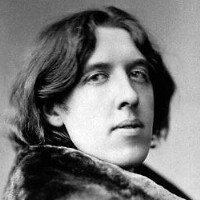
I was not the only Irishman on the SS Arizona, as we moored outside New York harbor, but I certainly wore the finest ankle-length otter-lined overcoat.
When we were advised that our ship could not dock until the next morning, I remarked to the captain that the Americans would be crestfallen at having to spend another night without their apostle of Aestheticism. He muttered some nautical expression under his breath.
A party of yellow journalists were hungry enough for epigrams that they chartered a launch and came on board to ask me questions, along with medical officers to clear us from quarantine. The journalists wore dreadful hats that reminded me of chimney pots. “I hope my arrival on these shores will be the beginning of a great movement here,†I told them.
Impudent questions followed, such as whether it was true that I had my bathwater colored with triple essence of verbena. I was already making a sensation.
The next day, as we proceeded to our berth in the North River, our ship got stuck in the mud. More journalists came aboard. One wished to know what I thought of the Atlantic. “A disappointment,†I said. “The roaring ocean does not roar.â€
WILDE UNIMPRESSED BY ATLANTIC, would be the headline.
My purpose here, I explained, while sailors scrambled in the rigging, and foghorns sounded plangently, was to assert the primacy of Art over life.
“Are you here to beautify America, Mr. Wilde?â€
“Beauty is all around us,†I observed, gesturing helpfully. “Man is hungry for beauty. All we want is a systematic way of bringing it out.â€
“That grain elevator over there, in Hoboken,†a reporter said, “does even that have aesthetic value?â€
Flicking dust off my lavender kid gloves, I responded that I was too near-sighted to perceive the item in question.
Once we landed, my luggage was retrieved from the bowels of the ship before anyone else’s, and I was swept off to the waterfront Customs House, a makeshift shed surrounded by coops of truculent geese. Inside the shed, a grizzled, red-nosed individual inspected my trunks full of lilac Hungarian smoking jackets and pantaloons of fawn-covered velvet. The old man asked me meekly whether my trunks contained any prohibited imports, such as animal hides, obscene materials, or Oriental carpets. Americans are infinitely curious about trivial matters.
“I have nothing to declare but my genius,†I clarified.
The inspector wore a horrific beard and a jacket of an unsightly blue, none too recently washed and studded with brass buttons. “I talked to the captain of the Arizona,†he said, sifting through some first editions of Poems I had brought as gifts for celebrated literati. “He said he should have had ye lashed to the ship’s bowsprit on the windward side.â€
On his lapel, my enigmatic interlocutor wore a tin badge bearing a name I suddenly recognized.
He’d attained some notoriety as an author of sea-going yarns, before Victoria’s accession. It came to me I’d even read a book of his once, on a winter’s afternoon in Merrion Square.
This was Herman Melville, author of Typee. Had he really bedded with cannibals? “I thought you were dead,†I exclaimed.
Melville shook his head. “I walk uptown to the docks six days a week,†he said. “I examine ships’ cargoes and passengers’ baggage. They pay me three dollars and sixty cents a day.â€
The ennui of such a life! Better by far he’d remained in the South Seas, in a tropical grove with dusky natives.
“They try to get me to take bribes,†he said, shifting back and forth on his feet, scrutinizing my cigars to make sure they had been correctly packaged. “Money is thrust into my pockets behind my back. I always return it.â€
Prising open the valise containing my letters of introduction to important American writers, Melville regarded me with an expression so changeful, I felt he was looking through me, at happier vistas from long ago. How had he come to this? Had he failed to cultivate the right people? It was certainly hard to see this spent and sunstruck seafarer as a figure in society, even New York society.
One’s real life is so often the life that one does not lead.
“All manner of men are discharged in this port,†Melville told me, “philosophers and footpads, apes and angels, speculators and parlor men.†He fingered my silk leggings with his gnarled hands. “Then beware lest if you go out of your way to be seen, you may also be seen through.”
Was it, by some Puritan tradition, his appointed task to examine not only my luggage but my soul also? The state of a man’s soul is perhaps better revealed by his choice of cravats than of convictions.
I inquired whether anything was amiss. Melville started filling in a form in large block letters. “My concern is with those who carry more than they claim to,†he said, “while you are as yet a ship with an empty hold, blown you know not where. On the surface, a crust of evanescent light,†he murmured. “Below, blackness. Man’s instinct is always to seek the darker realms. Yet what we seek in the depths is what is most likely to destroy us.â€
Before we parted, he handed me a long, privately-printed poem about a religious crisis of some description, inscribing it to me, Tell Truth, & shame the Devel. I would like to say that I later read this work, but I was presented with many poems on my travels, eccentrically-spelled verse histories of the Civil War and so forth, and soon acquired the habit of flinging them from the windows of railway carriages to divert the buffalo. For myself, I presented the customs officer with a free copy of my own collection which I inscribed l’art pour l’art, art for art’s sake, a principle in which I found I had just ceased to place any faith, rather distressingly since it was the underlying premise of my impending lecture tour. But how dull life would be if we never said things we disbelieved.
The gesture with which Melville bade me farewell made him seem almost phantasmal, so that I left the shed with a superstitious feeling of horror, as if I’d glimpsed my own reflection in a dream-mirror. This man had witnessed mutinies and shipwrecks, but perhaps nothing more terrible than the general indifference that now confronted him.
Outside the customs shed, rats made forays among heaps of refuse. The retired Colonel who was managing my tour handed me some lillies and ushered me into a buggy, my portmanteaux were loaded onto other vehicles, and as we traversed the Manhattan streets, our weary horse up to its fetlocks in mud, a pack of quite charming urchins fell in behind us, chasing us past jobbers’ warehouses, imitating what they supposed to be my gait and laughing adorably. Vagabonds washed themselves at hydrants. I placed a cigarette in my mouth without lighting it.
That year I would traverse vast immensities to visit such exquisite places as New Orleans and San Francisco and transform them forever, by teaching their inhabitants that it is through means of the most evanescent things — art, conversation, fashion, reputation – that we may best perceive the eternal and the essential. Yet for now my colloquy with the ancient customs inspector had left me feeling out of sorts. Could it be that whoever drinks deeply enough from the chalice of the sublime is eventually compelled to drain also the flagons of failure, disgrace, humiliation, sorrow, and despair? I could not in those days have imagined ever coming to regret being the center of attention, nor was I yet ready to admit anything harsh or disturbing to the sacred precincts of Art, but as I lit my cigarette, surrounded by the hysteria-edged adulation of the crowd, I could finally admit that those Atlantic storms had scared the bejesus out of me.
James Warner’s writing has appeared in Eclectica, Pindeldyboz, Eyeshot, Monkey Bicycle, McSweeney’s Internet Tendency, and elsewhere. He lives in San Francisco. His web site is www.jameswarner.net.
-
What We Are Doing
What then shall I do this morning? How we spend our days is, of course, how we spend our lives. What we do with this hour, and that one, is what we are doing. ~Annie Dillard, The Writing Life
Of course it is a rather stupid thing to spend one’s morning reading a book about writing instead of writing the book one is supposed to be writing, the book that has been paid for, the book that a very kind and conscientious editor is waiting for, kindly and conscientiously but possibly inpatiently, because she has every right to be impatient at this point. But a good book is such a temptation! It is not unlike truffles from Joseph Schmidt or men with beautiful backs. It is a terribly difficult thing to resist! But it must be resisted. It must be put aside. One must return to the work at hand, this book of one’s own, this thing that has sucked up four years of one’s life, not consecutively but spottily, in fits and starts, a few weeks here, a few months there, with long intervals in between for things like babies and husbands and trips to far-off lands, sex and pilates and Scotch, movies and more movies and books and books and books.
Another writer told me recently that when she is in the throes of writing, when she is truly inspired, when the words are just coming, flowing forth, that it is “better than sex.” I have not found this to be true.
-
Borges on Criticism & Compulsory Happiness
“I have tried to disregard as much as possible the history of literature. When my students asked me for a bibilography, I told them, ‘A bibliography is unimportant–after all, Shakespeare knew nothing of Shakespearean criticism. Why not study the text directly? If you like the book, fine; if you don’t, don’t read it. The idea of compulsory reading is absured; it’s only worthwhile to speak of compulsory happiness…if a story doesn’t make you want to know what happened next, then the the author has not written for you. Put it aside. Literature is rich enough to offer you some other author worthy of your attention–or one today unworthy of your attention whom you will read tomorrow.”
From “Poetry,” a lecture in Seven Nights
-
Borges on enchantment
I have read almost all of Croce, and though I am not always in agreement with him, I am enchanted by him. Enchantment, as Stevenson said, is one of the special qualities a writer must have. Without enchantment, the rest is useless.
~from “The Divine Comedy,” the first lecture in Seven Nights
I love what Borges says here, by way of Stevenson. As authors we try so hard to enchant, but it is impossible to do so without being, by turns, enchanted–not only with language and narrative, but also with the complexities of human nature and the intricate mysteries of the natural world.
-
Letter from Latvia
by Zinta Aistars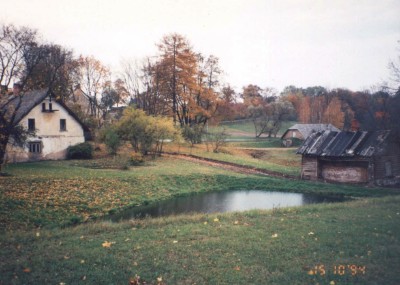
The first time I visited Latvia, my parents took me to Ventspils to see the city where my father had spent his teen years, just prior to World War II. A small stone house a short distance from the city, near a village called Sarnate, was the place where my father spent his childhood summers. Its weathered front faces the Baltic Sea–white sands scattered with pieces of amber, tall pines leaning into the wind, and the house itself holding within it the echoes of seven generations. Seven generations of hard work, love of land and family, many births, many weddings, many funerals, one generation gradually passing into the next, surviving many wars. My father knows Ventspils; his heart, in part, still resides there.It was a strange feeling, arriving in this place for the very first time, yet feeling myself at home. I was, yes, in a place that I knew instinctively I belonged. At least, some part of me did and always would. When my parents went to the house of Andris’s parents to meet with old friends, we two met for the first time. The boy with dark hair and dark eyes of unusual intensity greeted me with a firm handshake and a polite nod of his head. As our parents talked over dinner, bridging the lost years and the great divide between the paths their lives had taken, Andris’s eyes never left me. Mine dipped away shyly. In silence, I took in my surroundings. The house was tiny. One room, really, with curtains dividing space at room’s end for a bedroom for his parents, a corner serving as kitchen, and a closet-like space curtained off at the opposite end that was his bedroom. They were fortunate, I learned, to have the luxury of their own home under Soviet occupation, however small. An even greater luxury was to own a telephone, but Andris’s mother quickly took the telephone, pulling the long cord taut, and placed it outside the door of the house while we sat down to dinner inside. Soviet residents knew that telephones were commonly used as listening devices, and few things interested the eavesdroppers more than visitors from the Western world. “Let them listen to the crickets,” she said.
Andris spoke to me quietly after dinner. He played his guitar for me. Music, they say, is an international language, crossing all borders, and it melted any remaining between us. By visit’s end we had exchanged addresses, and over the years our letters crossed the ocean, and the Iron Curtain, even as we grew into adults, married, had children, and lived our lives–he as a musician and composer and I as a writer. If his letters on occasion hinted at some stronger emotional bond, I gave it little credence. There was, after all, an Iron Curtain between us, and if the term was a metaphor, its reality was truly one of iron.
Fifteen years after our first meeting, Andris made his first trip to the United States. The Soviets had cautiously begun to allow a crack in the Curtain, a few carefully monitored visitors permitted to travel the world outside, quickly to return again, their property and family members held as something of a ransom. Married couples, for instance, were never allowed to travel together. I did not meet him that first trip. I was married, had two children, and, well, it just didn’t work out. Or, in some deeper part of me, I knew it shouldn’t.
Two years later, when he came to the States again, he found me separated from my husband and living alone with my children. Andris, too, was no longer living with his wife and boys. When I heard the knock on my door, I opened it to a tall, bearded man who little resembled the 15-year-old boy I had met in Ventspils so long ago, if only for the intensity of his penetrating eyes. Suddenly, there were no more barriers.
Only, there was. A vast ocean, after all, separated our homes. We married in a small church in the northern wilderness of Michigan that had a strong resemblance to Latvia. Before we could file papers requesting a change in his citizenship status, Andris’s father died in Ventspils. An only child (his half-sister, Laima, was born to his father in a previous marriage), he returned to help his mother settle her affairs and heal her heart. I soon joined him, my two small children in tow. Around this time, the Soviet Union split open like a rotten fruit, the Iron Curtain crumbled into a rusted heap, and Latvia entered a time of anarchy and rebirth. As excited as we were to see this newborn freedom, it was undeniably a dangerous time, powers being challenged, new governments being formed, and a people struggling to find their way. It was no place to raise two American-born children.
The day of our first anniversary, I returned to the United States with my children. Andris remained in Ventspils. For the next six years, I would travel between these two countries as others move from room to room. To allow for enough time to stay with my husband in Latvia, enough to maintain a marriage, each time I left the States I also left a job, an address, and what few belongings I would keep, carefully boxed and stored in my parents’ garage or basement. Each time I returned, I would have to start my life all over again. Find a new job, lease a new apartment, unpack a few boxes, establish a new if temporary home. Wherever I was, a part of me longed for the place I was not.
My joys in life were simple ones. To be with those I loved was something I never took for granted. In the United States, I raised and nurtured my children, working hard to support our little household. I went to the office, attended parent teacher conferences, drove across town to take care of my many errands as any single parent might. In Latvia, I braided my hair in the manner of Latvian women, and I shopped for fresh produce at the open-air market on a daily basis, washed our laundry by hand, and boiled a large vat of water on the wood-burning stove for our bath water that Andris carried up the stairs in buckets from the well. While life in the capital city of Riga was quickly becoming as modernized as in any city in Europe, the countryside remained as if caught in another time.
One of the happiest days in my memory from those years was an evening spent at my sister-in-law’s house in Ventspils. Hers was a grand two-story place with walls nearly two feet thick, having survived several wars. It had no indoor plumbing, and the stove in her small kitchen was wood-burning, but it always felt like luxury to me. Laima took us out to her garden to pick fresh vegetables for our dinner. I held my shirt out to collect the beans Andris snapped neatly from their stems. Laima dug into the loose soil to pluck out round new potatoes. Her partner, Peteris, cut green onions, his small blade gleaming and sharp. In the kitchen, we rinsed and cut and snapped and prepared our meal, laughing and at moments bursting into song as Andris strummed his sister’s guitar. Surely I had never tasted a better meal than that one, with my family in Latvia warm around me, raising a toast of old cognac in the air. “Prozit!” To us, Laima offered, to our Latvian hearts, surviving all, strong and sure, and to our bright new future ahead.
I last saw Andris on October 15, 1994. It was the hardest, most heart ripping decision I ever had to make. My children could not thrive in such constant change. I was beginning to see signs of damage. They needed me. Full time.
That moment when the steel door at the Riga airport closed on Andris’s face, separating us perhaps forever, haunts me still in my dreams. His dark gaze never wavered as the door slammed shut, never moving from mine.
For months, no, years, I was tormented with the sense that I should never have left. I would wake in the night and, for a moment, not know where I was: here? There? Then, through the dark would come a light rustling, a child’s sigh in dreams, one of my own sleeping in the next room, and I would settle again into the twisted sheets. I am back in the States. Yes, I know: where I belong. With one heart that holds many loves and two homes.
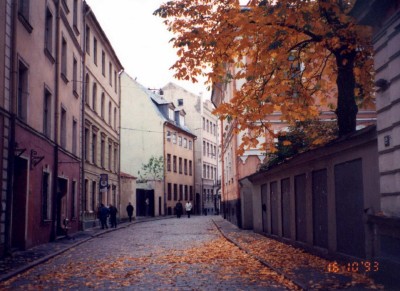
photos: Latvian countryside, 1994; Old Town section of Riga, 1993. Courtesy of Zinta Aistars
Zinta Aistars is the published author of three books. She is an editor and writer for LuxEsto, the Kalamazoo College alumni magazine and a contributing writer to County Wide News. She has published poetry, travel essays, stories, and articles in the United States, Latvia, England, Sweden, Germany, and Australia. Zinta publishes a monthly newsletter, Zeenythe Communications, for writers, and is one of a team of editors of the literary e-zine, insolent rudder.
-
10 Questions: an interview with Kate Braverman

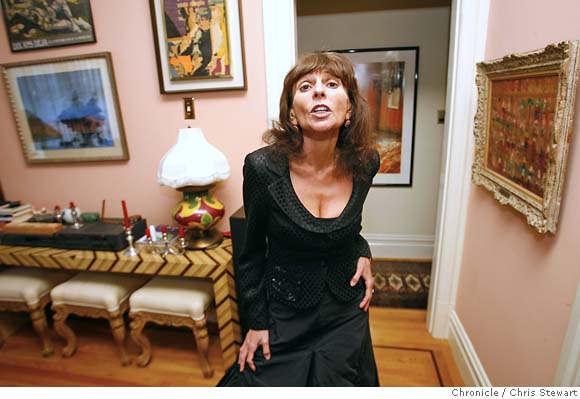
Kate Braverman photographed by Chris Stewart for the San Franicisco Chronicle In 2005, Michelle Richmond conducted this interview with Kate Braverman. Topics discussed: Braverman’s long career, experimentation in writing, book autopsies, San Francisco writers, revision, writing about climate, live audiences, and more.
Kate Braverman books: Lithium for Medea (1979), Palm Latitudes (1988), Squandering the Blue (1990), Wonders of the West (1993), Small Craft Warnings (1998), Frantic Transmissions to and From Los Angeles: An Accidental Memoir (forthcoming 2006, winner of the Graywolf Nonfiction Prize)
What are you reading right now?
In my new mission to build a critical apparatus for this region, which I think is lacking because we are a unique post-historical conceptual region–that’s our legacy and reality–rather than a 20th century area measured in miles and area codes. So I read the National Book Award offerings, particularly Vollmann’s Europe Central which I loved, and Didion’s Year of Magical Thinking which I loathed.
One is a revolutionary view and the other etiology of privilege. I want to make distinctions, from the text outward. A real political voice rises indigenous from the page effortlessly. A false one happens by inflicting the politics onto the page and then filling in a story. I can recognize the difference. I read Blaise Cendrares’s Prose on the Transsiberian for the pleasure, as I pick up one of the same half a dozen poets and just read out loud for the music and transcendent joy. Plath. Neruda. Paz. I re-read, recently books of the 70’s, beginning with Hunter Thompson, ‘Robert Stone’s Dog Soldier and A Flag for Sunrise, Tom McGuane’s 92 in the Shade and Panama. I like to be read to. My husband is re-re-re reading out loud the LaCarre Tinker Tailor trilogy for the 8 or 9th time. That trilogy is better than Grahme Greene. I read very little, as reading is a work activity for me, as demanding as writing. I don’t read a book, but autopsy it. With somebody like Vollmann, one of his novels is like receiving the schematics for literary wmd’s.
2. It’s the 25th anniversary of the publication of Lithium for Medea. Congratulations! Any advice to writers on how to hang in there for the long haul?
When I began pubishing in the early and mid 70’s, it was the publishing world. Then it became the publishing business, then the publishing industry. When I began publishing, it was “a hand shake” situation, it was daring to use a female name, as the chances of publication were automatically diminished. My first stories were sent out with just initals, as was the custom then. K.E. Braverman. Not overtly belonging to that unpublishable caste, females.
How to hang in for 25 years, doing experimental work and taking the chance that the increasingly random maketerplace will not delete you, the spreading dumbness and numbness of a reading public that wants tiny conventional restatements of what they already know rather than engage in the trek of ambiguity and complexity a real literary work demands?Agents and publishers who care least about the literary merit but most about sales? Marcel Duchamp said if you’re 20 and you write poetry, you are 20. If you’re 50 and you write poetry, you’re a poet. I write because I have a calling I’ve been practicing for 30 years and it is the way I interface with reality. I am addicted and can not live without it. I’ve burned all the boats back, so I am marooned on this island where there is only landscape, dialogue blowing in with the vanilla scented wind and a word processor. No seasons, no climate, no time zones, just the work. It’s not a question of hanging in, but rather chancing to survive.
Most of the writers I meet don’t have a calling. I’ll do another 12 drafts of a piece that’s been rejected because I know I can make it better, get deeper, find where there’s an intersection I missed. Many writers I meet are not writing for the acts of alchemy that can occur when the page is entered into by convenant, caress and sacrifice. They are not using the page as it is meant to be used, but inflicting other mediums onto the innocent surface–as tv shows or tv sized ideas in book format. This is not a book, but a desecration. Why don’t those people simply write screenplays or treatments? Essentially, I’ve been reading San Francisco writers and re-reading.
3. Your husband is a musician, correct? Do you write to music? If so, was there a soundtrack of choice while you were composing your latest book, Frantic Transmissions to and From Los Angeles: An Accidental Memoir?
My husband is a research scientist, a molcular biologist, genetic enginner, biomaterials, nanotechology visionary, and futurist. We tied for the Economist Prize in 2003, he wrote about the ethics of nanotech and I wrote a prose poem about growing up in LA and we were astounded to tie for the prize. He’s writing a book about the implications of the new technology on our collective human future.
He’s a musican by love. Over the years, we’ve experimented with putting his music behind or collaged with my poems. He’s in charge of all the music. Now we’ve got about 90 minutes of set music with poems and will be performing then for the Lithium for Medea birthday parties I’ll be having in NY, Paris, Instanbul and other cities. I’m using the 15 poems I arbitrarily chose that were written in the same voice, and then wrote a narrative for and between, the poems that were the spine and anatomy of LFM
4. What is the significance of the title of your forthcoming book, Transgressions to and From Los Angeles: An Accidental Memoir? Were there any other titles in the running before you chose this one?
The new Graywolf Prize book didn’t have a sound track but the 7 seasons that lashed me as I wrote it in a farmhouse in the Allegheny Mts. of remote rural western NY State, just above PA where our nearest city was Buffalo and there was an 8 month virulent winter. It had a brutal yellow glare, since it’s about growing up in LA, moving to the country for that mythic second life in buccolic rural America. Then I spent a month in Prague and soaked up Gothic architecture and the lavendar on the cobblestones and the reds and purples of acres of Bohemian crystal and gave the book a certain softening gilt, garnets on the fingers, neck and wrists.
There were no alternative titles, but there was a new ending I wrote after I’d won the prize which GW rejected. I wonder if it was censored and will be trying to identify those I can ask to read the ending I wrote and tell me if they think the real end was censored and if it damaged the political trajectory. I suspect it did.
I need to keep my living environment as bland, unobtrusive, quiet visually and audio as possible. I don’t have a tv or subscribe to any print publications. I delete popular culture completely from my writing life. I’ve been lisening to the same dozen albums for 10 years. I’m not interested in fashion, sports, the sport of politics. I pull the blinds when I write. I keep my back to the wall when I work. I’m a method writer, I live what I write (and so much more) so I’ve almost got my skin off, I’m using the loose tissue for sails, so I am always vulnerable and find transitions between the writing region and ordinary world extremely difficult.
5. You’ll be doing some events in Paris upon the publication of Frantic Transmissions in February. What does Paris mean to you as a writer?
I told my French publisher, Quidam, that I always wanted to be avant garde, but 25 years was more than I had planned on. When the books were published in Italy, it was information presented and received in so listless and posthumous a fashion, another publisher, another problem, that I didn’t see a way of partipating effectively. With the French, I sought contact and established a personal relationship by email. I offered to go and this has turned into a real tour. Turkey is publishing LFM in Jan and Palm Lat, my 1988 novel in May, and after Paris, I’m going to Istanbul for Univ readings, tv and media. I just found out about this and am very excited. Paris holds a significance not only in the conventional literary sense one ordinarily thinks of, but as a sign that my work must find a global audience, that the political intentions of my work might not be acceptable to American audiences (after 30 years) in the demand on the reader to engage in illness, marginalization, racism, the struggles of single mothers, anti-Semitism, the degradation of the 60’s asethetic entirely—I ‘ve always thought my books would be better read outside this country which continues to swing to right=Christian side in a suffociating, frightening way.
6. Okay, we ask this of everyone: what’s your favorite San Francisco eatery?
I am not interested in food as fashion. I hardly eat at all, don’t drink alcohol, work odd hours and don’t have a single favorite restaurant. I am not interested in food any more. A bowl of brown rice, oatmeal, fruit. I live on the milk in cafe lattes and vitamins. I just lost interest in food, selecting it, carting it in, preparing it, cleaning it up. In the Allegeny Mt exile, there were no restaurants and social life was the senior faculty inviting one another over for dinner. I learned to cook, grew my own foods, once made 3 pies a day for an entire summer to perfect my crust.
When our daguther left for college, I annnounced I was no longer cooking. When we moved to SF, I announced I was no longer shopping or washing dishes. The women’s arts are too time consuming–it takes me all day to make a dinner and clean it up. I don’t have six hours laying around like that. Or I chose not to. I have always resented the time and energy the correct wife and mother is supposed to give to banal unnecessary activities. I am disturbed by how easily women writers cave into the same traditional peer pressures, especially with children. I want to make a car bumper sign that says JUST SAY NO TO SOCCER.
I’ve dealt with these issues in the 2 collections of unpublished stories I have. Professional women are gutting their work and personal schedules for the new holy collective hallucination of soccer. My daughter, who is graduating from law school in May was raised by a feminist artist who was not a dillatante, but actually worked all the time. I told her my writing life was as much a real job as being a doctor or lawyer, that I had hours of work, that I wasn’t available for her every whim. We live in a society where every kid’s stray spasm of enthusiasm is met with an immediate new uniform and coach. It’s random. Like week of the “C”. Every kid has cello lessons, Chinese and calligraphy, canoe lessons. Then it’s “M” week. Mandolines, Mandarin study, Muslim awareness, micro something, Mars study. We give our children an enormous sense of entitlement by mutilating our professional and personal lives for childish passing whims. What kid actually possesses the plethora of gifts we routinely attribute to them? Virtually no one. It’s another passing fashion that I am passing on.
7. Climate is often such an enormous presence in your writing. Why?
I go native wherever I live. As a CA writer, as a writer without skin, I write on a molecular level using my synapses as tools, the external landscape is a character for me. I’ve been more intimate with certain landscapes than certain husbands. My aesthetics have an errotic compoenent. I love landscape in a profound way I can translate onto the page, which is a unique kingdom, with its own unique rules and seasons, like a continent, vast, mysterious, inexplicable and inexhorable. To be a CA woman, even more so in LA where I was based for 20 years. is to inhabit a non-traditional America, without seaons, closer to Mexico City or the Pacific Rim than Europe. In LA, it was always about keeping the indigenous out, that real art could actually be done by residents of the subliterate heathen masses was unthinkable when I began doing it. We have a different relationship to traditional anglo-europen writing. We don’t have Hawthrone’s dark forest, we’re not in opposition to our nature but coexist with it in harmony. Our cities are named for Spanish saints and butchers. Asia blows in our wind. It is a climate that encourages experimentation and a more confessional approach. That’s why SF has a legacy as an outlaw capital. We welcome the renagade, the outlawed, the visionary and eccentric here. LA does now, but only if the individual is carrying a pass from a studio and can prove they have a movie in a secondary phase of development. Climate has an impact that is defining. When I lived in rural isolation, where getting 12 miles to the town with a supermarket was often impossible, a certain smallness of ambition and possibility becomes an intrinsic compoenent of one’s actions and vision. I love SF, this port city built by desperate gold diggers and the adventuresome that have at least moored here at pivitol junctions.
8. Much of your work seems to beg to be performed. How would you describe the relationship between you and the audience during a live performance?
I began as a poet and one of the first poetry readings I attended was one I gave. As a poet and now a writer of incantory prose, such writing is intended to be read out loud. I have seen many opportunities during my career to put the work on stage. During the 70’s, when I came of age as a writer (I was a Haight Ashbury runaway at 15 and put myself through Berkeley High and Cal in LA (Hunter Thompson and the Beats are 20 and 30 years older then me) it was the time of Punk. Since many of the punk bands went through the Venice Poetry Workshop, which I was a director of at the time, poets and punk bands were performing together. I saw the change of dynamic becoming a performer would require and this did not appeal to me and my work on the page. I used to do readings with a pencil in one hand so I could live edit, feel the kinetics of where a piece was off. Trust your ear, not your eye. Trust the physical kinetics, not what the lines look like. I write music. I don’t write, I compose. I started to give live readings in SF after many years of not having a live audience and I loved it again, felt the thrill again. We would, over the years, do an occasional gig with music, but I didn’t want to put the energy into it—a form of washing dishes, dispensible. Now we’re doing it for fun, the classic poems with music written as for songs. The rush of connecting with an audience when you don’t have a book in your hand is up there with injecting drugs and sex. It’s an A list rush. Since moving to SF, I’ve become more experimental about the work in all forms, including considering stage and music, rythem, cadance, that which accentuates the incantory nature of the work. Our living room is now an ad hoc recording studio. We’re exploring a whole new terrain. I think I can write directly to the music and will be trying that as an experiment. Writers don’t experiment enough, take the wild chance, rearrange, restructure, re-experience, reinvent. Our approach with the sound collages is an entirely new synethesis. The possibilities are still unfolding.
9. Robert Polito, who judged the Graywolf Nonfiction Prize, called your prizewinning manuscript ” an enthralling mix of memoir, history, and fever dream.” What is the role of dream in literary creation? More specifically, fever dream?
Many answer, though few are called. To volantarily enter a sort of permanent house arrest, to live as though you are at all times engaged in a public psychoanalaytic session/AA sharing meeting, while feeling you are being interrogated by state police and confession to a priest is not for everyone nor should it be. To live with emotional malaria is not a wise decision and should only be taken if there is no alternative. They are graduating 10,000 certified MFA writers a year. That’s 10,000 unemployed writers who must get jobs teaching in MFA programs, of which few will be gainfully employed and fewer still will earn a living from the sales of their work.
In her great book on writing, The Writing Life, Annie Dillard observes that very few are writers and very little harm comes to them. I would add that the converse is also true. Looking at the artists of the last century in America, it’s a story of suicide, drug adiction, alcoholism, child abandonment, divorce, dysfunction, mental illness. Of course, when men engage in these behaviors, we say they not etching lives of brutal chaos, but are the embodiment of the mythic artist. When women engage in these identical behaviors, we call them mentally ill aberrations and degrade and dismiss their contributions. The fever dream, the complete surrender to a transcendent other has always been the province of males. When women enter this state of grace and vertigo, we call them mentally ill, promisicus, defective. Women are chained on the page as they are in life. The marketplace demands female versions of real characters that lack the epic dimensions males are permitted. This has not altered signifcantly during the 30 years of my work.
The new book is a complete experiment in subverting genre. It’s an “accidental memoir” and is, as all my work, rendered in my primary language, which is poetry, with its musical, incantory component. It’s real history, fiction, pure poetry, stand-up comedy monologues, essays I’d written for the LA Times during the Allegany exile, impressions by a CA woman on small town life. It’s about space, architecture, climate, region, identity, aging. It’s pushing the envelope on what nonfiction can do, and since Capote, Mailer, Didion and HST, nonfiction seems a fertile field, less fortressed, fewer crocodiles in the moats.I do wonder about the last chapter, which I may post on my web.
10: What’s in your attic?
Do you mean that metamorphically? My work is largely autobiographical, though the page requires a complete transformation of the original impulses. There are always 2 stories, the one you set out to tell and the dynamic that occurs when the page speaks. It’s a dance, you do some, the page does some. In this dynamic arises the discovery and revelation, the alchemy. My real life is much more exciting then what I’ve written in my 11 published and 5 still unpublished books. My life as a teenage runaway. My life in the LA Punk scene. My life in the barrio of LA where I had an illigitimate baby. My life on the run with my infant from prosecution by the authorities who wanted to decree that I tie my destiny to a stranger I didn’t want to know; most women wouldn’t run. I did. My activities as an anti-war activist during the 60’s. I think my attic has been open for decades. I invite the curious in.
author photo by Chris Felver
Visit Kate Braverman’s web site at www.katebraverman.com.