Your cart is currently empty!
Category: writers resources
-
Writers on Writing – Willa Cather on “Making It an Adventure”
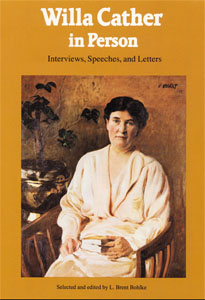 In 1921, Willa Cather told an editor for the magazine Bookman that she only worked for two and a half to three hours each day. “If I made a chore of it, my enthusiasm would die,” she said. “I make it an adventure every day.”
Like so many other writers, Cather preferred working in the morning when she was “fresh” and unencumbered by the day’s concerns. I always prefer working in the morning, too, although my intentions are far better than my practice. For me, the key is getting up early enough to give myself at least an hour before I switch to “mom” mode, which means getting up not a minute later than 5:00. I go to bed most nights believing I will be out of bed by 5:00 the next morning, and then I roll out of bed closer to 6:30 or 7:00, chastising myself and promising to do better tomorrow.
Today was one of those rare days when I happened to live up to my nightly vow. By 5:05 I was at my desk with my coffee, writing. By 6:30, I had written three and a half pages. Those three and a half pages felt more like 20; I felt triumphant, as if I had accomplished a great deal.
And it only took one and a half hours! Cather is on to something here. If you work in short spurts–two hours instead of five–every minute of it is more likely to feel like an adventure. If you can’t afford two hours, try one. If you can’t afford an hour, try thirty minutes. University of Nebraska Press has published a whole book of Cather’s insightful advice on writing, with the utterly unpretentious and spot-on title, Willa Cather on Writing.
Alice Munro, by the way, is a writer who accomplished much of her early success while juggling writing with motherhood. First, she wrote while her youngest child napped, and later, she wrote while her children were at school. Toni Morrison’s time was so limited as a single mother with a nine-to-five job that the time she did manage to find at the typewriter was rich with possibility. “By the time I get to the paper something’s there,” she said. “I can produce.”
No matter when you are able to make it to your writing desk, or your notebook, try to approach it as an adventure, not a chore. Merely having the privilege of an hour to write can be an adventure in itself.
This week, when you sit down to write, attempt to do it with a sense of enthusiasm for the hour that you have, the hour that will never repeat itself, this spectacular, beautiful, unique hour in which anything can happen.
-
How to End a Story
Stories are like relationships: the beginning is always so much fun, and the ending is fraught with turmoil.
When I sit down to start a story, the first sentence just sort of comes to me. The second sentence too. If I’m lucky, the third swiftly follows. The inimitable short story writer Kate Braverman once visited a class I was teaching and told the graduate students that she channels her characters. They speak through her and onto the page, she said, as if she isn’t even there.
I, unfortunately, channel nothing. It is all rough work after sentence three. By the time I’m in the middle of the story, I’m feeling more than a little uncomfortable. Where am I going? Where have I been? Have I gotten lost in the labyrinth? Probably, yes.
Somehow, I find my way through. The characters do things. They meet with hardship and grief, or maybe they just meet someone challenging in a Laundromat. They get into trouble, maybe out of it. Probably not. I find myself feeling that they have done all they can do. Not much more can be said. The action has fallen. We have all had our dénouement (which, by the way, is a French term meaning untying, from Middle French desnouement, from desnouer – to untie – from Old French desnoer, from des- de- + noer meaning to tie, from Latin nodare, from nodus knot.) And here we are in the labyrinth again, attempting to untie the knot, unwind the rope, escape the not-so-fun funhouse.
It’s time to write our way out.
One wants to resolve things, after all.One feels a deeply human need to conclude. After the falling action, there is often something more. Something unexpected. And here we come to what I have been meaning to say all along: a good ending is layered. The reader thinks she has discovered everything she can possibly discover about a story, but then: another image appears, another paragraph hums along, another question begs to be answered. One is left with the feeling of having walked out of the dark theater into the light, only to realize there was something else playing after the credits, some secret part of the film, some final moment. You can hear it through the door, vaguely, but you can’t get back in. You’re not sure what you’ve missed, but you’re certain that you’ve missed something, that the reel kept on playing, the story kept on going, after your departure. You were only an observer, a brief malingerer, there but not there. The lives within the story carry on.

-
A Handful of Glorious Pages
 Are you a novelist, a short story writer, or both?
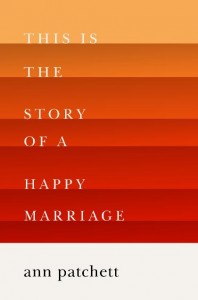
I’m currently reading Ann Patchett’s essay collection, This Is the Story of a Happy Marriage, which chronicles Patchett’s journey to becoming a writer. There are plenty of quotable passages in the book, but one of my favorite has to do with the short story form:
Love the short story for what it is: a handful of glorious pages that take you someplace you never knew you wanted to go.As both a novelist and a short story writer, I can tell you that I love the way stories happen: you write a sentence, and then another sentence, and a few weeks and twenty or so pages later, you have arrived at a totally unexpected destination.How does this differ from writing a novel? With a novel, while I don’t know exactly where I’m going or where and how the novel will end or what tangents it will take, I do usually begin with a general sense of direction. A sense of direction is important, because I know that a novel will require an investment of at least a couple of years. So I begin with a setting, a character, and a problem that needs to be solved or a question that begs to be answered.In my forthcoming novel, Golden State, for example, I began with two questions: 1) What would happen if California tried to secede from the nation in the present day? 2) What if the narrator’s estranged sister suddenly reappeared in her life? The novel was built from these questions, which married the personal with the political in a way that was very enjoyable to write and, I’ll admit, quite challenging to orchestrate.
With a short story, I feel more free, because I know my investment of time will be much shorter. I often don’t know what the problem is when I begin, or even who the major players are. I start instead with language–a series of words that present themselves in my brain and somehow compel me to follow them with other words.
Many novelists write only novels. Some short story writers write only stories. But the vast majority of published fiction writers do –or have done–some combination of both. Fiction writers frequently debut with a story collection, which is followed by a novel. One reason for this pattern, I believe, is that short stories tend to be the preferred form in graduate writing programs, so many writers come out of their MFA program with a story collection in near-publishable shape. After the writer gets a few good reviews and catches an agent’s eye with a story collection, he or she either a) decides that it would be fun to write a novel or b) concedes to the demands of the marketplace, which favors novels over story collections.
As for me, writing novels is my bread and butter, and I never feel quite whole unless I’m working on a book-length project. In fact, I can’t remember a time in the past twelve years when I wasn’t working on a book! But there is sustenance to be had in short stories too, and when I am feeling tired of my novel-in-progress, or antsy, or simply inspired in a different direction, I often begin a short story.
When you are feeling at wits’ end about your novel, I encourage you to set it aside for an hour or day or a week and begin a short story instead. It is possible that the writing of the story will push you back, joyfully, to your novel, and that you will abandon the story in short order for the bigger project. But it is also possible that you will sink blissfully into the freedom of the story, and that you will emerge, days or weeks later, with “a handful of glorious pages.”
As always, happy writing! Please join the conversation on twitter, stop by my facebook page, or read (and submit) good stories at Fiction Attic.
-
How to Publish a Book – Online Publishing Class
In this six-week course, you’ll learn the ins and outs of publishing in the digital age. What we’ll cover:
Traditional versus Independent Publishing: Learn the pros and cons of traditional and independent publishing, and decide which path is right for you.
Agents and Editors: What They Do and How to Find Them: Understand the role of the literary agent and the editor, as well as the relationship between the two. Discover how to find an agent, what terms to expect, and what red flags to watch out for.
The Path to Publication: Learn how you can improve your chances of getting your manuscript noticed by an agent or editor. Get my secret for building a publishing portfolio that will make your manuscript stand out.
Preparing Your Manuscript for Publication: Learn the 5 common mistakes that will keep your manuscript from getting a serious read. Understand the industry standards that are key to a professional manuscript presentation. Learn how to format your manuscript for independent ebook publishing.
The Money Trail: Learn the basics of advances and royalties. Understand what to look for in a traditional publishing contract, and how to get the best royalties for independently published work.
Understanding Copyright: Whether you choose to go the independent or traditional publishing route, copyright deeply affects your income stream. Learn how to protect your work from copyright infringement, and how to balance discoverability with copyright protection.
This course is intended for:
- Writers who are new to publishing
- Writers who have published independently but are interested in making the leap to traditional publishing
- Writers who are interested in having a hybrid career that includes both traditional and independent publishing
- Writers who have published in literary journals, magazines, or online but have not yet published a book
By the end of this course, you will have a clear idea of how to proceed with your manuscript. You will have created a personalized publishing plan to help you take your writing career to the next level.
Each week features a downloadable lecture, an assignment, and a discussion forum, where you can ask questions and post comments.
Go here to enroll in the publishing workshop.
-
Fundamentals of Fiction Writing Online Fiction Writing Course
My new online writing class, Fundamentals of Fiction Writing, is now open for enrollment. This is a self-paced, nine-week course. You may begin the class at any time.
In this course, you will learn how to write a story or novel using the fundamental building blocks of fiction. The course is divided into nine sections. Each craft section focuses on an essential element of narrative craft. Through video and written lectures, you will learn the tools you need to begin writing fiction:
- Characterization
- Point of View
- Setting and Description
- Dialogue
- Plot
- Structure
In the final week, we will focus on revision, a necessary step to getting your work out into the world.
Each section includes writing exercises to help you practice what you’ve learned and deepen your understanding of the material, as well as a discussion forum and suggestions for further reading.
Who should take this class:
If you’ve always wanted to write a story or novel but don’t know where to begin, or if you took a couple of writing classes in the past and want to brush up on your knowledge and reinvigorate your writing practice, this course is for you. Led by a New York Times bestselling author with more than a decade of experience teaching creative writing at the university level, Fundamentals of Fiction Writing provides a great foundation for anyone interested in writing short stories, novels, or novellas.
Although this is not a critique class, your enrollment entitles you to a free one-hour Google hangout, during which I will answer student questions. You can also subscribe to the workshop add-on to get one-on-one critiques from the instructor.
The regular tuition for Fundamentals of Fiction Writing is $79, but readers of this blog can enroll in July for just $49.
Use coupon code serif to get 30% off in July, 2014. (expires June 31, 2014).
Or follow this link to get the discounted rate.
-
5 Great Tools for Writers
 The only way to be a writer is to sit down and write. It doesn’t matter how many terrific notebooks and apps you have, or how gorgeous your desk looks, or how supportive your writing group is: if you don’t actually sit down and do the work, you can’t really call yourself a writer.
But if you’ve committed to sitting down and doing the work, there are some great tools to make the process run a bit more smoothly. Here are four of my favorites.
1. CREATAVIST
What it is: a free platform for writing and publishing your books.
Why I love it: Not so long ago, if you wanted to publish an ebook across different platforms, you had to perform a whole lot of formatting voodoo. Every major platform–Kindle, Nook, Kobo, ibooks, and Smashwords–had different formatting rule. The toughest part by far was creating a linkable table of contents. With Creatavist, you insert your text chapter by chapter, choose the formats in which you would like to publish, and then download a separate file for each platform.
Cost: free
Go to Creatavist.
2. CREATESPACE
What it is: Amazon’s free platform for designing and publishing print books
Why I love it: Createspace makes it easy to design a good-looking cover by inputting your title, image, cover copy, and author name. Once you’ve created your cover, you can upload the interior of your book as a PDF or .doc file. You can either use the online proof to make sure everything looks the way you want, or, to see exactly what your printed book will look like, you can order a proof. Once your book is ready for publication, it just takes a few clicks to put it up for sale on Amazon. You choose the price and distribution options; you can offer it for sale on Amazon, in bookstore chains, and for libraries. You can also order deeply discounted copies to sell or give away.
Cost: free to join, free to sell. Pay only for the books you purchase for yourself.
Go to Createspace.
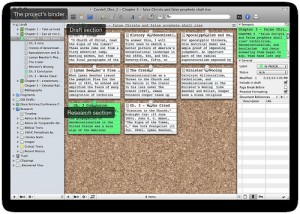
3. SCRIVENER
What it is: an app to help you organize your writing into chapters, research, scenes, and more
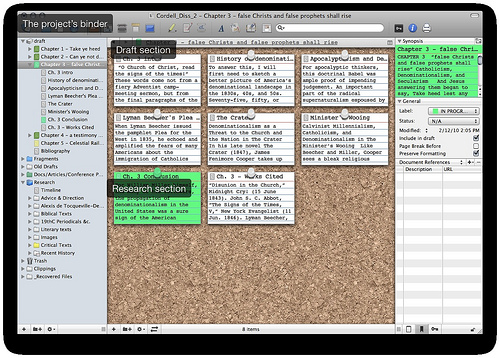
Why I love it: the corkboard interface is really attractive and intuitive. The highly customizable, hierarchical ranking of folders, files, and research is a great fit for anyone using The Paperclip Method to write their novel. Several years ago, I was so impressed by Scrivener that I bought a Mac laptop so that I could use it. I wasn’t disappointed! You can get the Scrivener app for Mac here. While Scrivener has, unfortunately, not available as an ipad app, you can download the Index Card app ($4.99) on your iphone or ipad and sync it with Scrivener. Scrivener is far from free, but I find that it’s very much worth the price.
Cost: $44.99 for the app
4. SUBMITTABLE
What it is: a free tool for submitting your work to literary journals and other magazines
Why I love it: Submittable allows you to submit work to any one of the hundreds of high-quality literary magazines that use the service. It will also keep track of all of your submissions in one place. It is currently becoming the most popular submission tool for everything from The Atlantic to McSweeney’s. Currently, the only way for writers to sign up for Submittable is to submit to a magazine that uses the service. Boo. Once you’ve done that, however, it will keep track of the status of all of your Submittable submissions–accepted, rejected, in progress, etc. As an editor (over at Fiction Attic Press), I use it to communicate with submitters and to run contests. By the way, once I’ve accepted someone’s work and it’s time to put together a book, I head over to Creatavist.
Cost: free
What it is: a series of workbooks designed to help you figure out the heart of your story and write your novel from start to finish
Why it works: The Paperlcip Method series includes four workbooks: Story Starters, The Complete Character, The Paperclip Method: The No-Outline Novel Method, and Next Draft: Tools for Revision. The series is designed for anyone who wants to write a novel but isn’t sure where to begin, or anyone who has tried to write a novel but can’t get all of the threads to come together. You can download the entire series instantly, or purchase individual workbooks.
Why I believe in it: I created this series based on my years of writing practice and teaching private classes and gradate-level writing workshops. The method outlined in these workbooks is the same method I have used to write four novels, including a New York Times bestseller.
Price: $14.99 for one workbook, $39.99 for all four
-
How to Submit a Story for Publication
So you’ve written a story, revised it, and are ready to send it out. Here are a few tips for submitting your stories for publication to literary journals and other magazines.
• Until recently, submitting to literary journals meant buying loads of stamps, weighing your manila envelopes at the post office, and including self-addressed, stamped envelopes. Fortunately, this is no longer the case. Most literary magazines have an online submission form, and most prefer online submissions to hard copies.
• If the literary magazine asks for a cover letter with your submission, make it brief. Your letter should mention where you’ve published in the past, and should include a very short bio. Your cover letter should NOT explain or praise the story. That is very bad form, and will likely result in your story being deleted before it is even read.
• Do submit to more than one place at once. Five is a good number to start with.
• Never send a publication a second story before the editors have responded to the first.
• Never call to check on the progress of your submission.
• Shorter stories (8-15 pages) are more likely to be accepted than very long stories.
• Always double-space your story, use one-inch margins, and indent every paragraph!
Here are some of the best online resources for anyone looking to submit fiction:
Newpages.com—litmags, publishers, and book reviewswww.webdelsol.com–Contains many useful links to literary magazines and resources for writers.
Mid-American Review–Contains useful links under “Writer’s Tools” link.
www.zuzu.com–Same concept as Webdelsol, but with even more links to literary magazines and e-zines
More great resources to check out before you submit:
• Novel and Short Story Writer’s Market (Writer’s Digest Books)–This is probably the best; it covers many of the better publications with detailed descriptions of tastes, editorial guidelines, payment, and rights.• Pushcart Prize Anthology (Pushcart Press)–Annual anthology of the best of literary magazines and presses selected by editors themselves; you’ll not only find fiction in here, but a list addresses of prize-winning magazines and presses.
For current publishing opportunities, check out the Writer’s Chronicle, published by the Associated Writing Programs (www.awpwriter.org) and Poets and Writers Magazine (my personal favorite), which has upcoming deadlines for literary contests, as well as calls for submissions. Go to www.pw.org
Some of my favorite literary magazines:
Glimmer Train Fourteen Hills The Sun
Other Voices Alaska Quarterly Review Mid-American Review
Ploughshares Granta Boulevard
Story Quarterly Quick Fiction Online:
CutBank South Carolina Review Nerve (sexy stuff only)
Missouri Review Bellevue Literary Review Blackbird
Mississippi Review Gulf Coast Identity Theory
North Dakota Quarterly Sycamore Review Exquisite CorpseAny publication is a big boon and a definite validation of your talent, but here are the magazines that can really jump-start a career: The Atlantic Monthly, Harper’s, The New Yorker, Zoetrope, McSweeney’s, The Paris Review. It never hurts to send to these guys as long as you’re sending out a bulk submission. All of them except McSweeney’s & The Paris Review publish mainly agented material, but occasionally a non-agented submissions will make it into the magazine..
[box]Sometimes the hardest part about being a writer is getting the first words on the page. Where Stories Begin: A Workbook for Writers, will banish writer’s block, spark your imagination, and provide endless opportunities to make stories out of thin air.[/box]
[box]Online Flash Fiction Class: 5 Very Short Stories in 5 Weeks
Begins April 14. Duration: 5 weeks. Tuition: $210.
[button link=”http://www.bayareabookdoctor.com/online-creative-writing-course/”]Learn more[/button] [/box]