Your cart is currently empty!
Category: short memoir
-

The Exile
memoir by Soul Vang
MY WIFE AND I drove slowly down a plumeria-lined road, passing through a neighborhood of sixties and seventies bungalows. The road was narrow, edged by emerald grass shoulders and hedged by tall bushes.
As we reached the end of the lane, there was a large mango tree to our left. A gravel drive cut through the hedge next to the mango tree. The address on the mailbox by the gravel drive told us we had reached our destination.
At the end of the gravel drive, shadowed by trees and almost hidden by tall bushes, was a little bungalow.
“How does a Hmong man live here, hidden in this landscape, among strangers?” I asked my wife.
Read this memoir in its entirety with your free trial subscription to Fiction Attic Press.
-
Childhood Stories: a Memoir of Soviet Russia
by Irina Howell
i.
When I turned eight I joined the “Oktyabronok” league in my elementary school. It is an honor to be a part of this group. The kids wear little red star badges made of metal, a portrait of Lenin carved in the middle. The most intelligent and well-behaved children are among the first to be admitted to the ranks. We are proud. Special extra-curricular activities with music, songs, stories about the little Volodya, as we dearly call Lenin, are organized for us. We are taught to be honest, kind, considerate, along with other well-meant principles. The badges shine brightly against our black aproned uniforms.
My dad is coming back from a trip to Moscow today. I haven’t seen him for weeks. We are very close. In the clean minimalistic kitchen of our apartment my father gives me a present, a new “Oktyabronok” badge, which he brought for me from his trip. It is superior to the one I already own. The red star is made of shiny clear red plastic; the portrait in the middle is an actual photo of the leader. I am simply thrilled with my gift and proudly wear it to school.
A few days later, my mother is going away: she takes university classes in a distant city, so I am left with my dad. It is not a problem, as I love them both dearly. I patiently await my father’s arrival home late in the evenings after work. My homework is usually finished. I manage to make food on my own. Parents are not worried to leave their children by themselves in our happy idealistic state.
My father is particularly excited and happy today. It is Friday, and I don’t have school the next day, nor does he have to go to work. He tells me that he has a great surprise in store for me, and we are going to take a bus trip this late at night. It is winter; New Year’s was here not long ago. Holiday trees are still decorated; the buildings are ornamented with lights. I feel mature next to my father, taking this strange evening expedition. I am also curious. “Why and where precisely are we going?” I keep on asking him.
“There is somebody very special I want you to meet. It is a great secret though, and you shouldn’t tell it to anyone,” he says to me to my delight.
End of excerpt. Read this story in its entirety with your free trial subscription to Fiction Attic.
About the author: Irina Howell was raised in Soviet Russia with a fighter pilot for a father. She later moved to Belarus, where she completed a BA in English. She immigrated to the U.S. in her early twenties and earned a Masters from Columbia. Irina’s life was affected by the collapse of the Soviet Empire, Russia’s economic crisis, and novel ideas of capitalism. In this exquisitely detailed memoir, Howell examines her Soviet childhood—the boundaries crossed and secrets kept within her broken family.
-
Eternity Along the Strand
an Account of Bloomsday 2013, Dublin
a short memoir by Becky Boncal

Becky Boncal retraces the steps of Stephen Dedalus on Sandymount Strand. Photo by Brandan Cadran. I went to Dublin as a writer, a tourist, a teacher with twenty-four college students who understood, through a series of lectures I gave before the trip, that this was, for me, a holy pilgrimage. A cooler June than that of 1904 when Nora first walked out with James, when Dignam was buried, and Dedalus was taken in by Bloom. During our four days in Dublin, we wore our legs sore walking between museums, parks, and theatres. Now and then, my students and I dipped into dusty little bookshops hidden at the tops of winding stairs, and I debated whether or not to buy another copy of Ulysses. I had three on my shelves back home—left there when I decided to download it to my iPad and leave room in my suitcase for the books I would bring back from Ireland. But the iPad, I realized, stepping into line in the bookshop, would not compliment my Bloomsday costume.
“The book opens at 8:00 a.m. tomorrow,” I told the students before I let them loose in Temple Bar for the night. The walk to the DART station would take fifteen minutes and the ride out to the museum at Martello Tower about twenty, so if they wanted to join me, they had to be in the lobby by of the hostel by 7:30 a.m. (I’d promised extra credit to anyone in my class willing to wear a t-shirt printed with the words Worst Man in Dublin.) Bloomsday would be our last day in Dublin before we took a bus to Galway—the students’ only free day in the city—and I was under no illusions about their commitment to my plans. I was actually looking forward to walking alone to the station in my velvet jacket, ruffled blouse, gauzy skirt, and straw cloche hat, gazing out the windows of the train with the book open on my lap, but I was surprised the next morning to find seven teenagers dressed in jeans and parkas waiting for me in the lobby, cameras strapped around their necks.
Though I’d assigned only Dubliners and Portrait as required reading in my 20th Century Irish Literature course, I’d taught them the novel’s inside jokes—What is home without Pumbtree’s Potted Meat? Incomplete!— showed them old maps of Dublin, (on Nabokov’s advice) marking out the characters’ paths. The word “beach” had enticed a few of them who were not in my literature class to join us, though, as we paraded through the empty city streets, my legs cold in the wet morning air, the sky grey and weepy, I worried I had overbuilt their expectations.
My worry turned to certainty when we found the gate at the DART station padlocked. No Sandymount tram. It was a Sunday, and in all my months of planning, it had not occurred to me that public transportation might be shut down (not on his day!). Even the bus station was closed. The students huddled on a corner amid the closed up shops, rubbing their arms in the chilly air, looking just sorry enough for me not to be irritated at having woken up so early for nothing, when I spotted a taxi. I flagged the driver and asked if he might call a second cab to shuttle out group out to Sandymount.
The strand glimmered silver outside one window as a crammed row of colorful cottages dipped up and down in the other. At a roundabout, in a quaint, unassuming beach neighborhood, the tower appeared from behind the trees—Kinch ahoy!
“Looks closed,” the Bahamian cab driver said as we pulled up.
It was smaller than I’d imagined and partially surrounded, I realized with an ache in my heart, by a moat of orange cones and a chain link fence where a sign was posted.
No Hat
No Boots
No Job.Posted nearby was a picture of the planned renovation. A description of the project said it was to be completed by next year. I stood starting at the heavy, locked door of the tower.
At the foot of the ladder Buck Mulligan asked:
—Did you bring the key?
My students were quick to recover from their disappointment, rushing from the cabs to the beach. I asked the drivers to return for us in an hour. The only other people around were joggers and dog walkers in sweats, some of whom waved at me or nodded, or looked the other way. My students took pictures of each other looking contemplative or dancing around in the cold, shallow water as I walked along the shore, Mary Janes under my arm, staring to the distance beyond the factories, imagining the view as it had been in 1904.
End of excerpt. Read this essay in its entirety here.
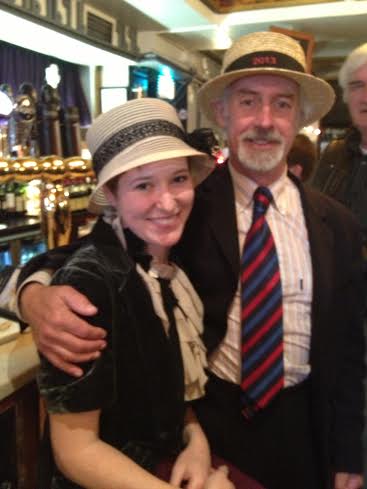
Becky Boncal with John Joyce, grand-nephew of James Joyce, in Davy Byrnes Pub in Dublin, photo by Nicole Joyce Becky Boncal is a graduate of the MFA program at George Mason University. She teaches writing at John Tyler Community College and at The Visual Arts Center in Richmond, VA. Her fiction, poetry, and essays have appeared in The Copperfield Review, The Menda City Review, Everyday Genius, Hoot, and The Buried Letter Press. She was chosen as a finalist for the 2013 Fulton Prize in Fiction for her story published in The Adirondack Review.
-
The Barbershop Quartet
a short memoir by Eileen Shields
The barbershop quartet had been my idea.
My mother-in-law lives in an elder care home located on a quiet, tree-lined street in a Northern California suburb. Her constant complaint is that she is bored. I feel sorry for her because she is a widow with three sons and no daughters. Whether through love or guilt or decades of female submission, daughters generally make more reliable caretakers than sons. For example, a daughter probably would not, as Jean’s sons do, point out that the reason she is bored is that she is disagreeable and grouchy and therefore has no friends. Granted, the boy’s opinion is hard to debate—even her own grandchildren refer to Grandma Jean as Grandma Mean.
The boys’ solution for Jean’s boredom was to hire a paid companion, a middle-aged redheaded woman who takes her on outings and then dutifully sends us photos of these excursions—to the museum, to the aquarium, and once, shockingly, on a helicopter ride with a helmeted and goggled Jean posing at the controls. When my husband asks Jean about her adventures, she does not remember them. The fact is, these days Jean does not remember much, but she does remember she has three sons, and wants nothing more than to spend time with them, because she is bored.
I know how lucky I am to have a daughter. I love my son and am confident he loves me back, but I can’t conceive of him volunteering to trim my toenails in the autumn of my life. He only moved out of the house about a year ago, and already great swathes of his life are a mystery to me. Unlike my daughter, he does not call frequently just to chat about the minutia of his day.
I try not to let more than a week pass without calling my own mother, but I have to twist my spouse’s arm to get him to phone Jean. Like Jean, my mom is a widow, but she is still independent, so she still has things to talk about. Like the hospital she volunteers at in the neighborhood where I grew up, where there are always people dying, many of whom I might possibly have met, briefly, thirty years ago. The deaths of people you barely know is a topic that never exhausts itself. But my husband’s mother responds to every call like a crabby twelve-year-old. I’m bored. The people here are boring.
So a few months back, when my husband had to go to Northern California for business and asked me to accompany him, I said, “Sure, and maybe while we’re there we can take your mom out.”
He said, “Sure, we can take her to brunch.”
I said, “No brunch.” Reminding him that brunch implies champagne or Ramos fizzes or Bloody Marys. Jean is forbidden alcohol—doctor’s orders. She has some liver damage from decades of ‘high living.’ Watching everyone around you gaily imbibing while you abstain could make even the most even-tempered person unpleasant. Jean has been known to threaten the waitstaff…
Sometimes I wish I’d met Jean in her heyday. I’ve seen photos and heard stories (over and over the stories) and it sounds as if, in her youth, Jean was something like the Dorothy Parker of the midwestern burbs, funny and witty and full of vinegar. Dorothy didn’t age gracefully either. It was her friend Edmund Wilson who wrote of Parker in her dotage, “She lives with a small and nervous bad-smelling poodle bitch, drinks a lot, and does not care to go out.”
Read this story in its entirety with your subscription to Fiction Attic.
About the author: Eileen Shields is an MFA candidate in fiction at the University of California Riverside Palm Desert. In 2013 she was runner-up for the Bechtel prize awarded by Susan Orlean for an essay to be published later this year in Teachers & Writers. Her work has previously appeared in The Los Angeles Review.
Submit your creative nonfiction, short stories, flash fiction, and novellas to Fiction Attic.