Your cart is currently empty!
Category: Novel writing
-
Revision: first draft vs. final draft
No one writes a perfect story, essay, or novel the first time around. That’s where revision comes in. The first draft contains everything you wanted to say. The final draft contains everything you needed to say—those things that are essential to the story.
The first draft is likely to have more abstractions, while the final draft should be brimming with significant detail.
The final draft should not contain every detail you find interesting or clever, every detail that came to you during your many inspired and challenging hours of writing. It should, instead, contain relevant details that add meaning. Purple flowered couch may be less meaningful, for example, than the broken pot beneath the window. The purple couch is merely a matter of taste, whereas the broken pot indicates that something has happened—a break-in, maybe, or a more general state of disrepair in the lives of the characters.
The final draft may be longer or shorter than the first draft, depending on your inclinations, but it should be more focused.
I usually edit out many thousands of words over the course of my revisions, but some writers create a skeletal first draft and flesh it out later. I tend to write an overblown first draft and pare it down over time. Whether you pare down or expand upon your first draft, in the end, your final draft should be more focused. The associations among the various parts of your narrative will be clearer, and the themes will have been strengthened by the actions and observations of the characters.
The first draft is your baby, the thing you can’t let go of. The final draft is your concession that a book must be interesting, it must be cognizant of an audience, and it must make the reader want to keep turning pages.
By “concession” I do not mean that you have sold your literary soul, only that you have found a way to combine your best vision and your hard-won narrative skills, in order to make a thing of beauty that is both meaningful and entertaining.
Michelle Richmond is the author of four novels and two story collections. Get her weekly writing and publishing tips, or sign up for an online writing class.
-
Writers on Writing – Willa Cather on “Making It an Adventure”
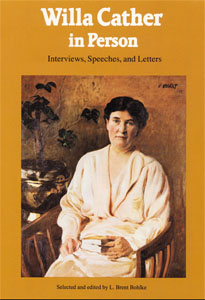 In 1921, Willa Cather told an editor for the magazine Bookman that she only worked for two and a half to three hours each day. “If I made a chore of it, my enthusiasm would die,” she said. “I make it an adventure every day.”
Like so many other writers, Cather preferred working in the morning when she was “fresh” and unencumbered by the day’s concerns. I always prefer working in the morning, too, although my intentions are far better than my practice. For me, the key is getting up early enough to give myself at least an hour before I switch to “mom” mode, which means getting up not a minute later than 5:00. I go to bed most nights believing I will be out of bed by 5:00 the next morning, and then I roll out of bed closer to 6:30 or 7:00, chastising myself and promising to do better tomorrow.
Today was one of those rare days when I happened to live up to my nightly vow. By 5:05 I was at my desk with my coffee, writing. By 6:30, I had written three and a half pages. Those three and a half pages felt more like 20; I felt triumphant, as if I had accomplished a great deal.
And it only took one and a half hours! Cather is on to something here. If you work in short spurts–two hours instead of five–every minute of it is more likely to feel like an adventure. If you can’t afford two hours, try one. If you can’t afford an hour, try thirty minutes. University of Nebraska Press has published a whole book of Cather’s insightful advice on writing, with the utterly unpretentious and spot-on title, Willa Cather on Writing.
Alice Munro, by the way, is a writer who accomplished much of her early success while juggling writing with motherhood. First, she wrote while her youngest child napped, and later, she wrote while her children were at school. Toni Morrison’s time was so limited as a single mother with a nine-to-five job that the time she did manage to find at the typewriter was rich with possibility. “By the time I get to the paper something’s there,” she said. “I can produce.”
No matter when you are able to make it to your writing desk, or your notebook, try to approach it as an adventure, not a chore. Merely having the privilege of an hour to write can be an adventure in itself.
This week, when you sit down to write, attempt to do it with a sense of enthusiasm for the hour that you have, the hour that will never repeat itself, this spectacular, beautiful, unique hour in which anything can happen.
-
Before You Begin: (or How to Get Past Fear & Procrastination and Write Your Novel)
Anyone who tells you that writing a novel is easy has probably never written one. Here are the five most common statements I hear from people who are struggling to write a novel:
- I don’t know where to begin.
- I’ve written a few chapters, but I can’t figure out where to go from here.
- I have a great idea for a novel, but the idea of actually sitting down and writing it feels too daunting.
- I’ve heard you’re supposed to write an outline for your novel, so I did. Now what?
- I’ve actually written a novel before, but I put it away because it isn’t good enough to send out.
No magic formula.
If you find yourself nodding your head to any of these statements, I know what you’re going through. I’ve been there. The truth is, there’s no magic formula for writing a novel. Writing a novel comes with no guarantee of publication, of success, of sales, of an audience. But if you’re reading this, you probably know all that already. And I believe that you’ve already made up your mind about one thing: writing a novel is worth the time and effort, the headaches, the inevitable state of not knowing what will happen to the book into which you’ve poured your heart and soul.You don’t have to know where you’re going.Too often, novels don’t get written because writers think they have to know exactly where the novel is going before they begin. Most of the how-to books on novel writing will tell you to sit down and write an outline first, and start writing your novel later. My approach is the opposite. There actually will come a time to write an outline, but not until you’re deep into the book, with some key chapters and scenes already written.
Trust the writing that comes naturally.
So often, when working with private clients, I’ll praise a particular section of the book for its naturalness, for the fluidity of the writing and the complexity of the characters. Often, the surprised writer will say, “But that was one of the easiest chapters to write!”
Letting go of the inner tension
I think what’s happened in these sections is that the writer has let go of the inner tension of trying to make the passage fit into a predefined idea, and has, instead, written about what mattered to them in the story.
Forget you’re writing a novel.
So, if you’ve been holding back on your novel because it scared you, or because you got stuck, or because you simply didn’t know where to go, my primary advice would be to forget for a moment that you’re writing a novel.
Instead, begin here:
“I want to write this story because…”Follow that up with:
“I care about these characters because…”Then, see where it takes you! You might be surprised.
Ready to get started? Go to DAY 1.
-
5 Great Tools for Writers
 The only way to be a writer is to sit down and write. It doesn’t matter how many terrific notebooks and apps you have, or how gorgeous your desk looks, or how supportive your writing group is: if you don’t actually sit down and do the work, you can’t really call yourself a writer.
But if you’ve committed to sitting down and doing the work, there are some great tools to make the process run a bit more smoothly. Here are four of my favorites.
1. CREATAVIST
What it is: a free platform for writing and publishing your books.
Why I love it: Not so long ago, if you wanted to publish an ebook across different platforms, you had to perform a whole lot of formatting voodoo. Every major platform–Kindle, Nook, Kobo, ibooks, and Smashwords–had different formatting rule. The toughest part by far was creating a linkable table of contents. With Creatavist, you insert your text chapter by chapter, choose the formats in which you would like to publish, and then download a separate file for each platform.
Cost: free
Go to Creatavist.
2. CREATESPACE
What it is: Amazon’s free platform for designing and publishing print books
Why I love it: Createspace makes it easy to design a good-looking cover by inputting your title, image, cover copy, and author name. Once you’ve created your cover, you can upload the interior of your book as a PDF or .doc file. You can either use the online proof to make sure everything looks the way you want, or, to see exactly what your printed book will look like, you can order a proof. Once your book is ready for publication, it just takes a few clicks to put it up for sale on Amazon. You choose the price and distribution options; you can offer it for sale on Amazon, in bookstore chains, and for libraries. You can also order deeply discounted copies to sell or give away.
Cost: free to join, free to sell. Pay only for the books you purchase for yourself.
Go to Createspace.
3. SCRIVENER
What it is: an app to help you organize your writing into chapters, research, scenes, and more
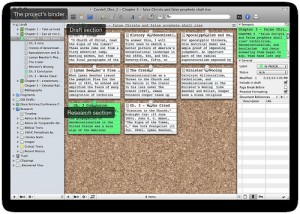
Why I love it: the corkboard interface is really attractive and intuitive. The highly customizable, hierarchical ranking of folders, files, and research is a great fit for anyone using The Paperclip Method to write their novel. Several years ago, I was so impressed by Scrivener that I bought a Mac laptop so that I could use it. I wasn’t disappointed! You can get the Scrivener app for Mac here. While Scrivener has, unfortunately, not available as an ipad app, you can download the Index Card app ($4.99) on your iphone or ipad and sync it with Scrivener. Scrivener is far from free, but I find that it’s very much worth the price.
Cost: $44.99 for the app
4. SUBMITTABLE
What it is: a free tool for submitting your work to literary journals and other magazines
Why I love it: Submittable allows you to submit work to any one of the hundreds of high-quality literary magazines that use the service. It will also keep track of all of your submissions in one place. It is currently becoming the most popular submission tool for everything from The Atlantic to McSweeney’s. Currently, the only way for writers to sign up for Submittable is to submit to a magazine that uses the service. Boo. Once you’ve done that, however, it will keep track of the status of all of your Submittable submissions–accepted, rejected, in progress, etc. As an editor (over at Fiction Attic Press), I use it to communicate with submitters and to run contests. By the way, once I’ve accepted someone’s work and it’s time to put together a book, I head over to Creatavist.
Cost: free
What it is: a series of workbooks designed to help you figure out the heart of your story and write your novel from start to finish
Why it works: The Paperlcip Method series includes four workbooks: Story Starters, The Complete Character, The Paperclip Method: The No-Outline Novel Method, and Next Draft: Tools for Revision. The series is designed for anyone who wants to write a novel but isn’t sure where to begin, or anyone who has tried to write a novel but can’t get all of the threads to come together. You can download the entire series instantly, or purchase individual workbooks.
Why I believe in it: I created this series based on my years of writing practice and teaching private classes and gradate-level writing workshops. The method outlined in these workbooks is the same method I have used to write four novels, including a New York Times bestseller.
Price: $14.99 for one workbook, $39.99 for all four
-
Novella Writing – a Map for Getting Started
The first thing you need to know about writing a novel is that there are no easy answers. There’s no magic formula for novel-writing. Every novel demands its own structure, its own pace, its own way of looking at the world.
Still with me? Good. Because, as it turns out, novel writing isn’t just a head-banging exercise in utter frustration and despair (although, trust me, sometimes it is just that). It’s also a deep swim into your own head space, a really fun adventure, and one of the most thrillingly creative things a person can do. It’s your world; you get to make it, populate it, cultivate it, and bring all of the pieces together.
If you’re ready to take on the challenge of writing a novel, continue reading for 10 steps to get your started.
1. Consider the setting.
Setting encompasses not only place, but also time. Where does your novel happen, and when?2. Consider the point of view.
Who is telling the story, from what distance? Do you have a first-person narrator who is at the center of the action, an omniscient narrator who is able to go into the thoughts of any character at any time, a limited third person narration that sticks closely to one character? (more…)