Your cart is currently empty!
Category: Featured
-
Google My Address
Essay by Amy McCullough
There are two things I won’t do in our (relatively) new house. I won’t bring in the previous tenants’ mail, and I won’t lie in bed a certain way.
There’s another thing: I won’t write about it from within it—or anywhere near it, for that matter. I’m in the Las Vegas airport right now; it’s just after midnight, Austin time (10 p.m. here). I’m on a layover en route to Chicago, where I’ll be helping my dad with his homecoming from rehab after a stroke (an unexpected, sobering implication of his elderliness for both him and me). It’s an alienating thing to be on an airplane with young couples and groups of friends and a mariachi band, all excited to arrive in Sin City, when I’m just a tired 38-year-old on a decidedly less celebratory errand.
I’m writing about the house now because I am far from it. I do not consider myself a superstitious person, but I have been reluctant to “go there” from there, as it were. My main concern is nightmares. I haven’t had any yet, and we’ve lived there going on a year (11 months almost to the date, actually).
When I first heard what happened there, on Cordell Lane, I thought it was a deal-breaker. I was in the midst of writing Jimmie a message that said, “I don’t think I can live there; those are just too bad of vibes” (or something to that effect), when a new message appeared in my inbox. It was Jimmie, reaching me before I sent my own email, saying he was down. Well, he wasn’t “down” as in cool with what had happened. He may have found it interesting or fascinating, if you had to choose a couple slightly positive adjectives. He might have seen it as a novelty that meant we could be right for the house—just the kind of couple who could “take it,” so to speak (I had a similar thought). But he was not discouraged. He was still “down” with submitting our rental applications. His one caveat was that the killer had to be dead.
“I mean, as long as the guy who did it isn’t still out there,” he explained, it doesn’t really bother me.
Okay. I got that. But did it bother me? I thought the vibes were so bad I was ready to let it go, to surrender that bright, sunny living room and open kitchen area with its bay window and white brick chimney, its exposed rafters and high, angled ceiling. I was about to stop imagining myself living in a home with closets and floors that didn’t give you splinters if you walked barefoot. I was “cool,” actually, with looking around a bit more. Mostly because I was afraid I’d have brutal nightmares.
You have likely surmised by now that a murder took place at our house. The previous tenants were an estranged married couple; I believe they were separated but still living together…I think he even had a girlfriend, and that topic caused a pot-boiler fight that alerted the neighbors to some potential violence before the final blows. I would check the details, but I prefer not to Google our address. I don’t want to see the headline, “Two bodies found in East Austin home,” because I don’t want to think about those bodies. I don’t want to start imagining where they were in the house, what room it happened in. I don’t want to think about their three dogs and if they tracked bloody paw prints all around the house afterward, before the police arrived. I can’t remember if he did it with a knife and a gun or just a gun; I recall reading of both weapons, but I might be confused. As I said, I don’t look it up. I don’t want to be reminded of the details. I don’t want to make it too real.

But it is real. Two people died in the house we’ve been living in for (almost) a year. A man and a woman not far from our ages, I don’t think, probably in their thirties (Jimmie just turned forty, but close enough). Shay, the ambitious young real estate agent that was helping the out-of-the-country owner rent her home, told us she had to disclose that someone had died in the house. You know, “just FYI.”
“Someone,” as indicated by the headline I prefer to avoid, was actually some two. The man apparently killed his wife and then killed himself. Murder-suicide. A compound noun that surely no one wants associated with themselves or their dwelling.
When Shay first mentioned the death in the house, I assumed it was probably an elderly person, perhaps a parent that was being cared for in their home by a hospice nurse or family member. Then I Googled our address. We moved in in September. The incident happened that June. The house had been “completely remodeled” since, Shay assured us. We were the very next tenants.
Jimmie says he loves making up stories, thinking about stories, and he does. For some stupid reason, I get upset or competitive when he says things like that. Like, “Oh, do you? Are you the creative one?” We are both creative, and we very often (almost always) work as a creative team (we make independent movies together as a hobby). So it’s pretty stupid to get defensive about such statements, but I sometimes do. I occasionally get a little pick-a-fighty, especially after a drink or two. That may be getting worse as I get older.
Jimmie and I don’t fight much, but we’ve actually had a few doozies in this new house. I honestly don’t think it’s the “bad vibes.” I think it’s because we wrapped up a two-year project there (a full-length movie titled Gary and the Underworld), and tensions and emotions always run high when we’re finalizing a movie. We want it to be perfect, and there are usually small discrepancies between how each of us thinks perfection will be attained, which leads to some disagreements. It makes sense, and we’re both used to and sort of expect the process to some extent. We feel bad for overreacting to criticisms or ideas we’re not into, but we work on it until we’re both happy with the end result.
But a few of those Gary-related arguments got me thinking, as we sat on our back patio, drinking rye whiskey and beer and getting more and more worked up, as we misunderstood each other and overreacted with each back-and-forth, about how things could escalate to such a horrible end. It has crossed my mind: What if this house is cursed? What if a bad enough fight leads us to dark, evil places we never would have expected?
I don’t worry about that often or even realistically. Jimmie and love each other very much. We truly want nothing more than to live together as long as possible. The envisioned possibility of a homicidal scenario is not a rational fear, but it’s one of those things that crosses your mind if you live in a murder house.
It’s also the kind of running-away-with-things imaginations Jimmie and I have. We can’t help but imagine horror movie plotlines, even if it’s wrong to have those thoughts about a real thing. Clearly, we realize this event did not happen to be our creative muse, but it happened, and we became a part of that story by being the next people to live there, and it is a muse.
It also, in a strange way, is an inspiration to be good to one another, to be the most confidence-inspiring couple. Can you imagine, for instance, what the owner must have been thinking when reviewing applications? How solid of a couple is this? Lucky for her, pretty solid. At the time of applying, we had 8 consecutive years of rental history in Austin and 11 years together. We’d even lived (enjoyably) on a 27-foot sailboat for a year; that’s compatibility.
But the storylines arise. I was doing some yard work not long after we moved in, and I found a bone in what seemed like the remains of a raised garden bed. There were no wooden borders anymore, but there were mounded areas of fresher-seeming soil, where the grass grew more lushly, as if someone had amended it with compost and fertilizer…or, you know, like a fucking grave.
So, of course, it crossed my mind that, if I continued digging and poking around, maybe I’d find more bones, human bones—and lots of them. Maybe the wife wasn’t the husband’s first victim? Maybe she was one of many.
It was probably from a past barbecue…or maybe some incident involving wildlife. Our dog, Dexter, has already killed two possums in our backyard—a skill we did not realize he had until about a month after we moved in, when he made my jaw drop in all earnestness as I watched him pluck a white-faced victim off the top of our rather high wooden fence and drag it down into an area of Tradescantia plants we call the “Secret Garden” (it’s sort of hidden around a corner). In the Secret Garden, Dexter took Springsteen’s advice and did not think twice; he promptly broke his victim’s neck—Jimmie heard the crack. Jimmie disposed of the body and I cleaned up our bloody hound dog, who did not have a single scratch on him. I do realize the faux pas when I let him out and say, “Try not to murder anything tonight” or when I refer to the yard as a crime scene (but it never occurs to me until after it comes out).
Jimmie actually just confessed to me last night that he has had a dream about the house—not a terrifying, gore-filled re-creation of the crime, but a story about a song and a cassette tape (which, incidentally, also involves digging). It’s interesting to me that it came up last night, because I was already planning on writing about this during my Las Vegas layover, while I had “the chance”; it’s also notable because we never talk about it. We agreed at some point not to, to avoid giving the event “energy” (this is an idea we got from Yoko Ono; she says something in an old interview about giving more energy to peace than to war).
Jimmie is a musician, even if he wouldn’t call himself that. He has played trumpet his entire life and has added bass guitar, keyboards, and tenor saxophone over the years. He’s added sax with especial vigor. The instrument he plays belonged to my paternal (favorite/only known) grandpa; Jimmie took it up to give it life outside of a dusty storage space on the second floor of my hermitic uncle’s house (and because he wanted to learn). And playing it has become a new passion for him. I (and Jimmie) believe this has something to do with the saxophone liberating him from the anxiety intrinsically linked to his trumpet playing (which developed from years of self-imposed pressure as a young man).
All that considered, I wasn’t surprised that Jimmie’s story related to “the horror” is also about a song. In his dream, he is working on a song and has something he really likes, a start, but he doesn’t know where to go with it. It feels like it has an ending, a direction, but he can’t find it. He has songwriter’s block. Then, one night, he is drawn via a strange impulse, an instinctual attraction, toward the backyard. He begins to dig and eventually finds a tape—and it has his song on it. His whole, completed song.
Jimmie interpreted this to mean that the guy, the murderer, had the same experience, wrote the same beginning of the same song in our house. That eventually he filled it out, realized where it needed to go, and recorded it. Then, presumably, he lost his mind and killed his wife and himself. I’m not sure where in that sequence he buried the tape, but you know how dreams are spotty and weird. This is all speculative, but the gist is that the song goes with the house, and the tenant becomes victim to the crazy-making songwriting experience. Jimmie’s character in this story is probably supposed to add to the composition and bury the tape again, then kill his whole family or what have you.
Initially, I wondered if a neighbor would say something, mosey over nonchalantly and ask, “You know what happened in this house, right?” But no one has been that classless, luckily. But there are kids around, and you know kids will say anything. Mariah, the grade-school-age daughter of our across-the-street neighbor, basically interrogated us the day we arrived with our moving truck; her little brother rolled his eyes as if to say, “She always does this.” She asked us what we were doing, formulated specific questions about items we were carrying out of the truck, asked if we had jobs and what and where they were. She is a natural journalist. So, she might have said something. Hopefully she doesn’t know.
You never know how people are going to take it, so you don’t tell anyone—or that’s what you agree to do before having your first houseguests. Along with agreeing that we would generally let the topic, um, die, Jimmie and I also agreed we probably shouldn’t tell anyone, especially anyone atthe house. (For instance, Jimmie told Richard, a coworker who he very much likes and respects but who is quite unlikely to come over, about the murder-suicide and about his dream; that seems more acceptable because Richard won’t ever have to think about that while in the space where it happened.)
The November after we moved, two of our closest friends came to visit from Portland. They are siblings (brother and sister), and the sister was bringing her newish boyfriend. We had met him briefly once before in Portland and liked him, but we did not know him well. Ashley, the sister, and I are best friends, and our birthdays are three days apart. So we make a point of getting together every year for “Scorpio Fest.” This was Scorp Fest 2017, and it would be everyone involved’s first time at our new house.
We now had two extra bedrooms, so that was exciting. Ashley and Shane could have the room we intended to convert into a guest room. It is normally my “boudoir,” a spare room that I’ve converted into an indulgent, early-‘90s-themed mega-closet and dressing room in a reactionary move against our old house, which we loved but which had, well, “nominal” closet space is putting it nicely.
Chris, the brother, could have the “Devil’s Office,” another extra bedroom that is basically a juvenile space for playing video games while seated in vinyl bean bags. (We don’t smoke pot often, but let’s just say that whenever we have some nearly all of it gets smoked in there.) It’s also, weirdly, a slightly smaller-scale replica of our old living room. We went a little bonkers and bought all new living room furniture for our new house—which, if I haven’t made clear, is a pretty beautiful, spacious, and stylish place in which to live (less the upsetting history). So we put our worn-out previous couch, as well as a lamp and a large piece of art from our old living room, in the Devil’s Office. It has this name because, for a few months after we moved in, we had every intention of turning that extra space into a set for a scene in Gary and the Underworld that, not surprisingly, takes place in Beelzebub’s place of business. (We ended up shooting the scene elsewhere, but the name stuck.)
We decided before this Oregonian threesome arrived that we would not, under any circumstances, bring up the incident at the house. We felt fairly sure that the Bonds (the siblings) wouldn’t care, meaning we didn’t think they’d be bothered, personally. We do not believe in ghosts—an important factor in our ability to live where we do—and we didn’t think they did, either. But we didn’t know about Shane.
As their visit went on, Jimmie and I both became more and more tempted to bring it up. We felt this temptation separately, we came to find out later; we were both effectively keeping our mouths shut about it, even to each other. The Bonds, as I have said, are some of our dearest friends in the world, and if we were going to share with anyone, it would be them. Also, that is just “one spicy meatball,” as an ex of mine would have put it. With the right (read: best friends who don’t believe in ghosts) company, it was hard not to want to spill the beans about the spilled blood.
I had resolved that we should tell them the day they were leaving. I thought, just in case they did find it upsetting, it would be courteous not to make them sleep in the house after planting that seed, a gruesome acorn from which to sprout (as I myself was certainly terrified) a horrible nightmare. I was going to tell Jimmie that I thought this was a good course of action the night before they left (in case he was feeling tempted, as well).
But he beat me to it.
In a moment of attempted male bonding during which Ashley and I were picking up a pizza, he told Chris and Shane. Chris was enthralled, in the ways a decent person could be. Shane Googled it…because the Internet makes things true. Having seen that Jimmie (who, admittedly, he did not know well) was not shitting him, and—unfortunately—being someone who does believe in ghosts, he got a bit too loaded and then freaked the fuck out.
I won’t go into the gory (social, not corporeal) details, as I would like to remain friends with these people. But a knock-down, drag-out fight between Shane and Ashley was the end result, fueled by simmering tension between boyfriend and brother (and not helped by some previous dickish behavior of Jimmie’s and a bit of OCD new-house uptightness on my part). Take booze and ghosts, add any amount of fodder for conflict—and drama is going to ensue.
Curbside crying took place, as did screaming in the house and on our front lawn. The front door was definitely slammed. During and after, I couldn’t help but wonder what the neighbors must have been thinking: hearing escalated, shriek-pitched fighting from the house where the worst kind of domestic dispute had played out just six months prior.
Speaking of the front door, if you Google our address (which is, apparently, the thing to do), you’ll see older photos of it with a cherry red door. It is now cobalt blue. I can only imagine that’s because the owner didn’t want to leave the door of the “murder house” red when going ahead with an overhaul remodeling effort.
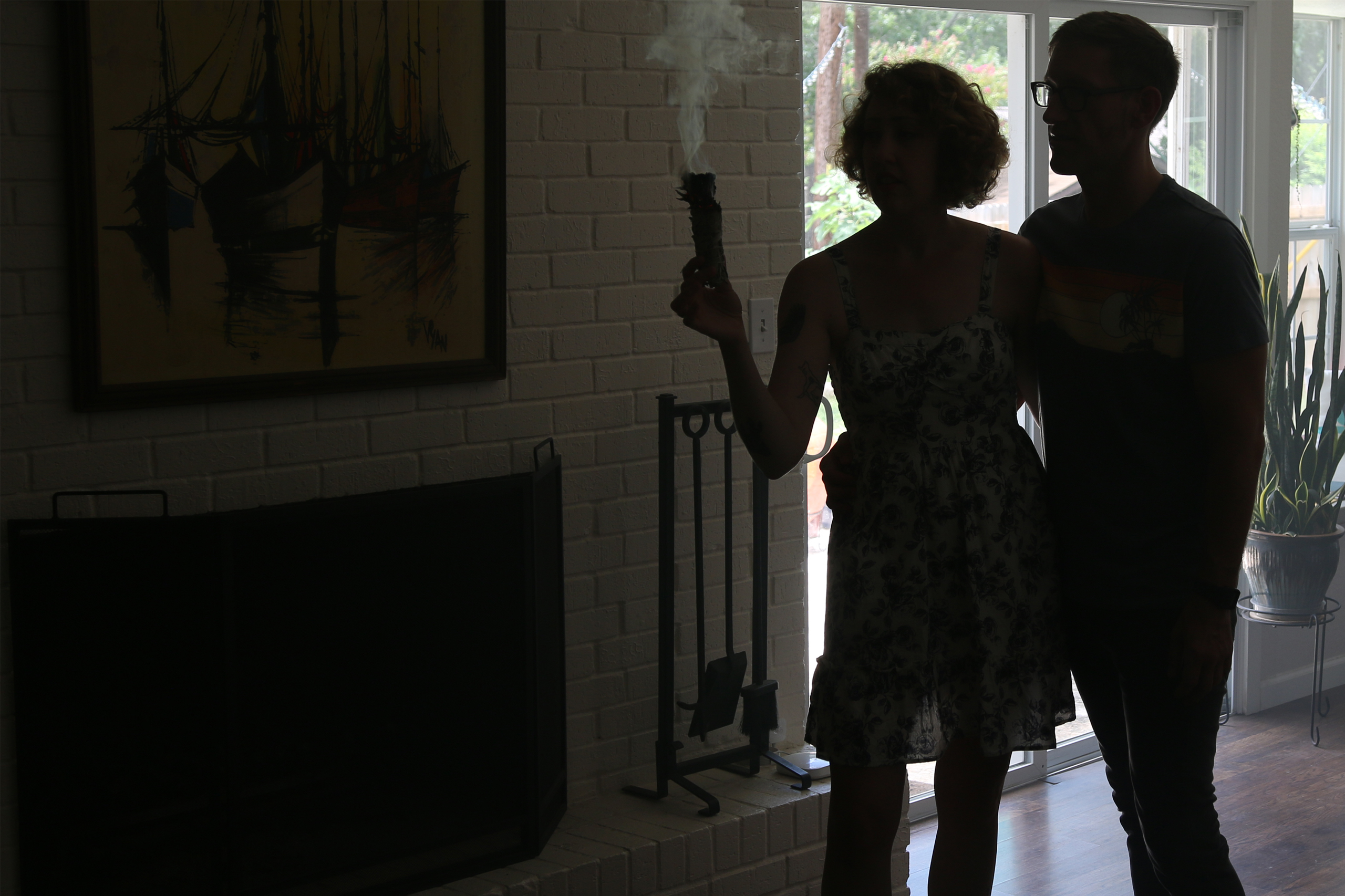
The first thing Jimmie and I did when we entered through that door as actual tenants was light a sage “smudge stick” and walk through the house, cleansing each room of “bad vibes” while listening to “At Dawn” by My Morning Jacket (you’re supposed to repeat something positive or important to you or listen to some sweet jams; we chose the latter). Neither of us necessarily subscribe to the idea that a sage smudge stick actually does anything, but Jimmie is from Oregon and I lived there for a while (in Eugene, even), so we are both part hippie (native and honorary); as such, we have soft spots for such metaphysical leanings, and the ritualistic/ceremonial aspect of it appealed to both of us.
When we were debating about living there after discovering the details about “the “death in the house,” as Shay put it, I arrived at the smudge stick idea as a way I could make myself feel okay with living there. Often, for me, just deciding something will work for me is enough to make it true. So we did that, and the sage is still in our fireplace, a totem to our good vibes. (Truth be told, we broke it out again after Scorp Fest 2017 just for good measure.)
The other superstitions I have mentioned. I won’t bring mail with names of the victim or the murderer into the house. I suppose I don’t want their presence there, in any form or suggestion. We don’t get things for them very often, but pieces do come. And I take them directly from the mailbox to the recycling bin. I have never mentioned this to Jimmie. The one or two times I’ve seen a piece of mail for one of them in the house or in the indoor recycling bin (because he beat me to the mail), I promptly take it outside without a word.
And I won’t lie in bed, in our bedroom, on my back with my arms crossed over my body. It reminds me too much of what I imagine is done when you die, how you’re put into a body bag. I remember (or was it my imagination?) seeing an image in one of the news stories about our house of a body bag being carried out. I suspect my psyche might have made that up afterward…but I think I saw it. I’m not going to check. Regardless, I don’t feel at all comfortable mimicking what I picture as that position: the position of death.
Like I said, I don’t know what room it happened in, and I don’t (ever) want to. When it came up briefly with Chris—after he confessed to me that Jimmie had served that spicy meatball (and that he was still okay with being our houseguest)—he flippantly said that it probably happened in the Devil’s Office. I have no idea why he’d say that other than to be nice: He might have realized it would help me sleep at night, forestall my nightmares—which, clearly, has been my fear all along. Good friends can read your mind like that.
I’m about to get on the plane to Chicago, where I will (hopefully) sleep. This might be the nightmare’s best chance to get me, actually—I just gave it quite a bit of energy, here at Ruby’s Diner in Concourse D of McCarran International Airport. At least I will be far away from the source as I sleep; flying through the air, uncomfortable in the small, non-reclining seat of a cheap, necessary flight; but unattached and not lying in an undesirable, corpselike position.
Amy McCullough is author of The Box Wine Sailors: Misadventures of a Broke Young Couple at Sea (2015, Chicago Review Press). She is the former music editor of Willamette Week, Portland, Oregon’s Pulitzer Prize-winning alt-weekly newspaper; has written for Eugene Weekly, SAIL Magazine, Loyola Magazine, Finder, and Edible Austin; and is currently editor of Wildflower, the magazine of the Lady Bird Johnson Wildflower Center. In addition to writing, she makes super-low-budget movies with her partner and former shipmate, Jimmie. They live in Austin, Texas, with a singing hound dog named Dexter. Read more about Amy on her website, theboxwinesailors.com.
Images by Jimmie Buchanan Jr.
Editor’s note:
I was trying to figure out how the writer was going to wrap this essay up. Endings are difficult, and sometimes the wrong ending can derail an otherwise great piece. I love the way she comes back to the airport terminal at the end. I love the immediacy she creates by bringing us there with her as she is about to board a flight, writing this essay that has been nagging at her.
I also love the idea of horror-as-muse, and the guilt that comes along with understanding the impropriety of murder as a muse. As writers we all have our creative springboards, our muses that lead us into the creative work. Because of choices McCullough makes in terms of how much she will reveal, and when, “Google My Address” becomes an essay about creativity more than an essay about murder, serving as a kind of confession of how creative people use other people’s pain as a jumping-off point for art. M.R. June 2019
-
CSI SUV – by Gloria Frym
I was taking a bath when the idea first occurred to me—the phone call which deprived me, forever I believe, of the good opinion of several friends. I have heard it said by others that they laughed so hard they wanted to do it themselves. Since I am not in possession of a great amount of free inventive powers, I always felt the need of some firm ground in the form of idea in my work. The same thing happened with this.
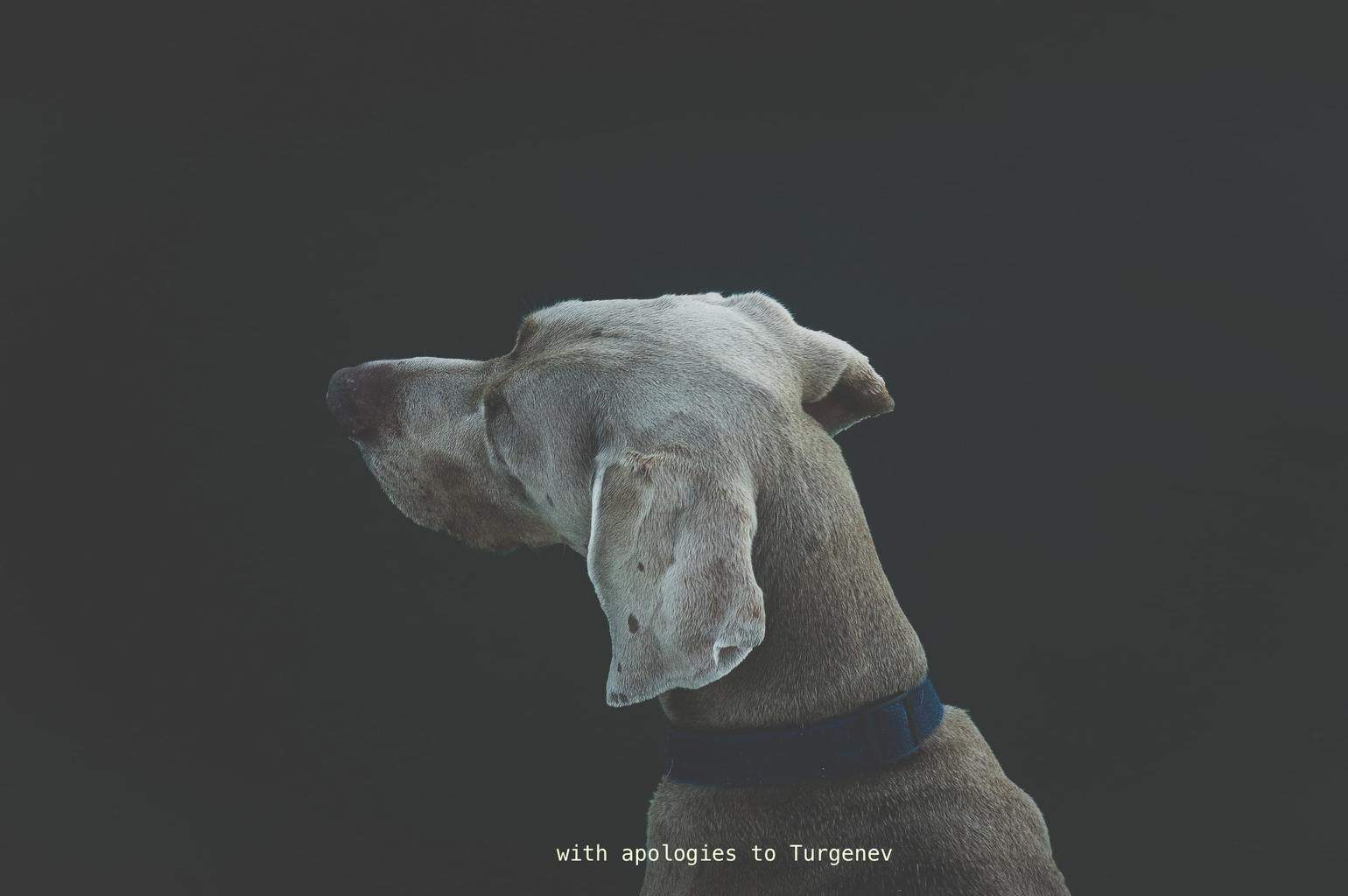
At the basis of it lay a story I had been greatly struck by just as three pit bulls in the dog park happened to rush by me, each yelping at the same pitch. In that remarkable moment I could watch the embodiment of a principle that had scarcely come to life but was just beginning to stir at the time, the principle which later received the name of ***.
Though very powerful, the impression this incident left on me was still rather vague. At first, I could not quite make out what the pits were after except one another.
I kept returning to the park to observe and listen to everything around me as though wishing to check the truth of my own impressions. I was worried by the following fact: not in one work of literature did I ever find as much as a hint at what I seemed to see everywhere. At the dog park, there was a woman who was endowed with an impressive nose for everything—namely, the ideas of our time. I told her what I was thinking of and what interested me so much and was astonished to hear the following remark:
Did you get this from something you saw in the movies? I said nothing.
These words produced such an effect on me that for several days I tried not to think of the idea I had in mind. However, at some point, it matured in my head. In order to sort the curds from the whey I accidentally returned a call from a dear friend. What was I after? An embodiment of the idea.
I pressed Send and when I did not hear her voice, I put the phone aside. Then I turned on the television. Nothing but crime shows on four of the few free channels left. I stretched out from a long day; my dear dog leapt onto the couch to sit beside me in order to be stroked. I was not entirely certain that this creature loved me for who I am or simply loved to be stroked and fed. Is that love? I wondered, further enlarging the sub-idea that was involved in this account. Also, my dog is not particularly affectionate and does not always run with others. Nor does she lick my face unless I should have some leftover meal or the scent of it besmirching my cheeks.
Sirens blared from the flat screen speakers, alerting my bitch’s ears, not to mention my own, and I summarily mistook the sound for 1)the emergency alert system at last in action; 2)medical aid rushing to the scene of a neighbor’s heart attack. The story on TV involved a dead body, a sharp-tongued detective, and a pert sarcastic set of female coroners who compete for excellence in their work as well as the attention of the same man.
She’s toast, the detective says, poking a campfire stick at the victim’s elbow.
She was burned like a marshmallow.
Ok, says one of the coroners, let’s do a work up. You never know the time of death with these sorts of SUVs.
No, you don’t, says the other coroner, removing her 5-inch heels to dump a pebble that had inadvertently crept its way into her arch.
What are you doing? screams the first pert coroner in concert with the detective. You’re occupying the crime scene with your crap.
What are you calling crap? And who is you? Who am I? Why?
A long silence ensued while the medics hoisted the charred body onto a stretcher.
Crispy, ya think? said one of the medics.
Lucky her lips are still intact, said the other.
Just as this pronouncement was made by the television medic, fire trucks pulled up to my house. I certainly had not asked for them. My landline phone rang. It was her, dear friend. Are you there? she yelled over crackling static. Am I where? I said. She seemed to not hear me.
After that it was all a blur. The television medic, the pert coroners, the sirens, the phone calls, the knocks on the door, the boyfriend, the girlfriends, the clerk in the mini-mart with whom I had exchanged ideas about capitalism. All rotating before me like a spinning globe. We heard what the police said, we feared, we rushed over because … .we love you, each said in their own voice, except all the voices became a chorus and the chorus stood by my couch and my dog barked a bark I had never heard before.
How utterly wonderful! I love you too, I said in the ensuing group hug.
Except that instantly the pedestal on which I stood among these dears had been destroyed chiefly by the chief medic combing through my home and discovering my cell phone, which was still blithely speaking to my friend who was standing right in front of me, not hearing it anymore, half-crazed at the thought that someone had put me on a spit and roasted all but my face.
Would they understand or forgive me? Not me, but my idea. The excuse of being an unloved child no longer held any caché among the best of them who had, well, let’s leave it at that. That it might have been an accident lingered in the minds of some of those present, except the boyfriend of my girlfriend who did not believe in accidents. They did not, have never got quite the right idea of what took place in the mind of a person, or of what exactly her joys and sorrows, her aims, successes and failures are. They do not, for instance, even suspect the pleasure that consists of castigating one’s self and one’s faults in the actions one commits. Now they seem quite sure that this was a little prank, even if the reality of life has been correctly and powerfully reproduced, even if this truth does not coincide with my own sympathies. In the words of Goethe, “if these are roses, they will bloom.”
Gloria Frym was born in Brooklyn. Her new collection of prose, THE TRUE PATRIOT, is just out from Spuyten Duyvil. Her recent books of poetry are The Stage Stop Motel and MIND OVER MATTER (BlazeVOX books, 2011). She is also the author of two short story collections—DISTANCE NO OBJECT (City Lights Publishers, 1999) and HOW I LEARNED (Coffee House Press, 1992). She teaches at California College of the Arts in the San Francisco Bay Area.
Photo courtesy of Will Langenberg. Visit the artist at willlangenberg.com.

-
The Electric Discharge Corona
photo courtesy of Tom Eversley @TomEversley Memoir by Anne-Marie Yerks
The things you don’t know about a house when you buy it: The leaks, the bugs, the dark and cold corners and warped walls. A stove that refuses to hit the right temperature, the driveway that isn’t shaped right, the too-loud clank of the mailbox door, a backyard too shady to grow vegetables. But the good things too: The porch with tall windows, the wood around the windows, the deep sills where the cat sleeps. Watching people stroll the sidewalk ? there are the dog-walkers, the power walkers, bottle deposit seekers, partiers, the carless, the insane. They go by as we look on from the enclosed porch of our ninety-four year old house of mysteries, the most compelling of which happened less than five years ago. A woman died here, and we don’t know why.
I don’t know why, but I know when. And I know who she was. Her name was Renee Galinyan, and she was 37 years old on her last day of life. She was in love with the man we bought the house from, and she liked belly dancing, comedy clubs, Renaissance festivals, and dogs. She was overweight, pretty and sparkly, with straight dark-brown hair and optimism shining from her brown eyes. An Armenian church prayed for her the week before she died, and a group of people from a medical lab donated $81.31 to the church in lieu of flowers for her memorial. Other people donated thousands. She had a tattoo on her shoulder ¾ one I didn’t look at closely because I dislike tattoos ¾ and, interestingly, an active account on MySpace. She had a brother not much older or younger than her, handsome in the way she was pretty, and a mother who liked the man she loved. All of this I learned from an Internet session of many hours. I combed search engines and Facebook profiles and photo albums, typing and retyping keywords into different combinations to learn more. Eventually, I had enough information that I could like Renee instead of fear her, but nowhere did I learn why she died. The final days, what were they like? Did she know it was coming, or was she still hoping for recovery?
With this question, the ghost made itself.
The Electric Discharge Corona won first place in the Fiction Attic Creative Nonfiction Contest and will appear in our forthcoming anthology, Modern American Essays. This is only an excerpt.
-
The Truth About Alaska
by Mickey Laurence Cohen
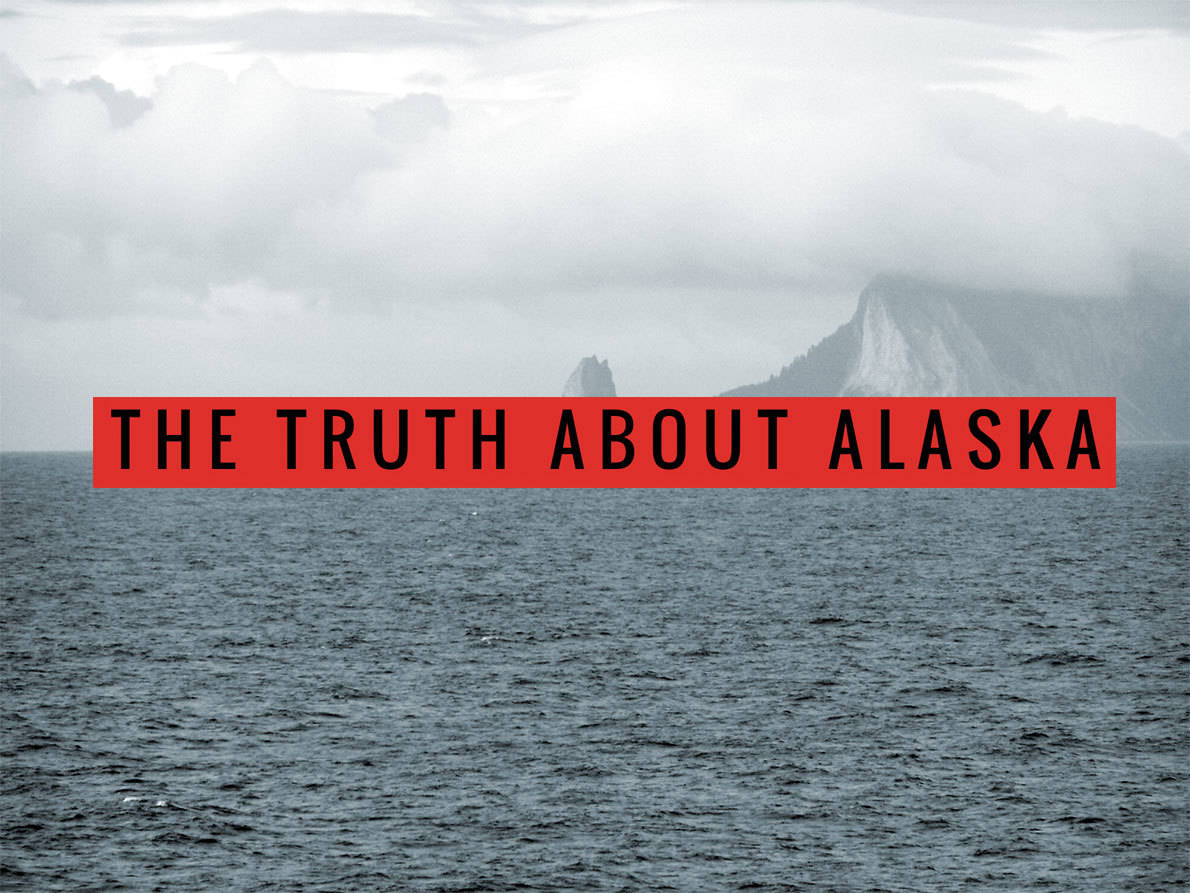
The ice field trapped us. Floes as long and thick as churches crowded the boat, shrieking the paint from the hull. Boredom settled among us like fog, like the frozen fog hanging in the cold Alaskan air around us. Now and then a floe snapped with a cracking sound like thunder. We cut the engines and we drifted.
There was no way to know for how long we’d be trapped. Another day, another week, perhaps longer. From time to time the engines came to life, the propellers burped and churned and shifted us this way or that to avoid a passing floe. Any one of them large enough to crush the hull and sink us.
We were bored. The night before the crew had all shaved their heads. This had been their idea; they had been drinking and one of them had asked to borrow my clippers and then another and another and pretty soon they were holding down the ones who refused. Oh, the way I used to tell it I stood back and watched them do this and claimed there were too many of them to make them stop. But now I will admit I egged them on. I wanted them to look like me. They were all young, most of them from the same town, most of them fresh out of high school. They were tall, good-looking, all-American farm boys and I looked nothing at all like them. If I could not look like them, I thought, I could make them look like me.
In the morning they gathered in the galley, hung over and ashamed, homely and humbled.
We were bored. Alaska was only just waking from its long winter’s night, trapping us in its endless twilight. At times the fog, already thick enough to touch, pressed in still closer around us, solid and prickly, stinging the nostrils, the tongue, the throat. The fog weighted us, bound us. I had the sensation we had sailed beyond time. I had the sensation the fog <i>was</i> time, the past, the present, the future mere objects like all the rest. We need only reach out, I thought, and take what we wish.
By then I had already taken to sitting on top of the boat, on what had formerly been the ship’s helicopter pad, now loaded high with pallets of cardboard boxes. On the stern end the pallets formed a small shelf, and this is where I liked to sit and watch Alaska.
The rest of the crew gathered at the rail below. An especially large floe had nestled itself against the starboard side of the hull and the crew were taking turns climbing down the ladder to stand on that and have their photos taken. The fog had drawn in close around us and from where I sat it appeared as if they walked on the fog.
It was dangerous to stand on the ice. There would no warning when an ice floe snapped, suddenly split and shattered and an instant later disappeared, leaving only the black sea, cold enough to kill in seconds. In the distance we heard other ice floes breaking up, the sudden cracking and roar, thunderous and deafening, snarled in the frozen fog.
One by one the crew dropped over the side, standing on the floe just long enough to have their photo taken, scrambling up again, merging back into the group. One of them, whom the others had nicknamed Father, spotted me and waved me down to join him. He was a couple years older than the others, almost my age, and he was studying to become a minister. He had been the first to ask me to shave his head but he had not taken part in the rest.
I arrived at the rail just as another of them, a jokester with a jawful of chew, climbed down the ladder and dropped to the floe. Instead of climbing up again, he started to walk on the ice, kicking at the layer of slushy snow on its surface. He walked out a few yards and turned to face us and danced a jig. The others laughed. They wanted me to climb down there too but I said no.
The floe drifted alongside the boat, nudging the hull, booming in the hollows of the holds, and slowly carried him away from the ladder.
The fog thickened around us. Nearby a floe cracked, a noise like gunshot, and another, farther off, and another, closer by again. Father called out to the jokester, told him to stop playing the fool. But he just laughed and danced his jig and the others laughed too and snapped photographs. The floe drifted, carried him toward mid-deck. Father rushed ahead to the ladder there, and I went to join him.
I liked Father. I had never met anyone quite like him. I felt he was so much the opposite of me that we somehow reached around and joined each other again on the other side, so to speak. He was earnest and strong and truthful and when he looked at me it was with genuine sadness. He had never met anyone like me either. Didn’t it bother me, he had asked me shortly after we’d set sail, to know I would go to hell? No one had ever asked me this before and from someone else I might have been offended. But I liked Father and he had looked at me with such honest concern that I said nothing.
Now he called to the jokester by his full name, scolding him. The jokester grinned and danced his jig and waved his hat at us. Wisps of steam tipped his bald skull. Father scolded him again, ordered him back to the boat. The jokester moved closer to the hull, reaching for the ladder. The others never argued with Father.
We exchanged a look. I felt as if we were thinking exactly the same thing at exactly the same moment. I felt as if we somehow reached into the future, perhaps only a split-second or so, enough. For just at that moment we heard the loudest crack of them all, a thunder so loud and so close it shook the boat and we struggled to keep our footing. Without a word, Father and I swung ourselves out on the ladder, we reached down and grabbed hold of the jokester just as the ice floe split and disappeared beneath him. We hung there, dangling the jokester between us above that black and deadly sea, until the rest of the crew caught up to us and helped us to drag him back onto the deck.
This is how I used to tell the story. The truth of it was I had been dazzled, I had been mesmerized by the seeming certainty of what was to come, shocked by this vision of the future, that is, I had already seen the jokester disappear beneath that cold black sea, and I had been afraid. It was Father who swung out first and saved him.
Back on deck the rest of the crew gathered about us and congratulated us while the jokester, who had swallowed back his chew, gagged and retched at our feet. The others clapped us on the back and shook our hands and I felt ashamed. I started to speak, I wanted to tell them it had been Father who had saved the kid, not me. But Father stopped me with a look. Quietly, so the other would not hear, he said to me: My fingers were slipping, you know. I couldn’t hold him. If it hadn’t been for you…
The others slapped me on the back and I did not stop them. And over the days and weeks, when the others would ask Father about it, his role in it grew smaller and smaller. I did not correct him. I did this for him, I told myself at the time, but this was not the truth.
At last we could sail again and a few days later we arrived in Ketchikan, where the captain, who had flown ahead from Seattle, awaited us. He boarded the boat and the crew lined up to greet him at the rail. The captain was tall, strong, ruggedly handsome in a way I was not and never could be. He had a quick wit and a sharp tongue; he had hired me at the last minute off the docks in Seattle and he had not yet had the opportunity to take his measure of me.
The crew stood at a mirthful attention as the captain inspected us. We wore wool caps to hide our heads and at a signal we removed our caps and revealed our smoothly shaved heads. The captain caught my eye and his smile hardened.
Just remember whose boat this is, he said. The others laughed.
Yes, sir, I said.
You, the captain said, but now he pointed at the jokester, who had recovered somewhat from his fright but remained ghostly pale, as if part of him had indeed drowned in the cold black Alaskan waters. The captain stepped up to him, said: I heard what you did. I can’t have that on my boat. I’m taking you to shore and I’m sending you home.
Anyone else here want to leave, the captain said, and his gaze traveled along the line of us, and hovered I thought for a moment or two longer on me, Now’s your chance.
This cast a pall on things. The crew stopped laughing and a few minutes later gathered at the rail to watch the kid climb back down the ladder to the waiting skiff.
I climbed to my perch on the pallets above the stern. There were dozens of boats anchored in the bay that evening, the smaller gillnets, the skeiners and trawlers, the larger processors like ours and farther out the giant freezer ships sent in from Japan, and as the evening drew in their lights smeared across the smooth black water. We floated on this sea of light. Presently Father joined me up on the perch and we sat together in silence, we watched the sunset draw its darkness down from the distant mountains, like a cloak to cover Ketchikan’s frail and narrow shoulders.<img title=”More…” alt=”” src=”https://fictionattic.com/wp-includes/js/tinymce/plugins/wordpress/img/trans.gif” />
<h4><b>2. </b>The Universe</h4>
Waves as tall and treacherous as cathedrals tossed us across the Gulf. At times the boat crested a wave and hung there, the either ends of the boat flapping above the void. The boat howled at the stretching of its hull and deafened us. Now and then we heard a popping sound like gunfire. This was the boat, losing its rivets.Sometimes the sea deceived us and grew suddenly calm, silent, flattening out around us, tempting us, telling us it was over, the storm had passed, like two lovers after a fight, come back to bed, oh lover, come let us sleep, only to pull out again from beneath us, suddenly there was nothing below us and we plunged into the darkness, into the void and the everlasting fall. Around us the sea rose in great walls of smoothed marble, towering cliffs of liquid madness – within them I had the sensation I witnessed the acceleration of time, as if I watched the birth of civilizations, the rise of empires and their collapse – crashing down upon us, ripping at the bow.
For five days the storm beat us across the Gulf of Alaska. From every bunk and berth came whimpered prayers. The crew vomited their songs of praise. Contrary to my usual telling of it I was just as sick as the rest of them at first, riding my bunk like a coffin. Never have I felt as helpless.
But soon enough my curiosity got the better of me and I forced myself to stand and soon after that I had got my sea legs and the queasiness was more tolerable. I patrolled the empty gangways, feeling my way through the darkness, opening the doors of the cabins to check in on the others. Some of them were awake and thirsty and I brought them water.
I looked in on Father’s cabin, which he shared with three of the others. Father? I called, but the darkness was so total I could not see and he did not answer.
I found him in the galley, moving his lips above his Bible. He was pale, very pale, and from time to time he would look up, struggling to calm the heaving of his stomach.
The chief engineer, a dog-faced Vietnam vet, sat at a table near the hatchway. The chief grabbed me, made me sit with him. A few minutes later, the foreman joined us. We watched Father, and the chief made fun of him, pulling faces, digging me in the ribs. It if had been anyone else, I might have joined in with the chief. But I could not make fun of Father. The foreman said nothing, only twirled his mustache.
The storm shook us, pounded at the portholes with its hard white fists. At the table in the galley the chief cursed the storm, the boat, the crew. It was just his luck, he said, to get stuck on a boat full of Bible-thumpers. You’re not one of them, are you? the chief asked me. I shook my head, no.
The foreman lighted a bowl and we passed that among us and smoked in silence, listening to the howling of the hull, the crash of the waves, the clatter and crash of our supplies shifting about in the hold beneath us. The chief and the foreman spoke about the boats they had sailed, the storms they had seen, oh, they’d been in storms before but never one like this. Maybe we should pray, the foreman said, nodding to Father, who had closed his Bible and his eyes.
I went to sit beside Father. He greeted with me a smile. I’ve been reading about the ark, he said. Have you ever wondered what that must have been like? To be chosen like that… I wonder if I would have had the strength.
I’m sure you would have, I said.
No, Father said, I think I would have refused. I wouldn’t have been able to leave everyone else behind like that. To die like that.
I’ve always assumed the others had their own boats, I said.
Father smiled at this. You know, he said, I’d always imagined those forty days and forty nights as perfectly calm. It never even occurred to me that they might have sailed through a storm. Suppose it had been like this?
The storm shook us, rocked us, rolled us. The waves tossed us, tore at us, tugged us. The boat howled, the hull screamed and now and then great booming sounds rose from the hold, from the engine room, the very bowels of the boat.
I’ve always imagined it exactly like this, I said.
Have you been to the wheelhouse?, Father said. No? Then you must come with me. It’s something to see.
We staggered through the gangways and crawled up the steep steps to the wheelhouse. The wheelhouse was dark. Only the lights of the panels, the greenish glow of the radar, broke the darkness. It felt as if we had already slipped below the sea. Father insisted I take the captain’s chair, which was fastened to a platform against the wheelhouse’s rear wall.
We watched as the boat topped a cresting wave and plunged down headlong into the horrifying black chasm of the sea. I have never seen anything deeper nor blacker. I was convinced we would sink, we were sinking, we were sunk. And then, miraculously, the boat began the long climb up again, to the top of an even taller wave.
You see?, said Father, seated in the chair beside mine, Did you see?
The sea smashed at the bow, where a line of gasoline drums had been lashed to the rail. I looked about the wheelhouse. I was surprised to discover the captain was not there. Perhaps he too had taken sick and confined himself to his cabin? Instead, the skipper stood at the helm. He was an older man, always drunk. He did not speak to us then, or ever.
Waves like giant fists pounded at the hull, ripped at the deck, finally tore away a portion of the rail so that the gasoline drums rolled freely over the deck, smashing up the machinery. Father gripped my arm and pointed. The chief and the foreman rushed across the mid-deck, bounding up the stairs to the forward bow. They wore survival suits and had tied ropes to themselves and they chased after the gasoline drums.
We better go help them, Father said.
We piled down the ladders and into survival suits and fastened our own ropes to the hatch locks and fought the wash and the wind. I have never been particularly brave in life and I did not feel brave then, but I could not allow Father to go out there alone. The chief waved at us, he yelled at us, but we could not hear him over the howling sea. Later we found out he was telling us to go back in.
We worked quickly, in unison, like a machine built to do just one thing and only this.
But on the way back in a wave punched us from portside and knocked me off my feet. I slid out across the deck, riding the palm of the wave as it pulled me toward the starboard side. I lay on my back, watching helplessly as above me the sea drew back in a new fist, the curl of its foamy fingers. I used to lie about this moment. I used to say I remained calm, pulling myself hand over hand back to safety. The truth is, I watched the sea rise up over me, and I had been too frightened to move. The others grabbed my line and pulled me back across the deck and through the hatch. Father helped me to stand, but the chief grabbed me, threw me up against the wall, pressing his forearm into my throat. I saw you, you son of a bitch, he said, Giving up like that…What the hell were you doing out there?
The foreman had already left us. Father watched us, saying nothing. But later, when we sat again in the wheelhouse, he looked at me and he was troubled.
I should have said something, he said, I should have stopped him. I should have told him it had been my idea to go out there.
He was very pale, almost ghost-like. It disturbed me to see Father so troubled, and it disturbed to think that I might have been the cause. I wanted to reassure him, I wanted to say something to him to relieve him of his troubles, to soothe his guilty conscience and lighten his burden. There must be words, for this, I thought, but for the life of me I could not think of them, and so I said nothing.
Later, much later, we learned we had been the only boat to make the crossing during that storm and for a day or two we had lost radio contact and had been given up for dead. By then, we had discovered that the captain had not made the crossing with us, but had once again flown on ahead, having calculated the crew would be too ill to notice his absence. As they staggered at last from their bunks, ghastly thin and pale and weakened from days without eating and only fitful sleep, the captain was there to greet them, tall and exuberant and flushed with fortune and health.
Father and I sat in the wheelhouse and stared at the sea, at the waves as tall and treacherous as cathedrals, at the darkness and the void, we listened to the howling of the boat and it seemed to us the waves would tear us all apart, from end to end. We were tossed from wave to wave, beaten by the storm across the Gulf. And we were alone in that formless, furious universe.<img title=”More…” alt=”” src=”https://fictionattic.com/wp-includes/js/tinymce/plugins/wordpress/img/trans.gif” />
<h4><b>3. </b>False Pass</h4>
We limped into False Pass. The crew were given leave to go ashore each day but the chief put me to work repairing the damage from the storm.On the first day he placed an acetylene torch in my hands and set me to fashioning new locks for the hatches and to mending the tears in the hull. On the second day he led me down into the belly of the boat, where its twin engines hulked in the murk, slopped by bilge water. We worked for hours, crawling on our backs through the bilge seeking out the leaks, twist this, turn that, weld and hammer. By the end of the day I was blackened from head to toe, deafened by the engines’ roar, exhausted and dizzy from the fumes. The crew was eating dinner in the galley, they spoke about what they had seen on land, they tried to talk to me about it but soon gave up.
You had to have been there, they said.
On the third day the chief set me to work repairing the roof of the roe hut on the bow. The day was ending and the crew were returning to the boat; the captain sat in the wheelhouse, cracking jokes over the loudspeaker. I knew he was watching me, I saw his shadow in the wheelhouse window. He called the others up to join him, and I could hear their laughter too, in the shadows of the captain’s voice.
Later that evening I came into the galley, and the captain was there, and some of the crew. They drank coffee while I served myself from the leftovers. They were gathered around the captain, laughing at his jokes. Son, the captain said, turning to me, you owe me twenty dollars.
Everyone laughed, except Father, who sat among them, watching me. The captain said: You didn’t see the eagle? You were working on the roof and the eagle was circling over you. Maybe ten yards away. It probably thought your head was an egg. We were betting on whether it would try to snatch you. I bet against you.
We all bet against you, the foreman said, Everyone except Father.
I looked at Father. The chief said: He don’t gamble. That right Father? But you would have bet against him too, right?
If Father gambled, I said, he would certainly have bet on me. Isn’t that true, Father?
Father looked down at his hands. Quietly, he said, I’m glad the eagle didn’t try to snatch you.
The repairs took the better part of a week. Each day the crew left for the shore and returned only for dinner, and sometimes I would get to eat before them but mostly I would arrive too late, they would have already finished and anyway, I reeked of bilge water, of grease and dope and diesel fuel and what have you, my hands blackened and callused, no one would have wanted to eat near me. Once in a while the chief would choose someone else to work with us, but mostly it was just him and me.
At last, there was no more work to be done and I was given leave to go ashore with the others, stroll the wooden walkways of False Pass, its post office and the old cannery and its general store. Father was pleased; the crew were going to climb the mountain and he wanted me to come with them. They were strong, all-American kids. They had all been raised on farms, they would all return to their farms, they knew each other from church, from school, from picnics and county fairs, they were all in excellent health and knew exactly what the future held for them and I envied them for this. I watched them as they scrambled up the face of that mountain, its peak lost in the clouds. From time to time Father came back to me, to climb beside me for a while, but then he’d scamper ahead to catch up again with the others. Sometimes I would have to sit to catch my breath and I gazed breathlessly at Alaska, its ragged distance.
Father came to sit beside me in these moments. We did not speak, although Father would let out a sigh or two and once or twice I thought for certain I saw the glimmer of a tear in his eye as we looked out over this world. I felt he had something he wanted to say to me, that his heart was heavy with what he wished to say, but he said nothing. Perhaps he could not find the words. Perhaps he did not wish to offend me. Presently we would climb again, and Father would keep pace with me for a bit, then race on ahead again, calling out to the others.
Near the peak the air was so thin I had to rest every few steps and finally my lungs were shrieking and I was certain I could go no further. I felt defeated, deflated and, my vision blackened from the lack of oxygen and my own distress, I felt certain I would fall off the very edge of the world. Far above me still the crew walked the ridge leading to the mountain’s peak, their figures black as if charred against the white sky. There was something primeval in their movements, as they walked in single-file, picking carefully among the crags, and for a moment I was certain they had been forged from fire, from when this mountain had once been a volcano, ever so long ago.
I heard voices then. It is not possible I heard the voices of the crew, for they were much too far away. And yet, I heard their voices, a whispering, a murmuring as close to me as if they spoke directly in my ear.
He won’t make it, the voices said, What’d I tell you?
Yes, he will, you’ll see, replied another voice, give him a chance. I recognized this voice: it was Father’s voice, I thought, even though it was not possible I could hear him, and he was calling out to the others, who had turned and walked away. Give him a chance, he was saying, You’ll see.
I did not want to prove Father wrong. For his sake I stood again and climbed, at the last dropping to all fours to pull myself, hand over hand up the loose shale at the top of that mountain. My lungs shrieked, I could barely see, my fingertips blistered, bloodied. Father waited for me at the peak and when he saw I could not get to my feet he grabbed hold of me and raised me up and helped me to stand. The others had gone on; far below us the boat blew its horn to call us back, the sun had started to set, the boat was ready to sail and would leave without us if we did not hurry. Snow covered the gentler slope on the other side of the mountain and we watched the others slide and tumble down the mountain face. They disappeared into a thicket below, reappearing again, their hoots and hollers echoing in the distance. Father and I smiled.
The boat sounded its horn. I said: You shouldn’t have waited for me.
He took out his camera. You’ll be wanting a photo of this, he said.
As proof, I said, yes. No one will believe me otherwise.
They’ll believe you, Father said, just tell them the truth.
The truth doesn’t matter, I said. People will believe anything they want.
Perhaps, Father said, and he frowned, I only meant I thought you’d like the photo for yourself.
I’m sorry, I said, as he turned away from me, I didn’t mean to make you angry.
I’m not angry, Father said. Come on, let’s take that photo.
We reached the boat just as they were getting ready to release the ropes. The foreman was there and he put us to work coiling the ropes. We stood on the stern and at one moment we both stopped working to watch False Pass disappear within a blaze of sunset. I remember thinking my eyes cannot open wide enough for this, knowing I would never see this again. I glanced over at Father. I believe he was thinking something similar, for he looked at me, placing his hand on my shoulder. We stood silently together and our eyes were opened wide.
Father sent me the photo he’d taken of me on top of the mountain a few months later. I rarely show that photograph. In the photograph, I stand tall and proud and grinning in triumph, standing high above the rest of the world and looking just as if I had conquered the world, and not the other way around. One day I will show this photograph to my sons. I hope that I will be strong enough to tell them the truth about it, at least this, if nothing else.
<img title=”More…” alt=”” src=”https://fictionattic.com/wp-includes/js/tinymce/plugins/wordpress/img/trans.gif” />
<h4><b>4. </b>No Fish</h4>
Porpoises guided us through chains of islands heavy with virgin forest. In the evenings, families of beluga came to frolic by the stern. Along the way we watched bears prowl the coastline. Farther north, we spotted sea lion, walrus.The distances were impressive. Once we witnessed the birth and death of a rain storm, we sailed right toward it and for hours we tracked its progress, the silent strikes of lightning, we followed the storm as it drifted and finally faded into the most brilliant rainbow I have ever seen, the colors so clear and pure it appeared solid.
At times the sun and moon circled slowly in the same sky, just above the rough line of the horizon, watching each other warily like wrestlers preparing to take hold.
We sailed north. To the port side, hidden in the mist and the smoke of volcanoes and tucked just behind the curve of this earth lay the Soviet Union, and we were chilled by this knowledge, the world over there shrouded in gloom.
Work had been sporadic. For weeks we chased after herring, then salmon, always arriving too late: the gillnets and skeiners gave up on us and instead sold their catch to the giant Japanese processors roaming the Alaskan coast. Sometimes we would arrive in a bay, juiced by the captain’s promises, oh, we’d be hip-deep in salmon before long, he would promise us. But we’d find nothing, at any rate, no fish. Nestled into a cove of the bay would be a small sad village of prefab houses and worn out Inuit, and the crew would scramble onto shore and spend their meager paychecks on Taiwanese trinkets and overpriced beer and long strands of tough leather-like chew. At other times the machinery would break down and we’d be forced to turn the fish away.
There were rumors. There was a rumor the captain had worked out a deal with the villages, for he seemed to know everyone and his pockets always bulged with cash. There was a rumor the captain had been hired by the company that owned the boat to lose money with it so they could post its losses against their taxes, for this is the kind of world we lived in. The company made more when there was no fish. But for the crew, no fish meant no pay, and over the course of salmon season the mood of the crew had soured greatly. They had grown to resent me, because the chief kept me working, always finding new things for me to fix, and if not him then the foreman, who had put me and Father to work in the freezer hold.
The hours were longer in the freezer and we stayed out of the wind and rain. We grew strong together, stacking the hundred-pound boxes of frozen fish. Even when the captain didn’t take on fresh fish, he’d buy them already frozen and sell the boxes on again to the Japanese, who were buying up everything, all the fish in the sea. I liked working with Father. He was the only one, I’d say, who could keep up with me, although the truth was it really was the other way around. No matter how tired we’d be, Father always kept his smile, and his spirit buoyed me. We’ll rest, he’d say, when the work is done. Of all the crew he was the only one who continued to shave his head.
We grew strong. The rest of the crew looked upon us as a different sort of man. They had all grown up with Father, and he was still one of them and of course they’d invite him to their Bible study sessions, but even he noticed they had begun to treat him differently, they had become more circumspect around him and when they’d go to shore without him they never spoke to him about the things they’d done there, although I gathered on their return their wallets were always much lighter. It was my fault if they treated Father differently, I felt, and I knew things would have been easier for Father without me. To his credit, he did not drop me.
Midway through salmon season we ran out of fresh water. For a week or more we had to ration what water was left. As luck would have it, that was a week when plenty of fish came in, we worked almost non-stop, in eighteen-hour shifts. By the end of the week, we all reeked of fish and sweat, our clothing crusted with fish scales, our lips parched with salt and thirst.
One morning the chief, the foreman, Father and I took the skiff to scout the coast for runoff. The chief had improvised a pump and we set that up to fill the ship’s tanks. This is going to take a few hours, the chief said. The foreman rolled a joint and offered it to me. But Father wanted to go explore the coast, look for walrus tusks. I decided to join him.
The tide was out, forming a skirt of pebbled beach against the otherwise sheer black cliffs. In other places the cliff face broke up in piles of massive boulders, still baring the traces from when they’d been spit out by volcanoes, their surfaces cragged, sharp, cutting despite the millions of years of being washed by waves. Once we passed a waterfall tumbling from a gorge cut into the land by the glacier’s runoff and we drank from it, water so cold and so pure as I will never again taste in my life. We found no sign of walrus, tusks or otherwise, although we were taken aback by the sudden spouting of a whale so close to us we were washed by the warmth of its spray.
I liked to be alone with Father, for we were often silent together, marveling at all that surrounded us. I knew he liked me too, and that knowing me had changed him, at least, that is what he told me, and I believe he told the truth. And yet I knew it saddened him to know me. He truly believed that I would go to hell, and this disturbed him, for he did not think I deserved this, he said, and he would be sad to see me go. He was deeply, earnestly convinced that I would go to hell and from anyone else this might have offended me. But I could not blame Father for his sadness.
We walked and now and then Father let out a long, deep sigh and I knew he wished to speak to me, I knew he believed he had failed me, and he believed I was going to hell and this would be his fault, for he had failed to find the words to save me. He had grown to like me, and even admire me, he said, and it was true at the beginning he had misjudged me. I knew that when I wasn’t around, Father would take up my defense in front of the others. Now the season was nearly over, and although we spoke of plans to see each other once we were back in Seattle, we both knew we would not. I had plans to go to Europe, and Father was headed back to seminary school in the fall.
As we walked along the coast, and as we spoke together, we failed to notice the tide returning and by then it was too late. Suddenly we found ourselves pushed up against the cliff wall. Within minutes all would be lost. Already the waves lashed the outlying boulders, chased us with great plumes of icy spray.
We ran, Father leading the way and me following, we scrambled up the cliff face, searching for footholds where we could discover them, catching hold of the plants, a scraggy leafless briar, that here and there grew among the crags. It was hard going, even for Father, and the sea was gaining fast on us, the skirt of beach had already disappeared and the waves pounded at the cliff face, reaching for us. I was frightened. I do not know if I had ever been so frightened up until this moment. But above me, Father encouraged me, he had already reached the top and he pointed out places for my hands and feet, shouting to me above the crashing waves to have courage, to have faith, in myself, if nothing else. As I neared the top I grabbed hold of a shrub of briar but felt its roots give way. I started to lose my balance and began to fall backwards. But Father reached down and grabbed hold of me and steadied me, helped pull me up the rest of the way. I collapsed on the ground, sobbing into the tundra, that miniature forest. But I was a puny giant.
The tundra spread out before us, undulating softly for a mile or more until it began the slow climb up the glacier’s legs. There we spotted a herd of musk ox, a new danger, for we knew they would charge us if they noticed us. We crept along the edge, between the tundra and the void, as it were, for the sea would not receive us, only swallow us.
Before long we reached the gorge carved by the runoff. It was far too wide for us to jump across. Our only hope was a bridge of ice spanning the gorge at the very edge of the cliff. The ice was melting, the surface glossy and puddling in places, although the bridge was still as wide as a man and easily as thick, and its surface was more or less level. At any rate, there was no choice, we could not move inland because of the musk ox, and anyway, the gorge would only widen as we came closer to the source. We should be thankful, Father said, we have this bridge.
Father bowed his head. When he looked up again he caught me watching him. Well, he said, and he smiled, here goes nothing.
And with that he turned and skipped across the bridge, his steps so light and sure I almost believed he flew.
Now Father stood on the other side and waved to me.
You can do it, he called, although amid the wind and the crashing waves his voice seemed to come from some impossible distance. It’s not so bad, he said, You’ll see.
Oh, I think were it not for Father, I never would have made it across. As it was, I was trembling so greatly with fear that I could not stand, and instead I sunk to my hands and knees and crept slowly forward, stopping sometimes because I suddenly found myself slipping on the ice and, paralyzed with fear, I lost control of my movements. If I had been frightened while climbing the cliff face, that fear had been nothing compared to this. Even now the thought of crossing that ice bridge, the memory of its slickness and how at any moment I might have lost my grip and slipped, noiselessly and helplessly, into the crashing waters below, sets my heart to pounding, my throat tightens, my eyes flood with tears. I remember looking out over the edge of that bridge, at the rushing white of the waterfall, at the impenetrable blackness of the sea, and I remember feeling as if I had lost myself, as I had been drained of everything I believed myself to have been, and empty, I would spend the rest of my life and never become full again.
But Father coaxed me, he encouraged me, he called to me and calmed me.
Once again, Father helped me. He threw himself down and stretched himself out onto the bridge and allowed me to clamber over his back and onto the tundra. He let me be for the moment, standing back while I grieved over what I had lost. Then he helped me to my feet again.
You don’t see?, Father said, at last, because he could no longer hold it in, You still don’t see?
I shook my head. I wanted to apologize to him, because I knew that I had troubled him. But he turned away and started walking.
We better get back, he said, They’ll be wondering where we are.
The skiff had returned to the boat, chased away by the tide. We walked along the beach. The remains of a fishing village still haunted the coast and we searched among the ruins, gathering planks for firewood. We built a fire on the beach, and sat staring at the boat. It was less than a hundred yards away, but with the ocean between us, it might as well have been on the other side of the world. Behind the boat we watched the sunset, the sun so large it looked as though it would swallow the boat, the ocean, the world, everything.
We had hardly spoken since the ice bridge. Father appeared troubled, although he pretended to be in a good mood, waving to the others who watched us from the railing of the boat.
I looked into the flames. I said: Listen. I want to apologize.
What for?
For the way I, well, you know. Crying like that. It only made things worse.
Why shouldn’t you cry? You were right to cry, Father said. He shivered, despite the heat of the fire, which burned nicely now. We almost died there.
Yes. Still.
Anyway, I should apologize to you, Father said. His chest heaved and he let out the saddest sound I have ever heard.
You have nothing to apologize for. If it wasn’t for you, I wouldn’t have made it. Not just here. The whole season. You’ve been a good friend.
Tears formed in his eyes and spilled slowly down his cheek. He made no effort to wipe his eyes, although he hung his head.
No. I have not been a good friend. All the things I’ve said to you. Telling you you’ll go to hell.
It’s okay, I understood what you meant.
No. How can that be okay? You’re a good guy. Why should you go to hell? It makes no sense.
I’m not a good guy, I said. I’m a coward. I’d be too afraid to go to hell.
You’re not a coward, Father said, and he waved his hand – at the gathering dusk, at the wind, at the tundra, at Alaska, What you did back there. That’s the bravest thing I’ve ever seen.
I was scared. I wasn’t brave, I said, I wished I could have been more like you.
No. You’re the brave one, Father said, and watched woefully the flames, stirred by the wind, To do what you did. With nothing, with no one… To be all alone like that. I could never be that brave. I could never be alone like you are.
I wanted to say something to him, I wanted to console him, to apologize to him, to convince him that I too was a coward, that we are all cowards, when you get down to it. I hated being alone.
I wasn’t alone back there, I said, You were there.
But Father turned away from me, he was crying and he did not wish me to see him cry.
Soon after, a skiff appeared from around a curve of the coast, driven by a family of Inuit from a nearby village, a father and his two sons. We waved them over and they pulled close enough to us to allow us to climb aboard and take us back to the boat. We were shivering. It was nearly night by then. Along the way one of the boys, not any older than my sons now, pointed to my wool cap and laughed and showed me his own, made of sealskin, thick and plush and warm. At the boat we shook their hands and to thank them we gave them a bottle of whiskey.
Oh, there were still a few weeks left of the season, but to tell the truth, no one held out much hope by then. The chief kept me busy enough, however, and it is surprising how much work there is to do on a boat, even when there is no fish.
Mickey Laurence Cohen is an American writer living in France, where he works as a journalist. His stories have also appeared in Prime Number Magazine, Atticus Review, and Smokelong Quarterly, and he has just completed work on a French novel, La Fin du Temps. A native of New Jersey, his last known address in the United States was in Chicago, where he earned a Bachelor’s degree in English/Creative Writing at the University of Chicago. He also performs as a musician and spoken-word video artist under the name Mickey Zero.
-
Telegraphing the Fox
In a drawerful of correspondence, I found a slew of cards addressed to my dour, sour father dated a few years previous, from one Gloria Greenberg on East 88th Street. Each message contained some sort of thank you – for flowers, a night at the theater, the card he’d sent her, and for being such a wonderfully kind and generous man on her birthday. What were his gifts, I wondered. Dinner out? Jewels? Art? From the handwriting, I deduced that Mrs. Greenberg–she used the title on her return address–was close to his age; each letter was carefully formed, slanting just so, her numerals curvaceous. Clearly, she’d studied penmanship, a skill dropped from the latter twentieth century curriculum. Naturally, I was glad to discover that this romance–how many were there?—had not been with some young gold-digger, though she might have been an old one.
This is an excerpt from a flash fiction by Annie Dawid.
Read this story in its entirety when you subscribe to Fiction Attic Press.
-
On the Nightwalk
by Mark Sheerin
He was on the road when they picked him up and it was night. There he was, large as life, in outsize Day-Glo, a coat like they used working on the motorways, except he worked for a fashion magazine.
The coat was bought second-hand.
“Can I ask you where you’re going?”
The police had the car window down. From all the vehicular markings and the lights he could tell this was a serious business..
“To the station,” he said.
He did not say he was leaving the country. That was surely understood.
“At this time?”
There was no mirth in the car, no flexibility, no grounds for argument.
“I was heading down there on the off-chance.”
“You’ve missed the last train now.”
The police said so with a kind of omniscient clarity.
“There’s always tomorrow’s first train.”
Said with a shrug, but they did not take kindly to him waiting for dawn, even though there had been a lot of that recently, a lot of nights spent vigilant against an enemy. It got so he was happy only on the move, remaining one step ahead of police, doctors, parents, special agents, white slave traders. Which is where this coat might really have helped, a high-visibility anti-kidnap strategy, in theory if not in fact.
“Where d’you live?”
He was not in the habit of fighting or lying. His strain of delinquency wasn’t up to it.
“You’d better get in, son.”
Son, he thought, Sonny Jim, Sunbeam. So let the re-oedipalisation process begin, he thought, then opened the passenger door like a lamb. The rear seat smelled of leather and he thought once again of the minotaur and his labyrinth and the darkness with which he was locked in combat. The radio crackled as the police upfront called in their report.
“Caucasian male. Aged around 20”
By god though, he was alive. While parents and peers slept he was under arrest, the subject of a radio report.
“Inappropriately dressed,” came the voice.
And he could never understand that final comment. There he was, on his way to Europe, where the jacket would make him famous. Tell me officer, he wanted to say, is that really such a crime?
Mark Sheerin is a journalist from Brighton, UK. He covers art for, among others, Culture24, Hyperallergic and his own blog criticismism. His fiction has appeared in Litro, Metazen and Pages Of magazine. He also runs a spoken word event in local gallery CAC.