Your cart is currently empty!
Category: featured archives 2
-
I Live in a Triangle
by Stephen MacKinnon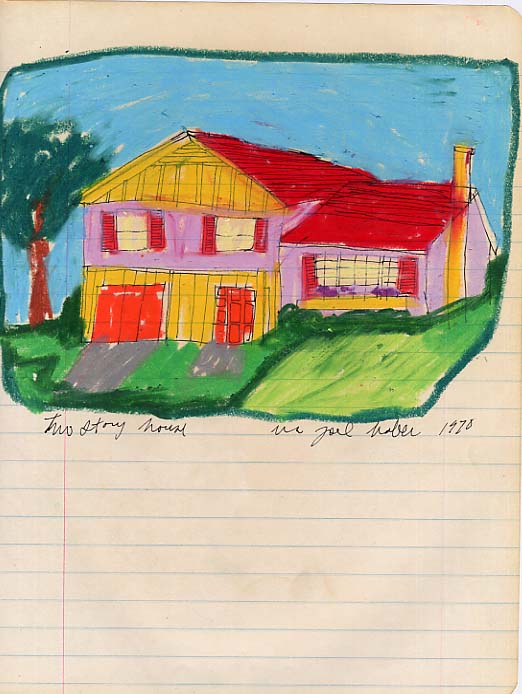
I live in a triangle. It’s exactly 213 square miles. It’s a place of Indian curses, ghostly apparitions, cattle mutilations, gigantic snakes, low-flying UFOs, huge birds, and ape-like creatures, seven feet in height, that leave 18-inch footprints. And I live right in the heart of it.
I work here, too, real estate, the only agent in town, although since I haven’t sold anything in six months that will probably change. Soon. The publicity about the reservoir and the Dark Forest Entry Association is killing me. After next month, when 20/20 and 48 Hours come, I doubt anyone will ever take me seriously again.
The activity centers around a 6,000 acre reservoir. Fear of the reservoir goes back 300 years, when the Wampanoag raiding parties hid among the black spruce during the tribe’s war with English settlers.
This much I was willing to discuss with the software engineers who seemed to like everything they saw: a colonial on Hemlock, the Greek Revival on Chestnut Street, the townhouse overlooking the reservoir. I spent little time on features, focusing instead on eliciting cues that might speak to what we call the magic moment, the exact moment the prospective buyer sees themselves in the house being to shown to them. If neither, especially the wife, has a magic moment, no amount of persuasion is going to save the sale. That would seem to explain his sudden departure, but I’m beginning to think it was all the conversation about the reservoir.
“This is it?” the husband asked, on the balcony, sweeping his arm toward the sun-sketched reservoir.
“Pretty, isn’t it? Can you imagine having your morning coffee here, leafing through the paper?”
He said friends were paddling across one day when they came across what looked like a small orange orangutan sitting on an island. “Have you heard that one?”
“No, that’s a new one.”
“You’ve heard the rest, though, right?”
“The rest?” I must have paused a second too long, because the next thing I knew he’d thrust out his hand, a very business-like hand, and was saying thank you for my time. I shook his hand, fumbled for a card from my breast pocket. By then he was at the door, letting himself outside.
I had no more appointments so I went back to the office and copied beauty sheets. Soon my mind went back to everything I’ve tortuously catalogued under “avoid at all cost.” Stories. Stories that could not stand up as theorems, much less even marginally plausible rumors, but they seem to stick in the local collective memory like tar, stories that seem to grow deeper and wider with every rumor and suspicion.
In December 1971, two UFOs were reported to have landed on Route 77. Less than a year later, another was sighted just a few miles up the highway. In 1973, Officer Dan Sweeney claimed he saw a white bird six feet tall and twelve feet from wing to wing soar over Baker Street.
I began to think of myself as I once was. A simple, stable, ordinary high school geometry teacher. Triangles, I always told the students, contain no mysteries. If you know two angles, you can find the third. Pythagoras did all that work centuries ago.
Yet sometimes on the drive home at the end of the day, the darkness closing in on me, I avoid the back roads and yet still find myself reluctantly gazing up at the sky as if it might, out of pity, yield the exculpatory evidence I am sure is there.
Grace Pelletier insisted for years she’d seen Bigfoot coming out of the reservoir. She had a photo. One photo. It certainly looked seven feet tall. But upon closer inspection, by Bert Clemson at the Chamber, it turned out to be a tree stump; its reflection in the water created the illusion it was walking toward a canoe.
But memory is a funny thing. When I am asked, especially by out-of-staters, relos, why property values are so cheap, I avoid reservoir talk. I point out proximity to major highways, vibrant downtown, better-than-average school system.
Inevitably, the conversation circles back to gigantic snakes, low-flying UFOs, huge birds, and ape-like creatures that leave 18-inch footprints coming out of the reservoir, which I tell them I can neither confirm nor deny, which is true, because I’ve seen none of that with my own eyes.
The Dark Forest Entry Association doesn’t help. They’ve festooned Route 77 with “No Trespassing” signs, which is heart-breaking, considering the quaint beauty of the dense woods and moss-tipped stone walls, pictures of which adorn most of the Chamber of Commerce literature I’m fond of mailing, when I have money and time. Yet I often pause and look at the photo of the reservoir that adorns the front of the tri-fold brochure. I swear at times the clouds say “Go Back.”
Driving home this evening, I passed the Dark Entry Road. I felt a tightening in my limbs, a new feeling. So I stopped, put the gear shift in reverse, and backed into the little entrance by the padlocked gate.
Just as I came to a stop, a pick up truck slowed near the entrance. The driver–a large, mustached man in a tan Carthart iron worker’s jacket and John Deere cap–said, after snapping my picture and license tag, “Can I help you?”
“Yes,” I said, “Can we talk?”
“About?”
I told him. I said this foolishness was beginning to get bad for business. He glanced at the magnetic Century 21 signs on my car, and said, “Put the car in drive, step on the gas, and head straight back to where you came from.” I repeated my request. He cocked a double-barrel. Humiliated, I did as told.
When I got home, Milly asked me how my day went. I told her. She said things will get better. How? I want to say.
“Market’s bad for everyone, Dick. It’ll pick up.”
Tonight, as most nights, I’ll wake in the middle of a dream about a serpent with an Indian head dress, something with a long tail that rolls and plunges in the middle of the reservoir. I’ll walk out into my backyard, glance at the house worth exactly half what I paid in 1965, and stare up at the sky for proof, proof what everybody has been saying cannot be true.
Stephen MacKinnon’s work has appeared in Armageddon’s Buffet, Conte, Fugue, Just A Moment, Marginalia, Ontario Review, Plum Biscuit, The Belletrist Review, The Oregon Literary Review, The Southeast Review, The Talking River Review, Triplopia, and Whistling Shade. In addition, his stories have received award recognition from Carve Magazine, Ontario Review, Rosebud and The Southeast Review.
Image by Ira Joel Haber, featured artist. View more of his work here.
-
Letter from Latvia
by Zinta Aistars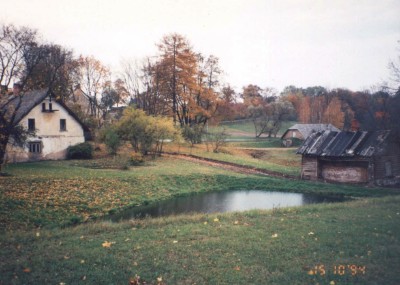
The first time I visited Latvia, my parents took me to Ventspils to see the city where my father had spent his teen years, just prior to World War II. A small stone house a short distance from the city, near a village called Sarnate, was the place where my father spent his childhood summers. Its weathered front faces the Baltic Sea–white sands scattered with pieces of amber, tall pines leaning into the wind, and the house itself holding within it the echoes of seven generations. Seven generations of hard work, love of land and family, many births, many weddings, many funerals, one generation gradually passing into the next, surviving many wars. My father knows Ventspils; his heart, in part, still resides there.It was a strange feeling, arriving in this place for the very first time, yet feeling myself at home. I was, yes, in a place that I knew instinctively I belonged. At least, some part of me did and always would. When my parents went to the house of Andris’s parents to meet with old friends, we two met for the first time. The boy with dark hair and dark eyes of unusual intensity greeted me with a firm handshake and a polite nod of his head. As our parents talked over dinner, bridging the lost years and the great divide between the paths their lives had taken, Andris’s eyes never left me. Mine dipped away shyly. In silence, I took in my surroundings. The house was tiny. One room, really, with curtains dividing space at room’s end for a bedroom for his parents, a corner serving as kitchen, and a closet-like space curtained off at the opposite end that was his bedroom. They were fortunate, I learned, to have the luxury of their own home under Soviet occupation, however small. An even greater luxury was to own a telephone, but Andris’s mother quickly took the telephone, pulling the long cord taut, and placed it outside the door of the house while we sat down to dinner inside. Soviet residents knew that telephones were commonly used as listening devices, and few things interested the eavesdroppers more than visitors from the Western world. “Let them listen to the crickets,” she said.
Andris spoke to me quietly after dinner. He played his guitar for me. Music, they say, is an international language, crossing all borders, and it melted any remaining between us. By visit’s end we had exchanged addresses, and over the years our letters crossed the ocean, and the Iron Curtain, even as we grew into adults, married, had children, and lived our lives–he as a musician and composer and I as a writer. If his letters on occasion hinted at some stronger emotional bond, I gave it little credence. There was, after all, an Iron Curtain between us, and if the term was a metaphor, its reality was truly one of iron.
Fifteen years after our first meeting, Andris made his first trip to the United States. The Soviets had cautiously begun to allow a crack in the Curtain, a few carefully monitored visitors permitted to travel the world outside, quickly to return again, their property and family members held as something of a ransom. Married couples, for instance, were never allowed to travel together. I did not meet him that first trip. I was married, had two children, and, well, it just didn’t work out. Or, in some deeper part of me, I knew it shouldn’t.
Two years later, when he came to the States again, he found me separated from my husband and living alone with my children. Andris, too, was no longer living with his wife and boys. When I heard the knock on my door, I opened it to a tall, bearded man who little resembled the 15-year-old boy I had met in Ventspils so long ago, if only for the intensity of his penetrating eyes. Suddenly, there were no more barriers.
Only, there was. A vast ocean, after all, separated our homes. We married in a small church in the northern wilderness of Michigan that had a strong resemblance to Latvia. Before we could file papers requesting a change in his citizenship status, Andris’s father died in Ventspils. An only child (his half-sister, Laima, was born to his father in a previous marriage), he returned to help his mother settle her affairs and heal her heart. I soon joined him, my two small children in tow. Around this time, the Soviet Union split open like a rotten fruit, the Iron Curtain crumbled into a rusted heap, and Latvia entered a time of anarchy and rebirth. As excited as we were to see this newborn freedom, it was undeniably a dangerous time, powers being challenged, new governments being formed, and a people struggling to find their way. It was no place to raise two American-born children.
The day of our first anniversary, I returned to the United States with my children. Andris remained in Ventspils. For the next six years, I would travel between these two countries as others move from room to room. To allow for enough time to stay with my husband in Latvia, enough to maintain a marriage, each time I left the States I also left a job, an address, and what few belongings I would keep, carefully boxed and stored in my parents’ garage or basement. Each time I returned, I would have to start my life all over again. Find a new job, lease a new apartment, unpack a few boxes, establish a new if temporary home. Wherever I was, a part of me longed for the place I was not.
My joys in life were simple ones. To be with those I loved was something I never took for granted. In the United States, I raised and nurtured my children, working hard to support our little household. I went to the office, attended parent teacher conferences, drove across town to take care of my many errands as any single parent might. In Latvia, I braided my hair in the manner of Latvian women, and I shopped for fresh produce at the open-air market on a daily basis, washed our laundry by hand, and boiled a large vat of water on the wood-burning stove for our bath water that Andris carried up the stairs in buckets from the well. While life in the capital city of Riga was quickly becoming as modernized as in any city in Europe, the countryside remained as if caught in another time.
One of the happiest days in my memory from those years was an evening spent at my sister-in-law’s house in Ventspils. Hers was a grand two-story place with walls nearly two feet thick, having survived several wars. It had no indoor plumbing, and the stove in her small kitchen was wood-burning, but it always felt like luxury to me. Laima took us out to her garden to pick fresh vegetables for our dinner. I held my shirt out to collect the beans Andris snapped neatly from their stems. Laima dug into the loose soil to pluck out round new potatoes. Her partner, Peteris, cut green onions, his small blade gleaming and sharp. In the kitchen, we rinsed and cut and snapped and prepared our meal, laughing and at moments bursting into song as Andris strummed his sister’s guitar. Surely I had never tasted a better meal than that one, with my family in Latvia warm around me, raising a toast of old cognac in the air. “Prozit!” To us, Laima offered, to our Latvian hearts, surviving all, strong and sure, and to our bright new future ahead.
I last saw Andris on October 15, 1994. It was the hardest, most heart ripping decision I ever had to make. My children could not thrive in such constant change. I was beginning to see signs of damage. They needed me. Full time.
That moment when the steel door at the Riga airport closed on Andris’s face, separating us perhaps forever, haunts me still in my dreams. His dark gaze never wavered as the door slammed shut, never moving from mine.
For months, no, years, I was tormented with the sense that I should never have left. I would wake in the night and, for a moment, not know where I was: here? There? Then, through the dark would come a light rustling, a child’s sigh in dreams, one of my own sleeping in the next room, and I would settle again into the twisted sheets. I am back in the States. Yes, I know: where I belong. With one heart that holds many loves and two homes.
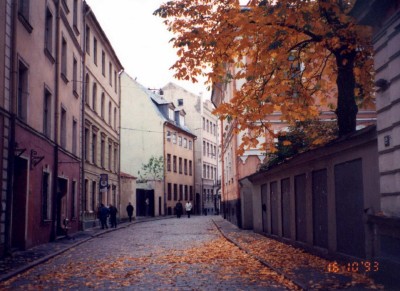
photos: Latvian countryside, 1994; Old Town section of Riga, 1993. Courtesy of Zinta Aistars
Zinta Aistars is the published author of three books. She is an editor and writer for LuxEsto, the Kalamazoo College alumni magazine and a contributing writer to County Wide News. She has published poetry, travel essays, stories, and articles in the United States, Latvia, England, Sweden, Germany, and Australia. Zinta publishes a monthly newsletter, Zeenythe Communications, for writers, and is one of a team of editors of the literary e-zine, insolent rudder.
-
An American Story
by Kelly Lundgren Pietrucha
photo courtesy of the Library of Congress
Just as I’m filling my mother’s glass with more wine, she tells me she doesn’t love my father.
Don’t say that, I tell her.
You don’t know me, she says.
She takes another drink of her wine and returns the glass to the table. We have just finished eating dinner. My husband is away and she says so is hers, but she does not mean it in the same way I do. My husband is fighting a war in Iraq and her husband is asleep on their twenty-year-old couch. It’s like we are living in two different worlds, my mother says. I wash the remains of our dinner into the sink and flick the switch for the disposal.
We have dinner together in silence, she says.
But my mother and father have always been silent with one another, even among words.
Behind my mother, on the buffet my husband and I bought together with our wedding money, there is a picture of my grandmother on Ellis Island. She is only eight years old in the photo, strapped to her uncle’s side like paste. I found the picture in my ninth grade history textbook, in a chapter called “The American Dream,” and despite the years I recognized her immediately. I showed my grandmother the book and she couldn’t stop touching the glossy pages.
Maybe you just don’t want to love him anymore, I say to my mother. She doesn’t answer. She picks her glasses up from the table and begins rubbing the lenses with her napkin. My napkin.
The day after my grandmother saw herself in my book she decided to take me to Ellis Island. You are a woman now, she said, and ready to know about struggle, the inevitabilities of life.
The American Dream, I said, remembering all I’d learned in school.
Genocide, she said, also remembering.
She had only been back there twice: once with my grandfather, and once with my mother. We walked through the building and said nothing to each other. Outside, between the East River and the Atlantic Ocean, between Brooklyn and Manhattan, between Manhattan and New Jersey, between New Jersey and Staten Island, between so much world and us, my grandmother said this: The worst was leaving my mother in Armenia. She kissed me and I knew we wouldn’t see each other again.
My mother puts her glasses back on. I should have known you wouldn’t understand, she says. She gets up from the table and walks into the bathroom. She turns the light on, stares into the mirror, looks back at me, and then closes the door. She does not come out for almost fifteen minutes.
When I first brought my husband home to meet my family, my grandmother didn’t like him because he said something about how Armenia and America are almost the same but with just a few letters in different places. She smiled to be polite and then left the table.
Come out of the bathroom, I say to my mother. It’s time for dessert. I can see her feet under my newly painted bathroom door, so clean and bright in its whiteness, just as I had wanted it to be. I walk back into the dining room and hear the handle turning and the bathroom door opening, and soon we are both back in our places at the table, eating dessert.
I’m leaving him, she says, her mouth full of chocolate cake. She has icing on her chin and I want to say something to her, but all I can do is hand her a napkin.
It’s not fair that they will take your husband like that, my grandmother said when I told her he was being sent to Iraq. There was a hummingbird feeding on sugar water outside her kitchen window.
Mom, I say and she stops thinking about whatever it is she is thinking about and turns to me. What did you feel when Grandma took you to Ellis Island? I have been wanting to ask her this for thirteen years.
Loneliness, she says. The tablecloth is worn and dirty and unsuitable for use anymore. And also anger and sadness. For her. What about hope, I say. I thought it was supposed to be a place of hope.
My mother leans back in her chair. I guess you know what everything is supposed to be, she says. She is moving the stem of her near-empty wine glass in circles on the tablecloth as though she is getting ready to drink the first sip and not the last.
It was not an easy life, my grandmother said on the ferry ride home from Ellis Island. I was never American.
You could have been, I said.
She looked at me, cold and foreign, and said: You think everything is so easy.
My mother gets up from the table and goes to the closet for her coat. I want to offer her something else but there is nothing left: the wine bottle is empty, our plates are bare and there are no words left for us to say.
The night before my husband left, he asked me how to fight for things you’re not sure you believe in. We had just finished making love and his chest was still heaving under the sheet. I reached to the nightstand and turned the light out, because it was all I could think of doing.
I can’t stand the way he breathes, my mother says at the door, one more grievance to add to the list, as if she is still required to convince. He pushes the air out of his lungs so forcefully, like he’s disturbing it, making it do something it doesn’t want to do.
You have a choice, I say, because I still want to believe in something.
Kelly Lundgren Pietrucha holds a Masters in Fiction from Temple University, where she now teaches creative writing and literature. She also teaches at Rutgers University and Camden County College in New Jersey. Her fiction has appeared in Pindeldyboz.