Your cart is currently empty!
Category: 2016
-
Delilah’s Skull – Flash Fiction by Nan Wigington
When my dad died, I wanted to sell everything, but my brothers said no, take something, so I took Delilah’s Skull.
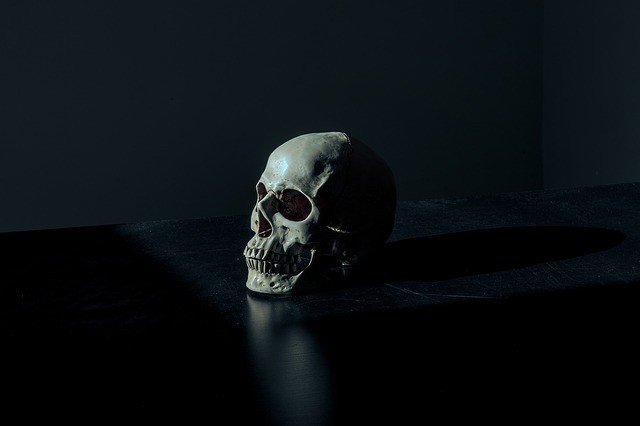
My dad kept cabinets. Mostly at the hospital. Patient parts, he said. For research. Some cabinets contained bones – the odd compressed spine, tibias, broken ulnas. He had organs, too, slices of cirrhotic livers, a cadre of cancerous lungs, eyes in jars of viscous liquid. They rolled upward when you shook them. The only part he didn’t keep locked away was Delilah’s skull. That stayed at the corner of his desk at home.
It was hardly a skull, though. No attached mandible, occipital. Just the hard cap of parietal and frontal bone. I used to like to run my finger along the coronal suture.
Until he stopped smoking, my dad used Delilah as an ashtray. Butterscotch candies lived there for awhile, too. But I remember it best empty. When you could see the trace of blood vessels. They ran down the yellow sides, dried tributaries of ancient rivers.
Delilah was my dad’s cadaver. He grew up in this profession when bodies were easy. No one donated, so you just took. Still the act of taking unhinges most of us a little. Even my dad.
My dad used to pretend he went a little crazy because of the formaldehyde and phenol, but he admitted later that it was the act of unzipping the bag and seeing her face – its walnut gleam, its perfect symmetry – half-lidded eyes, a crown of red hair.
Like all of us, he tried to justify his act, looked for proof of her bad life…tattoos, needle marks, wounds. But, over and over again, the only violence he could find were the strikes of his own scalpel. And his thievery. The hunger of it. Taking the heart and lungs first. Then the ovaries. My dad said his partner tore into her abdomen, cracked her pelvis like a hungry drunk, and ripped her perineum.
My dad hated most when he cut her throat, removed the larynx. Gone the curtain of speech and song. He said he touched the ossicles of her middle ear and whispered, “Sorry, sorry.”
What happened when they cut into Delilah’s skull? How many coils and folds did they find in her brain? What decisions and indecisions, what forgetting, what remembering? My dad said that back then, they were in the habit of throwing all that away.
I am my father’s daughter. I save what I have not destroyed. Delilah’s skull remains in plain sight on my desk at the hospital. Sometimes a patient picks her up and holds her in the palm of a hand.
Once a nurse put condoms in Delilah. Another time someone dumped in chocolate hearts. As if she were a stain to be covered. Both offerings were cast out. No one understands. Nothing can appease the long dead.
Nan Wigington‘s work has appeared in Gravel, The Airgonaut, Sicklitmagazine.com, and No Extra Words. She has worked as an unclaimed property clerk, an accounting analyst, an ensemble actress, and a paraprofessional in an K-2 Autism center classroom.
-

Kingdoms – flash fiction by Christopher Woods
They had lived in the dark, in its midst, some fifteen years. Ever since the children left, fleeing the house of perfection. And, the house of boredom.
He considered all this, driving through the night to their mountain cabin. Oncoming headlights, though there were very few, illuminated the snow on either side of the road. The darkness that followed each passing car triggered his thoughts back to the curving black road.
The road doubled back, then surged ahead, always elusive. It was treacherous going, as if there might be something, maybe even evil, along that road that night, as if something might, at any second, hiss and spit at them.
She sat beside but away from him. Giddy in the dark, she hummed along with the big band music on the radio and rubbed her thighs. These years she was spent, the same as he. And they both knew it all too well.
Already, on this late night road, they were quite beyond the boredom that had seeped inside the doors of their marriage. Then, above the sound of the music and the heater, she spoke. Best slow down, she said. He turned up the radio and scanned channels, looking for something she would not like. Best slow down, she repeated, louder than before.
Instead, he pressed his foot on the accelerator, hard. In his mind, he was going to rise above their shell of a family. To him, they would rise up from that twisting, viperlike road. They would glide through the dark sky where stars crisscrossed the blackness. He imagined himself going beyond all this. He didn’t know for how long, or even when he would return. He had bourbon singing in his blood.
She sighed, forgetting the song she had been humming. Looking away from him, she saw her sad reflection in the window. She imagined a snake was in their cabin. It was a snake that waited patiently in the night. She hoped that it was a very poisonous one, and that it was coiled on his side of the bed. Waiting.
He too was dreaming of a snake. His snake, also patient, had lived in the world long enough to know that waiting counted for much, maybe for everything. His snake was along this very road, this very night. It was coiled on the side of the road where he planned to push her out.
And though they both knew this was the dead of winter and snakes would be hibernating, it didn’t matter. For them, snakes would come out this night. These snakes could be commanded.
These snakes were a necessity.
It happened quickly, both of them silent and lost in thought. In an instant he passed out and his hands loosened from the steering wheel. Panicked, she looked out the window and once again came face to face with her reflection. Her eyes were frozen. When at last she broke her gaze and tried to take the wheel herself, it was too late.
The car seemed to fly, as he had wanted it to do. But it flew to the side, into the air, finally falling hundreds of feet to the snowbound trees below.
Beneath the roots of those trees, snakes huddled in balls, sleeping, awaiting the thaw. They dreamed of possibilities. Of warm beds in mountain cabins, where the people, for one reason or another, had gone away.
And, in their dreams, the people never returned. The sleeping snakes knew how waiting could count for much. How, if they waited long enough, even kingdoms could change hands.
Christopher Woods is a writer, teacher and photographer who lives in Houston and Chappell Hill, Texas. He has published a novel, THE DREAM PATCH, a prose collection, UNDER A RIVERBED SKY, and a book of stage monologues for actors, HEART SPEAK. His work has appeared in THE SOUTHERN REVIEW, NEW ENGLAND REVIEW, NEW ORLEANS REVIEW, COLUMBIA and GLIMMER TRAIN, among others. His photographs can be seen in his gallery –http://christopherwoods.zenfolio.com/
-

TSA: Here to Serve
flash fiction by Paul Beckman
Mendel stood waiting to board the plane.
He took off his shoes, emptied his pockets, turned on his computer and stepped into the x-ray machine with his hands up. No alarms went off but he was still escorted to the TSA headquarters where they questioned him for three hours and water boarded him twice.
Then he was taken into another room, allowed to shower, shave and given a set of expensive clothes and told to sit on the couch facing a wall. It was painted olive drab, a color he hadn’t thought about since his military days and that made it easy to sit immobile at attention. After twenty-two minutes the wall parted, opening curtain-like, and he was looking out at a studio audience who gave him a robust round of applause.
He remained sitting while the TSA water boarders brought his luggage in. Behind the audience was a full wall of windows and Mendel saw the airport and a large commercial jet sitting on the tarmac. Motioning for Mendel to stand, the TSA agents escorted him up a long aisle through the crowd. Some people waved handkerchiefs while others held “Free Mendel” signs. People on the aisle put out their hands for high fives and fist bumps until Mendel reached the ticket agent’s counter and secured door where he was given his boarding pass.
The crew waited at the door, checked his ticket and a flight attendant took him by the arm and led him through first and business classes to coach and then to a middle seat in the rear between a five year old and a large man overflowing his seat. As the plane began to taxi, the flight attendant showed everyone how to work their seat belts.
Paul Beckman was one of the winners in Queen’s Ferry Best of the Small Fictions (2016). His stories have appeared in Litro, Opium, Playboy, The Connecticut Review, and Brilliant Flash Fiction, among others. His flash story collection, PEEK, from Big Table Publishing weighed in at 65 stories and 117 pages and website is www.paulbeckmanstories.com
-

A Special Business Plan – flash fiction by Stefan Markovski
The scoundrel was a pirate.
“Scoundrel, why is it that you are a pirate?” he was asked by a captain, just a moment before his trial for piracy for which the penalty was known.
After serving it and the reincarnation into a body of another scoundrel, an antiques reseller, he began creating his business plans.
Once he organized an auction for purchase of toilet paper which he spent while taking notes on the–as the critics demystifying the literary essence of his artwork used to say–“beautiful poetry.”
Since no one ever bought it, he decided to go for a plan change and open up a Writers’ Units for Quick Deployment Agency.
On his business card one could read:
Traian Mitrevski, special writer Head of the Writers’ Units for Quick Deployment Agency – “Dead Horse Reflexes”
Soon the word about the agency spread throughout the kingdom, and then throughout the world. It was applied to by many reputable and internationally known writers, some of them even published.
However, the criteria were so strict that no one has come to the stage of bidding; none of the potential applicants managed to apply before the public calls deadline.
The application period was from 8:13:03 to 8: 13: 03: 08 time zone UTC + 5: 00 (Islamabad and Karachi), but the speed of the potential candidates filing for candidacy did not allow them to be called candidates for Agency for the Rapid Deployment of Writers.
Once he was called by a landowner whose fountain had gotten spoiled, and accordingly, needed express reaction.
Within a few minutes Traian has come, after successfully hacking the external gate by setting a new password, then slipping through ten guards, then hacking the inner door of the house, suspending and fixing the cameras, making two coffees and boiling five to six eggs (it was his routine to exercise immediately before) and finally, to come to the fountain and start writing.
He always wrote while standing. He stood on one leg. The left one. He was a leftist in the heart. Even in the kidney. Only the left one remained. (In that honor, he once wrote a poem: “Only the left remained.”)
He wrote for a few hours.
He wrote from heart, not for the audience.
When completed, he gave the sheet to the landowner and mysteriously disappeared.
No one ever saw him again.
The following words of wisdom were written on the paper:
“This fountain is like the mind of the true writer. Only a cracked pipe can pour so much water. Only a cracked mind can be a source of endless inspiration from monumental dimensions.”
He had written under a mysterious symbol: the word “AFRDOWDHR” and drawing pen. After years of interpretations, a team of scientists came to a conclusion that the word is actually a shortcut to the Agency For Rapid Deployment Of Writers – Dead Horse Reflexes. Nobody has managed to interpret the true meaning of the pen yet.Stefan Markovski is a Macedonian writer, poet and philosopher, member of Macedonian Writers’ Association. Born in the town of Gevgelija (01. 12. 1990), he completed primary and secondary education in his hometown, graduating on the Department of Comparative Literature, Faculty of Philology “Blazhe Koneski”. He’s an alumni at the Institute of Philosophy of Ss. Cyril and Methodius State University of Skopje. Markovski is the author of 7 books of fiction, nonfiction, and poetry.
Image courtesy of Viktor Mogilat via Unsplash
-

Gathering up the Bones of the Deceased
Flash Fiction by Hilary Wilson
Still hot from the flames, my father’s bones lie on a silver metal table. The bones are made brittle by the fire. They’re easier to crush that way.
All of the attendees take turns picking a piece of bone with their chopsticks, passing them down the line. Because me and my two sisters are our father’s daughters, it’s our duty to do most of the bone picking. Even though the sight of her husband’s skeleton renders her unable to stand, our mother watches intently from a nearby chair as we work from toe to scalp.
My sisters and I do this for our father.
Not only because this is Japanese tradition, but because it’s something that we want to do.
For him.
For our father.
My father.
Wails of the living fill the air.
The Buddhist priest chants The Heart Sutra to help drive away our father’s spirit from the place where he died.
Silently, my younger sister passes me a piece of bone with a pair of long chopsticks. I pass that piece to my older sister, who puts the piece in a wooden funeral box. Our father’s death name is written on the box in delicate handwriting. The characters in his death name are very old and very rare. Only a few people will know how to read it. Now he can’t be called back to earth.
My older sister grinds down the bones with a wooden pestle. The powder mixes together and soon our father is simply dust.
Blown away on the wind, he will find a new home among the stars.
Hilary Wilson is a Canadian writer.
Image courtesy of NASA via unsplash.
-
Billy, Elvis, & Jesus
Flash Fiction by Christopher Woods
Every morning, the same ritual. You dust both photographs. Turn Billy’s face up again for another day while the coffee brews. You look at Billy, then at Elvis. Outside the sun is coming up.
You never give up. Not you. Yes, it has been eighteen years since Billy walked out the door. That door. And ever since the door has grown smaller and the world beyond it vast and mysterious. A cruel kind of secret, maybe.
Billy, he never said boo. He left without a word. A light sleeper, you would have heard him if he had a last word or two. You don’t know where he went. He’s never called, never even dropped a postcard.
Mama, when she was still alive, always explained it to you this way. That Billy went to sow some wild oats. That you must have let him down somehow, him being a man and all, and you a woman. She said you could read all about it in the Bible. But you never bothered to read about it. That Bible reminded you too much of Mama and her runaway mouth.
Mama never knew the truth, that Billy didn’t have any wild oats to sow. Billy wasn’t so hot in the tame oats department either. But you got along with him fine. Oats or not, a warm body next to you on a cold night was a comfort.
Billy was no Casanova, not by a long shot. You always figured he would come home once he figured this out. Maybe when some woman told him so, and not so sweetly. You loved him because he was Billy, for his sturdy frame and strong jaw. That was enough. Still is, sad to say. And this is why it won’t surprise you if he comes back. That will mean he has learned his lesson, that no one loves him the way you do.
It’s strange, though. Elvis has been gone a long time too, but somehow it’s not the same. Oh, you know all about the sadness of Elvis being gone. Who doesn’t? You believe that Elvis was a giant among men when he was alive.
Now that he’s gone, he’s still about ten times bigger than the best of them. You think about this a lot, how a dead god is better than a cold man.
At the Visualize God In Grits Café, you work the lunch counter. You watch men coming and going, all day long. Some are nice. Others flirt. A few of them give you the creeps. Older now, you know better than to get involved. Besides, what would Billy say?
There was a time when you didn’t know who Elvis was. Mama changed all that. You must have been seven years old when she took you to see him in concert. Mama said the two of you had come along too late to see Jesus in person, but you were right on schedule for Elvis.
On her deathbed, Mama confessed something. She said that when Daddy climbed atop her on Saturday nights, she would close her eyes and imagine it was Elvis instead. Those were almost her last words, as if she was sharing the secret of the universe.
Seeing Elvis changed you. What your mother said when her death rattle was tuning up changed you too.
Tonight, when the sun goes down, you’ll be back here again, sitting on your lonely side of the bed. You’ll look at Billy and Elvis. You’ll turn Billy’s photograph face down for the night. Good night sweet Billy, wherever you are, you’ll say.
That will leave you and Elvis alone together. And you won’t feel the slightest tinge of shame when you reach for Elvis and hold him close. It’s one of those lonesome kinds of nights, you’ll tell him. You know, when the darkness sneaks inside and puts its arms around you? You know Elvis will give the darkness it marching papers. He knows all about it.
You will try to stay awake, hoping that Billy is coming home. If he does come home, this is how you picture it. It will be at dusk. Him coming up the road, the sun all fiery red through the trees. Lost people need to get home before dark. At night it’s too hard for them to find their way, especially after so many years.
But your eyes will close on their own in their weary way. You know that, wherever Billy is, he’s probably rubbing shoulders with the darkness that Elvis sent packing. And before you place Elvis back on the bedside table, you will kiss him like you would Jesus if he ever came back. Some say it’s just a matter of time.
Christopher Woods is a writer, teacher and photographer who lives in Houston and Chappell Hill, Texas. He has published a novel, THE DREAM PATCH, a prose collection, UNDER A RIVERBED SKY, and a book of stage monologues for actors, HEART SPEAK. His work has appeared in THE SOUTHERN REVIEW, NEW ENGLAND REVIEW, NEW ORLEANS REVIEW, COLUMBIA and GLIMMER TRAIN, among others. His photographs can be seen in his gallery –http://christopherwoods.zenfolio.com/
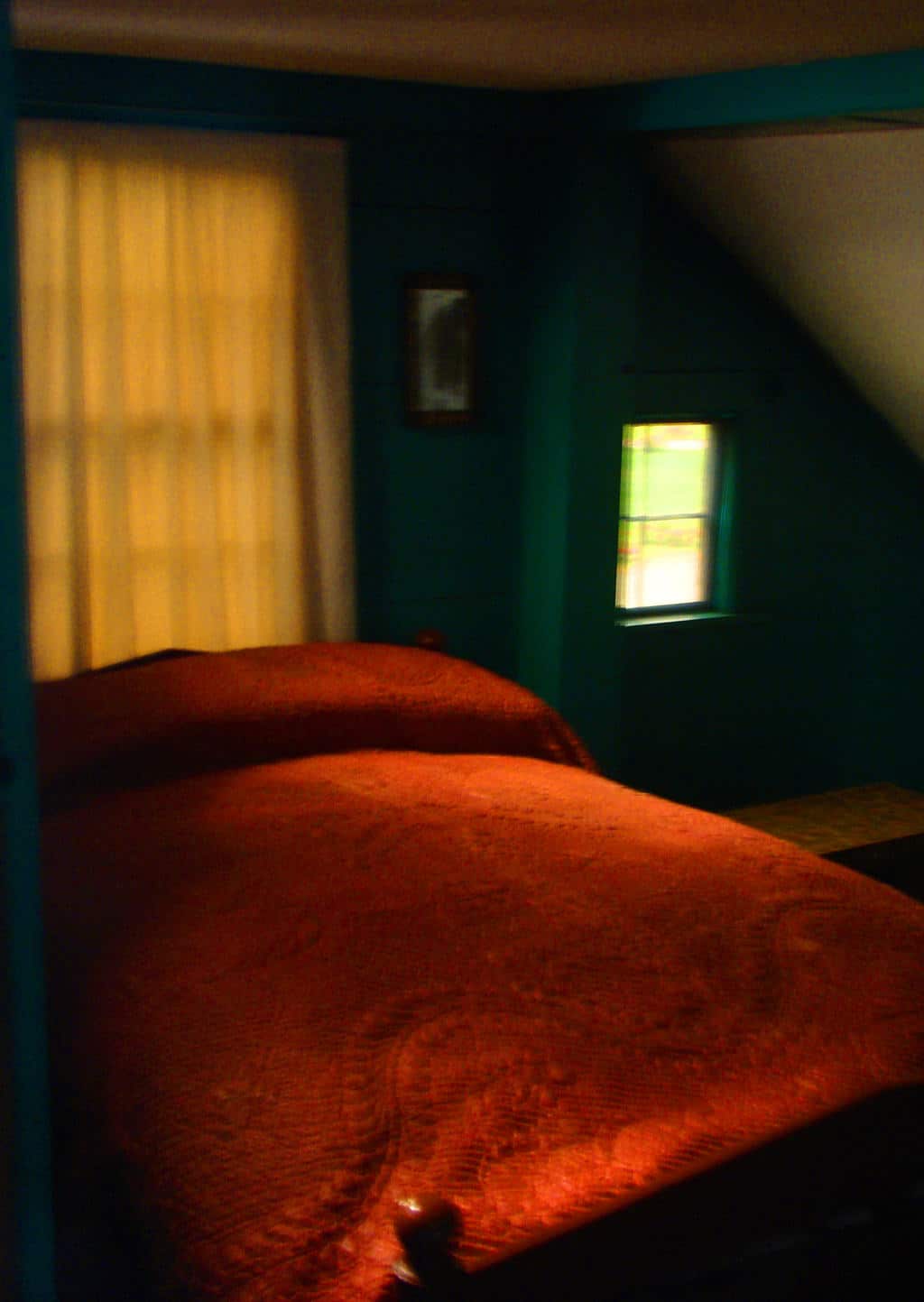
Image: Bed, Shelbourne, by Christopher Woods
-

Some Realizations after Ten Months in Texas
Memoir by Alyssa Sinclair
1.
My apartment door opens to a hallway lined with three other brown metal doors. An oversized patchwork owl hangs on my neighbor’s door, and a plastic waterfall—four tiers of fake rocks cascading down—has sat empty for weeks next to their welcome mat. Otherwise the hallway is a beige blur—cement floor, off-white walls, white light fixtures filled with dead bugs. The landing of the wide cement stairs affords a view to the outside. Standing at the railing, painted the same brown as my door, I can see the tall fence with its attenuated ribs separating the parking lot from the road, and the expanse of dusty, sparsely vegetated desert. Beyond that the highway loops around the limits of the town. The edges of the highway overpass are lined with birds nests, packed in wing to wing, like a Japanese hotel.
The stairs lead down to the lower hallway. The cement floor bleeds into the sidewalk and then the parking lot. The manager of the apartment complex refers to this whole hallway-and-staircase area together as “The Breezeway”. There is a brown film clinging to everything: the floor, the stair railing, the faux-wood paneling covering the walls, the bottoms of my shoes. I moved here in January. It is now October and the film of dirt has had four seasons in which to accumulate.
In the lower hallway there are belly-up cockroaches scattered across the cement floor. The numbers have grown since January. They are a red-brown color, their legs curled in “S” shapes, a trail of breadcrumbs to the stairs. Whenever I step on one a shiver of disgust runs from my flip-flopped feet up to my throat. Sometimes, at the base of the stairs, there will be one or two stuck between life and death for hours on end. Suspended on their rounded backs, their tiny, grasping legs pedal all day long. The movement rocks them back and forth, but it is not enough to fully flip upright. When they die it then takes a few days for them to disappear. Once, at midnight, I saw other cockroaches lingering around a dead one, and in the morning there was just a crumbly black substance left behind. More than once I have seen two ants dragging a dead cockroach down the sidewalk.
Upstairs, outside my door, spider webs dangle from the cream-colored paneling. Balls of lint and fuzz are caught in the silky threads. Occasionally I’ll spot a black spider curled in its web. It is either hibernating from the heat or dead from the heat. The bend of its legs is shiny and sharp, forming a basket around its underbelly. If I spray it with Raid it will die and fall to the ground, and I can check for the fatal red mark on its underbelly in the shape of an hourglass.
This summer the bugs began to enter the apartment. Since then I am often bitten in my sleep. I wake up to scabs pulled tight across itchy lumps on my ankles and nail marks up my thighs. For a few weeks in August there were small beetles buried in the beige carpet, and at least twenty tiny black bugs on the windowsill each morning.
The pest control man told me it’s all because I sleep by a northern facing window. “All that open land and the wind blowing in,” he said, “I’ll tell the manager to put a dimmer bulb in the light outside your window.”
The next night I walked my dog past that bulb at the corner of the building, and tried to tell if it was dimmer. Moth wings fluttered against the light and other, earth-ridden bugs twitched on the pavement. All of the movement made me jumpy. I didn’t think they had changed the bulb. A white truck, its tires lifted up high and a crane in the bed, pulled in and parked behind me. A young man got out wearing a fireproof jumpsuit. There were black smears down the fronts of his thighs. It was about ten o’clock. He was getting in from the oil field. He said hello and entered the Breezeway. The heavy knocking of his steel-toed boots echoed out into the parking lot. I could hear the gap between his steps as he climbed two at a time. I thought about taking two stairs at a time at my parent’s house, the thick runner beneath my feet. The darkness to the north suddenly seemed like a dream pulling me away from here. I heard the slam of his door come from the top floor. My dog tried to catch a giant sand-colored cricket in her mouth. It bounced away suddenly, sharply, almost as high as my hipbones. It seemed it could jump as high as my face if it really tried. I stepped away, pulling on the leash.
Alyssa Sinclair graduated from the University of St. Andrews in Scotland with an M.Litt in Creative Writing. Her thesis, a collection of short stories entitled This House of Bones, was based on stories of her father’s life. She is the recipient of the Dan Hemingway Short Story prize for her story “The Deposition.” Her nonfiction has been published in Salon.com and TheDailyBeast.com and has been short-listed for the New Writing section of Mslexia Magazine. She lives in Midland, Texas, the far-west center of the Oil and Gas industry, where she writes and teaches yoga.
-

Forgotten Flyers – Flash Fiction by Bobby Sauro
The Chief Inspector prints a flyer each time another woman is murdered. The woman is referred to by name; the unknown assailants are referred to as Citizen “10,” Citizen “11,” and so on. This serves the dual purpose of honoring the victims and letting the public know how many killers are out there. Some outsiders have suggested there is only one, but that would necessitate an individual ego and self-centeredness our society does not possess.
Katrina’s admirer was sweet; he doted on her from afar. She had become His Trina. The Station Master in her hamlet had introduced them through correspondence. Her admirer was looking for someone full of hope, unlike the jaded girls in his district. That she could belly dance was an unexpected bonus. He would put her in one of his little shows.
Our Chief Inspector will not rest until the killers are brought to justice, and what an exacting justice it will be! These foreign marauders will feel the hammer of the State.
For Katrina, this was also a way out of her province. Life had not been miserable but that wasn’t good enough. She would travel; be adventurous; her spirit would spread open.
We hang flyers at the train station to warn women not to travel by train (and also to advertise the holiday schedule because that must come out whether or not there are killers on the loose and we only have so much 80 lb. stock paper).
Her uncle warned Katrina. The city will swallow you whole. That would be fine, as long as it didn’t take her apart, piece by piece, over decades.
Our train station is a very windy place. The flyers become torn on their sides; their bottoms are shredded. Eventually, the pieces scatter in the woods. That is a fact of life here. Nevertheless, due to public outcry, we have hired a well-respected local to tend to the flyers. He is quite famous for his Top Hat, which will present a major challenge, given the wind.
In Katrina’s province, there had been a rumor of killers of women, but improving her station in life required bold action. Besides, there was no reason to fear; her gentleman would be waiting for her. What a team they will make! This man from her dreams, who brought all the places he had traveled alive in her mind, like only The Great Poet had done before.
By mistake, the former Commandant built the depot at the edge of town instead of in the center. This was outside of our control and so no apology is necessary but, as a result, the station has become a gathering spot for our fringe element: vagrants, drunks, the mentally challenged and the deviant (we are too polite to go into further detail). In lieu of an apology, we did make an announcement which apologized for any inconvenience the misplacing of the station had caused our fine citizens.
Katrina was surprised they let her bring her dog on the train but that is the province for you; not much concern about anything, nothing really matters. She will go somewhere that matters. Her name will be known. Her dog will run freely in the woods. She has never had him on a leash and the city will not change her.
Great news! At a symposium, our Chief Inspector heard of a new machine which will allow us to print the flyers more cheaply. This improvement will be available sometime within the next ten years. We will keep you posted on this exciting development but in all events expect the flyers to become more like a commodity.
Katrina is surprised there are not more people at the station when her train arrives. This will make it easier to spot her new lover. She will recognize him by his Top Hat.
Thanks to the efforts of our man in the Top Hat more than ten deviants have been arrested near the station. This has exceeded our expectations.
The station in the city looks worse than the one in her hamlet. Katrina pulls her stockings up over her knees. Because her province is frigid, she wears stockings on her arms as well. Missing feet, they run up her lean limbs, which were called gangly when she was young but which had become two of her greatest assets. An imposing man in a Top Hat waits impatiently by the tracks. Two stacks of flyers, each wrapped in a leather strap with large metal buckles, dangle from his hands.
Another one has been found, near the train station, in the woods. Choked. And also, sliced. We will no longer print new flyers every time, however, because it’s getting too expensive. Besides, this one was not from here, but from a faraway province we suspect (her stockings were ripped and, subpar). If we knew her name, we would tell you, but not print it because, well, you already know, the flyers.
On an unrelated note, due to our Chief Inspector’s razor sharp eye, a dog has been rescued in the woods near the station. Such a magnificent mane and a hunting dog nonetheless! Leather straps found tied to a tree nearby were too thick for the dog’s neck so the Chief Inspector left them to be retrieved at a later date. Out of the goodness of his heart, he brought the dog home. There is no need to describe the animal; you will see him in the photos we distribute with our special holiday flyers. As always, they will be posted at the station in time for the annual celebration, which this year will include carnival rides and be hosted by our newly-appointed Station Master (Our Chief Inspector is too busy with his growing family). There’s no need to print the Station Master’s name because, well, you already know him; he’s the man with the Top Hat in whom we have now vested total authority to tend to the flyers.
Bobby Sauro’s short fiction has appeared in Connotation Press, Fiction Southeast, elimae, Burnt Bridge, Corium, Dew on the Kudzu, and Red Fez. He resides in Atlanta but can often be found at www.sauromotel.com, a literary motel that houses short stories and articles about Kafka, Springsteen, sweet potato vendors and the occasional 1980’s vending machine. He once worked for a Chinese professor who knew Stalin and in a nail polish factory, but not at the same time.
Image courtesy of Paul Garaizar via unsplash.
-

Buried – Flash Fiction by Nathan Alling Long
You dropped it in the ocean so as hide it. But no, that’s not quite the right word—for hiding implies from someone, and no one was looking for it or would think to find it here. Hiding also suggests a temporariness. One hides something only later to reveal it. To hide something for good, one buries it.
Yet it seemed wrong to think of drawing the small parcel from your coat pocket as you leaned over the rail of the whale watching boat that afternoon, letting it slip out of your fingers into the water, to think of that as burying. You looked around, worried about being seen. But everyone else on deck was looking off in the distance for a tail or a spout of water.
You watched as the parcel floated a moment, then sank unceremoniously. As the boat pressed on, you could imagine the small wooden box swaying downward until it rested on the ocean floor. Yet all that water did not exactly bury the thing. Not made of earth, the ocean could not truly put it to rest.
As a child, you had been unsettled by the phrase ‘a man buried at sea’; you couldn’t understand how anyone could dig a grave at the bottom of the ocean, how they could pull the casket down, then cover it up. Wouldn’t the currents wash the dirt away and reveal the body? When you learned that it meant they simply let the body slip off the ship into the ocean, you were repulsed by the thought, the slothfulness and incompleteness of the act.
But you now have done the act yourself, buried but not buried, let the parcel fall into the immense anonymity of the sea. And since then, you have not spent a day without thinking about it. Sometimes you imagined the parcel jostled by the waves or the tail of a large fish. Other times you pictured it catching the hook of a fishing line or the net of a trawler. Or you imagined it scuttling across the ocean floor, incrementally, pushed by the currents so that it seemed almost a living thing again.
They told you before he was out of the womb that he would not live long. The arrhythmic pulse, a tell-tale heart. You said no matter, you would care for until it stopped. Then return it to a watery place, where it might feel comfort.
But now you find yourself going to the shore each day, as though the thing might wash up on the beach. You believe it is not comfortable, alone on the ocean floor. It is trying to come back to you, even though it is only ash in a box. You imagine that if you do not find it, it will be discovered by a fisherman or an early morning collector of shells. Then, years later, you will see it in someone’s living room or alone out on the curb.
When you are not at the shore, you find yourself watching what flows from faucets, as if your box might come through the small metal opening. You come to believe that all water is part of the same body, one endless being, like a grove of aspens connected by the roots. You believe it might return to you from any source. You look at the sky when it rains, wondering if it might fall from a cloud. You look for it in a glass of water at a restaurant, in a street puddle, in your own tears.
Soon it feels certain that you will find it, that you alone will find it, for you have buried it from everyone but yourself.
One day you wake from a frightening dream. In it, your tiny wooden box is still lying on the ocean floor, still as a stone, wedded to the floor like a shipwreck. It has not gone anywhere at all. You see then how well the sea, with its thick salty water, preserves the things it collects. Your box will never disappear. It will always wait for you.
That morning, you return to the shore, certain that it will never wash up at your feet. Still you feel the thread that tethers it to you. You place a hand in the salt water, feeling the tug. Without taking off your clothes, you step in the water, feeling you are a mother all over again, the cold sacrifice of everything. You start walking, then swimming. By effort or current, you will return to it. You know eventually you will be pulled under and sink down until the two of you are rejoined, there on the ocean floor, your body beside your tiny box, almost as if buried at sea.
Nathan Alling Long’s has appeared in over a hundred journals and anthologies, including Story Quarterly, Tin House, Glimmer Train, and Crab Orchard Review. He lives in Philadelphia, and teaches at Stockton Univeristy. “Buried” is part of a fifty story collection of flash fiction seeking publication. More can be found at https://blogs.stockton.edu/longn/.
Image by Tobias van Schneider via unsplash. -
Flight – Flash Fiction by Gypsy Martin
The first time it happened, it had been a shock. Ray’s head rested heavy on the small oval window of the airplane. His eyes had just closed when a gentle ding sounded and the fasten seatbelt light was extinguished. Ray started with a little snort at the noise and lifted his head, noting with relief the vacant seat beside him. A flutter of white outside the window caught the corner of his eye. There was something on the wing.
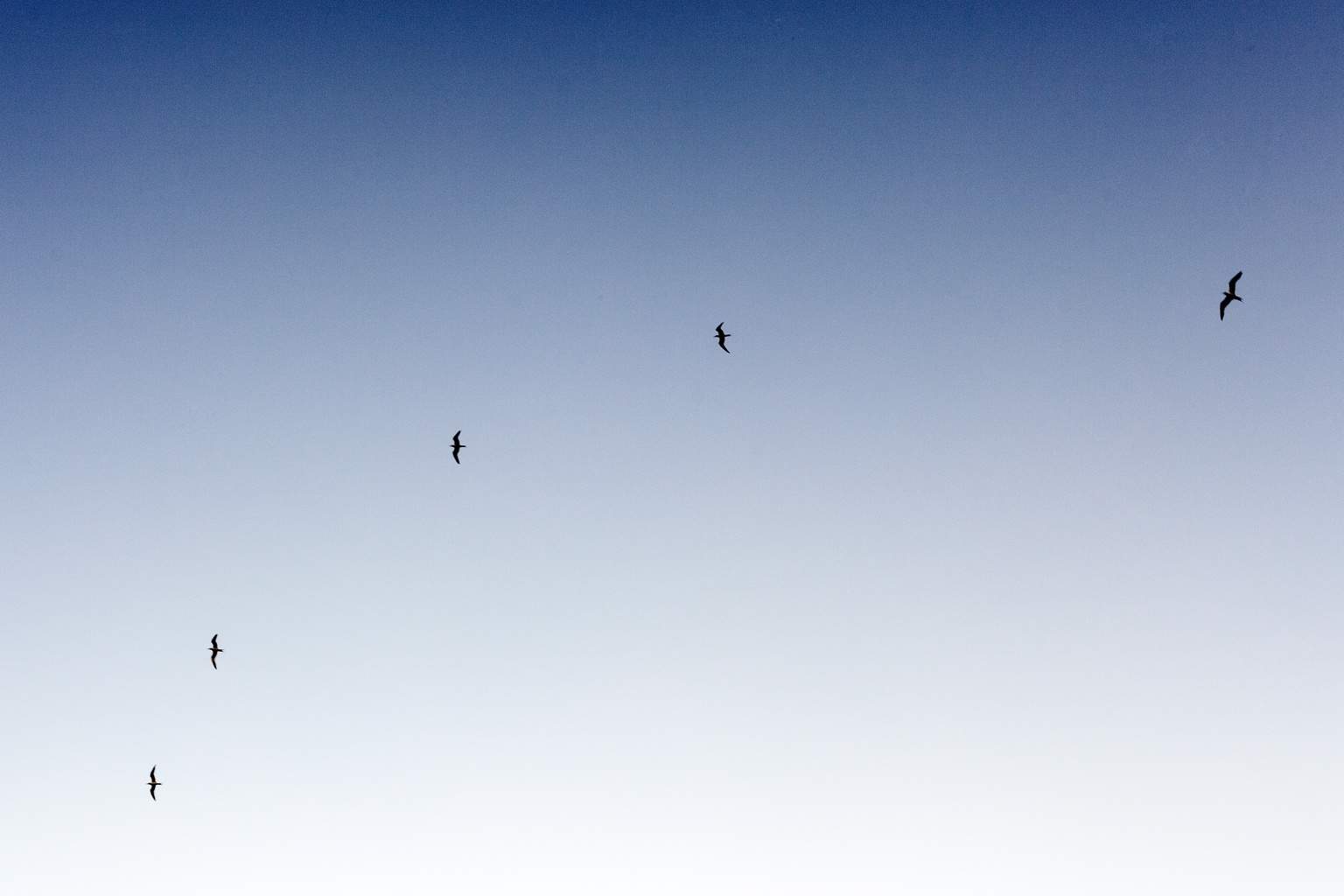
Squinting into the setting sun, he saw a woman sitting on a stool. She was knitting. A strand of yellow yarn extended from her needles to a worn canvas bag slumped at her feet. Her long white hair stirred in what looked to be a gentle breeze. The woman was his wife, Dorothy.
Or, rather, the woman was his wife, Dorothy. When she had been alive.
Ray and Dorothy had worked hard and loved each other and raised two good kids, which they figured made them better off than most. Their life together had been simple and sweet, and Ray’s only regret was that his big-minded wife had never set foot out of Iowa. She had never seen the ocean. That didn’t seem right, so Ray made a plan. He saved a little bit of every paycheck from the meatpacking plant, and for Dorothy’s 60th birthday he bought them two airplane tickets to Portland, Oregon. From there they’d drive to the coast.
Of course he’d suggested California first. It was the obvious west coast destination. But she’d demurred, saying California wasn’t really her kind of place, even if it was warmer. There would be no sojourn among the blonde and tan for Dorothy; she wanted to go somewhere wilder, lonelier. They would take Highway 26 from Portland to the coast, and drive north to Cape Disappointment.
To Ray, vacationing at a spot called Cape Disappointment was just asking for it. But they never made the trip anyway. A week before they were to fly to Portland, Dorothy collapsed on the kitchen floor. She died right there of a ruptured brain aneurysm. After that Ray didn’t care if he ever went anywhere again.
But his daughter worried about him, and, one year after the trip he didn’t take, Ray flew to Seattle to visit her. That’s when Ray saw Dorothy on the wing of the airplane. He’d gasped, then waved his hand madly to get her attention. Dorothy looked just past him, her lips turned up in almost a smile, her head tipped as though she were listening for something or someone.
Ray waved a few more times to no effect, and only then began to wonder just how crazy he was going. He watched her out the window until it grew dark and he fell asleep. When he woke up, she was gone.
The following year, on a hunch, Ray flew on the same date to visit a friend in Salt Lake City. He chose a window seat next to the wing. Dorothy was there again, knitting, with the same inscrutable expression on her face.
Ray flew somewhere every year after that, whether he could afford to or not. A phantom Dorothy on an airplane wing was better than no Dorothy at all, even if she never noticed him. She never changed, even when all the hair he lost from his head seemed to sprout from his eyebrows, and he began to walk with a stoop, and his fingers became gnarled and knobby. Nothing changed but the growing pile of knitting, which began to spill off her lap as the years went by.
On Ray’s twenty-sixth annual flight, he was alone, as usual. He had never remarried. He would never want anyone but Dorothy. His Dorothy could splint a broken arm, field dress a deer, and brew coffee for a hundred people at a church potluck. Good coffee. Ray had never been much of a reader, but Dorothy would check out stacks of books from the library and tell him the things they made her think. He’d never find another Dorothy and he didn’t want to.
Ray ducked to take his seat at the window, fastened his seatbelt, and pulled a pillow onto his lap to rest his arms on. He was going to Seattle, as he had the first year after Dorothy’s death, to see his daughter and her family. The grandchildren would hug him and ask a few perfunctory questions before easing their phones out of their pockets. They would settle into the overstuffed chairs in the family room, taking furtive peeks at their laps while pretending to talk to him. He did not think they should have phones, and he was not looking forward to the visit. But he had reserved a rental car, a Lincoln. After a just-long-enough stay, he would drive down to Cape Disappointment at last.
The cabin lights dimmed. Ray looked out into the dusk. Dorothy was there, as he knew she would be. But today she looked as she had when he met her, and she was most definitely not knitting. Dorothy wore a cream-colored sundress. Her hair fell in chestnut waves around her shoulders. She pulled an enormous blanket from her knitting bag, and Ray saw that he had been mistaken about the color of the yarn. It was not yellow, but gold. Dorothy set a wicker picnic basket down on the blanket. Kneeling, she opened the basket, took out a lemon meringue pie, and placed it front of her.
Dorothy picked up a fork and scooted closer to the pie. In the fading light she held up a second fork, raised an eyebrow, and smiled right at Ray. He smiled back. Then Ray Miller, age 86, reclined his seat as far as it would go, leaned back, and closed his eyes.
A resident of Camas, Washington, Gypsy Martin is mom to two boys and has achieved minor fame as a lunch lady at their elementary school. Her short fiction has been published online in the Journal of Microliterature. Her work has also appeared in print anthologies, including the forthcoming Flash in the Attic: 44 Very Short Stories from Fiction Attic Press. She also won a prize in the memoir category of the 2012 Writer’s Digest Writing Competition for a story about the indignities of homemade underwear.
Image courtesy of Andrej Chudy via unsplash