Your cart is currently empty!
Category: 19
-
Google My Address
Essay by Amy McCullough
There are two things I won’t do in our (relatively) new house. I won’t bring in the previous tenants’ mail, and I won’t lie in bed a certain way.
There’s another thing: I won’t write about it from within it—or anywhere near it, for that matter. I’m in the Las Vegas airport right now; it’s just after midnight, Austin time (10 p.m. here). I’m on a layover en route to Chicago, where I’ll be helping my dad with his homecoming from rehab after a stroke (an unexpected, sobering implication of his elderliness for both him and me). It’s an alienating thing to be on an airplane with young couples and groups of friends and a mariachi band, all excited to arrive in Sin City, when I’m just a tired 38-year-old on a decidedly less celebratory errand.
I’m writing about the house now because I am far from it. I do not consider myself a superstitious person, but I have been reluctant to “go there” from there, as it were. My main concern is nightmares. I haven’t had any yet, and we’ve lived there going on a year (11 months almost to the date, actually).
When I first heard what happened there, on Cordell Lane, I thought it was a deal-breaker. I was in the midst of writing Jimmie a message that said, “I don’t think I can live there; those are just too bad of vibes” (or something to that effect), when a new message appeared in my inbox. It was Jimmie, reaching me before I sent my own email, saying he was down. Well, he wasn’t “down” as in cool with what had happened. He may have found it interesting or fascinating, if you had to choose a couple slightly positive adjectives. He might have seen it as a novelty that meant we could be right for the house—just the kind of couple who could “take it,” so to speak (I had a similar thought). But he was not discouraged. He was still “down” with submitting our rental applications. His one caveat was that the killer had to be dead.
“I mean, as long as the guy who did it isn’t still out there,” he explained, it doesn’t really bother me.
Okay. I got that. But did it bother me? I thought the vibes were so bad I was ready to let it go, to surrender that bright, sunny living room and open kitchen area with its bay window and white brick chimney, its exposed rafters and high, angled ceiling. I was about to stop imagining myself living in a home with closets and floors that didn’t give you splinters if you walked barefoot. I was “cool,” actually, with looking around a bit more. Mostly because I was afraid I’d have brutal nightmares.
You have likely surmised by now that a murder took place at our house. The previous tenants were an estranged married couple; I believe they were separated but still living together…I think he even had a girlfriend, and that topic caused a pot-boiler fight that alerted the neighbors to some potential violence before the final blows. I would check the details, but I prefer not to Google our address. I don’t want to see the headline, “Two bodies found in East Austin home,” because I don’t want to think about those bodies. I don’t want to start imagining where they were in the house, what room it happened in. I don’t want to think about their three dogs and if they tracked bloody paw prints all around the house afterward, before the police arrived. I can’t remember if he did it with a knife and a gun or just a gun; I recall reading of both weapons, but I might be confused. As I said, I don’t look it up. I don’t want to be reminded of the details. I don’t want to make it too real.

But it is real. Two people died in the house we’ve been living in for (almost) a year. A man and a woman not far from our ages, I don’t think, probably in their thirties (Jimmie just turned forty, but close enough). Shay, the ambitious young real estate agent that was helping the out-of-the-country owner rent her home, told us she had to disclose that someone had died in the house. You know, “just FYI.”
“Someone,” as indicated by the headline I prefer to avoid, was actually some two. The man apparently killed his wife and then killed himself. Murder-suicide. A compound noun that surely no one wants associated with themselves or their dwelling.
When Shay first mentioned the death in the house, I assumed it was probably an elderly person, perhaps a parent that was being cared for in their home by a hospice nurse or family member. Then I Googled our address. We moved in in September. The incident happened that June. The house had been “completely remodeled” since, Shay assured us. We were the very next tenants.
Jimmie says he loves making up stories, thinking about stories, and he does. For some stupid reason, I get upset or competitive when he says things like that. Like, “Oh, do you? Are you the creative one?” We are both creative, and we very often (almost always) work as a creative team (we make independent movies together as a hobby). So it’s pretty stupid to get defensive about such statements, but I sometimes do. I occasionally get a little pick-a-fighty, especially after a drink or two. That may be getting worse as I get older.
Jimmie and I don’t fight much, but we’ve actually had a few doozies in this new house. I honestly don’t think it’s the “bad vibes.” I think it’s because we wrapped up a two-year project there (a full-length movie titled Gary and the Underworld), and tensions and emotions always run high when we’re finalizing a movie. We want it to be perfect, and there are usually small discrepancies between how each of us thinks perfection will be attained, which leads to some disagreements. It makes sense, and we’re both used to and sort of expect the process to some extent. We feel bad for overreacting to criticisms or ideas we’re not into, but we work on it until we’re both happy with the end result.
But a few of those Gary-related arguments got me thinking, as we sat on our back patio, drinking rye whiskey and beer and getting more and more worked up, as we misunderstood each other and overreacted with each back-and-forth, about how things could escalate to such a horrible end. It has crossed my mind: What if this house is cursed? What if a bad enough fight leads us to dark, evil places we never would have expected?
I don’t worry about that often or even realistically. Jimmie and love each other very much. We truly want nothing more than to live together as long as possible. The envisioned possibility of a homicidal scenario is not a rational fear, but it’s one of those things that crosses your mind if you live in a murder house.
It’s also the kind of running-away-with-things imaginations Jimmie and I have. We can’t help but imagine horror movie plotlines, even if it’s wrong to have those thoughts about a real thing. Clearly, we realize this event did not happen to be our creative muse, but it happened, and we became a part of that story by being the next people to live there, and it is a muse.
It also, in a strange way, is an inspiration to be good to one another, to be the most confidence-inspiring couple. Can you imagine, for instance, what the owner must have been thinking when reviewing applications? How solid of a couple is this? Lucky for her, pretty solid. At the time of applying, we had 8 consecutive years of rental history in Austin and 11 years together. We’d even lived (enjoyably) on a 27-foot sailboat for a year; that’s compatibility.
But the storylines arise. I was doing some yard work not long after we moved in, and I found a bone in what seemed like the remains of a raised garden bed. There were no wooden borders anymore, but there were mounded areas of fresher-seeming soil, where the grass grew more lushly, as if someone had amended it with compost and fertilizer…or, you know, like a fucking grave.
So, of course, it crossed my mind that, if I continued digging and poking around, maybe I’d find more bones, human bones—and lots of them. Maybe the wife wasn’t the husband’s first victim? Maybe she was one of many.
It was probably from a past barbecue…or maybe some incident involving wildlife. Our dog, Dexter, has already killed two possums in our backyard—a skill we did not realize he had until about a month after we moved in, when he made my jaw drop in all earnestness as I watched him pluck a white-faced victim off the top of our rather high wooden fence and drag it down into an area of Tradescantia plants we call the “Secret Garden” (it’s sort of hidden around a corner). In the Secret Garden, Dexter took Springsteen’s advice and did not think twice; he promptly broke his victim’s neck—Jimmie heard the crack. Jimmie disposed of the body and I cleaned up our bloody hound dog, who did not have a single scratch on him. I do realize the faux pas when I let him out and say, “Try not to murder anything tonight” or when I refer to the yard as a crime scene (but it never occurs to me until after it comes out).
Jimmie actually just confessed to me last night that he has had a dream about the house—not a terrifying, gore-filled re-creation of the crime, but a story about a song and a cassette tape (which, incidentally, also involves digging). It’s interesting to me that it came up last night, because I was already planning on writing about this during my Las Vegas layover, while I had “the chance”; it’s also notable because we never talk about it. We agreed at some point not to, to avoid giving the event “energy” (this is an idea we got from Yoko Ono; she says something in an old interview about giving more energy to peace than to war).
Jimmie is a musician, even if he wouldn’t call himself that. He has played trumpet his entire life and has added bass guitar, keyboards, and tenor saxophone over the years. He’s added sax with especial vigor. The instrument he plays belonged to my paternal (favorite/only known) grandpa; Jimmie took it up to give it life outside of a dusty storage space on the second floor of my hermitic uncle’s house (and because he wanted to learn). And playing it has become a new passion for him. I (and Jimmie) believe this has something to do with the saxophone liberating him from the anxiety intrinsically linked to his trumpet playing (which developed from years of self-imposed pressure as a young man).
All that considered, I wasn’t surprised that Jimmie’s story related to “the horror” is also about a song. In his dream, he is working on a song and has something he really likes, a start, but he doesn’t know where to go with it. It feels like it has an ending, a direction, but he can’t find it. He has songwriter’s block. Then, one night, he is drawn via a strange impulse, an instinctual attraction, toward the backyard. He begins to dig and eventually finds a tape—and it has his song on it. His whole, completed song.
Jimmie interpreted this to mean that the guy, the murderer, had the same experience, wrote the same beginning of the same song in our house. That eventually he filled it out, realized where it needed to go, and recorded it. Then, presumably, he lost his mind and killed his wife and himself. I’m not sure where in that sequence he buried the tape, but you know how dreams are spotty and weird. This is all speculative, but the gist is that the song goes with the house, and the tenant becomes victim to the crazy-making songwriting experience. Jimmie’s character in this story is probably supposed to add to the composition and bury the tape again, then kill his whole family or what have you.
Initially, I wondered if a neighbor would say something, mosey over nonchalantly and ask, “You know what happened in this house, right?” But no one has been that classless, luckily. But there are kids around, and you know kids will say anything. Mariah, the grade-school-age daughter of our across-the-street neighbor, basically interrogated us the day we arrived with our moving truck; her little brother rolled his eyes as if to say, “She always does this.” She asked us what we were doing, formulated specific questions about items we were carrying out of the truck, asked if we had jobs and what and where they were. She is a natural journalist. So, she might have said something. Hopefully she doesn’t know.
You never know how people are going to take it, so you don’t tell anyone—or that’s what you agree to do before having your first houseguests. Along with agreeing that we would generally let the topic, um, die, Jimmie and I also agreed we probably shouldn’t tell anyone, especially anyone atthe house. (For instance, Jimmie told Richard, a coworker who he very much likes and respects but who is quite unlikely to come over, about the murder-suicide and about his dream; that seems more acceptable because Richard won’t ever have to think about that while in the space where it happened.)
The November after we moved, two of our closest friends came to visit from Portland. They are siblings (brother and sister), and the sister was bringing her newish boyfriend. We had met him briefly once before in Portland and liked him, but we did not know him well. Ashley, the sister, and I are best friends, and our birthdays are three days apart. So we make a point of getting together every year for “Scorpio Fest.” This was Scorp Fest 2017, and it would be everyone involved’s first time at our new house.
We now had two extra bedrooms, so that was exciting. Ashley and Shane could have the room we intended to convert into a guest room. It is normally my “boudoir,” a spare room that I’ve converted into an indulgent, early-‘90s-themed mega-closet and dressing room in a reactionary move against our old house, which we loved but which had, well, “nominal” closet space is putting it nicely.
Chris, the brother, could have the “Devil’s Office,” another extra bedroom that is basically a juvenile space for playing video games while seated in vinyl bean bags. (We don’t smoke pot often, but let’s just say that whenever we have some nearly all of it gets smoked in there.) It’s also, weirdly, a slightly smaller-scale replica of our old living room. We went a little bonkers and bought all new living room furniture for our new house—which, if I haven’t made clear, is a pretty beautiful, spacious, and stylish place in which to live (less the upsetting history). So we put our worn-out previous couch, as well as a lamp and a large piece of art from our old living room, in the Devil’s Office. It has this name because, for a few months after we moved in, we had every intention of turning that extra space into a set for a scene in Gary and the Underworld that, not surprisingly, takes place in Beelzebub’s place of business. (We ended up shooting the scene elsewhere, but the name stuck.)
We decided before this Oregonian threesome arrived that we would not, under any circumstances, bring up the incident at the house. We felt fairly sure that the Bonds (the siblings) wouldn’t care, meaning we didn’t think they’d be bothered, personally. We do not believe in ghosts—an important factor in our ability to live where we do—and we didn’t think they did, either. But we didn’t know about Shane.
As their visit went on, Jimmie and I both became more and more tempted to bring it up. We felt this temptation separately, we came to find out later; we were both effectively keeping our mouths shut about it, even to each other. The Bonds, as I have said, are some of our dearest friends in the world, and if we were going to share with anyone, it would be them. Also, that is just “one spicy meatball,” as an ex of mine would have put it. With the right (read: best friends who don’t believe in ghosts) company, it was hard not to want to spill the beans about the spilled blood.
I had resolved that we should tell them the day they were leaving. I thought, just in case they did find it upsetting, it would be courteous not to make them sleep in the house after planting that seed, a gruesome acorn from which to sprout (as I myself was certainly terrified) a horrible nightmare. I was going to tell Jimmie that I thought this was a good course of action the night before they left (in case he was feeling tempted, as well).
But he beat me to it.
In a moment of attempted male bonding during which Ashley and I were picking up a pizza, he told Chris and Shane. Chris was enthralled, in the ways a decent person could be. Shane Googled it…because the Internet makes things true. Having seen that Jimmie (who, admittedly, he did not know well) was not shitting him, and—unfortunately—being someone who does believe in ghosts, he got a bit too loaded and then freaked the fuck out.
I won’t go into the gory (social, not corporeal) details, as I would like to remain friends with these people. But a knock-down, drag-out fight between Shane and Ashley was the end result, fueled by simmering tension between boyfriend and brother (and not helped by some previous dickish behavior of Jimmie’s and a bit of OCD new-house uptightness on my part). Take booze and ghosts, add any amount of fodder for conflict—and drama is going to ensue.
Curbside crying took place, as did screaming in the house and on our front lawn. The front door was definitely slammed. During and after, I couldn’t help but wonder what the neighbors must have been thinking: hearing escalated, shriek-pitched fighting from the house where the worst kind of domestic dispute had played out just six months prior.
Speaking of the front door, if you Google our address (which is, apparently, the thing to do), you’ll see older photos of it with a cherry red door. It is now cobalt blue. I can only imagine that’s because the owner didn’t want to leave the door of the “murder house” red when going ahead with an overhaul remodeling effort.
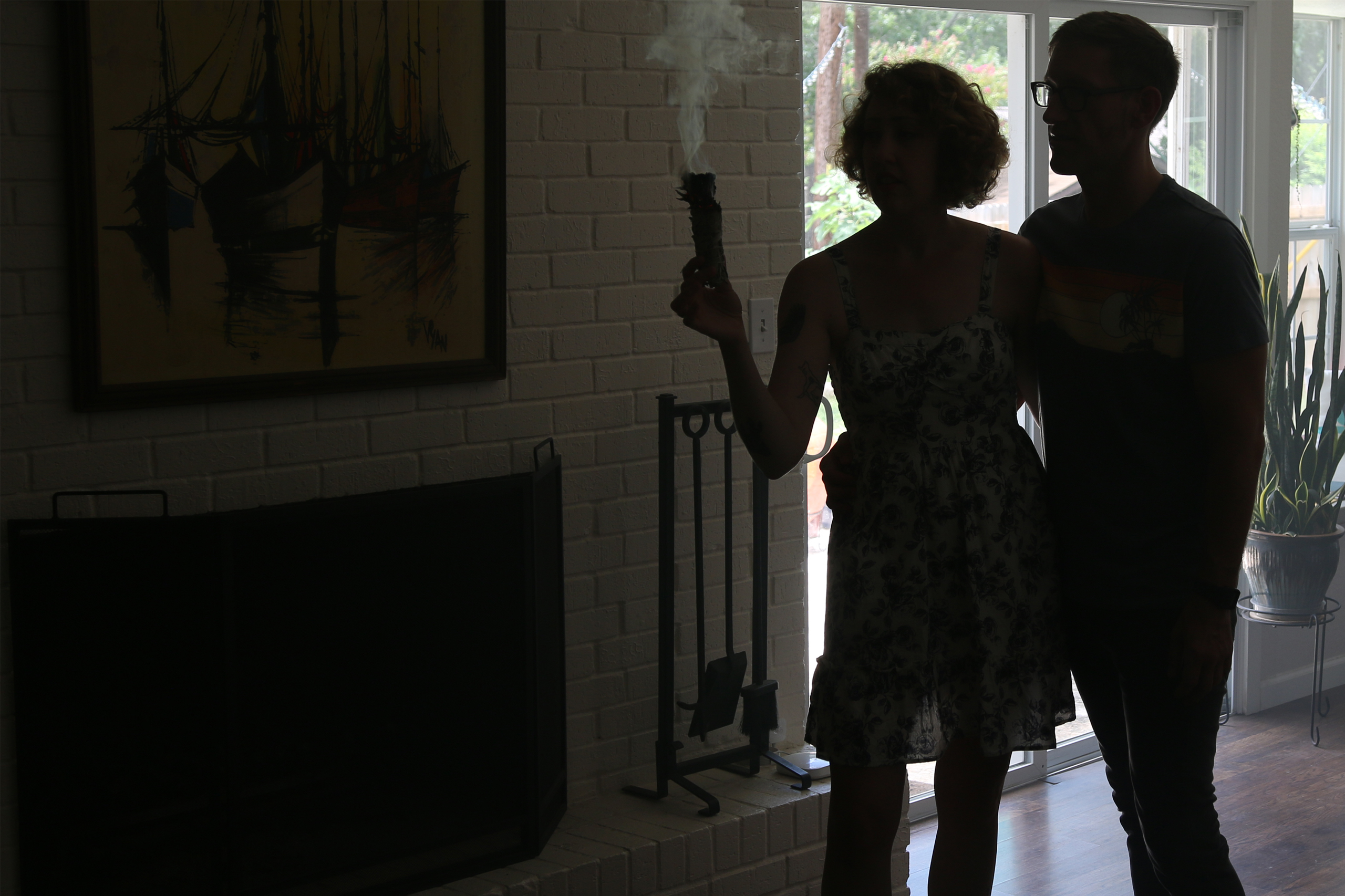
The first thing Jimmie and I did when we entered through that door as actual tenants was light a sage “smudge stick” and walk through the house, cleansing each room of “bad vibes” while listening to “At Dawn” by My Morning Jacket (you’re supposed to repeat something positive or important to you or listen to some sweet jams; we chose the latter). Neither of us necessarily subscribe to the idea that a sage smudge stick actually does anything, but Jimmie is from Oregon and I lived there for a while (in Eugene, even), so we are both part hippie (native and honorary); as such, we have soft spots for such metaphysical leanings, and the ritualistic/ceremonial aspect of it appealed to both of us.
When we were debating about living there after discovering the details about “the “death in the house,” as Shay put it, I arrived at the smudge stick idea as a way I could make myself feel okay with living there. Often, for me, just deciding something will work for me is enough to make it true. So we did that, and the sage is still in our fireplace, a totem to our good vibes. (Truth be told, we broke it out again after Scorp Fest 2017 just for good measure.)
The other superstitions I have mentioned. I won’t bring mail with names of the victim or the murderer into the house. I suppose I don’t want their presence there, in any form or suggestion. We don’t get things for them very often, but pieces do come. And I take them directly from the mailbox to the recycling bin. I have never mentioned this to Jimmie. The one or two times I’ve seen a piece of mail for one of them in the house or in the indoor recycling bin (because he beat me to the mail), I promptly take it outside without a word.
And I won’t lie in bed, in our bedroom, on my back with my arms crossed over my body. It reminds me too much of what I imagine is done when you die, how you’re put into a body bag. I remember (or was it my imagination?) seeing an image in one of the news stories about our house of a body bag being carried out. I suspect my psyche might have made that up afterward…but I think I saw it. I’m not going to check. Regardless, I don’t feel at all comfortable mimicking what I picture as that position: the position of death.
Like I said, I don’t know what room it happened in, and I don’t (ever) want to. When it came up briefly with Chris—after he confessed to me that Jimmie had served that spicy meatball (and that he was still okay with being our houseguest)—he flippantly said that it probably happened in the Devil’s Office. I have no idea why he’d say that other than to be nice: He might have realized it would help me sleep at night, forestall my nightmares—which, clearly, has been my fear all along. Good friends can read your mind like that.
I’m about to get on the plane to Chicago, where I will (hopefully) sleep. This might be the nightmare’s best chance to get me, actually—I just gave it quite a bit of energy, here at Ruby’s Diner in Concourse D of McCarran International Airport. At least I will be far away from the source as I sleep; flying through the air, uncomfortable in the small, non-reclining seat of a cheap, necessary flight; but unattached and not lying in an undesirable, corpselike position.
Amy McCullough is author of The Box Wine Sailors: Misadventures of a Broke Young Couple at Sea (2015, Chicago Review Press). She is the former music editor of Willamette Week, Portland, Oregon’s Pulitzer Prize-winning alt-weekly newspaper; has written for Eugene Weekly, SAIL Magazine, Loyola Magazine, Finder, and Edible Austin; and is currently editor of Wildflower, the magazine of the Lady Bird Johnson Wildflower Center. In addition to writing, she makes super-low-budget movies with her partner and former shipmate, Jimmie. They live in Austin, Texas, with a singing hound dog named Dexter. Read more about Amy on her website, theboxwinesailors.com.
Images by Jimmie Buchanan Jr.
Editor’s note:
I was trying to figure out how the writer was going to wrap this essay up. Endings are difficult, and sometimes the wrong ending can derail an otherwise great piece. I love the way she comes back to the airport terminal at the end. I love the immediacy she creates by bringing us there with her as she is about to board a flight, writing this essay that has been nagging at her.
I also love the idea of horror-as-muse, and the guilt that comes along with understanding the impropriety of murder as a muse. As writers we all have our creative springboards, our muses that lead us into the creative work. Because of choices McCullough makes in terms of how much she will reveal, and when, “Google My Address” becomes an essay about creativity more than an essay about murder, serving as a kind of confession of how creative people use other people’s pain as a jumping-off point for art. M.R. June 2019
-
Romney Schell, At the Disco (1979)
 I found myself wandering around Midtown, nearly 3:00am on a Tuesday night, finally single, finally alone. The town that never sleeps was asleep, and the storefront lights were out. A streetsweeper moved up and down Broadway, preparing for the the hordes of tourists that would converge with the first crack of sunglight. The vendors’ carts were packed and gone, the T-shirt shops now finally closed. I had been awake for nearly two straight days, and yet even the thought of bed seemed absurd. If I could just kill another hour, I could then hop the one uptown to see Major. He was still baking at the Donutland on West 96th, and, if I remembered correctly, his shift started at four. He would laugh when he saw me. It had been months. “Single again?” He would ask. “Yes.”
Then I would settle into the kitchen, put on a pair of gloves, and help him prepare the dough. Later, we would talk. At four in the morning though, it was all about the donuts. First the old fashioneds, then the crullers, and finally the cakes. They had to be ready by six, or it would be too late. With donuts, as Major will tell you, it is all about timing. People don’t eat donuts for lunch or dinner. On a Wednesday morning, if the line isn’t too long, if they’re not running late, commuters will stop in on the way to the train, on the way to work. As with many things, the window is small, and once it is closed it is closed.
Fiction Attic Press occasionally publishes found texts by writers you’ve never heard of. Where did we find them? We can’t tell you.
-
Hong Kong Karma
by Kevin Brownfor Suk Kuen Chow

The summer I realized girls didn’t have cooties, my father died of liver failure. I was not present at my father’s death, but figured it even, as he was not present for most of my life.The man I refuse to call Dad worked for people who never looked at him. Walking by, they’d say things like “tea” or “coffee,” or just snap their fingers while my father smiled so wide his eyes closed and bowed until they’d passed. He smiled so much at work he developed a facial tick at home, and believed the only way to relieve it was to never stop frowning.
At home, he rarely spoke when he talked, and never looked at Mom and me for more than a second. He’d drink bottles of Dynasty X.O., then snap his fingers for his shoes. He’d slam chairs and glasses and doors as he left the house, and come back late smelling not like Mom’s perfume. Mom would cry and yell while he sat in his chair, swigging brandy, his cheeks twitching.
“It’s not our fault you’re just a corporate world eunuch!” she’d scream, and I would close my eyes and sometimes hear a sound like slippers slapped together and my mom crying even harder. Most times, I just heard snoring.
His proudest memory was that he’d smelled Bruce Lee in person. He had the chance to shake his hand, but when the star walked by my father smiled and bowed, his eyes closed in instinct. “His cologne was so strong,” he’d tell me, his words slurring, his watery eyes upturned to the ceiling. “It was the smell of an important man.”
One night, my father left to get right and never returned. The last time I saw him alive was the afternoon Mom and I went to yum tsa in Victoria Harbor. He was leaning over the railing, staring at a junk crossing the sea, the dark water like dragon scales in the breeze.
“Father!” I said, waving my hands over my head like scissors. “It’s Cheuk Fan!”
He gripped the rail until his knuckles went white, lowered his head, and walked away.
Liver failure was listed as his cause of death because, Mom said, “You can’t just put ‘failure’ on a death certificate.”
At his funeral, a woman we had never seen before cried. Mom did not.
It is Chinese tradition that if a son is not present at his father’s death, the son must crawl toward the casket, wailing for penance. On my hands and knees, pushing his memory out behind me with each touch of palm and knee to the floor, moving toward the man who had always moved away from me, I could not help but marvel at what I didn’t know was karma—that finally, someone was bowing to my father, except that now, he was flat on his back.
Kevin Brown is in the MFA Program in Creative Writing at the University of Arkansas. He is the recipient of the Permafrost Literary Journal’s Midnight Sun Fiction Contest, as well as the Baucom-Fulkerson Memorial Award and the Lily Peter Fellowship for fiction. His fiction has appeared in The Ozark Review.
-
Feet
by Todd Chapman
I’ll settle for the color of skin. Skin is the color of his skin, which is my skin, and one day while running my skin gets cold, cells pass away, and I almost lose my feet. It’s winter in Chittenango and he wears a beard. This is before the divorce. I love my one-year-old sister Evelyn who is three years younger than I am. She’s at daycare, my mother is at work, and my father watches the house. James Leon, my father, is supposed to be watching the house but we’re stretching our legs on the porch. I wear shorts, a sweatshirt, and a knit cap, and my socks are pulled up to my knees. My sneakers are laced tighter than ice-skates and I don’t really want to do this. The snow will cover our tractor soon. Wind batters our plastic porch windows.“Are you ready?†he says. “You’re ready.â€
James Leon is a runner. He has run the Boston Marathon three times and the New York City twice. He has given up competitive running, he says, to help my mother raise the family. But he’s made a quiet agreement with himself. He’ll run twelve miles every day and he’ll bring me along for part of it. His body, as he likes to say, is a well-conditioned rock.
With a grunt he pushes the porch door open, and one of the aluminum panels blows in with a windy pop. I follow him outside. My sweatshirt is a sieve, and since I haven’t an ounce of fat on my frame, the wind scoops heat from my belly and my back. I take a couple of jumps.
“Here, put these on your hands,†he says, and he rolls thick grey socks over the knuckles of my fingers. He wants to keep them warm. The wool is itchy and cold, so I make fists as he pulls the hem of each sock up to the elbow, He snaps rubber bands around my arms to hold the socks in place.
“Is that good?†he says. “It’s good.â€
James Leon claps his hands. I jump, because I’m a good soldier. He wants to warm up for the run. He bounces too, and the cold gravel driveway crunches under our feet. We curve off the end of the driveway, out to the open road, and he directs me to a lane of dirt that covers the narrow shoulder. We run slowly, as we always do, and he and I keep pace. My cheeks feel raw and scraped already. Ice crystals glint from the pavement.
We run past barns and wide fields and past the old missile silo near the Gaveston Yard. For those of us who have inherited our politics rather than arrived at them, who mentally lay dynamite at the California borders to float us out to sea, who have forgotten Clinton’s Rwanda, who never bother with Bayview or Hunter’s Point let alone strike out for New England, or for a southern state, who grow up here, settle here, because we know we hit the jackpot, who watch others come and go as we calmly assume a shape, who fear and detest the Ivy League but can’t name the schools that compose it, New England is studded with missile silos. They are hidden in random fields. They are hidden all over the country, and one day a few years after the divorce my third grade math teacher will assign a project based on proportions. We’ll live in another house, in another town, and I’ll choose my bedroom for a model. I’ll lay astro-turf in a cardboard box, and then add a dresser and a bed. I’ll paint a mirror on the wall and then I’ll draft some falsified plans. I’m not impressed with this work, and it’s worse when I show up for class, because my friend Favvy will be standing next to her beautiful rendition of a missile silo. It will be three feet tall, with windows and wheels, and entirely in proportion. Her picture will appear in the Adirondack Daily, and we’ll both receive grades of one hundred.
James Leon checks in with me now and then, but as the strong wind pushes us along the road, I rarely give honest answers. He has drawn my shoelaces far too tight. My feet are cold and pinched. He looks fine, and as he trots like a Clydesdale with bumpers on his feet, steam shoots out of his mouth. He breaks into a slick sweat, and he rolls his hat up over his ears.
My face feels bitten by wind as I run, and by sand thrown up from the road. I’m losing feeling in my feet. It hasn’t been this cold on our previous runs, and we won’t run together again. In a few weeks my mother, carrying Evelyn in her arms, will move us out of our house.
“You’re warm enough?†he says. “You can make it to the pole?â€
The utility pole is my turn-around point. It is .51 miles from our house. My father, who is always taking the measure of things, has driven the distance out in his truck, and pegged it with the odometer. I sat in the passenger’s seat as he drove, watching the moon follow us through the window.
“You can you make it to the pole,†he decides.
I wonder if I can. My feet no longer belong to me, and I sort of flap them with my shins. Flap, flap. I watch them hit the road. Flap…and onward with the pattern until, to my surprise, the rusty rims of the transformer pot hang above our heads. Electrical jumpers quiver and hum as my father runs in place.
“Okay,†he says. “Go around it.â€
I swing around the pole with my sock-fist, twice, because this is our tradition. I tug the sock free when it snags.
“You remember what to do?†he says. “Run on the side of the road. Look for our yellow house.â€
He claps his hands together, and I flap off down the road.
“Now, home!†he calls out after me.
James Leon has found himself caught between two conflicting agreements; the agreement he has made with himself – to train – and an agreement he has made with my Mother.
I flap with high knees and a straight back because there’s a chance he might be watching. There’s a chance he isn’t watching, too, so I turn around to see. He’s running. His legs are fluid and they appear relaxed. He’s hit his natural stride. He removes his hat and holds it with his hand and oh my Lord I’m proud. His feet snap comfortably back to the road after each smooth reach of his legs. He disappears at a point along the horizon, and I linger for a while, until it’s clear there’s nobody there. With the toe of his sock I cover my neck. I bend my head against the wind.
I daydream.
I look at my feet.
The road just looks the same.
I begin to walk to the house, but the wind skates through my body and threatens to blow me off the road. In truth I feel unbalanced. My feet are numb, and if I tilt into one of these uncut fields I’m certain that I’ll be lost. Then, as if thinking about being lost has made me – not lost, but clumsy – I trip and skin my knee.
I roll onto my butt and I take off my hat.
With blood on my knee, I daydream.
There is a considerable body of evidence that points to the emotional and social benefits that accrue to resilient children. What are the characteristics of a resilient child, and how can we identify vulnerable children? Barbara T. Bowman will present a practical and engaging session in which she will consider strategies adults can use to promote resiliency in children. You will leave empowered with new ideas for enhancing coping and negotiation skills that will serve children throughout their lives.
This woman’s leg is attractive.
She pulls her car to the side of the road, opens a blue door, and slips her beautiful leg out. The leg is several cuts above my family’s class and sophistication. When the woman gets out, she looks at me. She looks at the socks that are bound to my hands and I feel a little embarrassed. She looks at my bloody knee.
“Where are you’re parents?†she says.
I don’t want trouble, for me or for my father. I point toward our yellow house.
“You better come with me,†she says.
She helps me up off the side of the road and brings me to her car. She wraps a blanket around me. The car is plush and warm, like the woman’s soft blue coat, and it smells like a pile of rum cookies. I shiver as she drives. When we reach the yellow house, she pulls into the driveway, and she puts the car in park. She sits for a moment, letting her wide brown eyes rest on me. She smiles. There is concern in this smile, and apprehension, and a brisk intelligence in her eyes, and even, it seems to me, a sexual consideration. She understands something of my past, and of my future.
“You might be okay,†she says.
She is who I want to be.
Her smile fades as she touches my hand, and then she opens the door. She leaves me in the car with her blanket, and her face assumes a curious expression as she walks up to our house. She knocks on the door, waits a moment, and then she tries the handle. The door of course swings open. She gathers me up like a puppy in a blanket and carries me into the living room. She sets me down on the couch.
“I can’t believe these socks,†she says.
She removes the rubber bands from my elbows and unrolls the socks from my hands. In our bathroom, the woman finds a sponge that my mother uses to remove make-up from her face. The woman cleans my cuts.
“Your lips are blue,†she says.
If I weren’t so cold, I’d blush.
“Which direction did he run in?†she says. “Try to remember for me.â€
I point in a direction.
“Okay,†she says, and she takes a deep breath. Leaving me in alone in my house seems hard for her to do.
“I’m going to leave, but I’ll be back soon,†she says. “Are you thirsty?â€
“No.â€
“Keep this blanket tight around you. Stay there on the couch.â€
She touches my face and Lord her hand is warm. I don’t want her to take it away. She leaves me wrapped in her blanket, though, and after she closes the door I think about locking it. I wish there were a way to warn my father that this woman is out there on the road, looking for him. I sense there might be trouble.
I want to get these sneakers off, but the laces are stiffly knotted. My fingers make ticking sounds as they slip against the knots.
It’s all a game of waiting. You wait for school to start, and you wait for school to end. You wait for summer. You wait for lunch, and when a sandwich is served you don’t really want to eat it. You wait for leaves to fall from the trees, and you rake them into piles. You cover yourself with them.
I should give up on the woman.
Instead, I’ll wait for James Leon to come in from his run. I’ll wait with Deacon, our boa constrictor.
Deacon and I are the same age and we both eat once a month. That’s my mother’s joke. Our family is a robust and healthy family, as you can see, but I happen to be an exception. I’m a picky eater. I want to eat; that is, I want to want to eat. But I have no appetite for it. Now and then my appetite comes and I eat and eat and eat.
I ate eleven pancakes for breakfast once and my mother beamed. She beamed so brightly that I made a big display of it, counting out the pancakes as I swallowed them down, and eating while my appetite was good.
Deacon? I’m freezing.
Let’s look at each other’s tongues.
James Leon has arrived, and he doesn’t look cold. In fact, he seems to be sweating.The woman doesn’t come inside. She drops him off and leaves. She leaves me with her blanket, though, and with my father, James Leon: a twice-decorated US Marine who can’t untie my shoes. He cuts the laces with a knife.
One at a time he removes each sneaker, and he then removes each sock. As we look at my feet it occurs to me: the Marines haven’t taught him shit. If I was under fire in the living room and there was a bunker in the kitchen he would be very quick to drag me there. His belt would be ready if my foot were a spurting stump. But it isn’t. It’s just cold. Both my feet are cold, and my father James Leon looks worried. I look at him, and he looks at my feet. My feet aren’t looking good. Parts of my left foot – including the ball and two toes – are white and luminescent. The cells of my feet, like stars, are releasing energy as they die. My father and I wonder what he’s going to do, and if he’s smart, he’s making agreements with himself.
James Leon is smart – but he’s smart in peculiar ways.
I wonder if I’m being fair. If I, right now, were to chart a graph of my own life with the y-axis being my level of emotional maturity and the x-axis being time, the result would more closely resemble my high-risk stock, with all of its spikes and slides, than the comfortable hypotenuse of my more stable holdings.
This is true of James Leon, too, and right now he’s in a slide. It isn’t the worst of slides. The worst will come in sixteen weeks, when he will slide lower than most people ever slide. Most people never spend an evening raping their wife, after she’s left him, and then leave her – as he will – with a badly broken jaw. Most people don’t do that. For this reason it will be difficult, years later, for him to find a way to talk about it. It will take courage. One day when I’m fourteen – and all grown up – James Leon and I will sit alone in a car with theater stubs in our hands. He’s nervously enjoying visiting rights, trying to find courage in me.
I’ve done stupid things, he says. I’ll regret them all my life.
It’s okay, I say.
Your mother’s a very strong woman.
This is true. My mother is an interesting woman. My father, who turns a ticket stub in his hand, is making a beginning. He’s laying groundwork for our future, for years when we’re both older, when I’m no longer fourteen, and he’s not thirty-nine. People need someone to call on the phone, when things get tough, or to take care of them, when they get older. He wants me to understand this. James Leon has made an agreement with himself to try to make things right.
Listen, I say. It’s over. For the most part, we’re okay.
This isn’t true. My sister Evelyn, for example, is far from okay. My sister Evelyn, for example, is twenty-six years old and she’s afraid to have sex. She wants to have sex, that is, she wants to want to have sex, but she has no appetite for it. She’s told me this over the phone. She has no appetite for kissing either, or for dating men, or women, which is a strange wrinkle in this narrative, a little tic in logic. I was present for my mother’s rape, and I heard the awful screams. She and I are okay. But Evelyn, who was only a year old when the rape occurred, who was pre-conscious, and technically, not present for the rape, is none-the-less obsessed with it. This rape is all over her life. It’s in the books she reads, and in the movies she watches. It’s in men she finds attractive.
Evelyn has lost her balance. She has intense imagination, and if her mind twirls and her hands reach out, they reach wants for understanding. She says that she wants to live (which is a trend in the right direction) and last year she earned a teaching degree. But teaching isn’t enough for Evelyn; she wants to keep patterns from repeating. She wants to know our history so she can lean against a frame. She told me this over the phone. Since I remember everything, I felt obliged to help. I told her I lay on the couch in the living room and I heard Mom’s screams from the bedroom as I tried to fall asleep.
This wasn’t enough for Evelyn.
“This is my father that we’re talking about, and my mother, and they’re your parents too. You need to do better than that.â€
So I told her.
One day Dad lied and he took me on a run during winter in Chittenango and my feet got cold but he saved them. He put water on the stove and I still worry about the water but he rolled up his shirt and put my feet on his belly. His belly got cold and my feet were still cold so he moved my feet up to his chest. His mouth was open. I could hear water boil but dad heard nothing. He looked at my feet which were dead, and Evelyn, I tell you he knew he had killed them. He said please to somebody and it wasn’t to me and he breathed harder than I’d ever heard him run. He moved my feet to his armpits. He kneeled on the floor before the couch and he lay his head down on my knees. He said please please but not to me, and my kneecaps itched under his beard. He had killed them. The water boiled in the kitchen but it must have boiled away because after an hour I no longer heard it, but still I worry about it. Then the feeling came back and yeah the pain was so bad that I screamed. So he saved them.
This wasn’t enough for Evelyn, either.
So I decided to take a trip.
Where there is no great love, there can be no great disappointment.
Martin Luther King, Riverside Church,
New York, 1967Evelyn is smart with money. She owns a small house in Albuquerque. The house stands on a plot of land with a yard surrounded by a short wall of pink cinderblocks that breaks a New Mexican wind. It blows in from the Sandias Mountains. The sky pulses orange and yellow light as she drives me in from the airport, and the cactus shudder in the warm wind as we pull into her driveway. I can only stay for an evening.
“It will remain like this for an hour,†she says, looking up at the sky. “I’ll show you through the yard.â€
Her backyard is pretty. Native succulents green the dry sand, and a tall cactus with many arms reaches above the pink wall. The yard isn’t big, but as we walk, Evelyn gives me a short history. She explains how the yard was desert when she first moved in, how she planted things but they died, and so she tried to plant again. A few of them took, she says, and as she shows me the leaf of a bottle tree, we sit down on a swing.
So, she says.
So.
Where do you want to start?
Evelyn, there’s no good place to start.
In that case, just start talking.
Can’t you see I’m trying?
Todd Chapman, an MFA student at San Francisco State University, was raised in the Adirondack Mountains of New York. Todd’s interest in writing began through the works of Roald Dahl, and at age thirteen he wrote a letter to Mr. Dahl soliciting tips on writing. He never received a response.
Photo by Thomas Kearnes. Thomas Kearnes is a freelance visual designer, author and photographer from East Texas. His fiction has appeared in Wicked Hollow, Southern Hum, flashquake, Underground Voices and Blithe House Quarterly. His
photography is forthcoming in Tattoo Highway.View artist’s other photos here. -
Run Away
by Jay Boyer
That is not true. Mommy did not call you an asshole.
Mommy does not use that kind of language. Not with her little girl, who Mommy loves with all of her heart.
All right, Mommy might have, in the very distant past, felt so overwhelmed that she called you a shithead. She didn’t mean for you to hear that of course. She was speaking to herself, which Mommies are allowed to do when their little girls look them right in the eye and say the kitty ate Mommy’s chocolate. Did you honestly think Mommy would believe we have a kitty?
I know this is hard for you to understand, but Mommy has a Masters Degree. She wrote her thesis on String Theory and made a groundbreaking case that particles of light change in direct proportion to the mass of the waterline at the edge of a pond. Now Mommy can’t tell you where she just put her glasses. Do you see? This is what this life is doing to me. There is simply not enough of Mommy to go around sometimes. She’s like particles of light reflecting off the water. She hasn’t the height, weight, or mass you are perceiving. She appears to be whole but she isn’t. She feels like the world is the mass of the waterline, and Mommy is coming apart at warp speed before her very eyes.
That is why sometimes Mommy has to go into the bathroom and say her name aloud twenty-five times just to be certain she actually exists.
Now, Mommy is going to take a deep breath. See? Would you like to take a deep breath as well? That’s it, honey. But deeper. Should we try it again? Don’t be frightened. Mommy did not call you an asshole when you ignored what she told you to do.
That would be a sign Mommy’s coming apart. Which she’s not. Which she’s totally not. She would if she could, but she can’t. And you know why? Do you want to know why, honey? Because Mommy is your rock.
-
The Roaring Ocean Does Not Roar
by James Warner
I was not the only Irishman on the SS Arizona, as we moored outside New York harbor, but I certainly wore the finest ankle-length otter-lined overcoat.
When we were advised that our ship could not dock until the next morning, I remarked to the captain that the Americans would be crestfallen at having to spend another night without their apostle of Aestheticism. He muttered some nautical expression under his breath.
A party of yellow journalists were hungry enough for epigrams that they chartered a launch and came on board to ask me questions, along with medical officers to clear us from quarantine. The journalists wore dreadful hats that reminded me of chimney pots. “I hope my arrival on these shores will be the beginning of a great movement here,†I told them.
Impudent questions followed, such as whether it was true that I had my bathwater colored with triple essence of verbena. I was already making a sensation.
The next day, as we proceeded to our berth in the North River, our ship got stuck in the mud. More journalists came aboard. One wished to know what I thought of the Atlantic. “A disappointment,†I said. “The roaring ocean does not roar.â€
WILDE UNIMPRESSED BY ATLANTIC, would be the headline.
My purpose here, I explained, while sailors scrambled in the rigging, and foghorns sounded plangently, was to assert the primacy of Art over life.
“Are you here to beautify America, Mr. Wilde?â€
“Beauty is all around us,†I observed, gesturing helpfully. “Man is hungry for beauty. All we want is a systematic way of bringing it out.â€
“That grain elevator over there, in Hoboken,†a reporter said, “does even that have aesthetic value?â€
Flicking dust off my lavender kid gloves, I responded that I was too near-sighted to perceive the item in question.
Once we landed, my luggage was retrieved from the bowels of the ship before anyone else’s, and I was swept off to the waterfront Customs House, a makeshift shed surrounded by coops of truculent geese. Inside the shed, a grizzled, red-nosed individual inspected my trunks full of lilac Hungarian smoking jackets and pantaloons of fawn-covered velvet. The old man asked me meekly whether my trunks contained any prohibited imports, such as animal hides, obscene materials, or Oriental carpets. Americans are infinitely curious about trivial matters.
“I have nothing to declare but my genius,†I clarified.
The inspector wore a horrific beard and a jacket of an unsightly blue, none too recently washed and studded with brass buttons. “I talked to the captain of the Arizona,†he said, sifting through some first editions of Poems I had brought as gifts for celebrated literati. “He said he should have had ye lashed to the ship’s bowsprit on the windward side.â€
On his lapel, my enigmatic interlocutor wore a tin badge bearing a name I suddenly recognized.
He’d attained some notoriety as an author of sea-going yarns, before Victoria’s accession. It came to me I’d even read a book of his once, on a winter’s afternoon in Merrion Square.
This was Herman Melville, author of Typee. Had he really bedded with cannibals? “I thought you were dead,†I exclaimed.
Melville shook his head. “I walk uptown to the docks six days a week,†he said. “I examine ships’ cargoes and passengers’ baggage. They pay me three dollars and sixty cents a day.â€
The ennui of such a life! Better by far he’d remained in the South Seas, in a tropical grove with dusky natives.
“They try to get me to take bribes,†he said, shifting back and forth on his feet, scrutinizing my cigars to make sure they had been correctly packaged. “Money is thrust into my pockets behind my back. I always return it.â€
Prising open the valise containing my letters of introduction to important American writers, Melville regarded me with an expression so changeful, I felt he was looking through me, at happier vistas from long ago. How had he come to this? Had he failed to cultivate the right people? It was certainly hard to see this spent and sunstruck seafarer as a figure in society, even New York society.
One’s real life is so often the life that one does not lead.
“All manner of men are discharged in this port,†Melville told me, “philosophers and footpads, apes and angels, speculators and parlor men.†He fingered my silk leggings with his gnarled hands. “Then beware lest if you go out of your way to be seen, you may also be seen through.”
Was it, by some Puritan tradition, his appointed task to examine not only my luggage but my soul also? The state of a man’s soul is perhaps better revealed by his choice of cravats than of convictions.
I inquired whether anything was amiss. Melville started filling in a form in large block letters. “My concern is with those who carry more than they claim to,†he said, “while you are as yet a ship with an empty hold, blown you know not where. On the surface, a crust of evanescent light,†he murmured. “Below, blackness. Man’s instinct is always to seek the darker realms. Yet what we seek in the depths is what is most likely to destroy us.â€
Before we parted, he handed me a long, privately-printed poem about a religious crisis of some description, inscribing it to me, Tell Truth, & shame the Devel. I would like to say that I later read this work, but I was presented with many poems on my travels, eccentrically-spelled verse histories of the Civil War and so forth, and soon acquired the habit of flinging them from the windows of railway carriages to divert the buffalo. For myself, I presented the customs officer with a free copy of my own collection which I inscribed l’art pour l’art, art for art’s sake, a principle in which I found I had just ceased to place any faith, rather distressingly since it was the underlying premise of my impending lecture tour. But how dull life would be if we never said things we disbelieved.
The gesture with which Melville bade me farewell made him seem almost phantasmal, so that I left the shed with a superstitious feeling of horror, as if I’d glimpsed my own reflection in a dream-mirror. This man had witnessed mutinies and shipwrecks, but perhaps nothing more terrible than the general indifference that now confronted him.
Outside the customs shed, rats made forays among heaps of refuse. The retired Colonel who was managing my tour handed me some lillies and ushered me into a buggy, my portmanteaux were loaded onto other vehicles, and as we traversed the Manhattan streets, our weary horse up to its fetlocks in mud, a pack of quite charming urchins fell in behind us, chasing us past jobbers’ warehouses, imitating what they supposed to be my gait and laughing adorably. Vagabonds washed themselves at hydrants. I placed a cigarette in my mouth without lighting it.
That year I would traverse vast immensities to visit such exquisite places as New Orleans and San Francisco and transform them forever, by teaching their inhabitants that it is through means of the most evanescent things — art, conversation, fashion, reputation – that we may best perceive the eternal and the essential. Yet for now my colloquy with the ancient customs inspector had left me feeling out of sorts. Could it be that whoever drinks deeply enough from the chalice of the sublime is eventually compelled to drain also the flagons of failure, disgrace, humiliation, sorrow, and despair? I could not in those days have imagined ever coming to regret being the center of attention, nor was I yet ready to admit anything harsh or disturbing to the sacred precincts of Art, but as I lit my cigarette, surrounded by the hysteria-edged adulation of the crowd, I could finally admit that those Atlantic storms had scared the bejesus out of me.
James Warner’s writing has appeared in Eclectica, Pindeldyboz, Eyeshot, Monkey Bicycle, McSweeney’s Internet Tendency, and elsewhere. He lives in San Francisco. His web site is www.jameswarner.net.